Menu

Posts tagged “marketing”

Our obsession with data

Virginia Heffernan’s A Sucker Is Optimized Every Minute is a deeply cynical, extremely funny rant on our obsession with data:

These days, optimizers of squeeze pages, drawing lessons as much from the labcoats at Optimizely as from the big daddies at Google, recommend creating a three-to-10 minute video that’s introduced by a “magnetic headline” (“Find the Perfect Lampshade for Any Lamp”) and quickly chase it with an “information gap” like “You’re Not Going to Believe the Trick I Use While Lampshade Shopping.” (Article of faith among optimizers: humans find information gaps intolerable and will move heaven and earth to close them.) Next you get specific: “Click the play button to see me do my lampshade trick!” — after which the video unspools, only to stall at the midpoint with a virtual tollbooth. You can’t go on unless you hand over an email address. Presto.

A sucker is optimized every minute.

Real markets vs. Expectation markets

Putting the linkbait title aside, Steve Denning’s The Dumbest Idea In The World: Maximizing Shareholder Value1 is a really interesting article about the difference between “real markets” and “expectations markets”:

In today’s paradoxical world of maximizing shareholder value, which Jack Welch himself has called “the dumbest idea in the world”, CEOs and their top managers have massive incentives to focus most of their attentions on the expectations market, rather than the real job of running the company producing real products and services.

And that comes at the expense of customers. This sentence also stood out for me:

Unfortunately, as often happens with bad ideas that make some people a lot of money, the idea caught on and has even become the conventional wisdom.


  1. Link is to the print version because the Forbes site is so unreadable 

Dark pattern: Walmart login

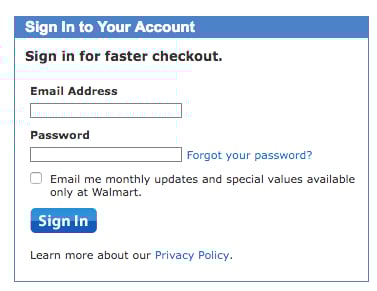
This is the login screen on Walmart.com:

Walmart login

It looks like any other login screen, with one difference. See that check box? What does that check box usually indicate?

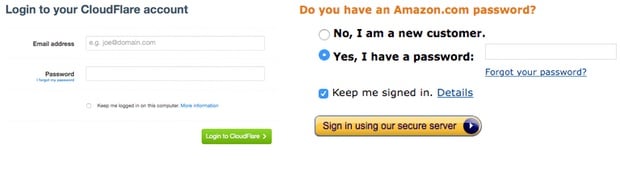
Yep. The standard pattern on the web is to use that space for the “Keep me signed in” check box on login screens. Here are a couple of examples I quickly went to:

Signing in

That Walmart interface was designed to trick people into signing up for marketing email, since most people will simply check the box without reading the text. We really need to stop with these dark patterns.

[Sponsor] Mandrill: the fastest way to deliver email

Thank you to Mandrill for sponsoring Elezea this week! I’m a big MailChimp fan, and this is another great product of theirs.

Integrate, deliver, track, and analyze with email infrastructure from Mandrill.

Mandrill is a scalable, reliable, and secure email infrastructure service trusted by more than 300,000 customers. It’s easy to set up and integrate with existing apps. And it’s really fast, too. With servers all over the world, Mandrill can deliver your email in milliseconds. Detailed delivery reports, advanced analytics, and a friendly interface mean your entire team—from developers to marketers—can easily monitor and evaluate email performance.

Get started with Mandrill today.

Mandrill

Sponsored via Syndicate Ads

Newsletters: not dead yet

David Carr in For Email Newsletters, a Death Greatly Exaggerated:

Email newsletters, an old-school artifact of the web that was supposed to die along with dial-up connections, are not only still around, but very much on the march. […]

And:

Email is a 40-year-old technology that is not going away for very good reasons — it’s the cockroach of the Internet.

Well, I confess that I have also succumbed to the lure of this particular cockroach, and have been experimenting with a revamped newsletter. If you’re keen, join in…

The real problem with Facebook's latest ad targeting move

Cotton Delo in Facebook to Use Web Browsing History For Ad Targeting:

But what Facebook is now enabling is far more expansive in terms how it uses data for ad targeting. In a move bound to stir up some controversy given the company’s reach and scale, the social network will not be honoring the do-not-track setting on web browsers. A Facebook spokesman said that’s “because currently there is no industry consensus.” Social-media competitors Twitter and Pinterest do honor the setting. Google and Yahoo do not.

There’s going to be a lot of handwringing about this over the next few days. And then we’re going to forget about it and move on. I’m guilty of this myself — the number of times I’ve quit and rejoined Facebook over the last few years is embarrassing. But I do think this might be the time I unfriend Facebook1 for good. Here’s why.

I’m becoming increasingly uncomfortable with how online data collection is driving product decisions. If a product’s sole source of revenue is advertising, then the design is going to reflect that. The product is going to be optimized for data collection so that it can provide better accuracy for advertisers. And if a product’s direction is driven by anything other than user needs, that product becomes worse for end users. That is inevitable. Nothing you can do about it.

This is why the “Well, what’s wrong with better ads?” argument doesn’t hold water. It’s not that I want to see less relevant ads (or no ads at all). It’s that I don’t want a company’s design decisions to be driven by a need to get as much data out of people as possible (as apposed to how to meet their core needs better).

I think Nicholas Carr summarized the problem with this type ad targeting very well in his post A complicated courtship:

Anyone who has a car accident today, and mentions it in an e-mail, can receive an offer for a new car from a manufacturer on his mobile phone tomorrow. Terribly convenient. Today, someone surfing high-blood-pressure web sites, who automatically betrays his notorious sedentary lifestyle through his Jawbone fitness wristband, can expect a higher health insurance premium the day after tomorrow. Not at all convenient. Simply terrible. It is possible that it will not take much longer before more and more people realize that the currency of his or her own behavior exacts a high price: the freedom of self-determination. And that is why it is better and cheaper to pay with something very old fashioned — namely money.

I want to use products that I pay for, so that I can say with reasonable certainty that those products are designed based on my needs, not to satisfy the never-ending data hunger of a faceless entity.

(link via Daring Fireball)


  1. Sorry. I’m putting myself in internet time-out for that joke. 

[Sponsor] Campaign Monitor: create and send beautiful emails

Designing emails that look beautiful, render perfectly and drive strong response is increasingly difficult. That’s why Campaign Monitor compiled the top 100 emails of 2013 into a free eBook, alongside tips on design and content. The Top 100 Email Marketing Campaigns eBook features brands like Fitbit, SmugMug, Panic and includes:

  • High performing newsletters with open rates of more than 50%.
  • Examples of great layouts & responsive designs.
  • Emails that go against best practices and still drive top results.
  • Campaigns that saw open rates improve by 20% after A/B testing, and more.

Check out the free eBook at campaignmonitor.com/top100.

Campaign Monitor makes software that lets you create and send beautiful emails. Today more than 800,000 designers, agencies, and amazing companies across the globe rely on Campaign Monitor to manage their email marketing.

Misunderstanding Amazon

It’s always worth reading Eugene Wei’s thoughts on Amazon’s strategy, and Amazon and the “profitless business model” fallacy is no exception. Wei discusses how most analysts don’t understand Amazon’s business at all. In particular, he tears into the idea that at some point, Amazon will just “flip the switch” — increase the prices on all their products and instantly become profitable:

But “flipping a switch” is the wrong analogy because Amazon’s core business model does generate a profit with most every transaction at its current price level. The reason it isn’t showing a profit is because it’s undertaken a massive investment to support an even larger sales base.

How does Amazon turn a profit? Not by flipping a switch but by waiting, once again, until its transaction volume grows and income exceeds its fixed cost base again. It can choose to reach that point faster or slower depending on how quickly it continues to grow its fixed cost base, but a simple way to accelerate that would be to stop investing in so many new fulfillment centers.

Amazon is using their revenue to build more and more infrastructure until they become so large (and efficient) that no one will be able to compete with them. That’s pretty smart.

Speaking of Amazon, Benedict Evans wrote an interesting post discussing Amazon’s “selective” secrecy. He explains in Amazon’s PR genius that there is one area they don’t mind exposing to the world — logistics:

Price is obviously a large part of the consumer story, but talking about logistics is a competitive weapon just like not talking about Kindle sales. Every story about how Amazon has built an amazing, incredibly efficient, incredibly low-cost distribution platform is another ecommerce start-up that doesn’t get funded, or even started. Jeff Bezos famously said that he was happy for Amazon to be misunderstood for long periods of time, but no-one is in any danger of underestimating the scale of Amazon’s distribution.

Paying for less information

Kontra explores a particularly egregious style of “content marketing”-style advertising on CNN’s website in his post “You Might Also Like”. He concludes:

Will these advertorial deceptions and misdirections move from the ad wells around the periphery of the page into the news delivery itself? Will there be product placements within news sentences? What follows that? Is the “mainstream media” management about to capitulate on long-held principles because it’s unable or unwilling to pursue any other strategy but the race to the bottom of the advertising barrel? Is there anything more precious than credibility to a news organization? If not, why is Time Inc. poisoning its own well so nonchalantly?

Contrast CNN’s approach with The Information, an online-only publication that just launched with a price tag of $400/year. Most people believe it won’t work, but I think Hunter Walk makes a good point in $400 for The Information Is About What’s Missing, Not What’s There:

For me the value in The Information is not solely in what they’re providing but what they’re leaving out. The ~two articles a day are both interesting. Because they’re not playing a page views game, they don’t need to overload me with 25+ posts every 24 hrs. The site is spartan because they don’t need to worry about IAB units. A small number of writers building their beats give me the chance to see each journalist’s style distinctly, not settle into some random byline slot machine of varying quality.

It’s sad that we have to pay not just to have a distraction-free reading environment, but also to reduce the amount of information we get to something more manageable (and focused on quality over quantity). But that appears to be the new world of publishing.

Don't let advertising fool you

Adam Corner provides a very interesting perspective on modern advertising in Ad nauseam — Advertising turned anti-consumerism into a weapon. He starts off by discussing a new brand of ad that wants to join us in our distaste for, well, advertising:

These ads want to be our friends — to empathise with us against the tyranny of the corporate world they inhabit. Just when we thought we’d cottoned on to subliminal advertising, personalised sidebars on web pages, advertorials and infomercials, products started echoing our contempt for them. ‘Shut up!’ we shout at the TV, and the TV gets behind the sofa and shouts along with us.

He cites this recent Orange ad as an example of an attempt to empathize with our contempt for excessive product placement:

Adam then goes on to explain why it matters to be wary of these techniques:

And the industry’s seemingly endless capacity to perpetuate itself matters. Marketing is not simply a mirror of our prevailing aspirations. It systematically promotes and presents a specific cluster of values that undermine pro-social and pro-environmental attitudes and behaviour. In other words, the more that we’re encouraged to obsess about the latest phone upgrade, the less likely we are to concern ourselves with society’s more pressing problems. That’s a reason to want to keep a careful tab on advertising’s elusive and ephemeral forms.