Menu

Posts tagged “marketing”

A positioning framework for product managers

Sachin Rekhi reviews April Dunford’s book Obviously Awesome: How to Nail Product Positioning so Customers Get It, Buy It, Love It in his post Positioning for Product Managers:

While 2000’s Differentiate or Die spoke at length on why positioning is important, it never really went into detail on how to actually go about developing your product’s positioning. The traditional approach is to develop a positioning statement. While useful as an output to your positioning process, it really doesn’t describe the process one could use to come up with such a positioning statement. That’s why I was excited to read April Dunford’s new book entitled Obviously Awesome, which is an in-depth tactical guide on how to go about actually developing your product’s positioning.

The reality when it comes to positioning is that most companies end up with default positioning. This is simply leveraging the positioning that the original folks who came up with the product concept thought about when they conceptualized the product offering. But what’s important is to be deliberate about your product’s positioning because a great product could end up failing due to poor positioning alone.

He also discusses April’s advice to replace a “positioning statement” with a deeper 5-part positioning framework which defines the following for your product. This is a really good summary of the book.
Reducing Time to Value, and other important product-led growth metrics

In 8 essential metrics for measuring product-led growth Katryna Balboni discusses a few important metrics for measuring and monitoring product-led growth (i.e., turning users into advocates so that they can they drive more acquisition and growth). Time to Value is one that seems particularly useful:

Time to value (TTV) is the amount of time it takes new users to realize your product’s value. Your goal should be to reduce time to value as much as possible-the sooner users reach their first aha moment or activation event, the better.

To do this, focus on optimizing your user onboarding experience around the key actions within your product that correlate to activation-like inviting colleagues to your platform, importing customer data, or integrating with other tools in their tech stack.

The primary cause of disruption, and how incumbents should respond

Thales S. Teixeira distills years of research on how companies are disrupted in his HBR article Disruption Starts with Unhappy Customers, Not Technology:

For eight years I’ve visited leading companies in more than 20 industries around the world that claimed to be in the process of being disrupted. Each time, I’d ask the executives of these incumbent companies the same question: “What is disrupting your business?” No matter who I talked to, I would always get one of two answers: “Technology X is disrupting our business” or “Startup Y is disrupting our business.” But my latest research and analysis reveals flaws in that thinking. It is customers who are driving the disruption.

He goes on to explain why disruption is a customer-driven phenomenon, and how incumbents should respond.

How to effectively onboard additional team members on a customer’s primary account

This is a helpful article from Jeff Vincent about the “nth user problem”. This is a not-so-great term for a very real problem: how to make sure you’re able to effectively onboard additional team members on a customer’s primary account. From SaaS has an nth user problem:

A huge driver of churn in the most successful SaaS businesses is loss of champion churn — or when your product’s greatest advocate within a customer company moves on to another job or department and the replacement admin abandons your product in favor of a new platform. This is the end result of the nth user problem at work.

Jeff shares lots of good advice on how to take care of additional account users and make sure they become engaged users and advocates.

“Marketing-driven development is bad,” and other misconceptions of product management

I like the reframing Sherif Mansour does in his talk Popular Misconceptions of the Product Craft. For example, here is his response to the common misconception that marketing-driven development is always bad:

As product managers we should always educate our teams on the value of great marketing, embrace the art of storytelling that infuses our marketing teams, and think about how we can bring that back to our teams. Whether you follow Amazon’s press release method, mock-up landing pages before starting a new feature, or do a box design exercise where you design the fictional in-store box for your new product, thinking about the Who, What, and Why of your product can help you build a better product for your customer.

Culture/market fit is more important than product/market fit

I really like the NOBL team’s focus on Culture/Market fit in their article The Only Thing More Important Than Product/Market Fit:

Find yourself a healthy market, yes. Then develop a culture that can deliver product/market fit. Your culture is what produces your products and services. You know you have culture/market fit when both talent and customers flock to your company for who you are, even above what you make. You know you have product/market fit when legions of customers buy your product.

Without culture/market fit, sustainable product/market fit (at any size, scale, or maturity) is impossible.

They go on to describe four competing flavors of organizational culture, each with unique traits and competitive strengths.

“Growth hacking” is user-hostile and needs to stop

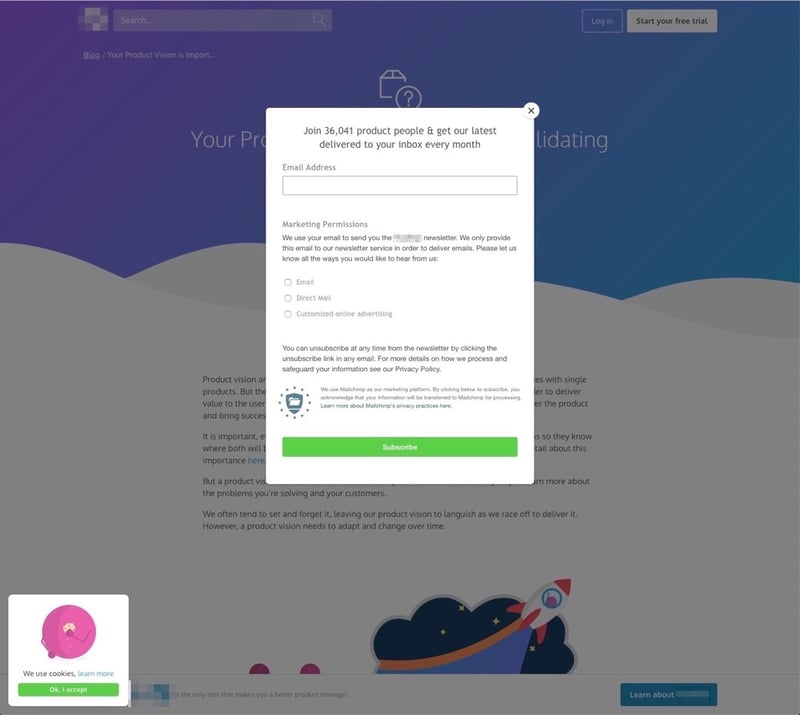
This morning I clicked on a link to read a blog post, and within 3 seconds of arriving the popup above stopped me in my tracks. I am asked to provide my email address before I’ve had any opportunity to determine if the site might have value to me1. I came to the site to read an article, which means I intended to spend time there. By serving a pop-up just as I enter the site, it is preventing me from seeing any value until I make a decision about whether or not to give them access to my email.

In a discussion about this topic on Twitter the most common defense I heard is that the sign-ups are worth it even if the method is sketchy. I disagree with that, and firmly believe that product growth should never happen at the expense of users. It might take longer to get right, but I would rather work to find ways to create more value for users and attain product growth that way, than resort to tactics that are hostile.

Which brings me to the topic of growth hacking. I think it needs to be said that all growth hacking methods, at their core, use human psychology to get people to do what you want them to do without taking their needs or intentions into consideration. The founder of the term defines a growth hacker as “a person whose true north is growth.” Growth at any and all cost. When we talk about this type of growth it’s usually in the context of persuasive design and habit-forming products, which have implicit goals to “nudge” people into directions they didn’t intend to go.

I don’t think this an ethical practice, and I think as product managers it is our responsibility to put an end to it. Instead of evaluating features and ideas based on the concept of “growth at any cost”, let’s ask the question “growth at what cost?” to guide our decisions more. Let’s find ways to grow that respect users and their intentions, not subvert them.


  1. I don’t mean to single out this site — this happens everywhere on the web these days. It was just the proverbial final straw today. 

The ideal balance between product building and marketing, and other advice from a product founder

My friend and colleague Garrett Dimon wrote about his experiences building and selling a product in his post Hindsight. He gives some advice based on what he learned. You might not agree with everything, but I think his perspective is really interesting and worth checking out. For example, on the balance between building product and doing marketing:

I don’t want to build an operational system to grow a business and then spend no time on the product. I want to design a company to build the product and serve customers. That’s not to say that there shouldn’t be some type of marketing that will need to be done, but I’d rather find ways where marketing is a by-product of the software rather than a separate activity. Checking analytics and numbers eventually becomes relevant for a business, but it’s a spectrum. I want to check the numbers to make sure the business is healthy, but I don’t want to be in a situation where I’m spending days analyzing or optimizing.

Startups die at the mercy of go-to-market, not at the hands of product.

This interview with former Google and Flipkart product leader Punit Soni covers a lot of ground and is interesting all the way through. His thoughts on the importance of a go-to-market strategy is so important, and a trap many product managers fall into:

When an idea is finally in sight, it may be tempting to jump feet first into product building. According to Soni, founders need to resist the impulse to obsess over product to the exclusion of everything else at the very beginning. “It’s tempting to slip into a ‘build it and they will come’ mentality, especially if you’re convinced of your own product prowess. Now I’m a product manager through and through, but I’ll be the first to tell you that product usually isn’t the issue,” he says.

Instead, tackle go-to-market, working through who’s going to buy, why and what they would pay. “Product is more binary in that, either the tech will allow you to do it or it’s not possible. Making sure that you can build a sustainable business model around that product is a far tougher task,” Soni says. “Figure all of that out before you start a company, not as you go along. Once you check that box, then you can become a product-focused company.”

Podcast: why customer education should be a priority for all companies

I found this discussion on the Product Love podcast really interesting. Eric Boduch talks to Adam Avramescu (Head of Education at Checkr) about the importance of educating customers on how to use your product. They cover a bunch of topics, including the myth that you don’t need education if your UX is good enough, the right way to approach documentation, and how onboarding is an important part of customer education but not the only thing you need.

Listen on Soundcloud or Overcast.