Support is a revenue driver, and a personal touch at scale is a great way to grow a business.
— Nick Francis, The Business Case for Support-Driven Growth
Support is a revenue driver, and a personal touch at scale is a great way to grow a business.
— Nick Francis, The Business Case for Support-Driven Growth
Ok this is creepy:
Over the past few years, Spotify has been ramping up its data analytic capabilities in a bid to help marketers target consumers with adverts tailored to the mood they’re in. They deduce this from the sort of music you’re listening to, coupled with where and when you’re listening to it, along with third-party data that might be available.
And they’re not alone:
Spotify is far from the only platform helping brands target people according to their emotions; real-time mood-based marketing is a growing trend and one we all ought to be cognizant of. In 2016, eBay launched a mood marketing tool, for example. And last year, Facebook told advertisers that it could identify when teenagers felt “insecure” and “worthless” or needed “a confidence boost”.
I continue to be fascinated by Instagram’s cultural and economic impact. Taylor Lorenz writes in Posting Instagram Sponsored Content Is the New Summer Job:
Helen Boogzel, CEO of Boogzel Apparel, said her company receives a steady stream of messages from young people — almost universally girls — looking to make extra money, and that teen marketing has been critical to the young company’s growth. “Some companies buy positive reviews or try to get into fashion magazines,” she said. “That’s fake and it kills your brand. It’s better to work with teenagers directly and know their honest opinion about your brand. Our clothes are inspired by culture and the internet. Young people create this culture.”
They also, crucially, don’t charge much: Depending on the teen’s audience and experience, most shops typically pay $5 to $20 for a post.
“Teenagers are more affordable to work with because of their follower count and age,” said Christy Oh, an 18-year-old who handles marketing for DouxLashes, which sells fake eyelashes. “They’re not doing insta as a full time thing, they’re just trying to make extra money, so it’s not super expensive to partner with them.”
Here are a few other interesting articles about Instagram’s impact and… bizarreness:
Listen, I held out as long as I could with this whole fidget spinner thing. Sure yeah “It’s only $3, Dad!” but I just couldn’t get myself to do it. And then my 7-year old used the age-old trick used by 7-year olds for centuries: she went over my head and convinced my wife to buy one for her a couple of weeks ago.
Of course, the joke’s on her, because the fad is basically over. Why so soon? In The Rise of the Fidget Spinner and the Fall of the Well-Managed Fad Charles Duhigg takes a fascinating look at why fads… well, aren’t what they used to be. It all comes down to how they used to be managed carefully by marketing & sales departments, as is still the case with Beanie Babies:
In reality, though, all these middlemen were often crucial to ensuring that the pie was baked at all. As Osborne learned when she started selling Beanie Babies, middlemen like Joyce are often the ones who turn a fad into a sustainable business that creates jobs. You might think a company’s main function is to make stuff. But that’s usually wrong. Making stuff is often the easiest part of what a company does. It’s everything else — marketing and defending intellectual property, coming up with distribution strategies and knowing when to stop manufacturing Peanut the Elephant — that’s the hard part. That’s what middlemen do.
Anyway, consider this your PSA that we appear to have finally seen the last of those ghastly things.
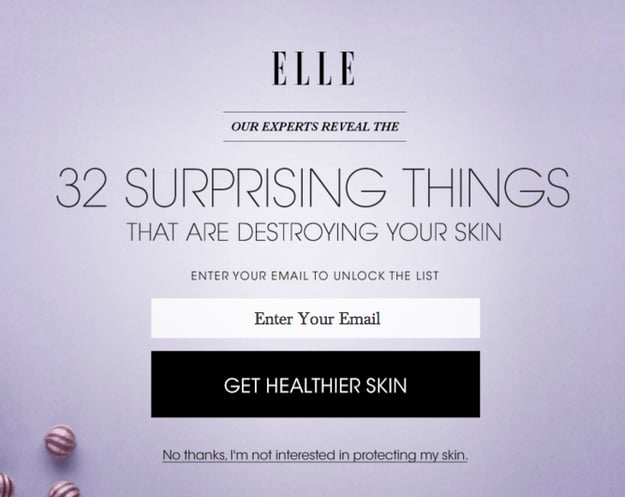
Katie Notopoulos writes about an extremely annoying marketing trend in Guilt And Shame As A UI Design Element—opt-out messages that make you feel bad about opting out:
The worst shame offender of all, however, is quickly becoming the mailing list opt-out guilt trip. When visiting a website, a pop-up implores you to sign up for their fantastic mailing list. The only way to get rid of this list is to click on the fine print at the bottom. But too often, this doesn’t merely say “Opt out” or “No thanks.”
No. It forces you to click a statement acknowledging you are a terrible, deplorable, disgusting human being.
It is not just enough that you don’t want to subscribe to the mailing list about political news. You must admit that “no, I DON’T care about being well-informed and reading great journalism.”
Did you know that you’re absolutely, positively, not allowed to use Q-tips to clean your ears? Not only that, but you’re not even supposed to clean your ears at all. From Roberto A. Ferdman more-fascinating-than-it-should-be The strange life of Q-tips, the most bizarre thing people buy:
“People have been led to think that it’s normal to clean their ears — they think that ear wax is dirty, that it’s gross or unnecessary,” [Dennis Fitzgerald, an otolaryngologist in Washington, D.C.] said. “But that’s not true at all.”
Fitzgerald likens ear wax to tears, which help lubricate and protect our eyeballs. Wax, he says, does something similar for the ear canal, where the skin is thin and fragile and highly susceptible to infection.
“Your body produces it [ear wax] to protect the ear canal,” Fitzgerald said. “What you’re taking out is supposed to be in there. There’s a natural migration that carries the wax out when left alone.”
Even if our ears were meant to be cleaned, the truth is that Q-tips would still be a terrible thing to use, he says. The shape, size, and texture of cotton swabs is such that inserting them into your ears tends to push wax inward, toward your ear drum, rather than woo it out.
The article explains a true marvel of product design: perhaps the only “major consumer product whose main purpose is precisely the one the manufacturer explicitly warns against.” It’s so interesting how it took the manufacturer decades to start warning against this behavior on the packaging.
Leigh Alexander wrote a very interesting essay on how Facebook is getting a little… “intimate” with its users lately. She extrapolates that to a growing trend in The New Intimacy Economy:
Pretending at closeness is really the only way forward for anyone who wants to make money on the internet. As such, watch as organizations pretend, with increasing intensity, that they are individuals. Start counting how many times platforms, services and websites entreat you in human voices, with awkward humor, for money. Watch as the things we expect to be invisible, utilitarian, start oozing emojis and winky-smileys. Even Silicon Valley, global epicenter of whitewashed empathy voids and 1-percenter sci-fi wank fantasies, is going to pretend it cares about you.
I don’t want Yelp; I want to know where to eat. I don’t care about Google Calendar; I care about not missing appointments. I don’t buy iPhones; I buy best-in-class pictures of my kids. I’m loyal only to results, and I suspect you are, too.
— From John Pavlus’s Apple and Google Race to See Who Can Kill the App First, a good reminder that users care about outcomes, not features
Ben Thompson wrote the best analysis of Tidal I’ve seen so far. From Tidal and the Future of Music:
I would again draw an analogy to venture capital: startups can spread via Twitter or new discovery services like Product Hunt; minimum viable products are cheaper to build than ever thanks to Amazon Web Services, Microsoft Azure, etc.; and distribution channels like App Stores have natural promotional channels. And yet the importance – and amount – of venture capital has never been greater.
The truth is that because so many folks can now get started it is that much harder – and more expensive – to cut through the noise. Consumer companies need massive growth for many years, and enterprise companies need expensive sales forces, and the only folks enabling both are venture capitalists.
It’s a great overview of the all the challenges Tidal will have to overcome to beat incumbents like Spotify and Pandora.
Douglas McGray’s How Carrots Became The New Junk Food is not about carrots. I mean it is, a little bit. But it’s mostly about product positioning and marketing.
“Everyone else pitched baby carrots as an antidote to junk food,” [Jeff] Dunn says. “Where [ad agency Crispin Porter + Bogusky] came out was almost the exact opposite. We want to be junk food.”
They realized that junk food is desirable. So instead of pitting carrots against that industry, they decided to play to its strengths instead. And it worked:
Crispin imagined individual snack packs made of opaque, crinkly plastic, like a potato-chip bag, with bold, junk-food-style graphics (the new packaging would cost about 25% more than traditional veggie bags, but Dunn could justify it as a marketing expense). “People are now grabbing a bag of these, you know, eating them in the car,” Dunn’s marketing chief, Bryan Reese, says. They’d look right at home by a convenience-store checkout.