Menu

Posts tagged “marketing”

[Sponsor] HostGator web hosting

Web hosting is many things to many people. Grandma wants to start a knitting blog? WordPress. New tech start-up needs a server to present their minimum viable product? Ruby on Rails, PHP, and MySQL. HostGator has you covered, and with one-click installs via the proprietary QuickInstall application, free with every hosting plan.

HostGator is with you every step of the way. The Texas-based, award-winning support staff is available via telephone, LiveChat, and email 24/7/365.

From Shared plans, for just a few dollars per month, up to custom Dedicated servers and featuring both Linux and Windows hosting platforms, HostGator has a hosting solution for everyone. Have you ever considered a side business providing hosting services to your own clients? Perhaps you’re a web designer and want to add hosting value for your clients; a HostGator Reseller plan is the answer!

Try HostGator and get 20% off.

Sponsorship by The Syndicate.

Sorting out messy online reputations

Graeme Wood takes a fascinating look at The World of Black-Ops Reputation Management for New York Magazine:

Whoever he was, it seemed that “Xander Fields” had built a whole Potemkin universe of positive-press websites that amplified made-up praise, often by made-up people, for a handful of rich folks with messy online reputations. I was now deep down in a ­rabbit hole but hadn’t yet landed with a ­satisfying thud. Who was “Xander Fields”?

I love reading stories like this. Consider this your required weekend reading.

[Sponsor] Tokens: a Mac app for managing App Store promo codes

Thanks to Tokens for sponsoring Elezea’s RSS feed this week.

Tokens is a Mac app for managing App Store promo codes

Tokens gets promo codes from iTunes Connect, creates shareable URLs for each code and notifies you once they’re redeemed.

The first step to getting your app noticed is inviting bloggers to try it. Promo codes let you give away free copies of your app, but unfortunately they’re laborious to create, awkward to redeem and impossible to track.

With Tokens you create a code with one click and bloggers can redeem it just as easily. By naming the token you can tell who has tried your app and follow up with them. You can also reuse any unredeemed codes before they expire.

Tokens is available now at usetokens.com/syndicate. Elezea readers get a special 20% discount until July using this link.

Tokens

Sponsorship by The Syndicate.

[Sponsor] X WordPress Theme

My thanks to Themeco for sponsoring Elezea’s RSS feed this week to promote their brand new WordPress theme.

Themeco is proud to launch X, a first of its kind WordPress theme built in conjunction with leading business and marketing experts. To celebrate our release, we wanted to share a really powerful SEO technique that you can implement today.

Did you know there’s a little piece of code you can add to your popular posts or pages that will almost double or triple the amount of clicks you get? Google tracks on-site engagement closely, so anytime you can get your visitors to click through to multiple pages of your site it’s great for your SEO efforts. We’ll show you this one amazing trick and how we built it into our incredible new WordPress theme plus show you how to implement it even if you don’t use WordPress.

Get a free copy of our one-page report and learn how you can implement this strategy in the next 10 minutes.

X

Sponsorship by The Syndicate.

The dying art of the small magazine ad

In Small Ads Dushko Petrovich turns our attention away from Facebook and Google to take a philosophical journey through those small, weird, completely non-targeted block-ads that appear in magazines:

At first you think these little rectangles are amusing because they offer monogrammed sweaters and self-publishing opportunities—things that are undoubtedly funny, in a sad, Skymall sort of way. But sometimes the funny sadness goes deeper than that, like the sadness of “unique diamond fish jewelry” for $15,000. And then sometimes you are plunged so deep into these ads, you wish there was a German word, or school of social thought, that could sufficiently describe the experience.

There might not be a German word for the experience, but Dushko’s troubled thoughts on the matter is entertainment enough.

[Sponsor] Fracture. Photos printed on glass.

Fracture prints your photos in vivid color directly on glass. It’s picture, frame & mount, all in one.

It’s a modern, elegant and affordable way to print and display your favorite memories. Your print comes with everything you need to display your photo, right in the durable packaging.

Fractures come in a variety of sizes and prices, starting at just $12, with free shipping on orders of $100 or more.

Fracture prints make great Father’s Day gifts and are the perfect way to fill up empty walls in your new home or apartment. Check it out.

Fracture

Sponsorship by The Syndicate.

[Sponsor] Mad Mimi Email Marketing

Mad Mimi is a design-oriented email newsletter service founded in 2008. Developed to provide a mobile-app-like feel, and with a drag-and-drop email composer, Mad Mimi offers a simple, elegant user experience that helps customers create, send, and track beautiful html email campaigns.

Mad Mimi also offers robust APIs, integrations, and add-on features. This makes it a perfect fit for today’s visionaries, artists, and entrepreneurs, including great digital brands like Fancy and StumbleUpon, who use Mad Mimi to communicate with their customers.

Best yet, Mad Mimi is free for up to 2,500 contacts. We hope you’ll give us a try or email us with questions.

Mad Mimi

Sponsorship by The Syndicate.

The trouble with advertising

Nicholas Carr compares two recent Facebook ad campaigns in Home away from Home, and comes to the following conclusion:

What’s really remarkable about “Dinner,” though, is that, in tone and meaning, it’s set in a universe not parallel to that depicted in “The Things That Connect Us” but altogether opposite to it — fiercely opposed to it, in fact. The new ad comes off, disconcertingly, as a sarcastic and dismissive rejoinder to the earlier one: Facebook calling bullshit on itself.

“Our place on this earth”? Doorbells? Bridges? What a load of crap! The earth sucks! Things are boring! People are ugly! Go online and stay online! Chairs, mawkishly celebrated in “The Things That Connect Us” as bulwarks against the meaninglessness of the universe, as concrete means of connection and hence liberation, become in “Dinner” instruments of torture. They trap us in the distasteful world of the flesh, the hell of other people.

It’s an astute observation not just about Facebook, but about advertising in general. How many of the ads we celebrate — yes, even the new iPhone 5 ad — are just fleeting attempts to play on emotions that we find appealing in that instant? The Facebook ad pulls away the curtain to reveal in stark fashion that there is often no thought put into a larger story, an honest portrayal of what a product is and does.

All of this reminds me of the “Bring the love back” campaign from a few years ago:

Sadly — but perhaps as a fitting metaphor for the advertising industry — the bringtheloveback.com domain doesn’t exist any more.

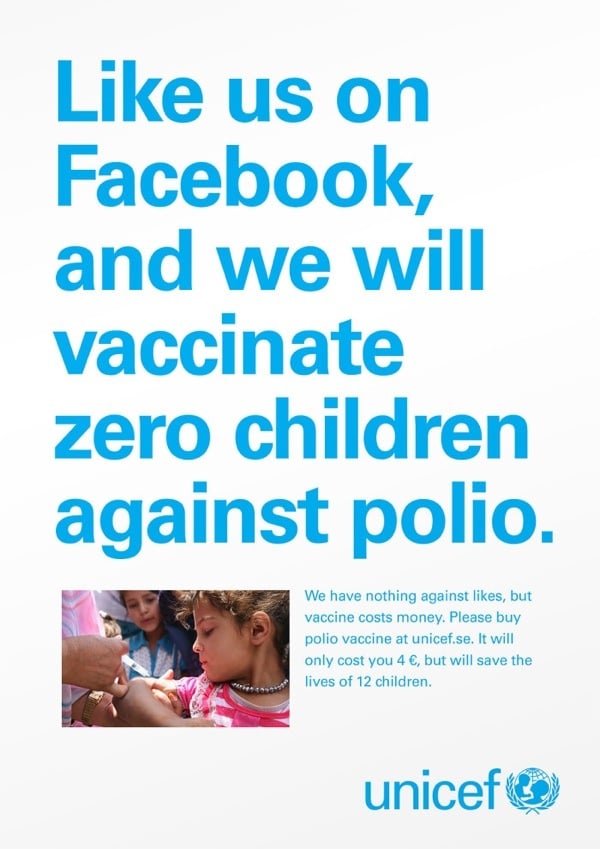
UNICEF: Likes don't save lives. Money does.

Olga Khazan covers a new UNICEF ad campaign in UNICEF Tells Slacktivists: Give Money, Not Facebook Likes:

But one thing clicking “like” doesn’t do is, say, get malaria nets to African villages or boost funding for charity groups. And now that Facebook is nearly 9 years old and Twitter is 7, we’re seeing the inevitable backlash against social-media “slacktivism.”

The print component of the campaign is shown below. It’s a bold, welcome move from UNICEF.

UNICEF Facebook like ad

Facebook is not a website, it's a data set

One of the most interesting analyses I’ve read about Facebook’s ad business and the future of the company is Kurt Eichenwald’s Facebook Leans In. This Marc Andreessen quote stood out immediately as core to a proper understanding of how Facebook works:

None of the people close to Mark and the company think of Facebook as a Web site. They think of it as a data set, a feedback loop.

Kurt does a stellar job of piecing together information from different sources to tell a compelling story:

The Facebook of old—well, of a year ago—is almost irrelevant to the company that exists today, which not only is set to change the world of social networking, but could herald the biggest transformation in American advertising since the advent of television.

That is my conclusion from months of interviews with Facebook ad clients, investors, the company’s senior management and other key executives, as well as reviews of reams of data, including confidential reports. What emerges is a portrait of a widely misunderstood company that has quietly been pioneering a marketing business model unlike any other in Silicon Valley—or, for that matter, Madison Avenue.

It’s a long article, but if you’re at all interested in how Facebook is redefining the ad business, it’s a must-read.

(link via @kbaxter)