Menu

Posts tagged “marketing”

How to optimize your pricing page

Good advice here from Kyle Poyar on how to optimize your pricing page, including a reminder to emphasize benefits, not features:

Did your feature matrix get dumped on your pricing page as-is, leading to confusion and eye-rolls across your target buyers? Don’t do that. Tell a story about what the customer can do with the feature.

Link roundup for July 2, 2023

Technology and product

Pledge To Executives →

Marty Cagan’s latest is all about the agreements between product teams and executive teams. This point about deadlines stood out for me:

Product teams ask that only the product team that will be responsible for delivering on a promise be the one to make that promise, and they not be asked to make a promise or deliver on a commitment where they don’t know what is involved and what would be required to succeed.

How will AI affect workers? Tech waves of the past show how unpredictable the path can be →

A good piece by Bhaskar Chakravorti, also discussing AI’s impact on DEI in the workplace:

For example, while the broad shift toward remote work could help promote diversity with more flexible hiring, I see the increasing use of AI as likely to have the opposite effect. Black and Hispanic workers are overrepresented in the 30 occupations with the highest exposure to automation and underrepresented in the 30 occupations with the lowest exposure. While AI might help workers get more done in less time, and this increased productivity could increase wages of those employed, it could lead to a severe loss of wages for those whose jobs are displaced. A 2021 paper found that wage inequality tended to increase the most in countries in which companies already relied a lot on robots and that were quick to adopt the latest robotic technologies.

Also worth noting this discrepancy, which we seem to hear about a lot these days:

A 2022 study showed improved efficiencies for remote work as companies and employees grew more comfortable with work-from-home arrangements, but according to a separate 2023 study, managers and employees disagree about the impact: The former believe that remote working reduces productivity, while employees believe the opposite.

SparkToro Year 3 Retrospective: Investor Payback, Systemic Challenges, and V2 on the Way →

I enjoyed Rand Fishkin’s extensive and transparent thoughts on how their business is doing. A couple of things especially stood out. First, this point about marketing attribution:

In businesses like ours, most top-of-funnel marketing happens months or years before conversions do. When someone buys SparkToro, we have no way to attribute it to the three videos they watched on LinkedIn or the word-of-mouth recommendation from an ex-colleague at their previous agency, or the podcast they heard Amanda on last month. This would drive a lot of CMOs and CFOs bananas, but if you can lean into the process of trusting your “vanity metrics” (views, likes, comments, shares, emails, I-heard-about-you-ons), you can build a marketing flywheel that’s almost entirely devoid of competition.

I had to read that last sentence a few times to make sure it’s not a typo. This may be the first time I’ve ever seen someone speak positively about vanity metrics. Definitely food for thought…

And then there’s this important point about market segmentation:

Great products aren’t enough, either. To be “great” is, in my opinion, not nearly as valuable as being irrelevant to 99% of people, but exactly perfect for the 1% who deeply care about the problem you solve. Extra bonus points: target your product at a group that’s well-connected to others in their field, and gets value from sharing new things. Nothing’s better than word of mouth marketing. Nothing.

Other interests

The customers might be human, but the audience is Google →

This is a really interesting exploration of how “the SEO arms race has left Google and the web drowning in garbage text, with customers and businesses flailing to find each other.” Some small businesses deal with by having two websites: one for humans and one for robots.

How Google Reader died — and why the web misses it more than ever →

This is a really good history and retrospective of Google Reader. Dang, I feel for this team. It was so much more than an RSS Reader, and they didn’t even like that name. It was the first true social media feed: curated content you care about.

In other words, Fusion was meant to be a social network. One based on content, on curation, on discussion. In retrospect, what Shellen and Wetherell proposed sounds more like Twitter or Instagram than an RSS reader. “We were trying to avoid saying ‘feed reader,’” Shellen says, “or reading at all. Because I think we built a social product.”

Why aren’t smart people happier? →

Really interesting exploration by Adam Mastroianni, and a history of how messed up our definition of “smart” has become:

My grandma does not know how to use the “input” button on her TV’s remote control, but she does know how to raise a family full of good people who love each other, how to carry on through a tragedy, and how to make the perfect pumpkin pie. We sometimes condescendingly refer to this kind of wisdom as “folksy” or “homespun,” as if answering multiple-choice questions is real intelligence, and living a good, full life is just some down-home, gee-whiz, cutesy thing that little old ladies do.

Hometown’s Finest →

I’ve always been interested in “sense of place”—finding the reasons why a town or a place exists, and why people are drawn to certain places. Anne Helen Petersen writes beautifully about this concept in an essay about her hometown:

Optimization and remodel culture robs spaces of that heart. I’m sure MOD Pizza, the latest upstart in the pizza world, makes a lot more money. It’s slicker, faster, easier. But it’s not a place, it’s a product—a profit center. You can always tell, can’t you, when a restaurant’s primary purpose is to make a bunch of people who’d probably never eat there a whole bunch of money.

The Reader in Mind Is Me →

John Warner writes about the passing of Cormac McCarthy as well as Elizabeth Gilbert’s decision to indefinitely postpone the publication of her novel following the appearance of over 500 negative reviews of the book on Goodreads (also see How Goodreads Reviews Can Tank a Book Before It’s Published). He makes some interesting observations about “parasocial relationships”:

My first reaction was that we were in the realm of the parasocial, the invention or a relationship with a celebrity who doesn’t know you exist. My most parasocial relationships are with my favorite Peloton instructors who are clearly encouraged to stoke this feeling in platform participants as a way to keep us invested and involved.

Another example is Taylor Swift’s recent relationship with some other recording artist with bad politics and questionable hygiene, something her fans could apparently not countenance, and perhaps drove her to break up with the dude.

MrBeast and product management (sorry)

This is a fascinating profile of MrBeast and his YouTube empire (NYT Gift Article). It’s extensively researched and presented with a steady hand. The reason I link to it here is I think he would be a pretty good product manager, albeit a litte bit on the obsessive side:

Donaldson stands out for his dedication to understanding how YouTube works. For most of his teenage years, “I woke up, I studied YouTube, I studied videos, I studied filmmaking, I went to bed and that was my life,” Donaldson once told Bloomberg. “I hardly had any friends because I was so obsessed with YouTube,” he said on “The Joe Rogan Experience” last year.

After high school, he hooked up with a gang of similarly obsessed “lunatics” and planned out a program of study. He and his friends “did nothing but just hyperstudy what makes a good video, what makes a good thumbnail, what’s good pacing, how to go viral,” he told Rogan. “We’d do things like take a thousand thumbnails and see if there’s correlation to the brightness of the thumbnail to how many views it got. Videos that got over 10 million views, how often do they cut the camera angles? Things like that.”

That reminds me of the famous 41 shades of blue testing at Google. Also, one thing I never realized about the whole thing is that MrBeast’s pitch is basically “Hey, you do charity just by watching me because I use the money I get for charity, so the more you watch me the more charitable you are.” That is a bit disturbing but also pretty clever.

Product-led growth and micro-conversions

The first part Sara Ramaswamy’s Product-Led Growth and UX is just a summary (a good one!), but the “How UX Can Help” sections has some really great insights and ideas, like this one:

While macro conversions (high-level conversion tied to the primary purpose of the site) are often the first success indicators considered, it is, however, important to define and revisit micro conversions, which measure incremental improvements to the user experience. In product-led growth, products are competing at the micro-conversion level. Analyze the conversion user journey and create milestone micro conversions that capture progress toward primary macro conversions. Also identify secondary user actions on site that are correlated with macro conversions.

“Compete at the micro-conversion level” is a really good lens to keep in mind as we improve our products.

On the dangers of vanity metrics

I saw two deeply personal posts this week, each related to the dangers of chasing after vanity metrics. First, Justin Andersun tells us about The Ski Lesson, and concludes with this:

We should not lose touch with the spirit of what we’re doing. A job’s essence is to serve the needs of others, and friendship is to support the people we love. Metrics become vanity when they lose touch with that spirit.

Second, fio dossetto writes this about being mindful of vanity metrics:

Vanity metrics are easy to pick and hard to let go of. They can subtly but significantly damage the system for a long time before you spot them, at which point you’ll need to take a hard look at your actions and decide how to course correct. Fast.

Both posts highly recommended!

12 metrics to track for B2B SaaS companies

Elena Verna has a great summary of leading metrics for B2B SaaS companies, including some really useful benchmarks. Also a good reminder that revenue is a lagging metric:

Many leaders obsess over revenue. And rightfully so, because revenue is the outcome of any business. But revenue is a lousy metric to goal the team against because it assesses past performance instead of predicting the future.

If you want to dig a little deeper on the best metrics to choose for SaaS companies, here are a few more resources:

How your product is discovered and adopted is part of the product

Shift left on go-to-market to build better products is a great post by Frank Tisellano on why product managers have to consider Go to Market efforts while they are still deep in the understanding/planning phase of a project:

Great PMs recognize that building a good product is table stakes and that the way to truly differentiate themselves is by taking a strategic approach to how customers or users find and adopt their products.

In other words, great PMs shift left on go to market, considering and developing their distribution strategy while they’re still prioritizing problems to solve, long before a PRD is written, let alone a line of code.

He goes on to give some practical tips—and examples—on how to make GTM a bigger part of the PM process.

The 4-subfunctions of growth marketing, and a good Figma example

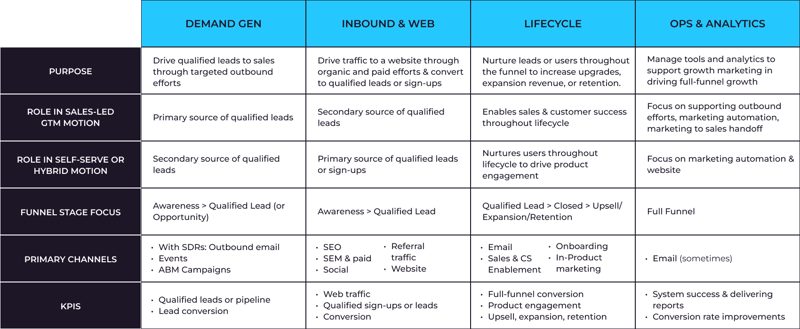
In How to organize your B2B growth marketing team Emily Kramer explains growth marketing in a way that I think I finally understand:

To support full-funnel marketing, multiple GTM motions, and all of the data and tools available, 4 sub-functions of growth-marketing are needed: Demand Gen, Inbound & Web, Lifecycle Marketing, and Ops & Analytics.

Emily also touches on the many ways that this team ideally works with Product and Engineering. It’s a highly recommended overview of this critical function in an organization.

And speaking of growth marketing… In Figma and product-led sales Jesus Requena, former head of growth marketing at Figma, shares some really interesting details on how Figma’s Growth team works with their Sales team:

We wanted to take this to the next level and learn what exact product behavior correlated with an upgrade. We partnered with our data product team, sales ops and sales leaders and created a model that surfaced around 10 data points. When two or more of these were triggered, there was a high likelihood for the account to upgrade. We showed sales and sales leaders the data and got their interest, then we tested it in a small group. Endgame, the product-led sales software, helped us display the data at account level and user-within-account level.

Link roundup for February 19, 2023

Underwater Photographer of the Year—2023 Winners. These are so great.

Impostered. Great post from Mandy Brown about the need to reframe how we think about imposter syndrome. “I’ve started to think less about imposter syndrome (a description of a person’s experience with it) and more about being impostered (a framing that draws attention to the systems and structures that lead people to believe they are imposters). While the former framing remains useful in many contexts, the latter creates space to consider not only the symptoms but the root cause of the phenomena.” [everythingchanges.us]

What’s So Funny? Very good essay about the current state of stand-up comedy, and what makes something funny. “The audience whooping and applauding Roseanne’s ‘anti-woke’ comedy is not reacting with laughter at a previously un-acknowledged truth, but instead expressing approval for the point of view that they already knew they agreed with. This is not the same thing as laughter in response to a joke.” [biblioracle.substack.com]

Why Are You Seeing So Many Bad Digital Ads Now? “Social media advertising, once a niche art practiced by specialist agencies, is now easily available to anyone. Many of them are eschewing targeted ads — placements intended to reach specific audiences, usually at a higher cost — in favor of a cheaper spray-and-pray approach online, hoping to catch the attention of gullible or bored shoppers.” [NYT gift link]

Traffic Lights Need a Fourth Color, Study Says: Here’s Why. Yeah what could possibly go wrong. “For the dawning age of the self-driving car, transportation engineers from North Carolina State University are proposing the addition of a fourth ‘white light’ whose function would be to alert humans to simply ‘follow the car in front of them.’” [popularmechanics.com]

The people who live inside airplanes. Ok I kind of like this idea. “By the end, she had a fully functional home, with over 1,500 square feet of living space, three bedrooms, two bathrooms and even a hot tub — where the cockpit used to be. All for less than $30,000, or about $60,000 in today’s money.” [cnn.com]

Turn customers into a coalition of defenders

I love this sentiment from Rich Ziade in the post The New MVP: The Minimum Valuable Product. He talks about what happens when customers become a coalition that shares your mission. This is written from an agency perspective, but it applies just as much to product companies:

There is no more powerful political tool than releasing good software into people’s hands. You’ll find that the burden of consensus-building and campaigning is far lighter because the thing speaks for itself. It’s something you can draft behind to keep going.

Rinse and repeat. Done right and you’ll bank some political capital. You’ll need it along the way. Mistakes will be made and you will be blindsided by who-knows-what. Ideally you’ll string together a few wins that continuously impress people. Trust increases, anxiety decreases the temperature has gone down. What were once your customers will become part of your coalition, defending your product and mission because it is now their product and mission.

“…it is now their product and mission.” That is an excellent goal we can all aspire to.