Menu

Posts tagged “design”

The most dangerous thing about self-driving cars

Cliff Kuang makes some interesting points in his essay The Secret UX Issues That Will Make (Or Break) Self-Driving Cars:

Recall that first principle that [Brian Lathrop at Volkswagen] laid out for designing autonomous cars—that the driver has to know whether the car is driving itself. That harks to probably the oldest dictate in interface design; mode confusion causes 90% of airplane crashes, and that insight helped invent the field of human-computer interaction. Think about all the times you’ve heard news reports about a pilot being confused about whether the flaps of the wings were down, or whether to auto-pilot was properly set. If you’ve ever failed to realize that your car was in park when you hit the accelerator, or you’ve ever tried typing into the wrong window on your computer screen, you’ve been a victim of mode confusion.

So, the scariest thing about self-driving cars is not whether or not the car can drive safely, but whether it can effectively communicate when it is driving and when it is not. It’s the age-old Visibility of system status UI heuristic in action.

Beyoncé, Coldplay, and the myth of the “average” user

I am not qualified to talk about politics so don’t worry, I won’t. That said, Spencer Kornhaber’s essay on Beyoncé’s Radical Halftime Statement is so incredibly good (and very applicable to product design) that it’s worth discussing here. The part that I found particularly interesting is how differently Beyoncé and Coldplay view their “target markets”. Beyoncé is very focused:

But in pop and in politics, “everyone” is a loaded term. Stars as ubiquitous as Beyoncé have haters, the “albino alligators” who “Formation” informs us she twirls upon. And in a more general historical sense, “everyone” can be a dangerous illusion that elevates one point of view as universal while minimizing others. Beyoncé gets all of this, it seems. As a pop star, she surely wants to have as broad a reach as possible. But as an artist, she has a specific message, born of a specific experience, meaningful to specific people. Rather than pretend otherwise, she’s going to make art about the tension implied by this dynamic. She’s going to show up to Super Bowl with a phalanx of women dressed as Black Panthers.

Whereas Beyoncé is very specific about who her music is for (and not for), Coldplay tries to please everyone:

The poor guys of Coldplay, meanwhile, actually think they can work solely at the level of the universal. “Wherever you are, we’re in this together,” Chris Martin cried out, early on, last night. I don’t want to diss that intention, nor the take-home message at the end: “Believe in Love.” But from their first hit, “Yellow,” to their recent Holi-appropriating music video with Beyoncé, to their pan-cultural rainbow rally at Levi’s Stadium last night, their theme has only been about love to the extent that it’s been about how everyone loves colors. It’s music about being awed by the blandest kind of harmony: ROYGBIV, yeah yeah yeah!

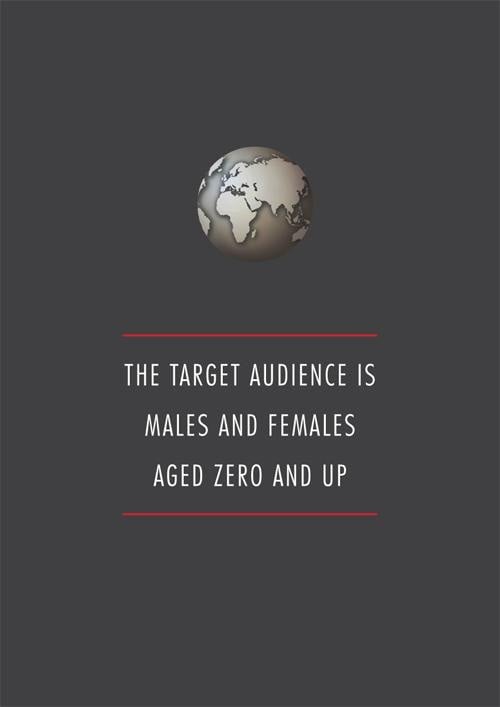
Coldplay’s approach reminds me of this classic Sharp Suits poster:

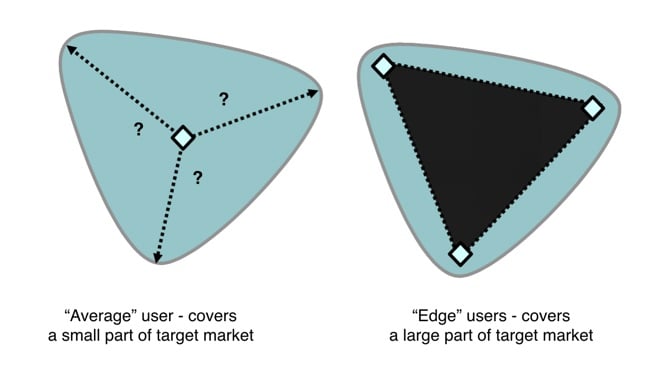
The problem with a target market of literally everyone is that you end up with a heavily compromised experience that appeals only to the very few people who identify with the “average” experience. Bringing this back to product design, this is why I’m still such a big fan of design personas. As opposed to a mythical “average” user, personas are solid people we can imagine using our product to achieve their goals. This is helpful because by focusing on a few different individuals that are closer to the edges of an experience, instead of the average, we end up catering for a larger portion of the user base:

Persona edges

This is what Beyoncé does so well. She makes music at the edges, so it’s exciting and anything but bland. It’s a lesson that Coldplay clearly hasn’t learned yet.

Netflix and the problem with established interface mental models

There were some interesting Netflix articles over the past week or so. First, Nathan McAlone writes that Netflix wants to ditch 5-star ratings:

The problem, [CPO Neil] Hunt tells Business Insider, is that people subconsciously try to be critics. When they rate a movie or show from one to five stars, they fall into trying to objectively assess the “quality,” instead of basing the stars on how much “enjoyment” they got out of it.

Here’s an example. Let’s say you had fun watching a crappy movie, but still gave it a two-star rating because you know it’s not a “good” film. That presents Netflix with a problem. The system thinks you hated the movie.

I think embarrassment plays a part in this as well. Even when ratings are private, we’re worried that word might get out. For example, I’d be happy if all my Netflix recommendations consist of “Movies similar to Battleship”, but I certainly don’t want any of you to know how much I liked that terrible movie.

Related to this, McAlone also wrote about Netflix’s most important metric:

That means that the most important economic metric for Netflix is how much a TV show or movie contributes to Netflix’s ability to sign up and retain customers.

The problem is that the current star rating system doesn’t give them that metric because it’s associated with “quality”, not “enjoyment”. So I might rate Out of Africa 5 stars because I objective know it’s a good movie, but if Netflix starts recommending “Boring movies with Meryl Streep” to me, I’m out of there.

Netflix has a very difficult product design challenge ahead of them. They have to change an established user mental model (“stars=quality”) to something different (“tell us what you enjoy watching”) that will help them provide a better and more compelling service.

Why projects fail if they neglect research

Erika Hall’s The Secret Cost of Research is a great explanation of why research is essential for products to succeed:

The reason design projects that neglect research fail isn’t because of a lack of knowledge. It’s because of a lack of shared knowledge. Creating something of any complexity generally requires several different people with different backgrounds and different priorities to collaborate on a goal. If you don’t go through an initial research process with your team, if you just get down to designing without examining your assumptions, you may think your individual views line up much more than they do. Poorly distributed knowledge is barely more useful than no knowledge at all.

I can definitely attest to this. It’s exactly why I’m such a big fan of Product Discovery:

This phase always—without fail—produces insights the team finds incredibly valuable. Startups gain clarity about what to say “yes” and “no” to in their product, and large corporations learn how to go beyond customer-centricity buzzwords and discover which benefits they should be selling to their users. As just one of many examples, I was once in a workshop that revealed the executives had a completely different vision for the company than the designers and developers. It was an awkward two hours, but in the end they agreed on the tough but correct decision to suspend their e-commerce plans until some of the content areas on the site had been sorted out. It’s great to see a statement of purpose emerge from these sessions—one that finally gets an organization to agree on what the product’s focus should be.

It’s pretty remarkable how different people’s visions for a product can be, especially since there’s such a simple two-step program to fix that:

  1. Understand user needs and business goals.
  2. Talk about it, together.

Effective onboarding through human connection

Jeremy Keith writes about the onboarding process of the site The Session in his post Words of welcome. He shows a series of screen shots of simple messages that teaches users how to be good citizens on the site. Keith closes with this:

No intricate JavaScript; no smooth animations; just some words on a screen encouraging a human connection.

Design words to live by.

Don't shame users into reading your stuff

No thanks

Katie Notopoulos writes about an extremely annoying marketing trend in Guilt And Shame As A UI Design Element—opt-out messages that make you feel bad about opting out:

The worst shame offender of all, however, is quickly becoming the mailing list opt-out guilt trip. When visiting a website, a pop-up implores you to sign up for their fantastic mailing list. The only way to get rid of this list is to click on the fine print at the bottom. But too often, this doesn’t merely say “Opt out” or “No thanks.”

No. It forces you to click a statement acknowledging you are a terrible, deplorable, disgusting human being.

It is not just enough that you don’t want to subscribe to the mailing list about political news. You must admit that “no, I DON’T care about being well-informed and reading great journalism.”

Personal AI assistants: the battle and the war

A friend once told me that for him, one of the weirdest moments as a parent was the realization that their kids have a relationship with each other, not just with him. That conversation always stuck with me, and when our own daughters started to have a bond with each other that’s completely separate from their bond with us, I understood what he meant. It’s just something that is, for some reason, very difficult to wrap one’s head around—these people you made, suddenly having lives apart from you. Today I’m thinking of that conversation again, but in a very different context—personal AI assistants, and what that means for how we design their interfaces.

But before I get there, let me take a step back and recap some of the recent conversations about personal AI. In The internet bundle is already here Dieter Bohn writes that AI personal assistants are a threat to net neutrality:

The bundle is already here, it came from places we haven’t been watching closely enough, and it has many names. There’s more than enough doomsaying about the issues related to Instant Articles, Internet.org, and Binge On. Instead, I’d like to take a minute to doomsay what could become the other opponents to the kind of free, transparent, and open internet we all want: Siri, Cortana, Alexa, Facebook M, and Google Now.

These intelligent assistants are great. I use them every day and expect I will continue to use them for, well, ever. But there’s a problem that’s built into them: they only seem to work with certain parts of the web and — here’s the real rub — certain apps.

Mark Wilson makes a similar argument in Why Every Gadget You Own Suddenly Wants To Talk To You, and then takes the argument further to imagine what happens when you have a bunch of non-neutral devices in your home:

But the problem with a scenario in which you can talk to anything is that you’re no longer talking to one thing. Only so many ears can live in one room. If I muse aloud that I need more shampoo in the shower, what hears me? Is it my iPhone sitting at the sink? Alexa networked in my apartment? Some new smart water nozzle from Kohler? […]

As consumers, we’re caught in the middle of the convenience. Do we choose to side with Siri, Alexa, or Cortana, and talk only to her, despite looming bias and the risk of growing dependent on a single voice—a voice that could take advantage of us? Or do we side with a free market that gives a voice to every stupid overzealous object in our lives, however confusing that may be, in a world where ordering milk becomes a bidding war on a commodities training floor?

Which future do you root for? They both sound horrible.

All of this is part of a big “the conversation is the interface” trend we’ve been seeing a lot of recently (see The search for the killer bot and 2016 will be the year of conversational commerce). From a design perspective the main challenge we seem to be thinking about is how to give these AI assistants the right personality (see The Next Phase Of UX: Designing Chatbot Personalities and The New Intimacy Economy). But I wonder if that’s the wrong AI design focus. I wonder if we should rather spend our time encouraging design for what Alan Cooper calls The Edges:

The difficulty in making these systems work smoothly comes from their edges, not from their centers. Each vendor builds a reliable and effective product, and through diligent testing assures that they meet high standards of performance. The only place where those standards fall is at the edges, where the maker is unsure of the requirements.

The edges are the interfaces with entities outside their control, outside their offices. Out there they are a little unsure of what they have to do and what forces affect them. Inside the company’s four walls they know exactly what they’re making, how it should behave, and what it should do. But for the entities outside those four walls, some measure of haziness creeps in, notably, the user.

Applied to AI assistants (and back to my parenting story), this means we need to start thinking about not just how humans interact with Siri and Alexa, but how Siri and Alexa interact with each other. There is, of course, a huge disconnect here between user needs and business goals. It would be very beneficial for users if different AI assistants could interact with each other, but that doesn’t help companies to strengthen their silos.

The trouble is that if we don’t figure out how to do this (and do it profitably), we might lose more than the battle of whose personal assistant wins. We might lose the war of personal AI getting any significant user adoption.
How to decide on prototyping fidelity

Ryan Singer shares some tips about prototyping tradeoffs in The Fidelity Curve: How to weigh the costs and benefits of creating UI mockups:

The purpose of making sketches and mockups before coding is to gain confidence in what we plan to do. I’m trying to remove risk from the decision to build something by somehow “previewing” it in a cheaper form. There’s a trade-off here. The higher the fidelity of the mockup, the more confidence it gives me. But the longer it takes to create that mockup, the more time I’ve wasted on an intermediate step before building the real thing.

I like to look at that trade-off economically. Each method reduces risk by letting me preview the outcome at lower fidelity, at the cost of time spent on it. The cost/benefit of each type of mockup is going to vary depending on the fidelity of the simulation and the work involved in building the real thing.

He goes on to provide some solid guidelines for when to go with paper & pencil vs. interactive or higher fidelity mock-ups.

Don't clean your ears

Did you know that you’re absolutely, positively, not allowed to use Q-tips to clean your ears? Not only that, but you’re not even supposed to clean your ears at all. From Roberto A. Ferdman more-fascinating-than-it-should-be The strange life of Q-tips, the most bizarre thing people buy:

“People have been led to think that it’s normal to clean their ears — they think that ear wax is dirty, that it’s gross or unnecessary,” [Dennis Fitzgerald, an otolaryngologist in Washington, D.C.] said. “But that’s not true at all.”

Fitzgerald likens ear wax to tears, which help lubricate and protect our eyeballs. Wax, he says, does something similar for the ear canal, where the skin is thin and fragile and highly susceptible to infection.

“Your body produces it [ear wax] to protect the ear canal,” Fitzgerald said. “What you’re taking out is supposed to be in there. There’s a natural migration that carries the wax out when left alone.”

Even if our ears were meant to be cleaned, the truth is that Q-tips would still be a terrible thing to use, he says. The shape, size, and texture of cotton swabs is such that inserting them into your ears tends to push wax inward, toward your ear drum, rather than woo it out.

The article explains a true marvel of product design: perhaps the only “major consumer product whose main purpose is precisely the one the manufacturer explicitly warns against.” It’s so interesting how it took the manufacturer decades to start warning against this behavior on the packaging.

Designing cities for citizens of all ages

Dominic Basulto wrote an excellent summary of a recent McGraw Hill Financial Global Institute report called What the world’s best cities will look like in 2030. The main point the report makes is that people in cities are aging, and we’re not really paying attention to that. There are, however, several things we can do to make sure that older people can live comfortably in our cities:

First, the city of the future should have the infrastructure and transportation links to address the needs of citizens of all generations. Second, each city should build new housing options to enable older citizens to “age in place.” Thirdly, each city should include access to community health programs with innovative medical technology for seniors. And finally, the city of the future should have plenty of opportunities for continuing work, education, arts and recreation for all ages.

This reminds me of an attempted joke I made the other day about the font size in Facebook Messenger1:

You’ll get old too, young designer. And when you can’t read your own product any more I’ll laugh so hard my teeth with fall out.

— Rian Van Der Merwe (@RianVDM) August 31, 2015

From cities to software, the evidence is all around us that if there’s one thing we desperately need to build more inclusive products, it’s a more diverse workforce. It’s very hard for us to design for people and situations that we have no experience with. We need to make sure our workplaces are more diverse, and then we need to go out and understand our users.


  1. I’m ridiculously embarrassed about that typo.