Menu

Posts tagged “design”

The perils of a lack of diversity in urban design

Diana Budds does some great reporting in How Urban Design Perpetuates Racial Inequality — And What We Can Do About It. It’s startling to see how deeply ingrained racism is in the way cities are designed. One of the most effective ways to change this? Diversity and immersion in the needs of users…

Justin Moore, an architecture professor at Columbia University, believes that while designers focus on creative solutions for urban problems, issues that are rarely broached are shortfalls within the profession, like diversity, a deep understanding of the communities in which they’re building, and the methodology of design education.

”There is a need to redesign the designers, and to give them the tools and competencies to work within social constructs and spatial contexts that they are meant to serve. Designers spend much of their academic and professional training to build the spatial, technical, communication, and critical-thinking skills that are needed to do the difficult work of transforming spaces and places. They use their skills, often with good intentions and ‘best practices,’ toward results that may not align with what is needed or wanted in a given context.

Boxes and arrows: more powerful than we think

Alex Maughan voices some things I’ve been thinking about as well in a great post on user journey mapping. After one particular project he observed this:

This user flow may seem an obvious solution, but it wasn’t obvious to the company hired to design the app before I got involved, which had up to that point resulted in some very limiting and confusing design flows. I don’t say this to blow my own horn. The point I’m making is had they explored the designs with some rough, high-level journey sketching upfront, they probably would have realised this themselves.

I’ve become increasingly convinced that there is no complicated design problem that can’t be solved with a few hours of collective thinking and some boxes and arrows. Yeah, I get some eye-rolls for my boxes-and-arrows reliance sometimes—especially because the outcome sometimes feels just too simple. But I’m with Alex on this one—these things are only simple in retrospect.

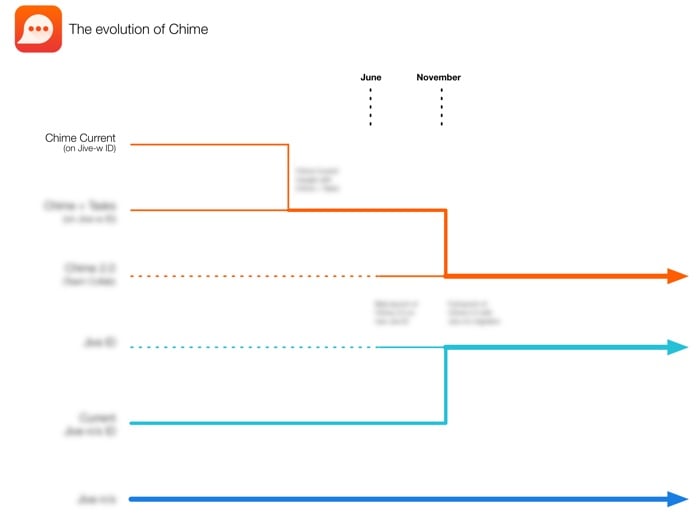
I recently worked on a project where we had to figure out the migration paths of 6 different products, and how they will all work together. We were talking for a long time, but we didn’t really get anywhere until I started drawing it out on the whiteboard. The end result was deceptively simple (some parts blurred out because it’s roadmap stuff):

“That’s it?” we all said of what came to be known as the Tron diagram. Yep, we realized together: that’s it. But it took a few hours of discussion and drawing to get us to the “that’s it” state. So this is me adding my voice to Alex’s in saying: never underestimate the power of sketching flows and user journeys to help us solve difficult problems.

Expanding the role of wireframes

I’ve done a fair bit of hand-wringing about wireframes myself (see here and here), so I read Travis LaFleur’s Toward a More Expansive View of Wireframes with great interest. I really like Travis’s approach of expanding wireframes beyond their traditional use:

Rather than thinking of the wireframe as a low-fidelity, grayscale snapshot of what a page will eventually look like, coming further and further into focus as the design is refined, we can embrace a broader view of the wireframe as a thematically rich conceptual model — one that is now depicting page-level details, reinforcing previous models of the system as a whole.

Click through to his post for some examples.

Build software to feed the world, not eat it

Kevin Slavin’s Design as Participation is one of those articles that stays with you for days. There are multiple ways to read it, but I view it as a thoughtful critique of my primary field of focus: user-centered design (UCD). There have been other discussions on this topic, most notably Cennydd Bowles’s excellent Looking Beyond User-Centered Design, and Mike Long’s Stop Designing for Users. Kevin’s is a worthy addition to the debate.

Kevin’s main thesis is that UCD is selfish (since it puts a user at the center of everything), and we should instead see users as active participants in a design:

Broadly, UCD optimizes around engagement with the needs, desires and shortcomings of the user and explores design from the analysis and insight into what the User might need or want to do. Simply, it moves the center from the designer’s imagination of the system to the designer’s imagination of the user of the system.

But we are no longer just using computers. We are using computers to use the world. The obscured and complex code and engineering now engages with people, resources, civics, communities and ecosystems. Should designers continue to privilege users above all others in the system? What would it mean to design for participants instead? For all the participants?

Also:

Some contemporary work suggests that we are not only designing for participation, but that design is a fundamentally participatory act, engaging systems that extend further than the constraints of individual (or even human) activity and imagination. This is design as an activity that doesn’t place the designer or the user in the center.

If this all seems overly academic, fear not, practitioners! Kevin shows several examples of “Design as Participation” in his essay, and also ends with this call to action:

A new generation of designers has emerged, concerned with designing strategies to subvert this “natural default-setting” in which each person understands themselves at the center of the world.

These designers do this by engaging with the complex adaptive systems that surround us, by revealing instead of obscuring, by building friction instead of hiding it, and by making clear that every one of us (designers included) are nothing more than participants in systems that have no center to begin with. These are designers of systems that participate – with us and with one another – systems that invite participation instead of demanding interaction.

We can build software to eat the world, or software to feed it. And if we are going to feed it, it will require a different approach to design, one which optimizes for a different type of growth, and one that draws upon – and rewards – the humility of the designers who participate within it.

It’s always hard to see one’s views challenged, but Kevin does it in the best possible way here. He understands UCD and why it came about, he presents a compelling argument about its issues, and then he shows us how we can do better.

I don’t think this means the end of UCD (or even that we should stop using its basic methods like personas and usability testing). But I do agree that we need to shift our thinking so that we’re less concerned about the success of an individual user (or groups of users), and more concerned about how different systems interact with each other. Alan Cooper touches on this topic in his wonderful essay The Edges:

What each organization has to do today is to regard the edges of its products with as much diligence and attention as they give the center. The quality of both their outside system connections (known as application program interfaces, or APIs) and their user interfaces demand levels of expertise and investment that have historically fallen short.

As nebulous as Kevin’s idea of “building software to feed the world” sounds, I like the sound of it. I like the hope and the desire to do good in the world that it communicates. We need to make that idea concrete in our daily design worlds, and I don’t think we quite know how to do that yet. But every practical mission starts with a grand vision, and I quite like this one.

Quote: Jon Kolko on product development that focuses on people first

The traditional way of building software focused on requirements, driven by a competitive view of the market, and responded to perceived needs with additional features and functions. Our new way of developing products focuses on people first: on spending lots of time with them in order to build an almost intuitive sense for their emotional journey. We design with that journey and those emotions in mind, and as a result, we can produce great products that people love.

—Jon Kolko, Understanding our product design strategy and ecosystem.

Why everyone should do usability testing (even you)

I vividly remember the first usability test I attended. I was a brand new employee at eBay, and I walked into a dark observation room with no idea what to expect. I came out of that room 60 minutes later with the strangest mix of emotions—heartbroken that our product clearly had usability issues that made users incredibly frustrated, but also relieved and excited that we now had the information we needed to fix those issues. I became a usability testing convert for life, and have been making it a part of my product design process ever since.

I’m deeply passionate about this methodology and how it makes us better designers (and improves the experiences of our users), so I don’t think it should be something that we reserve only for the “highly trained” to do. Usability testing is something all of us should do as a regular part of our design process. But that doesn’t mean it’s straight-forward—there are many pitfalls and ways to generate bad data with usability testing. So I wanted to write a brief introduction to the methodology and why it’s so important, as a foundation for people who haven’t had training in the method but would like to make it part of their process1.

So, let’s start at the beginning.

Usability testing is a very powerful (and shamefully underused) user research methodology—when it is used correctly. In fact, usability testing is probably the only method that can be relied on to consistently produce measurable improvements to the usability of a product. Bruce Tognazzini once said:

Iterative design, with its repeating cycle of design and testing, is the only validated methodology in existence that will consistently produce successful results. If you don’t have user-testing as an integral part of your design process you are going to throw buckets of money down the drain.

But that all depends on the all-important “when it is used correctly” caveat. To make sure we do that, we need to understand when to do usability testing, and what to use it for.

When to do usability testing

To answer the “when” question I need to bring back the three buckets of user research I first discussed in Making It Right:

  • Exploratory Research is used before a product is designed, to uncover unmet user needs and make it easier to get to product-market fit. Ethnography and contextual inquiries are the most-used methods in this bucket.
  • Design Research helps to develop and refine product ideas that come out of the user needs analysis. Methods include traditional usability testing, RITE testing (rapid iterative testing and evaluation), and even quantitative methods like eye tracking.
  • Assessment research helps us figure out if the changes we’ve made actually improved the product, or if we’re just spinning our wheels for nothing.

Usability testing is best used during the design research phase of a product. Ideally you’ll have an interactive prototype or some other lightweight interface to work with. It needs to be detailed enough to make sense to a user, but not so detailed that you’re reluctant to make changes based on feedback. Of course, you can also do usability testing on an existing live product, as long as the team has an appetite to make changes based on the insights that come back.

Usability testing shines during the design research phase since it plays on its strengths as a way to uncover the issues with an existing product or prototype. Trying to shoehorn usability testing into one of the other user research phases leads to trouble, since the nature of the data you get from it simply won’t help you make good decisions (i.e., don’t use it to try to decide what products to build, or if something you built objectively improved user satisfaction).

What to use usability testing for

This leads into what usability testing is good at: refining a product. It’s not good at finding out what to build (unless it’s combined with an ethnographic component). To put a finer point on what usability testing is most useful for, here’s a much-simplified diagram to put it in context with some other research methods.
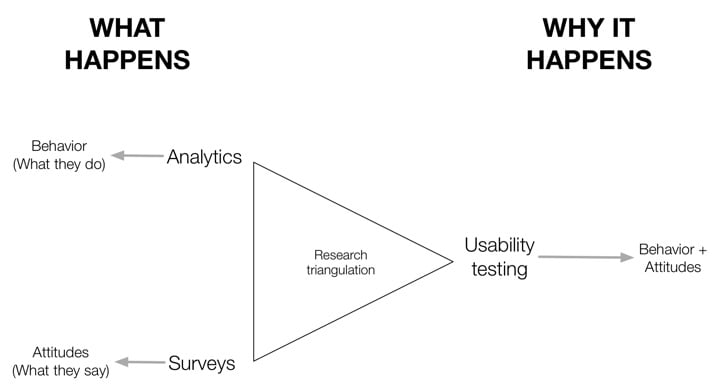
What usability testing is for

We use methods like analytics and surveys to understand what happens in the product. We use analytics to figure what users do, and we use surveys or other interview techniques to figure out what they say about the experience. The problem is that this doesn’t help us understand why something happens, and without that information we won’t be able to fix any of the problems we come across. That’s where usability testing comes in.

What makes usability testing so perfect for understanding the issues with an interface is that it is an observational research method. It’s not about asking people what they think about an interface. It’s about showing them an interface, giving them tasks to do in that interface, and then watching them as they go through those tasks. We can ask them questions about the experience, but that’s just to provide context.

At its core, usability testing means that we observe users as they make their way around an interface, and use that data to understand what issues we need to fix. So, for example, if we see in our analytics that there is a large drop-off in our checkout flow, usability testing can help us figure out why that drop-off happens, and how to fix it.

Haters gonna stop hating

I’ve seen usability testing abused in several ways that have ended up giving it a bad name in some circles. Here are some guidelines to keep in mind to help break through those prejudices.

First, don’t confuse usability testing with focus groups. They are very different methodologies, and they are certainly not interchangeable. Focus groups are good for some marketing purposes—to understand brand sentiment or positioning. It is a terrible way to get feedback on an interface. Usability testing is so good at what it does precisely because it is a 1:1 methodology. There is no groupthink, no way to get influenced by other users. In that sense, it is controlled environment. Focus groups are anything but.
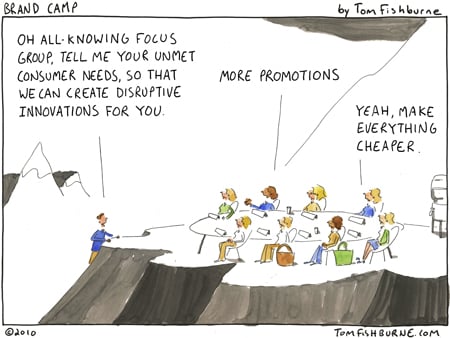
Focus groups

Second, remember the golden rule that usability testing is about observation. It can’t tell you which interface people like more than another, so don’t try to use it to settle those disputes. It’s the wrong question to answer anyway. It doesn’t matter what users like—it matters what they can use effectively to accomplish their goals. So usability testing is not “lightweight A/B testing”, as I’ve heard it described. It is meant to be part of an ongoing iterative design process with the goal of improving the product incrementally.

Finally, remember that you don’t need to be in a large organization or have tons of money to do usability testing. This is a methodology that scales really well. For startups who just have an afternoon to get some feedback, you can take some paper prototypes to a coffee shop. For large companies who need to convince a bunch of stakeholders to make changes, you can run a series of formal usability testing sessions. Whatever works—and don’t be mistaken, every little bit helps.

Go and make it so

I want to end this introduction with a small call to arms. Usability testing is an inherently uncomfortable methodology because it assumes and embraces the fact that your product isn’t perfect. That’s a difficult thing to make peace with—especially as a designer. But taking that position is the only way your product is going to get better. You can’t fix something that you don’t think is broken. Clayton Christensen made a similar point in The Innovator’s Dilemma. He calls this mindset “discovery-based planning”:

Discovery-based planning suggests that managers assume that forecasts are wrong, rather than right, and that the strategy they have chosen to pursue may likewise be wrong.

Investing and managing under such assumptions drives managers to develop plans for learning what needs to be known, a much more effective way to confront disruptive technologies successfully.

Or to repeat one of my other favorite quotes: “Design like you’re right, listen like you’re wrong.” Usability testing gives us a proven process to understand what we got wrong so we can get more of it right. That makes it a methodology we should all invest in more.


  1. Who knows, maybe I’ll turn it into a longer, very practical series if there’s interest. 

Quote: Chloe Green on the ROI of user experience

Numerous studies have found that every dollar spent on UX brings in between $2 and $100 dollars in return. Forrester revealed that ‘implementing a focus on customers’ experience increases their willingness to pay by 14.4 %, reduces their reluctance to switch brands by 15.8 %, and boosts their likelihood to recommend your product by 16.6 %’.

–Chloe Green, The business of user experience: how good UX directly impacts on company performance.

The rise of inclusive design

Cliff Kuang wrote an excellent article on Microsoft’s push for more inclusive design. From Microsoft’s Radical Bet On A New Type Of Design Thinking:

Dubbed inclusive design, it begins with studying overlooked communities, ranging from dyslexics to the deaf. By learning about how they adapt to their world, the hope is that you can actually build better new products for everyone else.

What’s more, by finding more analogues between tribes of people outside the mainstream and situations that we’ve all found ourselves in, you can come up with all kinds of new products. The big idea is that in order to build machines that adapt to humans better, there needs to be a more robust process for watching how humans adapt to each other, and to their world. “The point isn’t to solve for a problem,” such as typing when you’re blind, said Holmes. “We’re flipping it.” They are finding the expertise and ingenuity that arises naturally, when people are forced to live a life differently from most.

This is similar to the points I tried to make in Beyoncé, Coldplay, and the myth of the “average” user. The advantages of having more diversity in our design and development processes go far beyond the moral rightness of it. We end up with better products that serve a much wider cross-section of a population.

The ethics of "empowering" users

Katherine Benjamin wrote a fantastic essay on designing for user empowerment, and what that really means. She asks, specifically in the context of digital health, When are we empowering users, and when are we just being lazy?

The World Bank talks about empowerment in terms of two things. Firstly, they talk about enhancing an individual’s capacity to make choices. They then talk about leveraging those choices into desired actions or outcomes. […]

When we think about things like wearable devices that enable people to actualise the “quantified-self”, we are usually realising just the ability of someone to self-monitor. In other words, we can make it possible for people to take better care of themselves by developing new technologies that support self-care. However, these innovations will only help those who are genuinely interested in taking greater control of their health. This type of self-determination with regard to health is a necessary pre-condition for successful adoption of digital health solutions.

Unfortunately, all too often, in the digital health industry, we get lazy and speak as though technology itself can create that individual level of empowerment. This fails to consider the inherent power dynamics between providers and users of health services, and the role this dynamic plays in facilitating agency among the users of health services.

When we design to empower users we can’t just think about giving people the information they need to act. We also need to help them develop the desire to act on that information.

We need a renewed focus on Information Architecture

Abby Covert wrote a brilliant and passionate plea for a return to the basic principles of Information Architecture in our design work. From The Pain With No Name:

In too many cases, educational programs in design and technology have stopped teaching or even talking about IA. Professionals in the web industry have stopped teaching their clients about its importance. Reasons for this include “navigation is dead,” “the web is bottom up, not top down,” and “search overthrew structure”—but these all frame IA as a pattern or fad that went out with tree controls being used as navigation.

These misconceptions need to be addressed if we are going to deal with the reality of the impending “tsunami of information” approaching our shores. The need for clarity will never go out of style, and neither will the importance of language and structure. We will always need to have semantic and structural arguments to get good work done.