Menu

Posts tagged “design”

The user experience of treadmills

Sheila Marikar wrote a very interesting piece for Bloomberg called The Race to Disrupt Your Tedious Treadmill Workout Is Heating Up. It talks about the mind-numbing boredom of running on a treadmill, with a focus on their design:

Today’s electric machines absorb shock better and look sleeker, but the ones in most gyms retain a certain quaintness, with their last-gen phone-charging cables and omnipresent menu of Calorie, Heart Rate, Manual, Random, Hill.

It then discusses how companies like Peloton are trying to change that:

In a kettlebell-adorned lounge area afterward, Foley talks up the treadmill’s design. “You don’t want to hit a little button 20 times when you’re running full sprint,” he says. “So we asked, ‘Where are your hands, and what would be easy to interact with?’

“Fitness equipment is a very dopey category,” he adds. “It hasn’t evolved. You still sometimes see the dots rotating around the track. It’s a 1979 interface.”

I love reading stories about how user-centered design is used to upend and dramatically improve the user experience of entire industries. We saw it in phones, in the taxi industry, and countless others. I’m looking forward to seeing it in treadmills as well.
Using storytelling to demystify meditation

I enjoyed this interview with Anna Charity, the head of design at Headspace. Here she explains designing the product specifically to make meditation feel more inclusive:

One of the main things that we considered when we created the brand was that meditation should feel like it’s for everybody, and it should feel accessible and inclusive. More importantly, we try to show meditation in a really everyday way — we show it in contexts that people can easily imagine. And one thing that all of us have in common is, is that we have a mind. Ever since Headspace’s inception we have always used characters and storytelling to explain meditation. As we all know, our minds are a complex place. They are full of different thoughts and emotions, and it isn’t always an easy place to inhabit. (That’s the reason meditation is so valuable.) From this, we knew we had to develop a style that communicated these ideas in an approachable and relatable way. And more importantly we found that characters are a great vehicle to represent the weirdness inside your head because they feel playful and memorable.

The benefits of buttons that don’t do anything

CNN has an interesting article about placebo buttons:

In New York City, only about 100 of the 1,000 crosswalk buttons actually function, confirmed a spokesperson from the city’s Department of Transportation in an email.

The article quotes Harvard psychologist Ellen Langer for the reasoning behind this:

According to Langer, placebo buttons have a net positive effect on our lives, because they give us the illusion of control — and something to do in situations where the alternative would be doing nothing (which explains why people press the elevator call button when it’s already lit). […]

In the case of pedestrian crossings, they may even make us safer by forcing us to pay attention to our surroundings. And ultimately, pressing a button doesn’t require much effort.

The BCC had a similar article a couple of years ago. Press me! The buttons that lie to you also quotes Ellen Langer, because there is nothing new under the sun:

But instead of framing this as an irrational delusion, Langer described the effect as a positive thing. “Feeling you have control over your world is a desirable state,” she explains. When it comes to those deceptive traffic light buttons, Langer says there could be a whole host of reasons why the placebo effect might be counted as a good thing. “Doing something is better than doing nothing, so people believe,” she says. “And when you go to press the button your attention is on the activity at hand. If I’m just standing at the corner I may not even see the light change, or I might only catch the last part of the change, in which case I could put myself in danger.”

When friction in software is not a bad thing

Clive Thompson digs into software that aims to add friction to our lives in his Wired essay We Need Software to Help Us Slow Down, Not Speed Up:

It’s certainly possible to slow our software, and thereby ourselves. But it’ll happen only when we become too unsettled by the speed of our journey.

His post reminds me of some other ideas I’ve read about this in the past. Chris Palmieri in A Practice of Ethics:

But some friction is borne of respect, when we present information about the choices available to users and help them make better decisions. An emailed invoice could remind a customer they were paying for a service they no longer use. A checkbox could assure a user of their current content privacy settings before posting a sensitive photo. Recognition of a past purchase can save a customer the hassle of having to return a book they already have, or confirm that they are re-buying exactly the same shampoo.

And here is Andrew Grimes in Meta-Moments: Thoughtfulness by Design:

Meta-moments can provide us with space to interpret, understand, and add meaning to our experiences. A little friction in our flow is all we need. A roadblock must be overcome. A speed bump must be negotiated. A diversion must be navigated. Each of these cases involves our attention in a thoughtful way. Our level of engagement deepens. We have an experience we can remember.

Not all friction is bad…

Mutemath on creative collaboration and the importance of (sometimes) working alone

I’m a really big Mutemath fan. If you haven’t listened to their latest album, please do yourself a favor and get on that! In the Rolling Stone interview Mutemath’s Paul Meany on Near-Breakup, New LP ‘Play Dead’ they talk about their creative process on the album:

Mutemath assembled the track list in an unconventional way. Instead of arguing endlessly over what songs to pull from their massive pile of 30 demos, the musicians each hand-picked three and assembled the basic framework themselves before bringing the other back into the process.

”We just trusted each of us to go into our corners and materialize a vision for that particular song and bring it back to the band to finish the puzzle together,” Meany says. “And it was exciting to watch everyone in the band firing on all cylinders. The mantra was just ‘indulge,’ and we trusted each other to do that. And we wouldn’t have been able to do that a few albums ago. If you just get into ‘indulge’ mode, that’s usually the recipe for garbage. Every person in the band should always feel that – someone’s gotta to create some parameters at some point. But I think we’ve worked together long enough now and have developed the trust within that creative space to just say ‘go.’ This was the culmination of all that.”

I tend to think that’s a great way to collaborate on design as well. Go away and do your thing with no constraints, come up for air and get feedback and make changes, rinse and repeat.

What we lost when sound systems stopped being furniture

Kate Wagner explores How speakers went from statement furniture to unseen tech:

In today’s wireless age, most want their sound system to be out of sight and out of mind. “If interior designers had their way,” says Scott Orth, director of electroacoustics at Sound United, “there would be no speakers at all.” Orth adds that “the trend among average consumers has been to go smaller for the last thirty years.”

But there was a time when speakers were as essential a piece of furniture as the sofa: The peak of home hi-fi offered handcrafted teak consoles and towering pairs of floor speakers. Today, small, easily hidden speaker systems are the mainstays of home listening. But how did we get from full cabinetry to speakers not much bigger than a tin can?

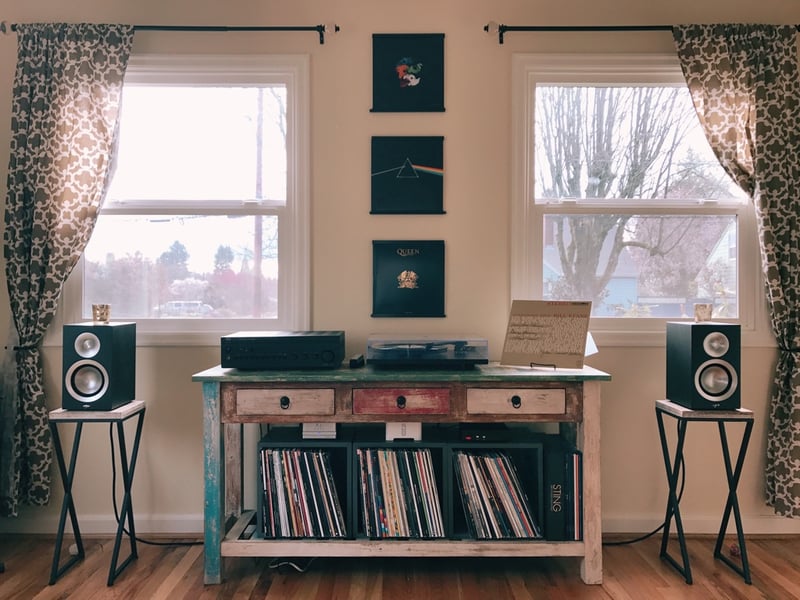
When we moved into our house we made a conscious decision not to make the TV the centerpiece of our living room. Instead, everything is laid out around this (the TV is banished to the basement):

The family sound system

I didn’t think much of it at the time, it was just something we wanted to try out. But the results have been positive: we watch less TV, and listen to (and argue about!) music more. I think when TVs started pushing sound systems out of the way in living rooms, we lost more than just a beautiful piece of design. We also lost an important connection point within families.

Rogue One as a story about engineering and design ethics

Spoilers abound so proceed with caution, but Rogue One: an ‘Engineering Ethics’ Story is so very good:

What Galen Erso does is not simply watch a system be built and then whistleblow; he actively shaped the design from its earliest stages considering its ultimate societal impacts. These early design decisions are proactive rather than reactive, which is part of the broader engineering ethics lesson of Rogue One.

The exploration of how Galen didn’t just walk away but took an active role in the destruction of the Death Star is interesting and highly relevant to what I consider an “ethical awakening” in our use of technology. It’s one thing to #DeleteUber — and those campaigns can certainly be effective, in that case to the tune of 500,000 accounts. It’s quite another to “infiltrate” your company and basically sabotage its technology because you believe it’s ethically dubious. The really complicated question is who gets to decide whether or not a company’s “ultimate societal impact” is good or bad. And, of course, who watches the watchers…

Good design and positive change

Kashmir Hill writes about How Nextdoor reduced racist posts by 75%. Nextdoor tested a bunch of different approaches:

Some just saw the addition of new language: “Ask yourself: Is what I saw actually suspicious, especially if I take race or ethnicity out of the equation?” Some were asked to say in advance whether they were reporting an actual crime or just “suspicious activity.” Others actually had their posts scanned for mentions of race (based on a list of hundreds of terms Nextdoor came up with) and if a post did mention race, the user got an error message and was asked to submit more information about the person.

This is proof that good design can make a positive difference in the world.

Defining the role of Product Designer

Chris Jones posted a really solid overview of The Product Designer Role that’s very much worth your time:

Your next task is to define the product design role within your company. This is an important one to get right. You don’t want to simply recreate an internal version of the agency model. The way that products are created has changed dramatically in recent years and new models for design are a critical part of this.

He goes over what he believes are the 5 core responsibilities of the role:

  1. Product Orientation
  2. Holistic Experience Design
  3. Prototyping
  4. User Testing
  5. Interaction and Visual Design

I can’t help but feel like this is a role we’ll start to see merge with Product Management before long.

The social media lives of teens

Mary Choi’s Wired feature on the social media lives of teens is utterly fascinating. I don’t even know where to begin. Let’s start with this bit from Like. Flirt. Ghost: A Journey Into the Social Media Lives of Teens:

Then there is the rule about likes and comments. According to Lara and Sofia, when your friend posts a selfie on Instagram, there’s a tacit social obligation to like it, and depending on how close you are, you may need to comment. The safest option, especially on a friend’s selfie, is the emoji with the heart eyes. Or a simple “so cute” or “so pretty.” It’s too much work to do anything else. If there’s any deviation, “you have to interpret the comment,” Sofia says. “If it’s nice, you’re like, is this really nice or are you …” “… I don’t know,” finishes Lara. Is the comment sincere? Or slyly sarcastic? Formulaic responses breed zero confusion. Instagram is not a place for tone or irony.

The whole article is full of examples like this that just makes me wonder how complicated it must be to be a teen right now. Of course, it’s not complicated to them, it just seems that way to us old folk. But seriously:

But back to the ladies. After a few mutual photo likes, the flirtation often escalates to emoji. If an emoji with the heart eyes gets another one in return, he says, you’re good. Other positive responses: an ellipsis thought-bubble to convey that she’s thinking about you; the bashful see-no-evil monkey. “‘Oh, thank you! I appreciate it’ is what I get from that emoji,” he says. Any of these responses means he’ll take it to DM (as in direct message). Other emoji are suboptimal. “The thinky face is like, ‘What are you doing commenting on my pictures?’” He says this isn’t a hard no, but it’s not great. The worst emoji—easily—is one you may not expect. “The smiley face,” says Ahmad with a pained expression. “Yeah, that’s the ‘Thank you, but I’m not interested.’”

I did do quite a double-take when I read this though:

Ubakum loves her [Android] phone. Deeply. iPhones for her are too easy, a little basic. “I’m not a fan of user-friendliness.”

I don’t really know what to make of that. It’s a fascinating statement, and I wish I could follow up to understand the sentiment more. If it’s true that a new generation of users don’t want products to be easy to use, what does that mean for us as designers? My head hurts.