Menu

Posts tagged “design”

Output isn’t design

The hard part of design is rarely generating the form. It is understanding the problem well enough to know what and how something should exist at all. There is use and place for these tools, but tools are not the design process.

Christopher Alexander came closer than anyone to naming this clearly. In Notes on the Synthesis of Form, he describes design as the search for a good fit between a form and its context. Context, in his sense, is not a background condition. It is the full set of forces that make a problem what it is: human needs, technical constraints, conflicting requirements, habits, edge cases, and relationships that are easy to miss until you spend time with them. Bad design appears where those forces remain unresolved. Good design appears where those misfits have been worked through carefully.

— Karri Saarinen, Output isn’t design

Time is On My Side

Wait hold the phone. Frank Chimero is writing again! One of my all-time favorite design writers. Welcome back to my RSS feed, (Internet) friend.

I wanted to get back to walking, reading, and writing. These were the foundational practices during the most prolific and enjoyable parts of my career. I longed to feel generative again and to have ideas with depth, meaning, and pleasant uncertainty, ideas whose remit extended beyond the boundaries of one company. I missed the opportunities of the internet as a common place for finding your people and feeling like a part of a group that actually had ideas instead of opinions or pleas for attention.

Source: Time is On My Side

DeepSeek is also a design story

Interesting theory by Casey Newton that good Design helped Deepseek to become popular so quickly:

Both models “thought” for about 13 seconds. ChatGPT showed me a handful of two- or three- word snippets to tell me what it was doing during this time: “comparing protocols,” for example. For the most part, though, I was in the dark about what it was up to.

DeepSeek, on the other hand, shared more than 500 words about its process. I found it disarmingly humble. “Let me start by recalling what I know about these two technologies,” it wrote. “First, ActivityPub. I remember it’s a W3C standard, so it’s widely adopted in the Fediverse. Mastodon uses it, right?” (Right.) As the model continues, it eventually stops to review its work for errors. (“But I should check if I’m mixing things up.”) And 13 seconds after starting—the same time that ChatGPT took—it offered me its full answer.

This is what Jakob Nielsen—back in 1994!—called “Visibility of System Status” as part of his 10 usability heuristics for design:

The design should always keep users informed about what is going on, through appropriate feedback within a reasonable amount of time.

Whether or not Casey’s theory about Deepseek is correct, I find it remarkable that over 30 years after those 10 heuristics were defined we are still seeing examples of their effectiveness on a large scale today.

Code shufflin’

In Code shufflin’ Robin Rendle writes about why he, as a designer, still messes around with coding projects. I think this is why I continue to obsess over my side project as well—and proactively reach out to indie devs who use the Cloudflare platform to see if I can help.

I’d forgotten what it feels like not to ask permission for changes and instead make pull requests and break things. There’s a momentum to this sort of work that I crave deep down in my bones because it doesn’t rely on meetings or six months of quarterly planning or going up the chain of command. And what I love most about shuffling code around is that every day there’s progress, every day there’s a tiny degree of success you can point to.

Figma’s CEO on life after the company’s failed sale to Adobe

Alex Heath has a really interesting interview with Figma’s CEO Dylan Field, covering life at Figma after regulators forced Adobe to abandon its $20 billion acquisition of his company. It covers a wide range of topics, but I wanted to highlight Field’s thoughts on generative AI, which largely matches my own viewpoint:

If I was to zoom out even further to knowledge work, we’re very much in a paradigm of AI as a tool and AI helping people get work done, but it’s not necessarily a replacement. I really think that there’s a human in the loop going forward in that AI might be a useful tool, but we all know its limits in terms of hallucinations, in terms of potential inaccuracies. Even if you apply it to rote tasks, it’s important to check the work. And you know better than anyone as a writer that the current models do not match your ability to write, let alone gain context in a conversation to ask the right questions or show the intelligence that you have as a journalist.

If you think about what it takes to create great design, there’s so much in that context window that’s emotional or thinking temporally about a brand experience or a user flow. I just don’t see how, in the near term, AI is able to have that as part of its context, which means that humans are providing that.

How ✨ became the unofficial AI emoji

I’ve definitely seen this too! How ✨ became the unofficial AI emoji:

In the relatively short history of emoji, sparkles have been used to express excitement and magic, said Jane Solomon, the senior emoji lexicographer at the emoji reference site Emojipedia. Branding new AI products with the ✨ emoji suggests that these tools are exciting and magical, which might encourage more people to test out the technology. “It can seem like magic if you don’t understand how it works,” Solomon said.

Dear Alt-Twitter Designers: It's about the network!

Excellent post by danah boyd, reminding us that with social networks it all comes down to nurturing the network dynamics, not the technical features.

That’s the thing about social media. For people to devote their time and energy to helping enable vibrancy, they have to gain something from it. Something that makes them feel enriched and whole, something that gives them pleasure (even if at someone else’s pain). Social media doesn’t come to life through military tactics. It comes to life because people devote their energies into making it vibrant for those that are around them. And this ripples through networks.

Design with users, not just for them

In What we’ve learned from our users about designing for accessibility Andrew Gosine describes how their team lived out one of Slack’s primary design principles, which is to design with users, not just for them:

In another proposed update, we tried to get clever about where we placed a user’s focus when they opened a thread. If there was an unread message, we’d drop them into that first message in the thread. If there were no unread messages, we’d move focus to the message input. We believed this would increase efficiency for screen-reader users. Our feedback group reacted strongly to this. We’d unintentionally deteriorated the reliability of knowing exactly where you would be when you open a thread, and, as a result, we broke the way-finding our users relied on in Slack. Thanks to our group, we reverted that change.

This is a great read with lots of examples from the project.

Link roundup for February 9, 2023

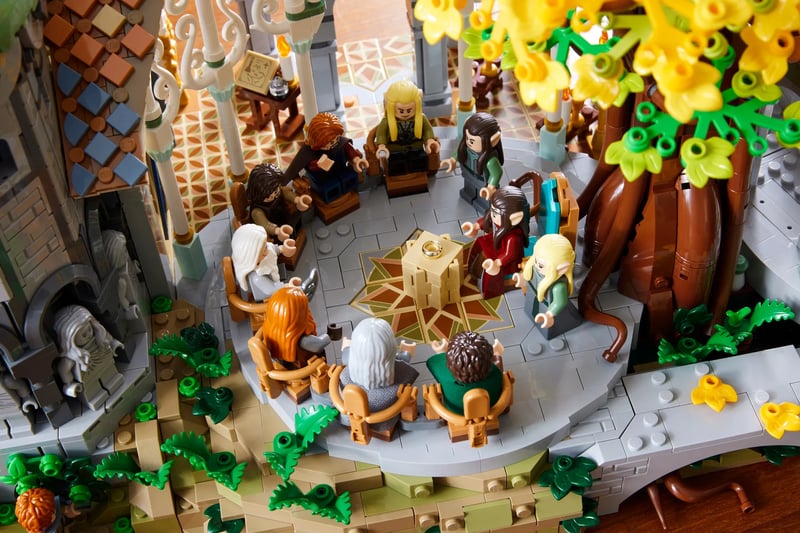
Lego reveals massively detailed Lord of the Rings Rivendell set. Take my money! [polygon.com]

The Window Trick of Las Vegas Hotels. “In order to make the buildings look smaller, less intimidating and messy, architects have come up with a ‘four or six windows in one’ solution. This means they grouped several windows (usually four or six) together and made them look like one window. This creates the visual effect of ‘shrinking’ the building, of making it more orderly and symmetrical.” [schedium.net]

You have to read this whole article for the full context, but this classification of the different ways we can choose to act online really got me thinking: “I see roughly three typical public stances: boring, lively, or outraged. Either you act boring, so the bandits will ignore you, you act lively, and invite bandit attacks, or you act outraged, and play a bandit yourself. Most big orgs and experts choose boring, and most everyone else who doesn’t pick boring picks bandit, especially on social media. It takes unusual art, allies, and energy, in a word “eliteness”, to survive while choosing lively. And that, my children, is why the world looks so boring.” [overcomingbias.com]

The Junkification of Amazon. Why Does It Feel Like Amazon Is Making Itself Worse? “If you understand Amazon as an aspiring megascale infrastructure company — a provider of systems, services, capacity, and labor — its junkification makes sense. Amazon hasn’t been acting like a store for a while. In its ideal future, selling things to people is everyone else’s problem.” [nymag.com]

People Can’t Stop ‘Spotify Snooping’ on Friends, Exes and Crushes (WSJ paywall, Archive.is link here). “When Ms. Ticoalu looked up what her ex-boyfriend was listening to in November, she saw ‘Glimpse of Us’ by Joji, a song about starting to date again after a relationship ended. Because he played the song so soon after their breakup, it led her to believe the two events were related. ‘It does lead me to overthink a lot,’ Ms. Ticoalu says.” [wsj.com]

New Form of Ice Discovered. “The newly discovered ice is amorphous — that is, its molecules are in a disorganized form, not neatly ordered as they are in ordinary, crystalline ice. Amorphous ice, although rare on Earth, is the main type of ice found in space. That is because, in the colder environment of space, ice does not have enough thermal energy to form crystals.” [scitechdaily.com]

This is such a fun and interesting story by Louie Mantia about his time working as an icon/UI designer at Apple in the early 2010s. [lmnt.me]

The one thing missing from UX today? Hope

This is a wonderful essay by Vivianne Castillo that encourages designers to hold fast to the belief that things could be better for users—and for themselves. From The one thing missing from UX today? Hope:

Today, it’s clear that many designers are feeling overwhelmed, disillusioned, and even unsafe within their organizations—and design leaders are recognizing that conversations around burnout and stress aren’t quite cutting it. I’ve found a deep sense of comfort in the words of American activist, grassroots organizer, and abolitionist Mariame Kaba: “Hope doesn’t preclude feeling sadness or frustration or anger or any other emotion that makes total sense. Hope isn’t an emotion…Hope is not optimism. Hope is a discipline… we have to practice it every single day.” 

Kaba’s quote is a reminder that the answer to feeling hopeless isn’t toxic positivity or forced optimism. The answer is to make our engagement with hope a discipline because of what’s at stake if we don’t: namely that designers will begin to believe that a better future is not possible within our lifetime.

She goes on to provide examples of how to uphold a comittment to hope in creative, human-centered ways, specifically as it relates to values of belonging, integrity, and power.