Menu

Posts tagged “culture”

What 11 technology books tell us about our moment

Monica Guzman spent the summer on a tech book binge. She read 11 technology books to get a sense of our current technological moment. In the short article How my summer tech book binge changed the way I think about tech she explains some of the things she learned:

Tech serves us best when we create rather than consume. Where [Nicholas] Carr saw the worst of tech’s impact, Clive Thompson, in “Smarter Than You Think,” saw the best. One difference was that Carr — in arguing, for example, that the rise of short, fast media makes our contemplative muscles weak — all but ignored how tech boosts creation. It’s a common oversight: We’re transitioning from a world where public creation was difficult to one where it’s a cinch.

The same goes for public collaboration. Great things happen when we swirl together and build. Think Wikipedia. Blogs. The Internet itself.

This is, if nothing else, a great reading list.

The trough of social media disillusionment

As usual, Frank Chimero manages to capture what a lot of people in our neck of the woods are thinking in From the Porch to the Street. It’s an interesting, considered lament about how Twitter has changed, but it’s this part in particular that caught my attention:

Have you heard of evaporative social cooling? It says the people who provide the most value to a social group or organization eventually burn out and leave, undermining the stability and progress of the group. Most of my internet friends have been on Twitter since 2008, so they probably fall into this group. How much more is there left to say?

The linked post is Xianhang Zhang’s The Evaporative Cooling Effect, a broad article from 2010 that covers the design flaws in most social platforms. It’s definitely worth reading the whole thing — I’ll just quote this interesting way to classify different online communities:

There are two fundamental patterns of social organization which I term “plaza” and “warrens”. In the plaza design, there is a central plaza which is one contiguous space and every person’s interaction is seen by every other person. In the warren design, the space is broken up into a series of smaller warrens and you can only see the warren you are currently in. There is the possibility of moving into adjacent warrens but it’s difficult to explore far outside of your zone. Plazas grow by becoming larger, warrens grow by adding more warrens.

It feels like Twitter started as a warren and morphed into a plaza, which is where most of the current discontent is coming from — “This isn’t what we signed up for!”

Going even further down the rabbit hole, Zhang links to Eliezer Yudkowsky’s 2007 piece Evaporative Cooling of Group Beliefs, which has some further interesting thoughts on how to create healthy online communities:

My own theory of Internet moderation is that you have to be willing to exclude trolls and spam to get a conversation going. You must even be willing to exclude kindly but technically uninformed folks from technical mailing lists if you want to get any work done. A genuinely open conversation on the Internet degenerates fast.

It’s the articulate trolls that you should be wary of ejecting, on this theory—they serve the hidden function of legitimizing less extreme disagreements. But you should not have so many articulate trolls that they begin arguing with each other, or begin to dominate conversations. If you have one person around who is the famous Guy Who Disagrees With Everything, anyone with a more reasonable, more moderate disagreement won’t look like the sole nail sticking out. This theory of Internet moderation may not have served me too well in practice, so take it with a grain of salt.

On Twitter there is no way to exclude trolls — there are just too many of them. So there is this huge problem that inevitably appears once a community grows sufficiently large:

  1. Conversation moves from small warrens to large plazas.
  2. Many people loiter in the plaza and are only there to make trouble and ruin it for the rest of the community, and since it’s a public space there’s no way to chase them away.
  3. The people who created the original culture of the community leaves, and before long the broken windows theory kicks in and the plaza falls into disrepair.

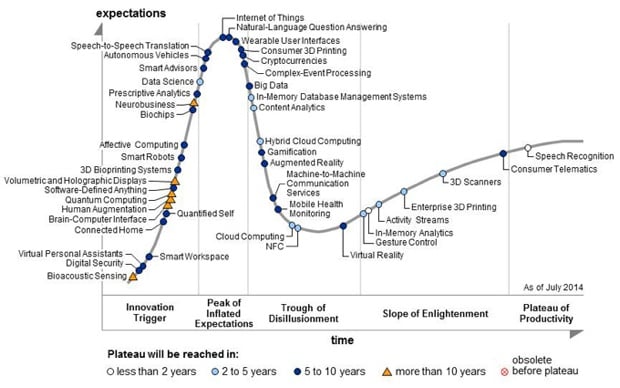
All this to say that designing effective online communities is much more difficult than it might have appeared at first. We couldn’t see into the future when Twitter became a thing, so who knew what would happen once the growth monster grew too big? It reminds me of Gartner’s 2014 Hype Cycle for Emerging Technologies:

Hype Cycle

I think we’re firmly in the trough of disillusionment with social platforms like Facebook and Twitter. I think we’ll get through it, but it feels like we’re all waking up right now going, “Wait, that’s what this has become?” We can — and will — do better. But it’s going to take time.

Wells Fargo: a big, lean company

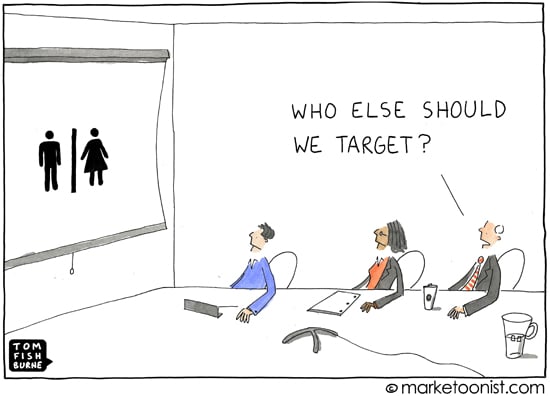
I was a little reluctant to click on Greg Satell’s How Wells Fargo Learned To Innovate Around the Customer. First, it’s on Forbes, which has become virtually impossible to read on mobile devices because there’s so much blegh on the page that’s not related to the article. Second, whenever you see people talking about “The Customer”, you should be sceptical. There is no average “user” or “customer”, so this kind of thinking usually results in defining an impossibe target market:

Target market

Image source: Tom Fishburne.

That said, despite my fears, the article is quite good. It discusses how Wells Fargo uses ethnography in their business, and there are also signs that they don’t operate like a large, slow-moving corporation at all:

However, it is not just internal processes that have changed, but the culture as well. Ellis’s bankers don’t sit in cozy offices, quietly examining financial statements (nor does Ellis himself), but work in open cubicles designed to promote collaboration. They are constantly iterating, experimenting and testing.

This part, especially, surprised me:

Perhaps most importantly, they are not limited by a long range plan. There is no “five year death march” toward a transformation that will never happen—or be outdated by the time it does. Instead, their purpose is to improve their customers’ businesses and adapt quickly to shifts in technology and the marketplace.

I’d love to see more detail on how Wells Fargo remains lean despite being such a large company. If this is really how they operate, it’s encouraging proof that big doesn’t have to equal slow and tired.

Be polite

Everyone is posting about this today but I don’t care because it is really that good and it wins all the points on the Internet today. Paul Ford in How to Be Polite:

People silently struggle from all kinds of terrible things. They suffer from depression, ambition, substance abuse, and pretension. They suffer from family tragedy, Ivy-League educations, and self-loathing. They suffer from failing marriages, physical pain, and publishing. The good thing about politeness is that you can treat these people exactly the same. And then wait to see what happens. You don’t have to have an opinion. You don’t need to make a judgment. I know that doesn’t sound like liberation, because we live and work in an opinion-based economy. But it is. Not having an opinion means not having an obligation. And not being obligated is one of the sweetest of life’s riches.

I wrote something slightly related (and, let’s be honest, not nearly as good) a while ago for Smashing Magazine: Making A Better Internet.

A product team worth fighting for

I nodded along vigorously to Cap Watkins’s The Fight:

What I’ve come to realize in the past two years is how important it is to find a company and a product worth fighting for. To find a team that is dedicated to delivering the best product they can, despite the bumps, the frustrations, the exhausting moments along the way. Hurdles and failure are totally unavoidable. Having a resilient team around you working on a product you all believe in will make those hurdles easier to clear. They’ll turn failure into a learning opportunity. Great teams working on products they’re passionate about will back you up when you’re exhausted and cover for you when you’re frustrated.

When you find a team like this, hold on for dear life.

The problem with "fighting" disease

Dhruv Khullar describes The Trouble With Medicine’s Metaphors:

The words we choose to describe illness are powerful. They carry weight and valence, creating the milieu in which goals of care are discussed and treatment plans designed. In medicine, the use of metaphor is pervasive. Antibiotics clog up bacterial machinery by disrupting the supply chain. Diabetes coats red blood cells with sugar until they’re little glazed donuts. Life with chronic disease is a marathon, not a sprint, with bumps on the road and frequent detours.

Khullar goes on to discuss in depth the use of military metaphors in medicine, such as the common saying “We’ll fight this together,” and why it can be counter-productive.

Love on Facebook

Claire Evans discusses how much more awkward break-ups have become in the age of social media. From Luddite love:

It’s time to end it online. I’m not just talking about the pedantic tick-box of Facebook ‘relationship status’: there are images to untag, emails to delete, an ‘unfriending’ to coordinate. There is the careful unravelling of the social web.

In a sense, every relationship now exists on two levels. The moments we spend in one another’s company, the neurochemical buzz of proximity, and the communion of shared silence: these are real. But just as physical places now have their geolocated overlays, every relationship, too, throws a digital shadow — and depending on the individuals involved, it can loom larger than the people who cast it. As we increasingly live our social lives in public, in a medium that retains the traces of our social noodling, the record and the relationship itself can approach a point of indistinguishability.

About that selfie

Want to read some philosophical pontification about selfies? Well, I’m here to help you out. Start with the recent Can you have self-worth without self-love?, in which Simon Blackburn believes we can do better:

If culture shifts one way, it can also shift back. Is it possible to imagine a reversal, so that something approaching a social contract, or a feeling of public spirit, a contempt for indecent expenditure, an embarrassment at vulgar display, or simply a desire to leave as modest a footprint as possible, begins to take over our sense of what we can expect from ourselves and others? We know that there are cultures in which it is poor form to shout that you are a taller poppy than any other.

But perhaps, above all, we should encourage the joyous, subversive spirit of mockery. If there are few things more awful than the arrogance and hubris of conceit, is there anything more ridiculous than a display of vanity? The word itself carries its own condemnation (Latin: vanus, empty; vanitas, emptiness). We can learn not to care about display, and not to crave the admiration of others. We could even learn to display fewer selfies.

Once you’ve whet your appetite, fill your Instapaper queue with these:

You’re welcome. Seriously though, it’s a pretty interesting phenomenon, and like most new things, we’re in that phase where it’s either really horrible and going to destroy everything, or it’s making us better people, depending on who writes the article.

Book culture everywhere

Hugh Howey is the author of WOOL, one of my favorite sci fi series. His essay Your Fear is My Opportunity is a rant on Amazon and self-publishing, and I really appreciate his perspective as someone who has gone through the hard process of self-publishing:

The things I advocate for: Reasonably priced e-books, for publishers to take risks and do exciting things, for us to embrace the future of storytelling and allow it to coexist with the past, to release all editions of a work at once, to get rid of DRM, to mix up genres and do something fresh and new … these are all things I’ve wanted as a reader for longer than I’ve been writing.

And this:

I am a reader first. And I want more readers. Selfishly, as a reader, I want more readers. I want to see airports full of people staring at books, e-readers, and tablets laced with text. Not people staring at cell phones, Candy Crush, Facebook, or authors’ blogs. I want book culture everywhere. I want interactions with strangers to be about what they’ve read lately. I want my social media feed to be all about books. I’m an addict, and I want to get other people hooked. Maybe that’s a bad thing. I don’t care.

If you haven’t read WOOL you should give it a try. Great storytelling whether you’re a sci fi fan or not.

The future of work is not jobs

A couple of articles about work and technology caught my eye this week. First, Claire Cain Miller describes how Technology, Aided by Recession, Is Polarizing the Work World:

[A new working paper from the National Bureau of Economic Research], which analyzed data from the Current Population Survey from 1976 to 2012, illustrates that the recession had a disproportionately large effect on routine jobs, and greatly sped up their loss. That is probably because even if a new technology is cheaper and more efficient than a human laborer, bosses are unlikely to fire employees and replace them with computers when times are good. The recession, however, gave them a motive. And the people who lost those jobs are generally unable to find new ones, said Henry E. Siu, an associate professor at the University of British Columbia and an author of the study.

Now, combine that problem in the mid-paying job market with an issue Thomas B. Edsall pointed out a few weeks ago in The Downward Ramp:

Just one example: the drying up of cognitively demanding jobs is having a cascade effect. College graduates are forced to take jobs beneath their level of educational training, moving into clerical and service positions instead of into finance and high tech.

This cascade eliminates opportunities for those without college degrees who would otherwise fill those service and clerical jobs. These displaced workers are then forced to take even less demanding, less well-paying jobs, in a process that pushes everyone down. At the bottom, the unskilled are pushed out of the job market altogether.

So, college graduates are pushed into mid-paying jobs, and those jobs are being replaced by technology. Not good.

Meanwhile, in opposite world, Louise Aronson writes about The Future of Robot Caregivers (if you’re counting, that’s three for three on the New York Times):

We do not have anywhere near enough human caregivers for the growing number of older Americans.

Zeynep Tufekci’s excessively titled Failing the Third Machine Age: When Robots Come for Grandma is a good critique of that piece:

Let me explain. When people confidently announce that once robots come for our jobs, we’ll find something else to do like we always did, they are drawing from a very short history. The truth is, there’s only been one-and-a-three-quarters of a machine age—we are close to concluding the second one—we are moving into the third one.

And there is probably no fourth one.

Humans have only so many “irreplaceable” skills, and the idea that we’ll just keep outrunning the machines, skill-wise, is a folly.

Put all these pieces together and you get a very scary vision of the future of jobs. The good news — I think — is that job != work.

The future of jobs might be bleak, but the future of work certainly isn’t. Technology might be taking our jobs, but it’s also giving us new ways to be creative. To be entrepreneurs. To work. As programs like Girls Who Code continue to grow, I’m increasingly optimistic about my daughters’ futures. They might not get a “regular” job one day. But my role as a parent is not to prepare them for a job anyway. It’s to foster in them the tenacity and grit to learn how to think big and make things. I’m excited about that.