Menu

Posts tagged “culture”

Taking back the music

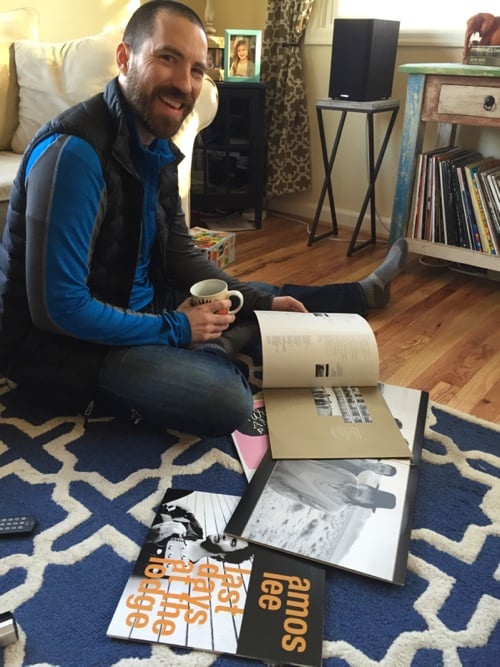
I wrote a story about jazz, coffee, and liner notes, and hopefully managed to turn it into something with a logical conclusion. But feel free to judge for yourself by reading Taking back the music:

We like things fast and disposable — I get that. I mean, no one even knew what the word “ephemeral” meant until Snapchat came along. But moving quickly from one thing to the next will just never be as satisfying as really spending time with something or someone, with no escape from the person or the artist’s intentions and successes and failures. We can all do with a little bit more of that.

Design and angry mobs

Paul Ford knocks it out of the park again in What I learned about hatred from my tiny daughter, an essay about collective anger on the internet:

When you aggregate enough people and get them to talk about design they become, basically, a single giant toddler.

The stories behind our passwords

There are some wonderful and surprising stories in Ian Urbina’s The Secret Life of Passwords:

SEVERAL YEARS AGO I began asking my friends and family to tell me their passwords. I had come to believe that these tiny personalized codes get a bum rap. Yes, I understand why passwords are universally despised: the strains they put on our memory, the endless demand to update them, their sheer number. I hate them, too. But there is more to passwords than their annoyance. In our authorship of them, in the fact that we construct them so that we (and only we) will remember them, they take on secret lives. Many of our passwords are suffused with pathos, mischief, sometimes even poetry. Often they have rich back stories. A motivational mantra, a swipe at the boss, a hidden shrine to a lost love, an inside joke with ourselves, a defining emotional scar — these keepsake passwords, as I came to call them, are like tchotchkes of our inner lives. They derive from anything: Scripture, horoscopes, nicknames, lyrics, book passages. Like a tattoo on a private part of the body, they tend to be intimate, compact and expressive.

I now use 1Password to create unique passwords for each service, but the article did take me back to the one password story I do have. Back in college, when it was time to select a password I could remember easily, I remember leaning back in my chair and giving it some serious thought.

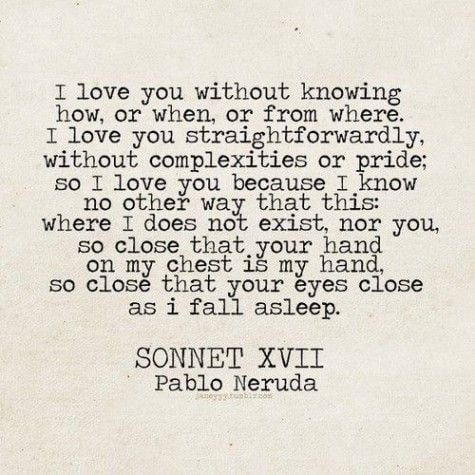
I had just seen Patch Adams and top of mind for me was part of a poem the character recited that really stuck with me (full version here):

Pablo Neruda

I know it’s ridiculously syrupy, but I apparently used to be a romantic. Huh.

Anyway, my default password became two words from the poem, smashed together. Even though I don’t use the password any more I just can’t get myself to tell you which words, though. I guess some of this story needs to remain mine alone.

Being

I’ve been thinking about being recently. Being online, being at home, being at work, being in public, being in private. This year my family and I made some gigantic changes in our lives that I won’t bore you with, except to say that constant change and discomfort gave me a renewed appreciation for human frailty. In fact, I’ll go so far as to say that, for the first time, I feel like I truly understand these words by Thomas Kempis:

A true understanding and humble estimate of oneself is the highest and most valuable of all lessons. To take no account of oneself, but always to think well and highly of others is the highest wisdom and perfection. Should you see another person openly doing evil, or carrying out a wicked purpose, do not on that account consider yourself better than him, for you cannot tell how long you will remain in a state of grace.

We are all frail; consider none more frail than yourself.

All of this helped me figure some things out about being that I haven’t been particularly certain about before. Things like who I want to be and what I want to do with my life. The answers to those questions are probably irrelevant for what I want to write about here, so I won’t dwell on that. What I will do is share a few things I’ve become fairly sure of over the last few months (while I remain open to data-driven mind-changing next year, like any decent designer would).

So here are some things I learned in 2014:

Smaller networks are better

During some of the darker months of the year I retracted from Facebook and found some solace in the 5 or so active friends I have on Path (go ahead, laugh it up…). On Twitter I doubled down on what I’ve always done: being a link monkey, there for your daily dose of UX and product management links. There’s certainly comfort in that ritual and the feedback that comes from it. But it does get pretty empty after a while.

When things started to improve I gave Facebook a try again. I once again expanded my network. And suddenly it just felt really really loud and crowded and filled with people like me who are just looking for positive reinforcement and I didn’t like the way that made me feel.

So I went back to small. I’m still active on Path. On Twitter I share more personal things in addition to links I really like. It pisses some people off, but it feels more real. I also started writing a newsletter and I’m really enjoying the personal nature of that medium.

All of this to say that we’ll do well to remember that the web is people all the way down. And that smaller networks mean more meaningful relationships.

Who we amplify is who we are

Every day we choose whose voices we amplify online, and those choices make us who we are. After Ferguson happened I felt like I didn’t have a right to say anything about it. But what I could do is amplify the voices of those who did have something important to say. So that’s what I did. I retweeted articles and calls for help. I eventually did write something, and I still feel uncomfortable about it, but in the end I felt like I had to.

The things we say are important. They make us. Not to get all preachy, but Matthew sums it up pretty well:

But the things that come out of a person’s mouth come from the heart.

So I’m not always getting this right, but I want to amplify good things and people who say important things. Who we amplify is who we are. So let’s choose wisely.

Learning and sharing is what makes us a community

After much reflection I realized that to become a better designer and be a good web citizen there are only a few basic things you have to do:

  1. Read about a new thing.
  2. Practice new thing until it works for you.
  3. Write about what you learned while practicing the new thing.
  4. Repeat ad infinitum.

That’s it. That’s what community is: learn from others, practice until you get it, and teach others the new things you learned. We should really do more of that.

Being a small fish in a big pond is ok

I don’t know how to write this without sounding weird so I’ll just go ahead and put it out there and hope it comes out right.

When I lived in South Africa I thought what I wanted was to become an author and conference speaker. It was a bit easier there because there aren’t as many UX people as there are elsewhere in the world. And when I decided to move back to the US several people didn’t understand. “You’ll be a small fish in a big pond,” they said. “I know,” I would answer, “isn’t that awesome?”

The fact is that where I am right now is a much better fit, and I recognize the importance of being content in the situation we’re in. I do a job I love at a company with an awesome culture. Every once in a while I share things. My book didn’t become a bestseller, but the people who read it seem to enjoy it, and that makes me happy. I spend time with my family, and I tweet some jokes and links every once in a while.

I don’t get invited to speak at conferences, and I don’t have a major book deal coming. But I still enjoy writing, and I enjoy being with the people I hang out with — online and in person. After the year I’ve had, that is all I could ever ask for.

It was hard, but I’m thankful for 2014 and the meaningful lessons that came out of it.

Now let’s get it behind us and move on, shall we?

Implementing Lean methodologies in large companies

Marysol Elorriaga discusses the challenges of implementing Lean methodologies in large companies in Getting buy-in while moving at rocket speed. One of the guiding principles is to “Release early and show results”:

To make the stakeholders feel like they are getting something equally valuable out of taking the “Lean approach”, deliver the MVP early and show results. Ensure that all features to be released can be measured and there is a proper feedback gathering mechanism in place. Ease the concerns of working under the Lean philosophy with weekly dashboards, including customer feedback, learnings from user validation/testing and analytics. Ultimately, having big data and skilled professionals to transform customer feedback and analytics into business insights is a pre-requisite for improvement and innovation.

From the same blog, Elizabeth White gives some advice on embedding a Lean team in a large company in Building the Right Culture in a Lab Environment. It’s especially important to understand that “We are Lean Enterprise – not Lean Start-up”:

Our room is lean but we are surrounded by a waterfall. While we are fully supported by TELUS, and most internal teams want to roll out what we are doing, we are a big company, depending on some serious backend systems. And while I can go on about our fantastic experience and the merits of working in a lean environment, it is important to note, waterfall shouldn’t become taboo either. There will be projects where waterfall methodology makes perfect sense, there are some – much like ours, where a hybrid approach is best and there will be some, where lean, in its purest form, is the correct path.

If you’re thinking of trying a Lean approach in a large company, there’s some great advice in these two articles.

When makers and decision-makers are far apart

Marty Cagan wrote one of his characteristically great posts in Product vs. IT Mindset. In one particularly harsh section he describes what happens when the people who make decisions about a product are far removed from those who make the product:

In IT mindset companies, accountability frankly is a farce. The people actually working on a project typically have no real say in what they are building, and sometimes even in how it’s built, and even when it’s due. In theory, the leadership team could try to hold the requesting stakeholders accountable for the results, but if they do they immediately hear complaints that they didn’t get what they actually wanted, and because of delays and costs, critical things had to get cut, and so it’s certainly not their fault. So management writes it off as yet another failed technology initiative. In contrast, in a product organization, we are measured by results.

I’ve always felt that this is the biggest challenge to companies as they grow. The further away those who make decisions are from those who build the product, the harder it is to remain customer-focused in the long term.

The importance of understanding both user and company culture

Peter Morville’s Creating a Cultural Fit: Using ethnography with users and stakeholders is one of the most useful UX articles I’ve read in a while. He talks about the importance of understanding the cultures of both users and companies to create good products. He concludes:

In short, the right design is one that fits the company and its customers. A mismatch on either side results in fatal error. We must use ethnography with our users and stakeholders to search for a bi-cultural fit. This is tricky since culture is mostly invisible. That’s why we should start with a map.

This is a must-read.

Don't be a manager like Dora

Just as my 5-year old exits her Dora the Explorer phase (to replace it with “Let it go! Let it gooooo!”), my 2-year old enters hers with the force of a thousand purple monkeys. So, look, I read a lot of Dora books these days. Recently Penny the Pony’s Big Race has been quite the hit. It’s about Dora trying to get her horse to… wait, who am I kidding. I’m sure you care about the plot as much as I do.

Anyway, there’s one part of the story that irritates me way above my average annoyance levels with these books (which is already quite high). Dora, Boots, and Penny are trying to cross a mud pit, but Penny is a bit scared. This is where we pick up the narrative:

Dora ugh

Let’s reflect on this for a moment. Penny is scared of jumping across the logs, because she thinks she might slip and fall into the mud. Dora’s proposed solution is infuriating:

Uh-oh! Penny is afraid that the logs might be slippery. Let’s count the logs as she walks across so she won’t be worried.

How is that a good solution? There are a number of things you could do to solve Penny’s fear of the slippery logs. They could walk around the mud pit. They could make sure the logs are more secure. They could give Penny special horse-shoes that increase friction. Look, I don’t know, I’m not an expert at horses jumping over logs, but I’m sure there are people who are, and who could come up with a good solution for the problem. Counting the logs to distract Penny is a pretty superficial and condescending approach to address this particular problem.

The thing is, this is all too often how managers operate in the context of their teams. Oh, you’re unhappy with the culture of the company? Let’s throw a company BBQ. On a Sunday afternoon. You’re concerned that the product development process is not optimal? Let’s hire another development manager. Instead of spending time to understand the cause of the anxiety communicated by team members, managers often rely on distraction or easy answers that give the illusion of a solution, but is nothing more than a way to check a box to say that they “did something.”

I read two really good management articles recently that are relevant here. The first is Gregg Satell’s What To Do While You’re Waiting For Steve Jobs (beware, that’s a Forbes link, so you’re going to have to do a lot of clicking around to dismiss all the things that try to distract you from reading it). He says this about treating people with respect:

If you expect your employees to be motivated to do their jobs well, you’d better treat them with dignity. Leadership is not the art of getting people to do what you want, but inspiring them to want what you want.[…] While many leaders believe that they can bend the organization to their will, that’s rarely true.  Being a jerk doesn’t make you Steve Jobs, it just makes you a jerk.

The second is Lindsay Holmwood’s It’s not a promotion — it’s a career change. It’s a great post and you should read the whole thing, but I want to quote most of the opening in full, because it’s great:

Your job is not to be an engineer. Your job is not to be a manager. Your job is to be a multiplier.

You exist to remove roadblocks and eliminate interruptions for the people you work with. You exist to listen to people (not just hear them!), to build relationships and trust, to deliver bad news, to resolve conflict in a just way.

You exist to think about the bigger picture, ask provoking and sometimes difficult questions, and relate the big picture back to something meaningful, tangible, and actionable to the team.

You exist to advocate for the team, to promote the group and individual achievements, to gaze into unconstructive criticism and see underlying motivations, and sometimes even give up control and make sacrifices you are uncomfortable or disagree with.

You exist to make systemic improvements with the help of the people you work with.

If I could summarize the advice in these articles, and what I’ve personally experienced about good managers vs. bad managers, I’d say this. If someone on your team complains that they’re worried about slippery logs across a mud pit, don’t tell them you’ll count loudly as they jump to distract them from the fear. Instead, take the time to understand the cause of their fear, and help them solve the real problem behind that fear.

In other words, don’t be like Dora. She’s a terrible manager.

Coffee and Craft

Coffee and Craft

My favorite story about coffee is from the year 1600, when Pope Clement VIII was the head of the Catholic Church. As the story goes, the Pope’s advisers urged him to make coffee a forbidden drink for Christians. They argued that since Muslims were not allowed to drink wine, Satan invented this “hellish black brew” as a substitute. In a moment of remarkable foresight the Pope asked to try a cup before he made his decision. He was so enamored with the concoction that he came up with a different plan. “This Satan’s drink,” he declared to his advisers, “is so delicious that it would be a pity to let the infidels have exclusive use of it. We shall cheat Satan by baptizing it.”

And so it came to be that despite our vast ideological differences across regions and cultures, we can at least all agree on one thing: coffee is a deeply spiritual experience.

It’s not that I didn’t always have a strong connection with my eldest daughter. It’s just that recently, as she’s running headlong into her fifth year of life, we’ve started to connect in ways I didn’t expect. For example, this weekend we spent most of early Sunday morning building Lego models together. How did that happen? How did she suddenly get into stuff I remember liking as a child?

I know everyone always talks about how quickly kids grow up. I don’t agree with that at all. Growing up takes a long time. But I do find these sudden jumps in growth quite surprising sometimes. I feel like I should be better prepared for each jump so I can catch her if she stumbles. I guess that feeling will never go away — especially when she starts dating. Man. That’s going to be rough.

Anyway. A few weeks ago my wife brought the girls to our office for a visit one morning. I made my daughter a Babycino (frothed milk + hot chocolate sprinkles), and myself a Cappuccino. While I was making the coffee drinks my daughter sat at the table and asked me questions about what I’m doing and how the espresso machine works. I talked to her about bean extraction and crema and milk steaming, thinking that it would bore her to tears. But she was really into it. So I kept going and we ended up having a conversation about craft and why it’s cool to take your time to learn how to do things well and how good it makes you feel when you really master a skill.

I can’t remember when my obsession with coffee started. I just know that one day I started reading books about coffee history, and the best ways to brew a good cup. Then I bought an AeroPress and starting Googling for recipes. Next I bought a grinder, and a Chemex, and became annoyingly picky about beans. And before I knew it, I was that guy at dinner parties. The guy who makes you stop what you’re doing to explain where the coffee came from, how I was going to prepare it, and what they should look for when they taste it. But mark my words: when you do eventually taste the coffee you instantly forget how weird I am, and instead start talking about the unexpected party in your mouth (A guest once remarked that it tasted like angels peeing on his tongue. It is, perhaps, my proudest moment).

Charles Maurice de Talleyrand-Périgord — the Prime Minister of France during the early 1800s — once wrote a completely over the top description of how coffee made him feel. Even though he was very likely under the influence of a vast amount of caffeine when he wrote these words, I swear when I’m drinking a great cup of coffee I want to nod in vigorous agreement:

A cup of coffee detracts nothing from your intellect; on the contrary, your stomach is freed by it and no longer distresses your brain; it will not hamper your mind with troubles but give freedom to its working. Suave molecules of Mocha stir up your blood, without causing excessive heat; the organ of thought receives from it a feeling of sympathy; work becomes easier and you will sit down without distress to your principal repast which will restore your body and afford you a calm delicious night.

Yes, the taste of a good cup of coffee is amazing, but it’s about so much more than that. Most of the joy of any craft — and coffee is no exception — is how you get there. My obsession gave me much more than the ability to make a decent cup. The process — the grind, the bloom, the slow pour — is now a comforting ritual that I associate with mindfulness. It’s a deep mental breath to allow my brain to process what’s going on around me. Most of us spend our days being outlandishly busy. But as with all crafts, during the 10 minutes it takes to make a pot of Chemex, nothing else exists. Time slows down, and I’m focused on getting every detail right. Making coffee keeps the chaos out for a few minutes every day — and it helps me focus when I return to my work.

What is your craft? It doesn’t have to be coffee. But is there something that takes you away from this world for a few minutes every day? Something that’s hard enough that it takes such intense concentration that you (gasp!) even forget to check Twitter? Something with a knowledge well deep enough that you’ll never reach the bottom? Those kinds of obsessions are healthy and necessary because they keep us on our toes, curious, always growing, always learning, always grounded because you can’t win a craft. There is always more to learn.

What you get from craftsmanship is not the end of the story. Despite its many personal benefits, I’ve found craft to be surprisingly social. Hours after my family’s visit a few weeks ago I was still thinking about the brief time I had with my daughter that morning. I couldn’t help but feel like it was significant, and that I should create more of those types of moments with her. And not just with her, but with friends and colleagues too. A discussion about craft — especially if it happens around that craft — usually leads into a discussion about passion, and that easily spirals out of control to anything from a new appreciation of life to brilliant product ideas. As people who create software, those discussions can be invaluable for the work we do.

So here we are: our lives intertwined with a drink that had the potential to divide nations, but instead ended up being the catalyst for the creation of many newspapers and universities; the common element in countless debates, first dates, and last dates; and the ever-present, unassuming ingredient to any everyday conversation or meeting. This hellish heavenly brew might just be the perfect ambassador for the value of learning and practicing a craft. It doesn’t just show us how much we personally have to gain from constant learning and a focused mind. It also shows us how a big part of the joy of craft is found in the gathering of people around its edges, and the ideas that are sparked and shared as a result. Let’s actively create and seek out those moments of shared passion for the world and all we get to do in it.

Preferably around a cup of coffee.

A View from a Different Valley

A couple of months ago I got an email from the wonderful people at A List Apart, asking if I’d be interested in starting a regular column on ALA. I believe my response was something to the effect of “1,000 times yes!!” How could it not be? I’ve been reading ALA for such a long time, and I really enjoyed the one time we’d worked together before, on an article called Usable yet Useless: Why Every Business Needs Product Discovery.

In an effort to figure out where to take the column, my editor asked me what kind of topics I’m interested in. I sent back a response that I was pretty sure would make her delete the email and step away from her computer very slowly. Here’s what I wrote:

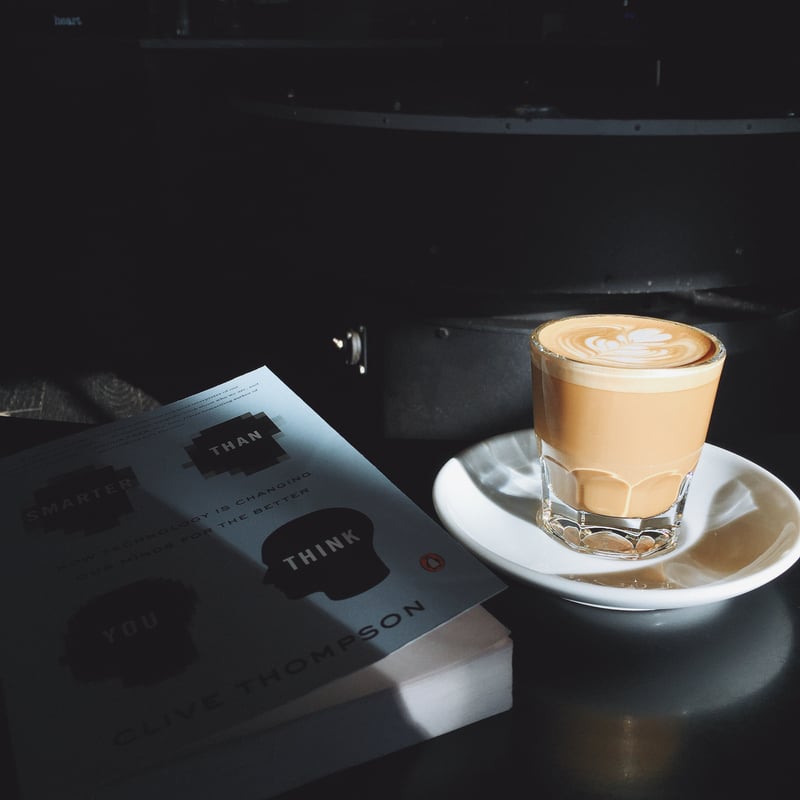
  • My background is in sociology. My PhD dissertation was about social network theory — the real, mathematical kind, not what the phrase “social network” has since come to mean. So I like thinking about how our networked society is changing us. I’m much less interested in the “Google is making us stupid” view, and much more interested in the positive side. Clive Thompson’s Smarter Than You Think comes to mind immediately. (When I grow up, I want to write like Clive)
  • Following on from that, I like thinking about what parenting means in this new era. As I’ve been thinking about what my next side project should be after the book, I’ve toyed with a site for tech-oriented dads with young kids. What are the products they should be interested in, how do we teach our kids about technology and that it is not to be feared, but also not to be abused, because it is not neutral (see What Technology Wants. When I grow up I want to write like Kevin).
  • And again, following on from that (at least in my weird head), how does Sci-Fi culture play into all of this? (I know, weird, but stick with me). Our science fiction has become increasingly dystopian. The last positive science fiction series was probably Star Trek TNG. So what do our visions of the future tell us about living (and designing) today?

To my surprise, my editor didn’t freak out, and instead encouraged these topics. So we came up with the column name A View from a Different Valley. A column about technology, but from a perspective we don’t always expect. My first article for the column is called Work Life Imbalance, and it came out last week. It’s about the blurring lines between work and life:

There is a blending of work and life that woos us with its promise of barbecues at work and daytime team celebrations at movie theaters, but we’re paying for it in another way: a complete eradication of the line between home life and work life. “Love what you do,” we say. “Get a job you don’t want to take a vacation from,” we say—and we sit back and watch the retweets stream in.

I don’t like it.

I don’t like it for two reasons.

And this is, of course, where I ask you to read the rest if you’d like to find out why I don’t like it…

I’m really excited about this column, and hope to keep it going for quite a while. Thanks again to ALA — they’re awesome people. I like them a lot.