Menu

Posts tagged “culture”

Embracing boredom

In Alone Together: Why We Expect More from Technology and Less from Each Other Sherry Turkle tells a story about having dinner in Paris with her daughter, Rebecca. While they are eating, Rebecca gets a call from a friend in Boston, asking if sh’s available for lunch. Rebecca simply answers that it won’t be possible, but that Friday could work. She doesn’t even tell her friend that sh’s currently in Paris. Sherry has mixed feelings about this:

I was wistful, worried that Rebecca was missing an experience I cherished in my youth: an undiluted Paris. My Paris came with the thrill of disconnection from everything I knew. My daughter’s Paris did not include this displacement.

I told me wife this story later that evening, and we started talking about our own tumultuous 30-day backpacking trip through Europe at a time when our relationship was”¦ well, let’s just say it was on less stable ground than it is now (remind me to tell you how we broke up on top of the Eiffel tower and got back together in Venice).

We talked about the truth in Sherry’s words - how being so utterly disconnected from the rest of the world played a big role in our ability to immerse ourselves in the newness and strangeness of the culture around us. We were only able to check email about once every 3-4 days. I can’t even imagine how I’d be able to go that long without email now, but back then it wasn’t a big deal. Less email = more time for walking through the streets of a new city.

Fast forward to today, and I am incredibly fortunate to travel for business reasonably often, but I must admit that it doesn’t fill me with the same excitement as that Europe backbacking trip did. And I think that’s partly because the constant connection means that I’m not really immersed in another culture, I’m just working from a different office.

Shelly comes to the following conclusion after her trip to Paris with her daughter:

Adolescents have always balanced connection and disconnection; we need to acknowledge the familiarity of our needs and the novelty of our circumstances. The Internet is more than old wine in new bottles; now we can always be elsewhere.

And that is perhaps the real issue here. If the Internet lets us be elsewhere any time we want, what point is there in physically moving ourselves across the world any more? Especially if we use the Internet to bring ourselves back to where we came from the minute we get there?

Alain de Botton recently tweeted:

The problem with the net: it prevents us from boredom and all its many advantages.

One of those advantages is the ability to sit in a restaurant in Paris and truly take it in without wondering what everyone else is up to. Even just sitting in your own back yard without wondering what everyone else is up to would probably already be a huge step in the right direction. Oh, the thinks you could think.

Her’s to being bored.

New Rules for Effective Customer Service

A couple of weeks ago our 2-year old daughter threw my wife’s phone in the swimming pool. The resulting journey through the Vodacom customer service labyrinth to replace the phone was frustrating, but it also gave me a new level of understanding and empathy for the immense challenges of providing customer service to hundreds of thousands of people.

This is an article about social media, customer support channels, and the principles every company should establish in their culture to serve their customers better. And (spoiler alert!) I do manage to get a new phone for my wife.

”Umm, So, Our Daughter Threw My Phone In The Pool”

What’s most surprising about getting a call about my wife’s phone suddenly finding itself at the bottom of our pool is how completely nonplussed I was about the whole thing. When you become a parent the kinds of things that upset you change significantly. I think I’ve discovered a pattern: if there is no blood involved, there’s really no reason to get upset. So after establishing that there was no blood involved, I proceeded to the next step - trying to replace the phone.

My wife had an LG Generic (or whatever it was called) on one of Vodacom’s cheapest plans, and the thing has been driving her nuts. She’s had her eye on my iPhone for a long time, so I decided to try to upgrade her. The problem is that I’m not eligible for an upgrade until the end of December. And that’s where this journey starts.

My first step was to walk into a Vodacom store to ask for assistance. This is pretty much the extent of the conversation that took place with the support representative:

Me: “Hi. My daughter threw my wife’s phone in the pool, so I’d like to get her an iPhone please.” Rep: “Your contract isn’t due for an upgrade until the end of December.” Me: “I understand that. I’m saying that my wife’s phone is now wet and doesn’t work any more, so I would like to give you more money by going onto a more expensive plan.” Rep: “It’s against policy to do an early upgrade. That’s why you should insure your phone.”

Imagine that conversation with a “Sucks to be you!” look on the representative’s face, and you’d have a really good idea of how it went down.

Having failed with the first point of contact, I took to Twitter:

Vodacom Support

The response was very quick, asking me to DM my number so that someone could call me. I sent my number, and a representative called me the next morning. I thought this was getting somewhere, and I was already starting to write this post in my head. My headline (“Social media works!”) needed some work, but it was going to be great.

But not so fast”¦ I told my story to the representative, who looked up the account and told me the same story: “Sorry, it’s against policy.” (At least this time someone was sorry about it). I threw out what would become my standard line throughout this process: “You realize I’m trying to give you more money, right?” But no luck. The conversation ended when the rep told me, “I will ask the upgrades department if there is anything we can do.” Translation: “You’ll never hear from us, ever again.”

After not hearing from the “upgrades department” I sent another DM, and got a call from another rep. Same story. Against policy. “You realize I’m trying to give you more money, right?” Sorry, against policy. I then took it to the next level and told the rep that I will be taking my business to MTN, convinced that this statement would trigger some script alarm somewhere and get me a free ticket to a ride up the “escalation path”. Not so much.

Rep: “Oh. Well that’s not good.” Me: “No, it’s not. Anything you want to do about that?” Rep: “Well, this is our policy. Can’t be changed.” Me: “You don’t want to tell someone that I’m about to take my business elsewhere?” Rep: “I’ll make a note in the system.”

At that point I gave up and decided to wait until I am eligible for an upgrade. That decision lasted about 3 days. I decided to give it one last shot, and tweeted Vodacom’s CEO:

Vodacom Support CEO

And this is where the story gets boring, in a good way. Pieter Uys tweeted me back (in my first language, which means he looked at my profile and thought before responding). 4 hours later I got a call to say we can do the upgrade. End of story. No questions, no statements about policy. I can do the upgrade = happy customer + more money for Vodacom.

Your Call Is Not That Important To Us

Before moving on to the main point of this article I want to tell another quick story. I’ve been banking with ABSA all my life. I’ve also been unhappy with ABSA all my life, but that’s a story for another day. I recently mentioned ABSA on Twitter and linked to this post. The post got retweeted a few times, and then I got this:

FNB

That really interested me. Here is a bank (FNB) that monitors what people are saying about their competitors, and joins the conversation in relevant ways. Notice that he wasn’t pushy, he was merely getting in on the joke. I tweeted back:

FNB

I said this would be a short story, so I’ll just say this. One week later someone from FNB was sitting with me, filling out forms to transfer all my accounts from ABSA to FNB. They took care of the whole thing, I didn’t have to fill out a single form. All because of a tweet. And I’m pretty sure ABSA doesn’t even know (or care) that they lost another customer.

It’s All About The People

All customer support revolves around people, processes, and tools.

CRM and community tools like Salesforce, Get Satisfaction, and Twitter give support reps the means to communicate with customers. Processes set guidelines for what those interactions should be like. But all of that is useless unless the people doing the support understand and live out the culture of the organization. The ease of establishing that culture also depends a great deal on the support channel used.

Synchronous, 1:1 support like in-store interactions and phone support is expensive and extremely difficult to manage. Unless you’re Zappos and call yourself “a support company that happens to sell shoes”, most companies don’t have a deeply ingrained support culture. So it’s very hard to filter the right processes and culture through to the 1:1 support channels, since they are generally pretty far removed from “management”. They are therefore very rarely empowered to make decisions that might not follow policy, but would be the best thing for the customer (and the company).

I would argue that my early upgrade situation is a good example of this. That representative in the store should have been empowered to ignore policy and upgrade me on the spot. It’s not her fault that she’s not allowed to do that, it’s just the way it is.

On the other hand, asynchronous, 1:many support like live chat, online forums, and social media platforms are much cheaper, and I would argue also easier to manage from a support culture perspective. You’re able to set appropriate guidelines (more on that later), and in general the people who manage those channels have a much more direct path to different resolution scenarios (and therefore more decision-making power).

All this to say that I am not upset any more about my bad experiences in the store and initially on the phone. Because I recognize how incredibly difficult it is to nurture a true culture of customer-centric support. And to find that balance between empowering everyone in the company to break policy when they feel it’s needed, while still having enough process in place so you don’t give away control of your short-term and long-term business strategy.

I don’t have an immediate solution for this, but I want to write about it because I believe it’s a very real problem that a lot of companies are struggling with. Especially now that social media support channels are getting so much adoption.

Lessons In Customer Service

Even though I don’t have the perfect answer, I do want to spend a little time discussing some recommendations I have for better customer service, based on my recent experiences with FNB and Vodacom.

1. Understand what engagement really means

There is no substitute for authenticity. When Pick n Pay asks what I’m going to be doing today, it doesn’t feel like real engagement. Why would I want to tell a supermarket that? When Vodacom sends me the scripted answer “I heard about the problem you experienced”, that tells me they didn’t really take the time to think about the response when sending it (“Well, of course you heard about it, I sent you a tweet!”).

When FNB joins a conversation in a natural way, or when the CEO of Vodacom responds to me by name - that’s engagement. It’s such a simple rule: read, think, respond like a human.

2. Web governance is essential

Web governance “defines decision-making processes for the web, and sets policies and standards for web content, design, and technology””in a way that respects subject-matter expertise” (from Web Governance: Become An Agent of Change). Defining user-centered standards for every touch point with an organization is enormously important to those who want to succeed, and it’s not getting enough attention at all.

One part of web governance that needs more attention in particular is content strategy, which “plans for the creation, publication, and governance of useful, usable content” (see The Discipline of Content Strategy for more). Among other things it defines the tone and language and underlying principles for talking to customers. Every company should do this before they open their Twitter account or create a Facebook page. (Btw, if you’re in South Africa and need help with stuff like this, talk to Kerry-Anne)

How you talk to your customers makes a huge difference to their experience, and if you don’t define a strategy for it, your community will define you and you’ll have no control over it. That’s not a good place to be.

3. Empower support representatives

I want to come back to this. As mentioned earlier, I recognize how difficult it is to walk the line between empowerment and total loss of control. But I think there are ways to test this out as a strategy without giving the whole house away.

Start with one specific department, call center, or representative. Allow them to make some decisions based on what they feel is right for the customer and the company, and see what happens. If they break some rules/policy, ask them why they did it, and follow up with the customer to see how they felt about the exchange.

This kind of empowerment isn’t a binary switch for the whole organization. Start small, test, and see if it might be possible to build a culture that encourages doing The Right Thing.

All’s Well That Ends Well

My story had a happy ending. But I know there are an enormous amount of customer support stories that don’t end that way. The rise of cheaper, more efficient channels for customer support can make experiences better not just for customers who engage in those channels, but for everyone. We can take the lessons from the asynchronous channels and apply them to the 1:1 interactions.

Be authentic, get in on the joke, and break some rules every once in a while. Because they did that, FNB has a new customer and Vodacom didn’t lose one. I think that makes it worth it.
Work hard; be good to your mother

When I lived in Australia there was an ad for Pizza Hut that ran about 5 times a day for over a month. It featured Dougie the delivery guy — always on time, always courteous, always immaculately dressed. As he hands over the pizza and gets his money, he asks, “So… how’s about a tip?”

The customer thinks for a bit, starts closing the door, and then says: “Work hard; be good to your mother.”

No, you’re right, it’s not a very funny ad. Nevertheless the words have stuck in my head for over a decade now. Because I realise that in life, as in business, these might be the only two non-negotiable rules we all need to adhere to in order to be successful at what we do. Work hard. Be good to your mother.

Work hard

I recently made the mistake of using the hasthag #leadership in a tweet. I immediately got 5 auto-follows, and they all fit the same profile:

  • Their bios all had some version of the term “leadership coach” in it.
  • They all had more than 20,000 followers, and they followed almost exactly the same number of people themselves. (This is, of course, because they auto-follow everyone who mentions the word “leadership”, and automatically unfollows that person if they don’t follow back in about 3-4 days)
  • They all tweet excessively, usually through API’s that generate random “inspirational” quotes every few minutes.

They basically automated their social media presence, and fine, that works for them. But that doesn’t inspire me. Mitch Joel says the following in a brilliant post called Wanting Something:

In the end, the majority of the answer is not about the talent or the ability to pull a thought together, it’s about the commitment. The blank screen does not care… it’s agnostic. If you write, good for you. If you don’t, good for you. That being said, if you keep at it… If you use these platforms to think deeply about what you’re about and why you think your industry is the way it is, then slowly over time you’ll find your groove and your talent will shine.

Sadly, most people want it fast and easy. That’s good news for those who are truly committed to it, because they’re the ones who actually get what they want.

Or, as Dave Duarte says in The Ultimate Social Media Strategy is Not Having One:

Ultimately, social media is not just a set of technologies to be mastered, it is a cultural reality to be engaged with. It promises to expose the corrupt and reveal the extraordinary, and if nothing else it is guaranteed to keep us on our toes. It is chaotic, unpredictable, and uncontrollable. So the best social media strategy, then, is not a strategy at all, it is to be purposeful, ethical, and transparent and let our communications and behaviours flow from that.

Those are the people I admire, and the ones I want to follow on Twitter and in life. The ones who show up every day, work hard to get better at what they do, and don’t look for shortcuts.

Be good to your mother

Well, not just your mother, but everyone around you. Be nice. There really is no excuse to be rude to people on Twitter or elsewhere on the web. But of course, you only have to spend 2 minutes reading comments on YouTube to give up the dream of a civil Internet forever.

In a great post on commenters online, Dmitri Fadeyev quotes the following Thomas More passage from Utopia:

Ther’s a rule in the Council that no resolution can be debated on the day that it’s first proposed. All discussion is postponed until the next well-attended meeting. Otherwise someon’s liable to say the first thing that comes into his head, and then start thinking up arguments to justify what he has said, instead of trying to decide what’s best for the community. That type of person is quite prepared to sacrifice the public to his own prestige, just because absurd as it may sound, h’s ashamed to admit that his first idea might have been wrong””when his first idea should have been to think before he spoke.

If only we could follow this rule before we reply/comment, the web would be such a nice neighborhood. Sure, it would probably be less interesting as well. And maybe I’m getting old, but I’d actually prefer nice at this point.

By the way, this doesn’t mean we shouldn’t criticize where it’s appropriate. It just means we should be respectful when we do it. As Mike Monteiro says in Giving Better Design Feedback:

Good feedback is not synonymous with positive feedback. If something isn’t working for you, tell the design team as early as possible. Will they be hurt? Not if they are professionals. A good designer will argue for their solution, and then will know when to let go.

By all means, be respectful, but don’t hold back in order to spare an individual’s feelings. Taking criticism is part of the job description. The sooner they know, the sooner they can explore other paths.

So make this your motto for a week or two, and seek out those who do the same. Who knows, maybe a nice Internet is out there after all.

Google+ is going to be huge! No, it's not!

I like Google+. I like it because it’s clean and well-designed. I like it because it feels fresh - like moving into a new neighborhood after the one you came from got taken over by fake farms and endless profile picture changes. But most of all I like it because it’s quiet.

Since it’s in limited Beta it means it’s still mostly populated by early adopters. So I can interact with brands like Mashable and Smashing Magazine and feel like I’m part of the conversation - something you can’t really do on Twitter and Facebook with mass-brands like that.

This thing is going to be huge

But alas, this will probably not last. Sooner or later the floodgates will open, and before you know it the once pristine Google+ neighborhood will once again get overrun and fall prey to the meaningless graffiti that also transformed Facebook from social network to chaotic metaverse. Rocky Agrawal sums it perfectly in When Google Circles Collide:

[Google+] doesn’t do anything to solve the biggest problem with social networks today: increasing the signal to noise ratio.

So the masses will descend, and we’ll be back to hunting for pockets of information among the endless streams of data. I’m getting tired just thinking about it.

Well, maybe it won’t be such a big deal

I could be wrong. The smart money might actually be on betting that Google+ never even gets enough adoption to become the loud mess that Facebook is today. The reason for that lies in an article that made the rounds a few weeks ago, A Brief History Of The Corporation:

Take an average housewife, the target of much time mining early in the 20th century. It was clear where her attention was directed. Laundry, cooking, walking to the well for water, cleaning, were all obvious attention sinks. Washing machines, kitchen appliances, plumbing and vacuum cleaners helped free up a lot of that attention, which was then immediately directed (as corporate-captive attention) to magazines and television.

But as you find and capture most of the wild attention, new pockets of attention become harder to find. Worse, you now have to cannibalize your own previous uses of captive attention. Time for TV must be stolen from magazines and newspapers. Time for specialized entertainment must be stolen from time devoted to generalized entertainment.

What does this mean? Google+ time has to be stolen from Facebook time. And good luck with that, Google. It’s all because we have this stupid thing called limited time:

Each new “well” of attention runs out sooner. Every human mind has been mined to capacity using attention-oil drilling technologies. To get to Clay Shirky’s hypothetical notion of cognitive surplus, we need Alternative Attention sources.

So that’s the real problem for Google. Theirs can’t be an acquisition strategy, because most people who are on a social network are already on Facebook. So it will have to be a migration strategy. As Dare Obasanjo put it:

For Google+ to be successful it means people will need to find enough utility in the site that it takes away from their usage of Facebook and Twitter, and perhaps even replaces one of these sites in their daily routine. So far it isn’t clear why any regular person would do this.

Google+ wants Circles to be the thing that convinces users to switch. They’re betting that enough users will want to share different things with different groups of people that they’re willing to give up their networks and start a new one. I just don’t think that’s a strong enough argument. Coming back to Agrawal’s point: the real problem is how to get better signal out of the noise of social networks. That’s a need that no one has filled yet.

There’s a parallel to the tablet market here. Trying to compete with the iPad is absolutely futile - you will lose. Instead, HP has a very smart strategy with their TouchPad:

HP acknowledged Appl’s dominance in the tablet market, but said Apple wasn’t its target with the TouchPad.

“We think ther’s a better opportunity for us to go after the enterprise space and those consumers that use PCs,” said Kerris. “This market is in it’s infancy and there is plenty of room for both of us to grow.”

They looked for a gap in the market, and they’re working actively to fill it. So it’s certainly not impossible that enough people migrate to Google+ for Metcalfe’s Law to kick in and we start to see some real network utility. But it’s going to be a tough sell unless they find that real gap in the market.

So which one is it?

Which way do I want it go? I’m on the fence. For now I’m enjoying the peace and quiet in the new neighborhood. But that can also get boring pretty quickly. So I want my cake and eat it too. I want Google+ to scale and at the same time figure out how to solve the signal to noise problem in social media. Is that too much to ask?

Humble Design

I’ve been thinking a lot about the importance of humility in design. About a month ago David Gillis said the following in a great article for UX Magazine:

When it comes to designing experiences, cultivating a humble approach is absolutely essential. The sheer complexity of the design challenges we face demands open-mindedness - a willingness to test and modify assumptions, to make mistakes and be proven wrong.

Humility is about knowing what you don’t know, and when it comes to dynamic, interdependent, multi-platform systems, there are an awful lot of unknowns.

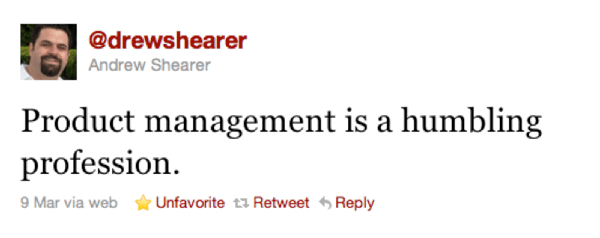
And then there’s this tweet by a good friend that’s been on my mind for a while now:

Humble

Ain’t that the truth.

But let’s also clarify: I’m talking about true humility here. Not the “Oh, I’m so humbled by your praise so let me retweet it to all my followers” humility. I’m talking about the humility that comes from realising that Design is about meeting user needs, that it’s a study of human behaviour so if any of us want to call ourselves experts at it we are sorely mistaken.

I didn’t think that a medieval monk could teach us much about design, but I recently stumbled on a quote by Thomas Kempis that brought this whole concept home for me:

A true understanding and humble estimate of oneself is the highest and most valuable of all lessons.

Should you see another person openly doing evil, or carrying out a wicked purpose, [or launch a really bad website,] do not on that account consider yourself better than him, for you cannot tell how long you will remain in a state of grace.

We are all frail; consider none more frail than yourself.

I don’t think this means we should stop being critical when we see bad design. But I do think it means we need to criticise with the aim to contribute to the design community, not break it down. If we learned anything from the Dustin Curtis “Dear American Airlines” story, it’s that we cannot possibly know why people make some of the design decisions they make.

So let’s help each other out, is all I’m saying. Because one day you might put a bad design out there, and all you’ll ask for then is a little advice and lots of grace.

On the creative process, getting started, and chasing Flow.

Last week I delivered a new talk at a Cape Town SPIN meeting (the Software Process Improvement Network). While I was preparing for it I thought of a working title for my next talk:

A talk about preparing a presentation for a talk about preparing a presentation for a talk.

You see, I have a love/hate relationship with new talks. I love delivering a new talk, and I love getting feedback on what worked and what didn’t. I love making it better. And I hate pretty much every moment leading up to delivering it.

But this is, of course, the problem with the creative process.  It’s blood, sweat, and tears, most of the way. Rands recently wrote a post entitled A Hard Thing is Done by Figuring Out How to Start. He writes:

Those who do not understand creativity think it has a well-defined and measurable on/off switch, when in reality it’s a walking dial with many labels. One label reads “Morose and apathetic” and another reads “Unexpectedly totally cranking it out”. This dial sports shy, mischievous feet - yes, feet - that allow it to simply walk away the moment you aren’t paying attention, and each time it walks away, it finds a new place to hide.

I’ve spent a good portion of my life wondering where that damned dial is hiding.

He goes on to explain how random moments of discovery and seemingly useless tangents are all part of the preparation process, and that we shouldn’t be so hard on ourselves when we’re struggling to get started. He closes with this:

W’re addicted to quick fixes, top ten lists, and four-hour work weeks, but the truth is - if it wasn’t hard, everyone would be doing it and a hard thing is never done by reading a list or a book or an article about doing it. A hard thing is done by figuring out how to start.

You’ve been spending a lot of time thinking the result is what matters. You have a bright and shiny goal in mind that is distracting you with its awesomeness. It is this allure of awesomeness that is the continued reason why you keep searching around your house looking for that mischievous walking dial.

My guarantee is that what is going to make this bright and shiny thing awesome isn’t finishing. It’s all the little, unexpected details you discover trying to start. It’s all the small pieces of unexplainable execution that will not only make it yours, but also continue to teach you how you get things done. And when you’re done, you’ll discover finishing, while cathartic, is just a good reason to go start something else.

I’ve absolutely found that to be true. My basic process for preparing a new talk is as follows:

  • First, I spend weeks researching and saving articles to Delicious.
  • Then I live in FreeMind for a few days, building the outline of the talk.
  • I then proceed to tell myself I’m ready to roll, so I  spend another week or more getting all those thoughts onto slides.
  • This is followed by several nights of bad sleep as I start seeing the holes in my thinking, and struggle to find the right words/pictures/length/style/order.
  • And then, suddenly and without fail, about two nights before the talk, I hit Flow. That “mental state of operation in which a person in an activity is fully immersed in a feeling of energized focus, full involvement, and success in the process of the activity.” Things suddenly fit, I spend 10 minutes re-ordering slides and it suddenly all makes sense. From that point on, the process is an absolute joy.

Why is Flow so hard to find? Or is it meant to be hard to find, because the creative process requires struggle as its fuel?

Whatever the reason, Rands helped me relax a little bit and panic less during the beginning phases of the creative process. Because all those starts, stops, and anxiety eventually come together to collide in the ultimate high that happens when things just… flow.

South African tech industry: don't succumb to Goldilocks syndrome

Hey, South African tech industry?  Meet me behind the rugby field at 15:00.  We need to talk.

I’ve been back in South Africa for 3 months now after 6 years working in Silicon Valley, and I think I finally figured out what’s been bothering me about the tech industry here ever since I got back.  The problem is that we have some serious Goldilocks issues going on right now.

This one is too cold

The first problem we have is a severe inferiority complex.

Remember: just because we’re not in Silicon Valley doesn’t mean we don’t know what we’re doing.  Like Morpheus says in The Matrix: “Some things are true whether you believe in them or not.”  We’re good at what we do.  We’re really good.  Why does it matter if anyone knows it at this point?  They will, soon enough.

I know that many of those dudes in San Francisco treat us like the little brothers of the world — adorable but not to be taken seriously.  But that doesn’t mean we have to grovel.  Who cares what they think?  Haven’t you heard?  Silicon Valley is dead.  You can be brilliant anywhere.  So we might as well be brilliant in the most beautiful place on earth.

This one is too hot

But we also have a second problem.  Some of us tend to overcompensate.  You see, since we have this inferiority complex, there is a danger in wanting to “show them a thing or two.”  So we livetweet from events that we’re not attending.  We write reviews of products we haven’t seen.  We fight about what the definition of a startup is, as if that matters.  We show up at conferences and give talks on who we are instead of what others can learn from our experience.

No, not cool.  There is no need to overcompensate.  We have some very unique skills, and we have the benefit of the element of surprise.  No one thinks the next Facebook is going to come from South Africa.  Let’s keep it that way — don’t let them know we’re here!

This one is just right

But there is an alternative.  We can make great products, build great companies, and take over the world without anyone even knowing where we’re from.  Does it matter where WooThemes are from?  It matters to us.  It doesn’t matter to anyone they sell their products to.

So, please.  Stop being apologetic about our skills.  Stop wishing we were Silicon Valley.  Stop pretending to be in Silicon Valley.

Instead, follow Seth’s advice.  And forgive me for quoting verbatim, but no one says this better than him:

Yes, I know you’re a master of the web, that you’ve visited every website written in English, that you’ve been going to SXSW for ten years, that you were one of the first bloggers, you used Foursquare before it was cool and you can code in HTML in your sleep. Yes, I know that you sit in the back of the room tweeting clever ripostes when speakers are up front failing on a panel and that you had a LOLcat published before they stopped being funny.

But what have you shipped?

What have you done with your connection skills that has been worthy of criticism, that moved the dial and that changed the world?

Go, do that.

On Google Buzz, online privacy, and where we go from here.

Google Buzz is really messing with my brain.  All my other social media activities fit nicely along the private-public continuum we all have to juggle.  But Buzz feels like an invasion of my personal space.  By infiltrating the most private of online communications (email), it’s also daring me to move that privacy line a little bit, and let people in on conversations that they really have no business in being a part of.  One of the few positive reviews I’ve read about Buzz so far is this tweet by my friend G-J:

Good point, but Tweetie for the iPhone already threads Twitter conversations, and I use Twitter lists to keep up with people in my closer network.  So I’m just not sure what to do with it, and that makes my brain hurt.

Privacy and the public persona

This issue, as well as the widely reported privacy gaps in Google Buzz, are just the latest in a growing conversation about privacy on the web.  Facebook’s recent updated privacy settings created quite a stir, and out of all the gazillion blog posts discussing it, none was more insightful than the brilliant Danah Boyd’s article Facebook’s move ain’t about changes in privacy norms.  It is a must-read for anyone interested in this topic.  In the article she says the following (my emphasis added):

There isn’t some radical shift in norms taking place. What’s changing is the opportunity to be public and the potential gain from doing so. Reality TV anyone? People are willing to put themselves out there when they can gain from it. But this doesn’t mean that everyone suddenly wants to be always in public. And it doesn’t mean that folks who live their lives in public don’t value privacy. The best way to maintain privacy as a public figure is to give folks the impression that everything about you is in public.

That last sentence really stuck with me.  It is so true.  Just because people divulge intimate details of their lives online, doesn’t mean everything they do is public.  Joshua Porter recently tweeted the following:

Ain’t that the truth…

But what if I want to maintain my privacy in public?

Another interesting story in this same vein — and a great example of the uncharted waters of online privacy — is that of designer Dustin Curtis.  I’ve been following his blog every since he blogged about the fascinating chain of events following his redesign of the American Airlines website.  That made him a bit of a celebrity in the world of web design, but it turned out to be nothing compared to what happened next.  On the day of the Apple iPad launch, he posted some very real-looking (but very fake) photos of the iPad.  It quickly sent the Internet into a frenzy and got him coverage on Mashable, TechCrunch and The Washington Post, among other places.

The next day he tweeted, simply:

Dustin Curtis: 1, Internet: 0.

Well played, sir.  Well played.  What’s interesting is what happened next, though.  He got a lot of attention from this stunt, and his Twitter follower count exploded.  He created an air of mystery leading a lot of people to wonder who he is.  It even led to a question on Quora with some amusing Chuck Norris-type answers: “Who is Dustin Curtis?”  The post on Quora prompted this tweet from him:

The answer is, of course, pretty straight-forward.  If you create a public and controversial persona, and in doing so amass over 13,000 followers on Twitter, people are going to want to find out more about you.  And, as a recent Times article pointed out:

When you make your private life public, when you seek attention in that broad a manner, you’re inviting not just the cool and the loving, but the angry and aggrieved.

And that is where online privacy get tricky.  We already talked about how public people value there privacy very much.  But at some point, people are going to assume that because you live a lot of your life in public, you have no need to be private, and won’t mind people digging around in your personal life (since there is no personal life any more).  But that’s clearly not the case, as Dustin points out in his tweet.

Facebook as theater

In a similar vein, I have to say that I have become increasingly uncomfortable with public conversations on Facebook.  And by that I mean girls who write “I miss you” on their boyfriends’ walls, people making coffee arrangements on each other’s walls, etc.  Once conversations that should be private are undertaken in a public forum, they become theater — meant for the onlookers more than the participants.  And that’s troubling.

Yes, there are legitimate cases (mostly for the sake humor) to have public conversations on Facebook.  But if you decide to write on someone’s wall and not send an email or a text, you are doing it so that other people can see it.  And that hurts the authenticity of the interaction.

So it’s not just that the lines between what is public and what is private are getting blurred.  It’s also that what is acceptable in the public realm is changing, as proven by those “I have to go to the bathroom” status updates I’m sure we all see occasionally in our news feeds.

Where do we go from here?

There are no universally agreed upon guidelines for what should be public and what should remain private online.  I’m pretty sure there will never be.  But I do believe that where that line is drawn should be a conscious decision by every person who goes online.  You can’t share every detail of your life online and then expect people to leave you alone.  You can’t go on Facebook, not change your privacy settings, and then complain if some of your photos leak out.  On the flipside, you can’t build a blog audience by writing articles that don’t expose your opinions in some way.

But wherever that line is drawn, it is extremely important that there is a point where your life stops being public.  The article Danger online: Perils of revealing every intimate moment puts it this way:

Concerns, though, are growing about the decline of the private self. Many people are questioning the wisdom particularly of blogs in which ordinary people write regular updates about their children and spouses, and they are asking whether we are surrendering our privacy too easily.

Or to put it another way, from another great article on the topic, Party On, but No Tweets:

We are fighting against this whole idea that everything people do has to be constantly chronicled. People think that every thought they have, every experience ”” if it is not captured it is lost.

When you let go of the pressure to chronicle, you are free to enjoy the moment for what it is, without the pressure of getting that picture up on Twitpic.

Don’t get me wrong — I think it is possible to build fantastic communities online by living public lives — both for business and personal purposes.  And I am definitely not going to stop blogging or shut down my Twitter account.  However, more and more I am finding myself agreeing with another sentence buried in that last article: There is something magical about a life less posted.

6 tips for better collaboration among distributed teams

I recently realized that you don’t hear the word “globalization” all that often any more.  And I think it’s because globalization has moved from being a buzz word to a reality that is just part of the way we do business now, making it unnecessary to give it a fancy name.  As we become more comfortable with managing companies and projects across multiple locations, it’s easy to assume that geography does not matter any more.  And certainly the technology is there to support the around-the-clock collaboration that is so valuable when you work across time zones.  With cloud computing now a reality, and plenty of collaboration applications to choose from, working together has never been more efficient.

But I believe geography does still matter, and can result in decreased efficiency if not managed correctly.  The difficulty with working across multiple locations is not technology limitations, it’s human nature.  We tend to not trust what we can’t see, and that’s a problem if developers, product managers, and marketing folks sit in different offices and different time zones.  Once different work philosophies come out and you’re not able to talk about it, things can escalate out of control and make for really bad relationships if conversations happen intra-office but not inter-office.

This is not an insurmountable problem though.  Here are some things I believe can help distributed teams run smoothly.  Please also add your tips and ideas in the comments section!

1. Meet in person. Now.

People get along so much better once they’ve shared a meal together.  This is just a fact of human nature — we thrive on in-person social interaction (yes, even us introverts).  If you have distributed teams, it is imperative that they meet each other in person as soon as they start working together.

If a trip can be planned during a major software release — even better.  Nothing binds people together like the stress and exhilaration of getting a new product out in the wild.  Work hard, but also make time to go have dinner together.  You’ll find that after the initial trip, you’re able to understand each other a lot better over IM/phone calls.  I do think it’s worth getting teams together at least once a year, but even if it’s just once at the beginning of the relationship, it will go a long way to improve working relationships.  So go ahead, spend the money on that trip.  It’s worth it.

2. Be respectful of time zones.

10am in San Francisco is 8pm in Cape Town.  Not a great time to have a meeting… Now, it won’t always be possible to line up time zones, but at the very least it’s important to trade off meeting times.  Don’t make the guy in the smaller office always dial in at 9pm.  Alternate between meeting times to give everyone a chance to have a life outside of work.  Try to have all night-time calls on one or two nights, not spread out across the week.  It’s the little things that count.

3. Use the right technology.

When it comes to collaboration across teams, there is no excuse for inefficiency.  We use the following applications, and I can highly recommend all of them:

4. Keep it human

One of the most important aspects of team dynamics — and especially distributed team dynamics — is not losing your sense of humor.  Even when things get really stressful, keeping funny alive is essential because it reminds you that there are real people on the other side of the phone line/email address.  And, of course, it relieves stress.

I’ll give an example from a project I recently worked on with a developer team in our Cape Town office.  They built an environment for us to test the new product flows, and the screens can live either in a website or a pop-up window.  The normal (boring) thing to do would be to put a link there that says “Open in pop-up” when you want to test the pop-up dialog version of the flow.  Instead, the developers called the link “Pop that collar,” and the following image appeared when you hovered over the link:

Now, I don’t know if they did this to amuse me or themselves, or a little but of both.  But for some reason the joke doesn’t get tired for me, and it made working on the project so much more enjoyable.  Always bring the funny on your projects.

5. Trust each other

A recent article called Forced compliance is an obstruction to discipline really got me thinking about trust within teams — especially distributed teams.  I agree with the author on how damaging it can be if team members don’t trust each other:

A forced compliance style of governance is a lot about trying to compensate for lack of trust and admitting that we are more likely to fail than succeed. On the other hand, discipline is not pain, suffering and anguish. It’s only sadistic if you implement discipline for nothing.

We need to trust our team members — they are (usually) smart people who do the things they do for a reason.  It doesn’t mean you don’t have tough conversations when someone makes a mistake.  But making a mistake doesn’t make you untrustworthy — who among us would be able to meet that bar of excellence anyway?  Ask questions before you judge…

6. Don’t stop talking, especially when you disagree

The book Crucial Conversations: Tools for Talking When Stakes are High is a must-read book about having those tough conversations when things do go wrong, or when disagreements arise.  At the heart of the book are tools to ensure that everyone on the team gets listened to, and that no discussions happen behind peoples’ backs.  I much rather prefer an open dialogue about a product disagreement, than having to find out 3 months after launch that someone on the team didn’t like the way we did things.  As Product Managers, our role is to gather information from a variety of sources and channel that into the best possible ideas and products.  How can we do that if we don’t listen to everyone?

I often remind myself that as Product Managers, we are not judged by the number of times we ask for input, or how often we change direction based on new and relevant information.  We are judged by the success of the live Product.  So why would we not want to hear everyone’s ideas upfront so that we can launch the best possible experience?

So these are a few principles I try my best to apply when working with teams on different continents.  But I have hardly figured it out, and we’re basically making this up as we go along.  I’d love to know your thoughts and ideas: how can distributed teams work better together?