Menu

Posts tagged “culture”

Don't be a manager like Dora

Just as my 5-year old exits her Dora the Explorer phase (to replace it with “Let it go! Let it gooooo!”), my 2-year old enters hers with the force of a thousand purple monkeys. So, look, I read a lot of Dora books these days. Recently Penny the Pony’s Big Race has been quite the hit. It’s about Dora trying to get her horse to… wait, who am I kidding. I’m sure you care about the plot as much as I do.

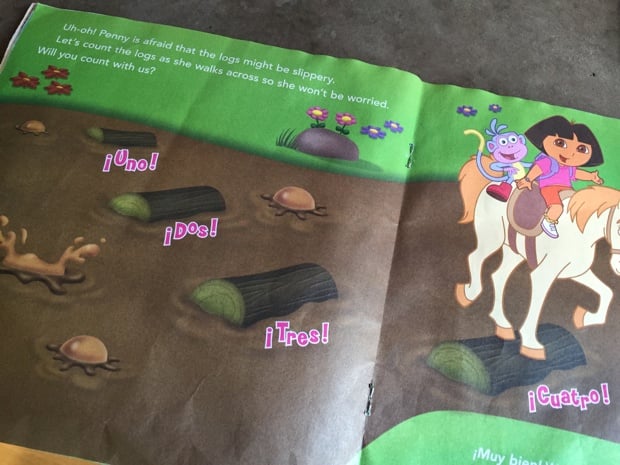
Anyway, there’s one part of the story that irritates me way above my average annoyance levels with these books (which is already quite high). Dora, Boots, and Penny are trying to cross a mud pit, but Penny is a bit scared. This is where we pick up the narrative:

Dora ugh

Let’s reflect on this for a moment. Penny is scared of jumping across the logs, because she thinks she might slip and fall into the mud. Dora’s proposed solution is infuriating:

Uh-oh! Penny is afraid that the logs might be slippery. Let’s count the logs as she walks across so she won’t be worried.

How is that a good solution? There are a number of things you could do to solve Penny’s fear of the slippery logs. They could walk around the mud pit. They could make sure the logs are more secure. They could give Penny special horse-shoes that increase friction. Look, I don’t know, I’m not an expert at horses jumping over logs, but I’m sure there are people who are, and who could come up with a good solution for the problem. Counting the logs to distract Penny is a pretty superficial and condescending approach to address this particular problem.

The thing is, this is all too often how managers operate in the context of their teams. Oh, you’re unhappy with the culture of the company? Let’s throw a company BBQ. On a Sunday afternoon. You’re concerned that the product development process is not optimal? Let’s hire another development manager. Instead of spending time to understand the cause of the anxiety communicated by team members, managers often rely on distraction or easy answers that give the illusion of a solution, but is nothing more than a way to check a box to say that they “did something.”

I read two really good management articles recently that are relevant here. The first is Gregg Satell’s What To Do While You’re Waiting For Steve Jobs (beware, that’s a Forbes link, so you’re going to have to do a lot of clicking around to dismiss all the things that try to distract you from reading it). He says this about treating people with respect:

If you expect your employees to be motivated to do their jobs well, you’d better treat them with dignity. Leadership is not the art of getting people to do what you want, but inspiring them to want what you want.[…] While many leaders believe that they can bend the organization to their will, that’s rarely true.  Being a jerk doesn’t make you Steve Jobs, it just makes you a jerk.

The second is Lindsay Holmwood’s It’s not a promotion — it’s a career change. It’s a great post and you should read the whole thing, but I want to quote most of the opening in full, because it’s great:

Your job is not to be an engineer. Your job is not to be a manager. Your job is to be a multiplier.

You exist to remove roadblocks and eliminate interruptions for the people you work with. You exist to listen to people (not just hear them!), to build relationships and trust, to deliver bad news, to resolve conflict in a just way.

You exist to think about the bigger picture, ask provoking and sometimes difficult questions, and relate the big picture back to something meaningful, tangible, and actionable to the team.

You exist to advocate for the team, to promote the group and individual achievements, to gaze into unconstructive criticism and see underlying motivations, and sometimes even give up control and make sacrifices you are uncomfortable or disagree with.

You exist to make systemic improvements with the help of the people you work with.

If I could summarize the advice in these articles, and what I’ve personally experienced about good managers vs. bad managers, I’d say this. If someone on your team complains that they’re worried about slippery logs across a mud pit, don’t tell them you’ll count loudly as they jump to distract them from the fear. Instead, take the time to understand the cause of their fear, and help them solve the real problem behind that fear.

In other words, don’t be like Dora. She’s a terrible manager.

Coffee and Craft

Coffee and Craft

My favorite story about coffee is from the year 1600, when Pope Clement VIII was the head of the Catholic Church. As the story goes, the Pope’s advisers urged him to make coffee a forbidden drink for Christians. They argued that since Muslims were not allowed to drink wine, Satan invented this “hellish black brew” as a substitute. In a moment of remarkable foresight the Pope asked to try a cup before he made his decision. He was so enamored with the concoction that he came up with a different plan. “This Satan’s drink,” he declared to his advisers, “is so delicious that it would be a pity to let the infidels have exclusive use of it. We shall cheat Satan by baptizing it.”

And so it came to be that despite our vast ideological differences across regions and cultures, we can at least all agree on one thing: coffee is a deeply spiritual experience.

It’s not that I didn’t always have a strong connection with my eldest daughter. It’s just that recently, as she’s running headlong into her fifth year of life, we’ve started to connect in ways I didn’t expect. For example, this weekend we spent most of early Sunday morning building Lego models together. How did that happen? How did she suddenly get into stuff I remember liking as a child?

I know everyone always talks about how quickly kids grow up. I don’t agree with that at all. Growing up takes a long time. But I do find these sudden jumps in growth quite surprising sometimes. I feel like I should be better prepared for each jump so I can catch her if she stumbles. I guess that feeling will never go away — especially when she starts dating. Man. That’s going to be rough.

Anyway. A few weeks ago my wife brought the girls to our office for a visit one morning. I made my daughter a Babycino (frothed milk + hot chocolate sprinkles), and myself a Cappuccino. While I was making the coffee drinks my daughter sat at the table and asked me questions about what I’m doing and how the espresso machine works. I talked to her about bean extraction and crema and milk steaming, thinking that it would bore her to tears. But she was really into it. So I kept going and we ended up having a conversation about craft and why it’s cool to take your time to learn how to do things well and how good it makes you feel when you really master a skill.

I can’t remember when my obsession with coffee started. I just know that one day I started reading books about coffee history, and the best ways to brew a good cup. Then I bought an AeroPress and starting Googling for recipes. Next I bought a grinder, and a Chemex, and became annoyingly picky about beans. And before I knew it, I was that guy at dinner parties. The guy who makes you stop what you’re doing to explain where the coffee came from, how I was going to prepare it, and what they should look for when they taste it. But mark my words: when you do eventually taste the coffee you instantly forget how weird I am, and instead start talking about the unexpected party in your mouth (A guest once remarked that it tasted like angels peeing on his tongue. It is, perhaps, my proudest moment).

Charles Maurice de Talleyrand-Périgord — the Prime Minister of France during the early 1800s — once wrote a completely over the top description of how coffee made him feel. Even though he was very likely under the influence of a vast amount of caffeine when he wrote these words, I swear when I’m drinking a great cup of coffee I want to nod in vigorous agreement:

A cup of coffee detracts nothing from your intellect; on the contrary, your stomach is freed by it and no longer distresses your brain; it will not hamper your mind with troubles but give freedom to its working. Suave molecules of Mocha stir up your blood, without causing excessive heat; the organ of thought receives from it a feeling of sympathy; work becomes easier and you will sit down without distress to your principal repast which will restore your body and afford you a calm delicious night.

Yes, the taste of a good cup of coffee is amazing, but it’s about so much more than that. Most of the joy of any craft — and coffee is no exception — is how you get there. My obsession gave me much more than the ability to make a decent cup. The process — the grind, the bloom, the slow pour — is now a comforting ritual that I associate with mindfulness. It’s a deep mental breath to allow my brain to process what’s going on around me. Most of us spend our days being outlandishly busy. But as with all crafts, during the 10 minutes it takes to make a pot of Chemex, nothing else exists. Time slows down, and I’m focused on getting every detail right. Making coffee keeps the chaos out for a few minutes every day — and it helps me focus when I return to my work.

What is your craft? It doesn’t have to be coffee. But is there something that takes you away from this world for a few minutes every day? Something that’s hard enough that it takes such intense concentration that you (gasp!) even forget to check Twitter? Something with a knowledge well deep enough that you’ll never reach the bottom? Those kinds of obsessions are healthy and necessary because they keep us on our toes, curious, always growing, always learning, always grounded because you can’t win a craft. There is always more to learn.

What you get from craftsmanship is not the end of the story. Despite its many personal benefits, I’ve found craft to be surprisingly social. Hours after my family’s visit a few weeks ago I was still thinking about the brief time I had with my daughter that morning. I couldn’t help but feel like it was significant, and that I should create more of those types of moments with her. And not just with her, but with friends and colleagues too. A discussion about craft — especially if it happens around that craft — usually leads into a discussion about passion, and that easily spirals out of control to anything from a new appreciation of life to brilliant product ideas. As people who create software, those discussions can be invaluable for the work we do.

So here we are: our lives intertwined with a drink that had the potential to divide nations, but instead ended up being the catalyst for the creation of many newspapers and universities; the common element in countless debates, first dates, and last dates; and the ever-present, unassuming ingredient to any everyday conversation or meeting. This hellish heavenly brew might just be the perfect ambassador for the value of learning and practicing a craft. It doesn’t just show us how much we personally have to gain from constant learning and a focused mind. It also shows us how a big part of the joy of craft is found in the gathering of people around its edges, and the ideas that are sparked and shared as a result. Let’s actively create and seek out those moments of shared passion for the world and all we get to do in it.

Preferably around a cup of coffee.
A View from a Different Valley

A couple of months ago I got an email from the wonderful people at A List Apart, asking if I’d be interested in starting a regular column on ALA. I believe my response was something to the effect of “1,000 times yes!!” How could it not be? I’ve been reading ALA for such a long time, and I really enjoyed the one time we’d worked together before, on an article called Usable yet Useless: Why Every Business Needs Product Discovery.

In an effort to figure out where to take the column, my editor asked me what kind of topics I’m interested in. I sent back a response that I was pretty sure would make her delete the email and step away from her computer very slowly. Here’s what I wrote:

  • My background is in sociology. My PhD dissertation was about social network theory — the real, mathematical kind, not what the phrase “social network” has since come to mean. So I like thinking about how our networked society is changing us. I’m much less interested in the “Google is making us stupid” view, and much more interested in the positive side. Clive Thompson’s Smarter Than You Think comes to mind immediately. (When I grow up, I want to write like Clive)
  • Following on from that, I like thinking about what parenting means in this new era. As I’ve been thinking about what my next side project should be after the book, I’ve toyed with a site for tech-oriented dads with young kids. What are the products they should be interested in, how do we teach our kids about technology and that it is not to be feared, but also not to be abused, because it is not neutral (see What Technology Wants. When I grow up I want to write like Kevin).
  • And again, following on from that (at least in my weird head), how does Sci-Fi culture play into all of this? (I know, weird, but stick with me). Our science fiction has become increasingly dystopian. The last positive science fiction series was probably Star Trek TNG. So what do our visions of the future tell us about living (and designing) today?

To my surprise, my editor didn’t freak out, and instead encouraged these topics. So we came up with the column name A View from a Different Valley. A column about technology, but from a perspective we don’t always expect. My first article for the column is called Work Life Imbalance, and it came out last week. It’s about the blurring lines between work and life:

There is a blending of work and life that woos us with its promise of barbecues at work and daytime team celebrations at movie theaters, but we’re paying for it in another way: a complete eradication of the line between home life and work life. “Love what you do,” we say. “Get a job you don’t want to take a vacation from,” we say—and we sit back and watch the retweets stream in.

I don’t like it.

I don’t like it for two reasons.

And this is, of course, where I ask you to read the rest if you’d like to find out why I don’t like it…

I’m really excited about this column, and hope to keep it going for quite a while. Thanks again to ALA — they’re awesome people. I like them a lot.

What 11 technology books tell us about our moment

Monica Guzman spent the summer on a tech book binge. She read 11 technology books to get a sense of our current technological moment. In the short article How my summer tech book binge changed the way I think about tech she explains some of the things she learned:

Tech serves us best when we create rather than consume. Where [Nicholas] Carr saw the worst of tech’s impact, Clive Thompson, in “Smarter Than You Think,” saw the best. One difference was that Carr — in arguing, for example, that the rise of short, fast media makes our contemplative muscles weak — all but ignored how tech boosts creation. It’s a common oversight: We’re transitioning from a world where public creation was difficult to one where it’s a cinch.

The same goes for public collaboration. Great things happen when we swirl together and build. Think Wikipedia. Blogs. The Internet itself.

This is, if nothing else, a great reading list.

The trough of social media disillusionment

As usual, Frank Chimero manages to capture what a lot of people in our neck of the woods are thinking in From the Porch to the Street. It’s an interesting, considered lament about how Twitter has changed, but it’s this part in particular that caught my attention:

Have you heard of evaporative social cooling? It says the people who provide the most value to a social group or organization eventually burn out and leave, undermining the stability and progress of the group. Most of my internet friends have been on Twitter since 2008, so they probably fall into this group. How much more is there left to say?

The linked post is Xianhang Zhang’s The Evaporative Cooling Effect, a broad article from 2010 that covers the design flaws in most social platforms. It’s definitely worth reading the whole thing — I’ll just quote this interesting way to classify different online communities:

There are two fundamental patterns of social organization which I term “plaza” and “warrens”. In the plaza design, there is a central plaza which is one contiguous space and every person’s interaction is seen by every other person. In the warren design, the space is broken up into a series of smaller warrens and you can only see the warren you are currently in. There is the possibility of moving into adjacent warrens but it’s difficult to explore far outside of your zone. Plazas grow by becoming larger, warrens grow by adding more warrens.

It feels like Twitter started as a warren and morphed into a plaza, which is where most of the current discontent is coming from — “This isn’t what we signed up for!”

Going even further down the rabbit hole, Zhang links to Eliezer Yudkowsky’s 2007 piece Evaporative Cooling of Group Beliefs, which has some further interesting thoughts on how to create healthy online communities:

My own theory of Internet moderation is that you have to be willing to exclude trolls and spam to get a conversation going. You must even be willing to exclude kindly but technically uninformed folks from technical mailing lists if you want to get any work done. A genuinely open conversation on the Internet degenerates fast.

It’s the articulate trolls that you should be wary of ejecting, on this theory—they serve the hidden function of legitimizing less extreme disagreements. But you should not have so many articulate trolls that they begin arguing with each other, or begin to dominate conversations. If you have one person around who is the famous Guy Who Disagrees With Everything, anyone with a more reasonable, more moderate disagreement won’t look like the sole nail sticking out. This theory of Internet moderation may not have served me too well in practice, so take it with a grain of salt.

On Twitter there is no way to exclude trolls — there are just too many of them. So there is this huge problem that inevitably appears once a community grows sufficiently large:

  1. Conversation moves from small warrens to large plazas.
  2. Many people loiter in the plaza and are only there to make trouble and ruin it for the rest of the community, and since it’s a public space there’s no way to chase them away.
  3. The people who created the original culture of the community leaves, and before long the broken windows theory kicks in and the plaza falls into disrepair.

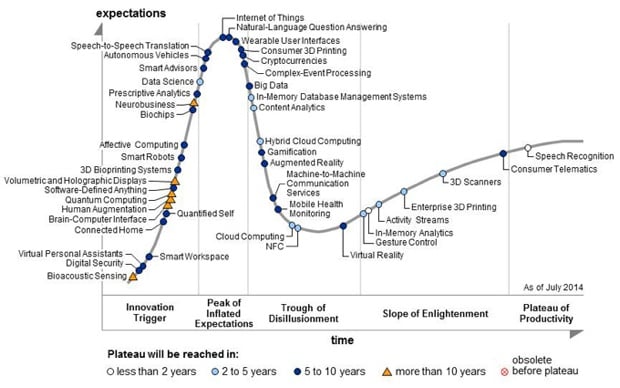
All this to say that designing effective online communities is much more difficult than it might have appeared at first. We couldn’t see into the future when Twitter became a thing, so who knew what would happen once the growth monster grew too big? It reminds me of Gartner’s 2014 Hype Cycle for Emerging Technologies:

Hype Cycle

I think we’re firmly in the trough of disillusionment with social platforms like Facebook and Twitter. I think we’ll get through it, but it feels like we’re all waking up right now going, “Wait, that’s what this has become?” We can — and will — do better. But it’s going to take time.

Wells Fargo: a big, lean company

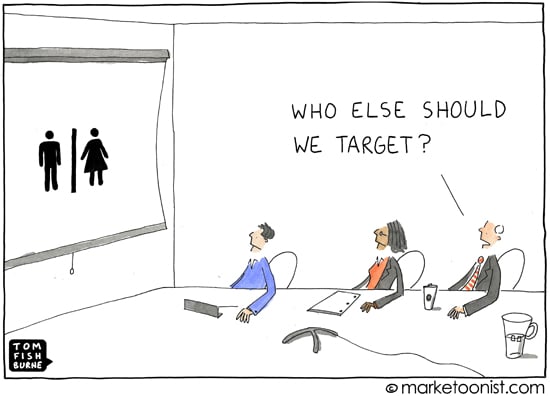
I was a little reluctant to click on Greg Satell’s How Wells Fargo Learned To Innovate Around the Customer. First, it’s on Forbes, which has become virtually impossible to read on mobile devices because there’s so much blegh on the page that’s not related to the article. Second, whenever you see people talking about “The Customer”, you should be sceptical. There is no average “user” or “customer”, so this kind of thinking usually results in defining an impossibe target market:

Target market

Image source: Tom Fishburne.

That said, despite my fears, the article is quite good. It discusses how Wells Fargo uses ethnography in their business, and there are also signs that they don’t operate like a large, slow-moving corporation at all:

However, it is not just internal processes that have changed, but the culture as well. Ellis’s bankers don’t sit in cozy offices, quietly examining financial statements (nor does Ellis himself), but work in open cubicles designed to promote collaboration. They are constantly iterating, experimenting and testing.

This part, especially, surprised me:

Perhaps most importantly, they are not limited by a long range plan. There is no “five year death march” toward a transformation that will never happen—or be outdated by the time it does. Instead, their purpose is to improve their customers’ businesses and adapt quickly to shifts in technology and the marketplace.

I’d love to see more detail on how Wells Fargo remains lean despite being such a large company. If this is really how they operate, it’s encouraging proof that big doesn’t have to equal slow and tired.

Be polite

Everyone is posting about this today but I don’t care because it is really that good and it wins all the points on the Internet today. Paul Ford in How to Be Polite:

People silently struggle from all kinds of terrible things. They suffer from depression, ambition, substance abuse, and pretension. They suffer from family tragedy, Ivy-League educations, and self-loathing. They suffer from failing marriages, physical pain, and publishing. The good thing about politeness is that you can treat these people exactly the same. And then wait to see what happens. You don’t have to have an opinion. You don’t need to make a judgment. I know that doesn’t sound like liberation, because we live and work in an opinion-based economy. But it is. Not having an opinion means not having an obligation. And not being obligated is one of the sweetest of life’s riches.

I wrote something slightly related (and, let’s be honest, not nearly as good) a while ago for Smashing Magazine: Making A Better Internet.

A product team worth fighting for

I nodded along vigorously to Cap Watkins’s The Fight:

What I’ve come to realize in the past two years is how important it is to find a company and a product worth fighting for. To find a team that is dedicated to delivering the best product they can, despite the bumps, the frustrations, the exhausting moments along the way. Hurdles and failure are totally unavoidable. Having a resilient team around you working on a product you all believe in will make those hurdles easier to clear. They’ll turn failure into a learning opportunity. Great teams working on products they’re passionate about will back you up when you’re exhausted and cover for you when you’re frustrated.

When you find a team like this, hold on for dear life.

The problem with "fighting" disease

Dhruv Khullar describes The Trouble With Medicine’s Metaphors:

The words we choose to describe illness are powerful. They carry weight and valence, creating the milieu in which goals of care are discussed and treatment plans designed. In medicine, the use of metaphor is pervasive. Antibiotics clog up bacterial machinery by disrupting the supply chain. Diabetes coats red blood cells with sugar until they’re little glazed donuts. Life with chronic disease is a marathon, not a sprint, with bumps on the road and frequent detours.

Khullar goes on to discuss in depth the use of military metaphors in medicine, such as the common saying “We’ll fight this together,” and why it can be counter-productive.

Love on Facebook

Claire Evans discusses how much more awkward break-ups have become in the age of social media. From Luddite love:

It’s time to end it online. I’m not just talking about the pedantic tick-box of Facebook ‘relationship status’: there are images to untag, emails to delete, an ‘unfriending’ to coordinate. There is the careful unravelling of the social web.

In a sense, every relationship now exists on two levels. The moments we spend in one another’s company, the neurochemical buzz of proximity, and the communion of shared silence: these are real. But just as physical places now have their geolocated overlays, every relationship, too, throws a digital shadow — and depending on the individuals involved, it can loom larger than the people who cast it. As we increasingly live our social lives in public, in a medium that retains the traces of our social noodling, the record and the relationship itself can approach a point of indistinguishability.