Menu

Posts tagged “creativity”

You should read these two zombie books

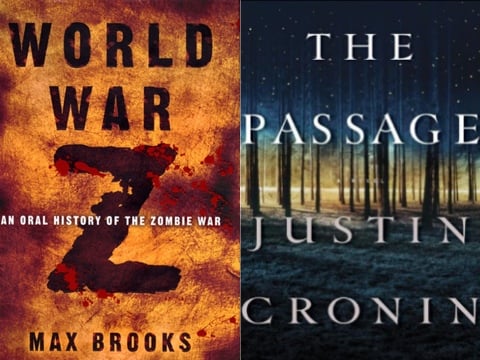
This isn’t a zombie blog1. Still, I’d be doing you a huge disservice if I didn’t tell you about two excellent zombie books I read recently. The books are great because yes, they have zombies in them, but they’re not actually about zombies. They’re about how humans treat each other when we turn on each other. How it’s easy to speak about our values but a bit harder to stick to those values when the going gets really tough. And that’s a topic worth exploring.
Great zombie books

The first book I want to recommend is World War Z. The BOOK, not the movie! I saw the movie, and it’s fine, but it is not even remotely similar to the book. I don’t even know why they kept the title. It’s really strange. You should still see the movie, because it’s fun, but the book is something completely different. It is, as the subtitle promises, “an oral history of the zombie war”. The war happened. It’s over. This is a book about people reflecting on what went down. And it is fascinating.

There are commentaries about the media:

The only rule that ever made sense to me I learned from a history, not an economics, professor at Wharton. “Fear,” he used to say, “fear is the most valuable commodity in the universe.” That blew me away. “Turn on the TV,” he’d say. “What are you seeing? People selling their products? No. People selling the fear of you having to live without their products.” Fuckin’ A, was he right. Fear of aging, fear of loneliness, fear of poverty, fear of failure. Fear is the most basic emotion we have. Fear is primal. Fear sells. That was my mantra. “Fear sells.”

There are commentaries on what happens when “knowledge work” is not needed any more:

You’re a high-powered corporate attorney. You’ve spent most of your life reviewing contracts, brokering deals, talking on the phone. That’s what you’re good at, that’s what made you rich and what allowed you to hire a plumber to fix your toilet, which allowed you to keep talking on the phone. The more work you do, the more money you make, the more peons you hire to free you up to make more money. That’s the way the world works. But one day it doesn’t. No one needs a contract reviewed or a deal brokered. What it does need is toilets fixed. And suddenly that peon is your teacher, maybe even your boss. For some, this was scarier than the living dead.

And what happens when those workers relearn how to do stuff with their hands:

It gave people the opportunity to see the fruits of their labor, it gave them a sense of individual pride to know they were making a clear, concrete contribution to victory, and it gave me a wonderful feeling that I was part of that. I needed that feeling. It kept me sane for the other part of my job.

And finally, on freedom:

Freedom isn’t just something you have for the sake of having, you have to want something else first and then want the freedom to fight for it.

The deep thought that went into this book results in an engrossing story full of detail that makes you think about your everyday relationships, and what might happen if those relationships are strained beyond their limits. I loved it.

The second book is The Passage. First, the backstory is great. The author first began developing his ideas for the book when his daughter asked him to write a book about a “girl who saves the world.” Well, it’s about a girl, and she tries to save the world, but it’s like no hero story you’ve read before. It starts when the zombie apocalypse picks up steam, and then jumps ahead 100 years to focus on how one isolated community is dealing with the aftermath. In contrast to World War Z, the war is very much not over in The Passage. It’s gruesome at times, but again, beautifully written.

From interesting reflections on what zombies represent:

What were the living dead, Wolgast thought, but a metaphor for the misbegotten march of middle age?

To what it means to believe in the future:

A baby wasn’t an idea, as love was an idea. A baby was a fact. It was a being with a mind and a nature, and you could feel about it any way you liked, but a baby wouldn’t care. Just by existing, it demanded that you believe in a future: the future it would crawl in, walk in, live in. A baby was a piece of time; it was a promise you made that the world made back to you. A baby was the oldest deal there was, to go on living.

And the nature of hope:

Courage is easy, when the alternative is getting killed. It’s hope that’s hard.

The Passage is not just a great story (I couldn’t put it down), but also another interesting look at what happens when circumstances bring out the worst (and the best) in humans.

All this got me thinking again about an article I read recently about the Zombie Renaissance in literature. And I realised how true this part is about these two books:

We are living in a time when what counts as “life” is in significant scientific dispute, and in the heyday of zombie computers and zombie banks, zombie this and zombie that. Why wouldn’t we also be living in a time of zombie literary forms? Whatever their specific emphases and intricacies, all these zombies represent a plague of suspended agency, a sense that the human world is no longer (if it ever was) commanded by individuals making rational decisions. Instead we are witnessing a slow, compulsive, collective movement toward Malthusian self-destruction. Of course all monsters are projections of human fears, but only zombies make this fundamentally social and self-accusatory charge: we the people are the problem we cannot solve. We outnumber ourselves.

If this is an idea that interests you, I highly recommend these books. Even if you don’t like zombies, you’ll appreciate the thoughtful writing and gripping stories. Do it.


  1. Although, maybe a pivot is in order? I’ll think about it. 

The importance of being idle

In Idle minds L.M. Frank writes about what happens inside our brains when we’re not actively working on or thinking about something:

Some researchers now think that resting-state networks may prime the brain to respond to stimuli. “The system is not sitting there doing nothing and waiting,” says [Andreas Kleinschmidt, director of research at the French National Institute of Health and Medical Research’s Cognitive Neuroimaging Unit]. Cycling activity in these networks may be helping the brain to use past experiences to inform its decisions. “It’s incredibly computationally demanding to calculate everything on the fly,” says Maurizio Corbetta at Washington University School of Medicine in St. Louis. “If I have ongoing patterns that are guessing what’s going to happen next in my life, then I don’t have to compute everything.” He likens the activity to the idling of a vehicle. “If your car is ready to go, you can leave faster than if you have to turn on the engine.”

It makes intuitive sense that we can’t just continue to create and consume information — our brains need time to process it all. And yet we still so often celebrate 80-hour weeks and shun “downtime” because we’re so afraid of not being productive. It seems like we’re doing ourselves more harm than good if we don’t give our brains time to be idle.

Focus and littered menu bars

The idea that we allow too many distractions to take our focus off the work we’re supposed to be doing is not new. And the solution — just turn things off! — is not rocket science either. But I find it interesting just how many blog posts we’ve seen about this topic over the past couple of years. Working in the Shed by Matt Gemmell is another really good one:

We act as if we take concentration for granted, yet everyone has had trouble keeping their mind on the task at hand. We litter our menubars with icons, keep notifications enabled, and run our email programs, chat apps and social media clients all day. Something’s got to give, and invariably it’s our creative output.

Pragmatism vs. idealism in design

From Mark Boulton’s great post I’m not a Craftsman:

I’m more often than not in a place where my own job, as a designer, is not to make something I love, but to make something appropriate. Something that does the job well. Something that responds to a hypothesis and serves a need. Not necessarily something loved and beautiful. And that’s ok.

In many cases, especially when it comes to client work, pragmatism beats idealism in design.

On photography, constant moments, and memory

Clayton Cubitt starts his fascinating article on how photography is changing with a definition of what French photographer (and the father of modern photojournalism) Henri Cartier-Bresson called “The Decisive Moment”:

Cartier-Bresson believed that the photographer is like a hunter, going forth into the wild, armed with quick reflexes and a finely-honed eye, in search of that one moment that most distills the time before him. In this instant the photographer reacts, snatching truth from the timestream in the snare of his shutter. The Decisive Moment is Gestalt psychology married to reflexive performance art in the blink of a mechanical eye.

It is the creation of art through the curation of time.

Cubitt goes on to point out that we now live in the Constant Moment, where it’s possible to take endless photos of everything, and edit (“curate”) later. Yet, notably, he doesn’t believe that’s a bad thing:

The Constant Moment doesn’t end [what characterizes the Decisive Moment]. All it does is capture the billion missed Decisive Moments that previously slipped through our fingers, by expanding the available window of temporal curation from “here and now” to “anywhere and anytime.” The Constant Moment eliminates dumb luck from photography. It minimizes, as much as anything ever can, the Hawthorne Effect caused by a lifeless camera between our interactions. It continues the photographic tradition of artistic democratization by flattening limits of time, of geography, of access.

It’s very interesting to follow Cubitt’s article by reading Dave Pell’s excellent This is You on Smiles, which essentially argues that the Constant Moment is changing how we experience life and create memories:

During a presentation on happiness at the Ted Conference, Nobel laureate Daniel Kahneman makes a distinction between the experiencing self and the remembering self. Digital photography gives additional dominance to the remembering self. […]

The digital age gives a new (and almost opposite) meaning to having a photographic memory. The experience of the moment has become the experience of the photo. […]

Snapping and sharing photos from meaningful events is nothing new. But the frequency with which we take pictures and the immediacy with which we view them will clearly have a deep impact on the way we remember. And with cameras being inserted into more devices, our collective shutterspeed will only increase.

Both pieces are worth reading this weekend.

The significance of zombie literature

Mark McGurl wrote a fascinating essay on the recent Zombie Renaissance in literature:

We are living in a time when what counts as “life” is in significant scientific dispute, and in the heyday of zombie computers and zombie banks, zombie this and zombie that. Why wouldn’t we also be living in a time of zombie literary forms? Whatever their specific emphases and intricacies, all these zombies represent a plague of suspended agency, a sense that the human world is no longer (if it ever was) commanded by individuals making rational decisions. Instead we are witnessing a slow, compulsive, collective movement toward Malthusian self-destruction. Of course all monsters are projections of human fears, but only zombies make this fundamentally social and self-accusatory charge: we the people are the problem we cannot solve. We outnumber ourselves.

It really is a very thought-provoking piece. I just finished reading Justin Cronin’s The Passage and I kid you not — it is the best book I’ve read in a long time. Cronin is a literary author who takes on the zombie/post-apocalyptic genre in such a compelling and beautifully-written way. And as I read those words in McGurl’s article — “we the people are the problem we cannot solve” — I realised that’s exactly what makes The Passage so hard to put down. It is a story about surviving ourselves. If you’re looking for something to read this summer/winter, I highly recommend it.

Why the Steampunk movement is important

I’ve long been fascinated by the Steampunk movement, and Nick Harkaway’s The Steampunk Movement Is Good And Important is another great essay on the topic. Nick starts by explaining why Steampunk appeals to people (“it is premised on a technology which is visible and pleasing to the naked eye, and whose moving parts are comprehensible on a human scale,” and “it is an ethos of design and creativity which acknowledges the humanly physical, that which we can understand with our fingers”). He then goes on to explain how different this is from modern technologies like cell phones:

The ethos admits of failure: Steampunk devices almost are not working properly if they don’t have leaks, if they don’t require maintenance and the occasional thump. That’s where they get character and animation, identities of their own which reflect their owners, while every iPhone can be seen as Apple’s endlessly replicated identity given passage into your every waking moment, a tiny and instantly replaceable cloned shopfront: what role is conferred or imposed by such a device on the person carrying it? It’s not that Jonathan Ive’s designs are poor, it’s that they are profoundly truthful: an iPhone is a vector, not an object, valued by its creator for its purpose and interchangeability, not individuality.

Steampunk, on the other hand, repurposes, scavenges, remakes and embellishes in an arena where embellishment is seen as decadence, never mind the inherent decadence of creating the sheer amount of computing power our society now possesses in order that most of it should sit idle or be used for email and occasional games of Plants vs Zombies.

Steampunk appeals to the idea of uniqueness, to the one-off item, while every mainstream consumer technology of recent years is about putting human beings into ever more granular, packageable and mass-produced identities so that they can be sold or sold to, perfectly mapped and understood.

Steampunk and the future of Interaction Design

Joshua Tanenbaum, Audrey Desjardins, and Karen Tanenbaum take an in-depth look at Steampunk sub-culture, and specifically what it means for the future of Interaction Design, in their article Steampunking interaction design. It’s a dense piece, but really interesting. They discuss design fiction as a form of envisioning the future, and how Interaction Design could adjust to that possible future:

Steampunks have imagined a whimsical neo-Victorian fiction to frame their design practice: an optimistic lost age of adventure where invention, individuality, and innovation reign supreme. This fictional world reflects a set of values and relationships with technology, but that is not the most interesting or relevant thing that Steampunk has to offer the HCI (Human-Computer Interaction) community. Instead, it is in the practices of Steampunk makers that we can observe a possible future for interaction design: a future in which design is driven by aesthetics, grounded in a sustainable ethos, and aimed at serving the needs and preferences of distributed communities of engaged expert users.

Also see How steampunk culture offers clues to building a better future for another interesting viewpoint on this movement.

Music and the power of pleasant surprise

Ivan Hewett did a write-up on some very interesting neuroscience research in Why your brain loves music:

When [participants] were willing to pay [for a song] there [was] a strong correlation with one brain region in particular, called the nucleus accumbens. This is the area responsible for the sensation of “pleasant surprise”.

It might seem surprising that people should enjoy having their expectations contradicted. But these results only reveal the physical basis for something we’ve known about for centuries. In the ancient world, teachers of rhetoric knew that one way to hold people’s attention was to set up expectations and then deny them.

“Pleasant surprise”. That does explain a lot. As a high school student with very limited budget, buying a CD was a huge deal, so I didn’t want to waste the opportunity when it did come along. One of my biggest criteria for buying a CD was this: “Will I be ok if this is the only album I can take with me to a deserted island?” The ability to listen to a CD over and over was a strong requirement to make the purchase worthwhile.

Anecdotally I can confirm that the albums I did end up listening to a hundred times over were the ones that were surprising in just the right ways. They were just pushing the boundaries of the sounds I was used to and expected to like. Pink Floyd’s The Division Bell immediately comes to mind as an example of this. It’s probably the same reason we like movies with a strong twist. Even though we’re technically being lied to for most of the movie, we kind of like it. As 17th century English philosopher Francis Bacon said: “There is pleasure even in being deceived.”

See also: The tyranny of endless musical choice

Designer Matthew Smith on endless streams, and turning hobbies into careers

I always enjoy the interviews on The Great Discontent, and this one with designer Matthew Smith is no exception. Here he describes how he turned his hobby into a business:

At the time, my wife was pregnant, we had a one year old, and we were all living on about $26,000 a year—I knew I had to think bigger, so I went for it. I got the first $8,000 job and then another. Then people started asking me to build more things, like customer databases. I would nod in agreement as if to say, “Of course I can do that,” and then I’d get off the phone, crap my pants, and go do research on Google, ask questions on forums, and figure it out in order to deliver a product to a client and make them happy with the results. Done!

I can certainly relate to the get off the phonecrap pantsfigure it out workflow. I also like Matthew’s critical take on the concept of endless feeds on the Internet:

Who came up with the idea of endless content constantly streaming toward us? There’s this unlimitedness that concerns me because it is so unlike the rest of the human experience and I think it confuses the human mind and puts us into a space where we aren’t at our best. I want to make sure that no matter the project or company I’m involved with, I’m always asking if it’s serving the human best and helping us be at our best.

That last part reminds me of something Alex Griendling said recently:

Our work does not exist in a vacuum; it is given context and meaning and power by the places it appears and the people that benefit from its usage. When clients hire us, they’re doing so because they believe it will benefit them. With this in mind, it’s important to ask yourself the question “Is this client worth helping?”. If great work is made for those that exhibit repugnant practices, how does this benefit anyone other than the individual client?

Words to live by…