Menu

Posts tagged “creativity”

The problem with the apostrophe

Benjamin Samuel dissects the humble comma in the absolutely brilliant The Comma From Which My Heart Hangs. But it’s his enraged rant against the use of apostrophes to indicate possession that really makes this a special essay:

My colleagues might argue that the apostrophe is a perfectly normal, even useful, if not vital punctuation mark. But I say that if language adapts with the times, then it is representative of society, and that if our need for awarding possession is so great as to warrant such a tawdry and sickening punctuation mark, then the apostrophe is indicative of precisely what is wrong with our society: our inability to communicate effectively, to build relationships, to share and support the goals of others—even when those goals mean working temporarily but yet quite hard in a less glamorous position as one pursues a more respectable appointment among his true colleagues.

I don’t personally have a gripe with the apostrophe, but his passion will definitely make me more wary of our obsession with owning things. Good writing often has that effect — it forces us to look at old things in new ways.

Give it a minute

Since I’m currently knee-deep in the sheer undiluted slog of writing a book, wondering what I was thinking, Ben Yu’s There are no shortcuts really resonated with me:

Take the time to do things right — a shortcut will end up costing much more time in the long run as things come crashing to the ground.

Also, optimize for the long run. Constantly aiming for the short term, particularly in the frantic and ever-changing startup world (hoping to build a lot of hype, raise a lot of money, and get acquired in two years), tends to encourage the taking of illusory shortcuts which have the fate of failure stamped on them from the very outset.

This follows hot on the heels of something Louis C.K. said in an excellent interview:

There’s people that say: “It’s not fair. You have all that stuff.” I wasn’t born with it. It was a horrible process to get to this. It took me my whole life. If you’re new at this — and by “new at it,” I mean 15 years in, or even 20 — you’re just starting to get traction. Young musicians believe they should be able to throw a band together and be famous, and anything that’s in their way is unfair and evil. What are you, in your 20s, you picked up a guitar? Give it a minute.

So I’m learning to stop complaining, do the necessary hard work, and just give it a minute.

(“No shortcuts” link via @mobivangelist)

Collaboration for introverts

Mark Boulton wrote a forceful counter-argument to the common mantra that collaboration results in better design. From Quietly working:

I see plenty of banner waving for collaborative working. Co-designing, pair programming, brainstorming, collaborative workshops. The overwhelming message is that these tools are better for reaching consensus, sharing work, and, ultimately, lead to better work. Well, I’m not so sure that’s the truth. Given my introverted nature, sometimes these activities can rush the process too much. They allow no time for me to think. […]

Personally speaking, a lot of the time, I’d rather listen to what you have to say and go and have a good think.

Mark makes some very good points, and as an introvert myself, his message really resonates with me. But I don’t think it’s an either/or situation. It’s not that we either collaborate, or work alone. Collaboration that doesn’t allow time and space for working alone is ineffective collaboration.

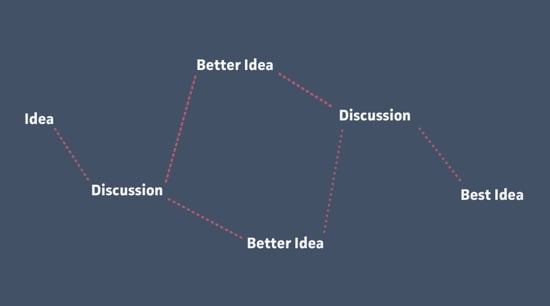
There are two illustrations about the collaboration process that summarize this idea well. The first is from Trent Walton’s Being Prepared To Contribute:

Better ideas

An idea, followed by discussion, often results in better ideas. But the “Better idea” step doesn’t happen in a meeting room — it happens at the designer’s desk, when they have time to reflect and focus on the problem without interruption.

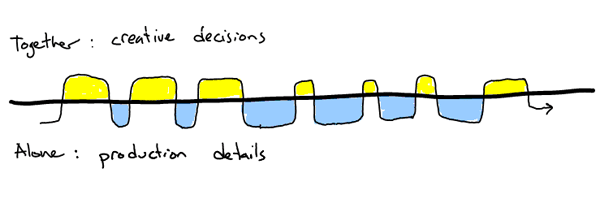
The second illustration is from Stefan Klocek’s excellent post Better together; the practice of successful creative collaboration:

Together

It shows how collaboration doesn’t mean that everyone should do everything together. Important decisions are made together, but the production details (the “better ideas”) happen while working alone.

So I’m definitely with Mark on his call for having more time to think and work alone. But that isn’t an alternative to collaborative working. It’s just a necessary — and too often ignored — part of the collaboration process.

(link via @ChrisFerdinandi)

Our weird and outdated definition of success

Jason Kottke once said that The Onion is often the most emotionally honest media source we have, and that was proven once again with David Ferguson’s recent article there called Find The Thing You’re Most Passionate About, Then Do It On Nights And Weekends For The Rest Of Your Life:

Because when you get right down to it, everyone has dreams, and you deserve the chance—hell, you owe it to yourself—to pursue those dreams when you only have enough energy to change out of your work clothes and make yourself a half-assed dinner before passing out.

But what I really want to talk about is Kevin Fanning’s excellent follow-up post where he tries to figure out why that Onion article struck a chord with so many people:

I think the reason this article is painful is because culturally we define success in such a weird and outdated way. There’s this idea that if you’re not doing what you’re most passionate about all the time, you’re a failure. If you aren’t making a living at it, you’re a failure. If you’re not Stephen King or Christina Aguilera, you’re a failure.

Kevin’s conclusion (among other things, that “maybe eventually we get to a place where we see that books and music and art are created by us, people who have school and day jobs and other shit we care about”) is a call to relax a bit, and be much less hard on ourselves. Read it and feel better!

Design for now, but make it last

Frank Chimero talks about the misuse of the word “timeless” as it relates to design in Let’s talk about timeless design. Here’s one of his complaints:

Why is timeless design always the goal? What’s wrong with making something look like it was made when it was made? Why do designers all of a sudden want to exist outside of time, like Scott Bakula in Quantum Leap? […]

Other people: can you help me understand what is happening in this world of ours? I want to know what technology is doing to my brain. How do I stay human in a digital world? I want to understand what all this technology does to my expectations of myself, other people, and the world. None of this is timeless. These problems are right now.

I agree with Frank on this point (and the others), so it’s a little embarrassing to admit that I wrote in favour of timeless design about a year ago in The elusive goal of lasting beauty in web design. But having just read that post again, and in keeping with Frank’s point that words matter, I think it’s important to make a distinction between design that is timeless and design that lasts. I concluded my piece with the following:

I wonder what would happen if we felt the weight of responsibility a little more when we’re designing. What if we go into each project as if the design will be around for 100 years or more? Would we make it fit into the web environment better, aim to give it a timeless aesthetic, and spend more time considering the consequences of our design decisions? Would we try to design something that “makes life worth living”?

Sure, I use the word “timeless” there (probably incorrectly), but the point I’m trying to make is slightly different. I’m trying to say that the ephemeral and fickle nature of digital products shouldn’t be used as an excuse to put out unconsidered, throwaway work. Our designs don’t have to be timeless — and they should solve the problems we have now — but we should go into each project with the care and attention needed to make things last for a long time.

What it takes to realize your ambitions

Jeff J. Lin looked at the life of director Ang Lee and pulled out some insights on what it takes to be successful. This part from Ang Lee and the uncertainty of success talks about the long periods of non-success that often occur:

If you’re an aspiring author, director, musician, startup founder, these long stretches of nothing are a huge reason why it’s important to pick something personally meaningful, something that you actually love to do. When external rewards and validation are nonexistent; when you suffer through bouts of jealousy, wondering “How come so-and-so got signed/is successful/got a deal/etc?”; when every new development seems like a kick in the stomach, the love of what you are doing gives you something to hang onto.

Much is made of genius and talent, but the foundation of any life where you get to realize your ambitions is simply being able to out-last everyone through the tough, crappy times — whether through sheer determination, a strong support network, or simply a lack of options.

Related, Paul Tough’s thesis on how children succeed:

Noncognitive skills, like persistence, self-control, curiosity, conscientiousness, grit and self-confidence, are more crucial than sheer brainpower to achieving success.

Choose work based on impact, not profit

Jason Cavnar wrote a great piece for VentureBeat called Why developers should start choosing conscience over profit. He urges us to be Makers, not Takers:

Makers choose their work based on impact and happiness. They recognize the truths in the work of people like Daniel Pink and Simon Sinek — that income does not generate happiness or enjoyment, nor alleviate sadness or stress. They concern themselves with doing work that is important. With thinking about what moves society forward. With jobs and startups and weekend hacking and open-source contributions to things that have a real-world impact. They introduce and push fundamentally new technologies.

It reminds me of Matt Gemmell’s Makers and Takers:

People who make things, or Makers, contribute something to the universe. Makers are people like writers, musicians, artists, architects, software engineers, carpenters, and the chap at the coffee shop who makes your morning latte. He has a skill, and he applies it to create something that makes your day a little bit better. […]

When I’m choosing who to spend time with, or seek inspiration from, or learn from, or adopt as a role model, I’m exclusively looking at Makers. The fire and water, rather than the mere pipework. The lightning, not the rod. Surround yourself with Makers.

And one more, just for good measure. Here’s Mike Monteiro in Design Is a Job:

I urge each and every one of you to seek out projects that leave the world a better place than you found it. We used to design ways to get to the moon; now we design ways to never have to get out of bed. You have the power to change that.

So there you go — some nice midweek inspiration.

What I learned about design in 2012

One of my favorite articles of 2011 was What I Learned About the Web in 2011 on A List Apart. In particular, Erin Kissane’s call to respect complexity stayed with me all through 2012:

If a single idea has followed me around this year, from politics to art and work to friendships, it’s been this one: “it’s more complicated than that.”

It’s centrally important to seek simplicity, and especially to avoid making things hard to use or understand. But if we want to make things that are usefully simple without being truncated or simplistic, we have to recognize and respect complexity—both in the design problems we address, and in the way we do our work.

So it was with a sense of great surprise and gratitude that I responded to a request to participate in the 2012 version of that article, What We Learned in 2012. The section I wrote is entitled “Confidence versus humility”, and in a sense, it’s a continuation of Erin’s plea in 2012:

The biggest thing I learned last year is that the two most important characteristics of a good designer are ones that, at first, appear to contradict one another.

I won’t quote the section in full, because I’d love for you to check out the whole article. There are some real gems in there from a bunch of designers and writers I really admire.

The power of good distractions

In The Redemption of Distraction James Shelly goes into the etymology of the word “distraction”. He points out that the original meaning implies being “pulled away” from something, so the word doesn’t always deserve its bad reputation. Being pulled away from less valuable activities to focus on something with more value could be quite useful to increase productivity:

Perhaps we ought to get over our cultish demonization of distractions so that we can effectively utilize them. Perhaps we would benefit from instituting better distractions — not necessarily less of them. Perhaps the spreadsheet, artwork, or document before us needs its own interval or chime. Perhaps eliminating so-called ‘negative’ distractions is only half the story: a monastery is designed to eliminate interruptions, and yet sights, sounds, and smells are still employed to ‘pull away’ one’s focus from intruding, wandering thoughts. Such a place does not provide the absence of distraction, it utilizes distraction. Intentional distractions ‘pull away’ our thoughts from useless tangents, in order to ‘contract’ our focus back where we want it.

Of course, these days, most of our distractions are more destructive than they are productive. Jean Jullien sums it up nicely:

Never alone

2013: the year of social network quitting

I can’t shake this feeling that this might be the year that quitting social networks goes mainstream. We’re not even through January, and already the posts are flooding in. Here’s Brent Simmons in Brave new network: Why I hope Apple never releases a smart watch:

I want to stay human, in other words. I want to like things in the thousand different ways there are to like things, rather than just click on a Like button. I want to say and think things that take more than 140 characters.

I want to not take a photograph, because no picture, no matter how beautifully filtered, can express what it’s like for one person to walk in the woods alone. I need to remember.

And here’s Keri Maijala in Why I’m not on Facebook:

I felt bad about myself after browsing Facebook.

I get that Facebook is like a reverse funhouse mirror that makes everything look better. It’s a sublimely distorted world filled with families and trips and drinks and straight white teeth. And I was just as guilty of perpetuating that myth, carefully choosing photos and crafting updates that supported how I wanted to be perceived: Happy, healthy, independent, adventurous, courageous, and with straight white teeth. Only half of those things are true. And ultimately, I found I felt depressed after browsing Facebook.

Or as Alex Charchar said on Twitter recently, we’re starting to get bored by our distractions. I think that’s a good thing, though. Boredom leads to creativity.