Menu

Posts tagged “creativity”

Going down intellectual rabbit holes

Rabbit holes: Why being smart hurts your productivity is a great post on staying focused without losing the value of going down intellectual rabbit holes:

The names change but the story remains the same. Designers find themselves studying fancy, new CSS3 effects when they should have been wire framing their checkout page. Hapless students find that they are on the Wikipedia page for Esperanto instead of writing notes on Norse mythology. Like Alice led into Wonderland by the White Rabbit, geeks too easily fall into “the rabbit hole”.

I won’t spoil the suggestions for you. See also: The potential and dangers of “˜squirrel projects’.

(via Brad Whittington)

Ideas of March 2012

This is my contribution to Chris Shiflett’s Ideas of March initiative, which encourages people to write about why they like blogs.

My love of writing comes from a love of problem-solving. There is a sense of pride and accomplishment in finding the right words to say something. And yet, great writing has an inherent unattainability to it that keeps me ever searching. There are good ways and bad ways to communicate something, but there is never a best way. It’s like a video game in the sense that you can level up by writing often, but it’s not a game you can ever beat. There is no big boss fight at the end that proves that you are now the best writer you can be. What keeps me going is the nagging sense that the last thing I wrote could have been written much better, so I’d better keep trying.

There are many benefits to writing, of course. Most importantly, it’s a problem solving technique in itself. By taking the time to structure your thoughts and your words in a way that other people need to understand, you tend to get a better understanding of what’s going on in your head. Clive Thompson addresses this well in The art of public thinking:

The process of writing exposes your own ignorance and half-baked assumptions: When I’m writing a Wired article, I often don’t realize what I don’t know until I’ve started writing, at which point my unanswered questions and lazy, autofill thinking becomes obvious. Then I freak out and panic and push myself way harder, because the article is soon going before two publics: First my editors, then eventually my readers. Blogging forces a similar clarity of mental purpose for me. As with Wired, I’m going before a public. I’m no longer just muttering to myself in a quiet room. It scarcely matters whether two or ten or a thousand people are going to read the blog post; the transition from nonpublic and public is nonlinear and powerful.

Writing in public continues to help me gain clarity about my thoughts and problems. That I expected. But I didn’t expect it to give me such a sense of community. The past few months have been especially gratifying, ever since I’ve been invited to become a contributor to Smashing Magazine. Through that process I’ve met amazing people, and through them, I think I’ve become a better writer. Which in turn helps me to solve problems better. It hardly seems fair that I gain so much from this community. If you’ll allow me the use of a ridiculous phrase, the ROI on my writing seems preposterously high.

I started my first blog on Windows Live Spaces in 2003. I’d just moved to the US and needed a way to feel connected to friends and family in South Africa. It’s 2012 now, and I don’t write on Windows Live Spaces any more. I also don’t live in the US any more. I’ve moved homes and countries and blogging platforms way too many times over the past 9 years. But looking back over many false starts and wrong turns in life and in blogging, I’m grateful for the thread of words that runs from my beginnings on Spaces, through the detour on Blogger, and now my own home on this domain. Somehow, those words anchor me.

So maybe writing this has once again shown me the error in my original thinking, just as it’s done so many times before. I was wrong in my opening paragraph. I don’t write because I love problem-solving. I write to know that I am here.

Never stop searching

This is a great interview with The Bad Plus. They talk about Jazz and finding your voice, but it’s this part on humility that stood out for me:

I prefer to think that it’s possible to always sort of double-check yourself and be like, “Is this really the right thing?” and be searching.  The classic jazz example is John Coltrane: consummate musician, but really never stopped searching. I don’t think he ever believed the hype about himself.  He could’ve been like, “Man, I got it, I’m great.”  But that’s not the feeling you get. Coltrane was incomparably great, but he was also just humbly trying to figure it out.

This should always be our attitude when we design as well. If we think that we’ve figured out how people use computers, or exactly how human psychology works, or that we can design the perfect, seamless experience - then we tend to start designing for ourselves at the expense of our users. Never stop searching.

See also: Humble Design.

The vomit draft

This is such a gem of an interview with Andy Ihnatko that it’s hard to pick just one section to quote, but I’ll go with this one:

What’s your advice to new writers?

Build your whole workflow around the “vomit draft.” When you create a blank document, empty your mind of any expectations or aspirations. Just start typing. Never edit anything. Just get it all out of you and into the document. Type, type, type until you get to the end. The results will be horrible, but the hardest work is done: you’ll have taken a nebulous idea out of your head and created something that really exists. Then you fix, fix, fix.

Such great advice - I’ve started doing this on all longer pieces.

The pursuit for perfection

I love this line from Sweet Maria’s Coffee Library:

Espresso is fussy. It is the pursuit for perfection by a person who is driven by minutiae.

It’s not just Espresso that’s fussy. Design is fussy too. So is writing, drawing, painting, or any other creative pursuit you can think of. It is all “the pursuit for perfection by a person who is driven by minutiae”. And this pursuit is usually undertaken by unreasonable people.

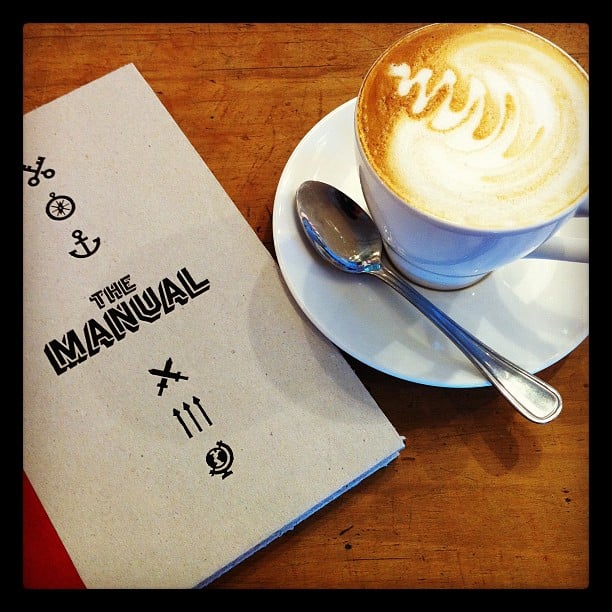
Speaking of coffee (a huge passion that’s pretty hard to merge with a blog on design and technology), I guess this is as good an excuse as any to post this recent photo, taken at Melissa’s Food Shop in Cape Town:

the-manual-melissas.jpg

Remember, always read the manual.

Innovation: it's complicated

Fabio Sergio wrote a slightly rambling but very interesting post called The Myth of the Brand New Innovation Myth. He takes on some recent opposing views on innovation and creative thinking. Should you listen to customers or not? Should you work in an environment where you can do your thinking alone, or collaborate? Sergio’s point is that (surprise!) it’s not that simple:

I don’t think there is an archetypal, simplistic image of what type of personality or process best fosters innovative thinking, or even what type of physical working environment can best support a creative culture. That view of the world is too polarized. In my experience there is no single specific behavioral trait, methodological approach, or carefully-selected set of contextual factors that guarantees success in the ability to think differently and translate that thinking into success in the market.

He goes on to say that the truth doesn’t lie in any of these extremes, but somewhere in between:

That said, there is indeed a common trait in the typical way creative thinkers approach challenges: they can comfortably hold opposing thoughts in their heads and get to work. [”¦] Informed intuition. Controlled chaos. Abductive analysis. This is often the mindset of successful creative, innovative thinkers: seeing opposites and apparently contradicting goals not just as a potential for dissonance, but as an opportunity for dynamic harmony.

It’s a much more balanced and realistic view than some of the other black-and-white proclamations of truth we’ve been seeing lately.

Wake up and start producing

Clay Johnson wants us to write 500 Words before 8am:

Starting your day as a producer means that your information consumption has meaning: the rest of the day means consuming information that is relevant to what it is that you’re producing. Waking up as a producer frames the rest of your habits. You’re not mindlessly grazing on everyone’s facebook’s statuses. You’re out getting what it is you need to get in order to produce. Waking up as a producer is procrastination insurance.

“Procrastination insurance.” I like that. This is tricky when you have a 2-year old that you want to read stories to in the morning, and you also need to get a run in before work. But there are other ways to apply this principle. I write most of my longer pieces at night when the family is already in bed. This is not ideal, but I do most of the planning in my head early in the morning while doing other tasks. I also tend to do a lot of design work in the shower - it’s uninterrupted time to think about a problem and come up with possible solutions. Maybe I’m rationalizing, but I choose to view this morning thinking time as part of producing and providing focus for the day to come.

It's time to find your voice

I’ve been following the recent back-and-forth about blog comments closely, since I have the same question about this blog: should comments be turned on or off? I even mentioned recently that I’m going to turn comments off for a while and see how it goes.

Matt Gemmell is driving/documenting the debate in the most articulate way, and his recent post on pseudonyms is another example of that. Even though the conversation now mostly appears to have run its course, it occurred to me that the root of this debate is related to what Paul Ford calls the fundamental question of the web:

“Why wasn’t I consulted,” which I abbreviate as WWIC, is the fundamental question of the web. It is the rule from which other rules are derived. Humans have a fundamental need to be consulted, engaged, to exercise their knowledge (and thus power), and no other medium that came before has been able to tap into that as effectively.

The Internet gives people this idea that if they can’t respond directly to something someone else said on a web site, their fundamental right to be consulted is violated. And that’s just not true - we don’t have a right to be consulted on everything that happens around us. What is true, however, is that we all have a voice, and that finding that voice is extremely important for our own development.

So the thing is, we’re having the wrong discussion. We shouldn’t be arguing about whether comments should be turned on or off on a blog. What we should be talking about is how all of us can spend more time finding our own obsession and voice, and how we can share that with the world. Tom Standage argues that writing is the greatest invention:

It is not just one of the foundations of civilisation: it underpins the steady accumulation of intellectual achievement. By capturing ideas in physical form, it allows them to travel across space and time without distortion, and thus slip the bonds of human memory and oral transmission, not to mention the whims of tyrants and the vicissitudes of history.

So forget about comments - it doesn’t matter whether you have them turned on or not. The real question is which one of the many available options you’re going to choose to start writing and owning your voice.


Update: Reader Greg Mathes asks in an email, “What’s so important about finding our own voice?” To answer, I’d like to quote Clive Thompson in The Art of Public Thinking:

The process of writing exposes your own ignorance and half-baked assumptions: When I’m writing a Wired article, I often don’t realize what I don’t know until I’ve started writing, at which point my unanswered questions and lazy, autofill thinking becomes obvious. Then I freak out and panic and push myself way harder, because the article is soon going before two publics: First my editors, then eventually my readers. Blogging (or tumbling or posterousing or even, in a smaller way, tweeting) forces a similar clarity of mental purpose for me. As with Wired, I’m going before a public. I’m no longer just muttering to myself in a quiet room. It scarcely matters whether two or ten or a thousand people are going to read the blog post; the transition from nonpublic and public is nonlinear and powerful.

Should designers learn to code? Who cares, as long as they always remain curious.

Tucked away among the usual arguments for and against designers being able to code, Mandy Brown makes an interesting observation in Specialist or Generalist?, a roundtable discussion on the issue:

You do not need to be proficient in practices other than your own; but you ought to be curious. Curious enough to ask questions, to read about things, to get your hands dirty. It’s lack of curiosity about other disciplines that is deadly, not lack of skill.

This is a statement worth digging into, because curiosity is one of the most important characteristics of a good designer (well, of anyone, really). Sara Wachter-Boettcher explains the reason really well in her piece On Content and Curiosity:

Curiosity keeps us hungry. It leads us to tackle new challenges when the easy questions have all been answered. It makes us wonder how things could be better””even when they are, if w’d just pause to admit it, pretty damn good already.

There is a very legitimate counter-argument to being incurably curious, though. We might gain such shallow knowledge about so many different things that we end up unable to form or articulate opinions on anything because we just don’t know enough about a specific topic.

This is the core of the “specialist” argument, and it’s articulated very well in Stop Trying To Be Diverse, an interesting post about photographers on the Musea blog. The author tells the story of a particular photographer who spent his entire life shooting black-and-white portraits of people against a white or grey background. Boring, right? Well…

We don’t want to restrict ourselves to something like that because we feel that we will get bored. However, boredom is a great thing! What actually occurs is, boredom forces us to be more creative if we can push through it. Our work will improve if we find different ways to solve the same problem over and over, instead of switching between 10 independent problems. Avedon forced himself to come up with something new every time his subject stepped in front of his white seamless background. He had to find something unique about each individual, otherwise he would fail. The difference in his work came from what his subjects brought to the image, not by some new Photoshop filter or fancy off-camera lighting technique he used.

I’ll illustrate this with a story about my own online behavior. The other night I went online to do something (who knows what it was), and an hour later I found myself reading an article about a guy who feels that Louis C.K. was stupid because he made “only” $1 million from his standup comedy experiment. The person claimed that he could have helped Louis C.K. make $5 MILLION!!! I got to end of the article and all I could think was, “Why do I read this crap?” Well, I read it because my curiosity sometimes overcomes my importance filter. And getting that balance right is what we all need to make this curiosity thing work for good, not evil.

So, how do we arrive at (and maintain) this balance? How do we remain curious, and still manage to temper our gluttonous, Internet-fed thirst for All Things, All The Time? The core of the solution lies in learning what to cull from our lives, and what to surrender instead. In The Sad, Beautiful Fact That We’re All Going To Miss Almost Everything, Linda Holmes describes the two concepts as follows:

Culling is the choosing you do for yourself. It’s the sorting of what’s worth your time and what’s not worth your time. It’s saying, “I deem Keeping Up With The Kardashians a poor use of my time, and therefore, I choose not to watch it.” It’s saying, “I read the last Jonathan Franzen book and fell asleep six times, so I’m not going to read this one.”

Surrender, on the other hand, is the realization that you do not have time for everything that would be worth the time you invested in it if you had the time. Surrender is the moment when you say, “I bet every single one of those 1,000 books I’m supposed to read before I die is very, very good, but I cannot read them all, and they will have to go on the list of things I didn’t get to.”

We constantly need to learn how to make better decisions about culling and surrendering. For example, I should have culled that Louis C.K. article. And at some point I need to choose to surrender all the UX articles in my Instapaper queue and just freakin’ fire up Balsamiq.

Should designers learn to code? It depends entirely on each designer’s ability to decide if it’s a skill that should be learned or surrendered in the bigger picture of meeting his or her ultimate life/career goals. Put another way, there is no right answer, as long as the designer is at the very least curious enough to know how development works, and at best has made a conscious decision either to surrender the skill or dive in and learn it.

The elusive goal of lasting beauty in web design

A few months ago Nilay Patel did a good interview with Tony Fadell, the creator of the Nest thermostat. From Inside the Nest on The Verge:

Fadell looks out at the Manhattan skyline and says that he always wanted to be an architect; that buildings stay beautiful forever but digital devices are quickly obsolete. “You look at hardware or software five years later? They’re crap. You would never use them again. People use architecture all the time.”

His voice rises. “What is our form of architecture? What is the thing that lasts of beauty?”

I’ve been thinking about this for a while now, and the reason I can’t get the interview out of my head is that I just can’t think of a good answer to Fadell’s question.

In web design, what is the thing that lasts of beauty?

Aesthetics and beauty in web design is so subjective, so polarizing, that I wonder if anything lasts of beauty in what we do. As one example among many, the current trend set by Path and Feedly seems to capture everyone’s imaginations. Beautiful, high-quality, full-screen photography with functional interactions and copy elegantly embedded:

feedly-home.jpg

I also find these sites beautiful - and functional. But will it last? 2010 and most of 2011 were mostly about minimalism, and now the pendelum seems to be swinging towards a more emotive aesthetic again. That’s fine because our field is fluid and dynamic, and unlike buildings, things change very rapidly in what we do.

But I do wonder: where are our timeless stadiums?

cape-town-stadium.jpg

In a recent article on Russian architecture Dmitry Fadeyev describes metro stations in Moscow and ends with the following remark:

What’s interesting about this type of architecture is that its aim goes far beyond that of creating a functional underground system. Its aim is to promote a political ideal, and it does it through beauty by enriching lives of the people who get to experience it. The question here isn’t: how do we solve the problem of creating a metro station in an efficient manner - instead the question is: how do we create a station that elevates people’s mood and inspires their lives. This architecture isn’t there just to help you live - it makes life worth living.

Maybe that’s why I think it’s important to talk about lasting beauty in web design. I wonder what would happen if we felt the weight of responsibility a little more when we’re designing. What if we go into each project as if the design will be around for 100 years or more? Would we make it fit into the web environment better, aim to give it a timeless aesthetic, and spend more time considering the consequences of our design decisions? Would we try to design something that “makes life worth living”?


Update 1/10/02: Francisco Inchauste wrote a great comment on Google+. Instead of summarizing it, I’ll post it here in its entirety. His point about content being that thing that lasts of beauty is particularly interesting. Francisco writes:

Our raw material doesn’t have a cost. You can cut up pixels and add to them. You can only cut a stone or wood once. Then it’s in a final form. We never find a final form for our digital goods, because by nature they are in a state of flux. The real beauty could be the changing connections of nodes that make up our Web.

_The lens (browsers/devices) to view that work is always different and also evolving everyday. I think that’s why people have landed on content as the focus again. The content can evolve in presentation, but at the core is still the same content. So, maybe the goal of lasting beauty is in content, instead?
_