Menu

Posts tagged “creativity”

If the porridge is too hot or too cold, make a fresh batch

Jeffrey Zeldman in The maker makes: on design, community, and personal empowerment:

I sometimes become impatient when members of our community spend their energy publicly lamenting that a website about cats isn’t about dogs. Their energy would be so much better spent starting bow-wow.com. The feeling that something is missing from a beloved online resource (or conference, or product) can be a wonderful motivator to start your own. I created A List Apart because I felt that webmonkey.com wasn’t enough about design and highfive.com was too much about it. If this porridge is too hot and that porridge is too cold, I better make some fresh, eh?

Sounds to me like a good mantra for 2012. Happy New Year, everyone! In the coming year, may we all make porridge that’s just right.

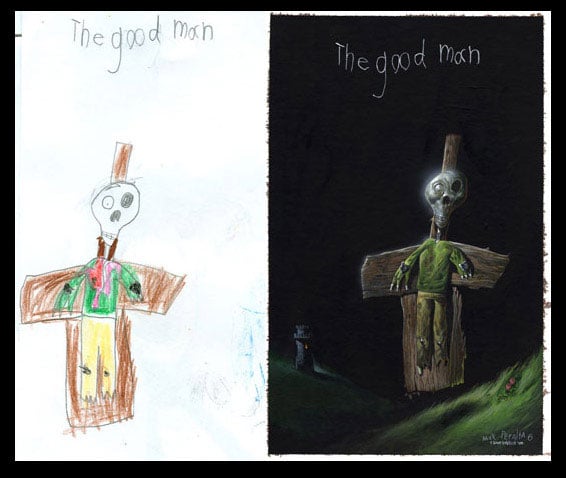
What children's drawings would look like if they were painted realistically

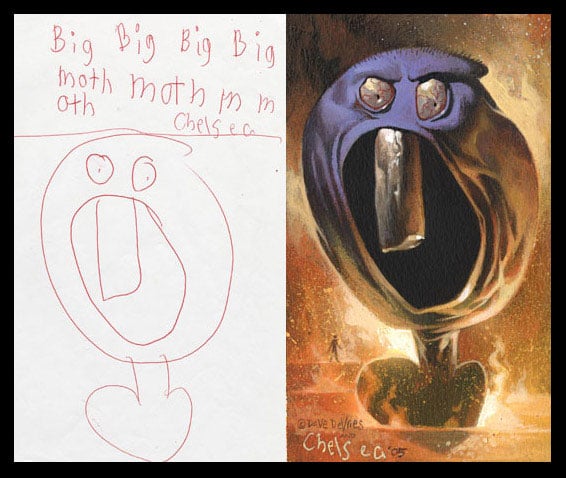
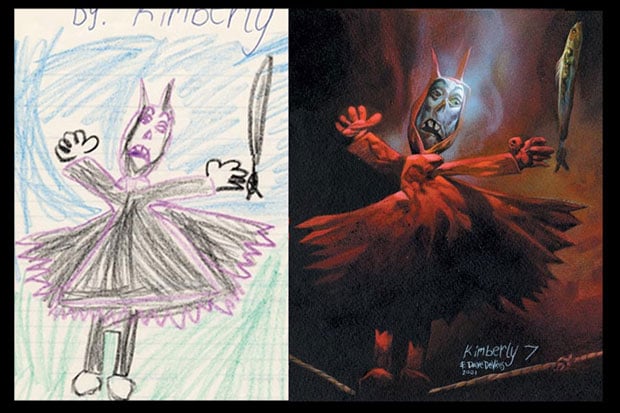
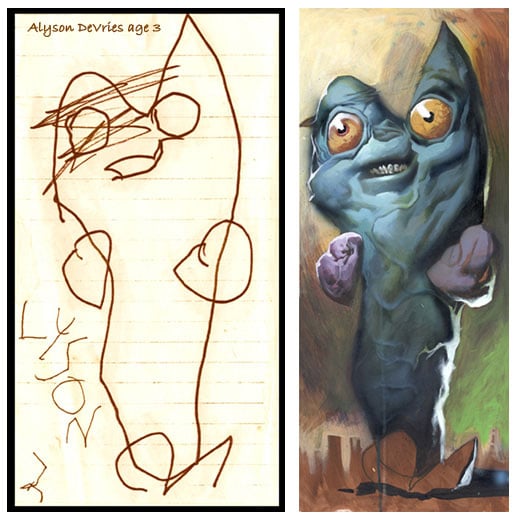
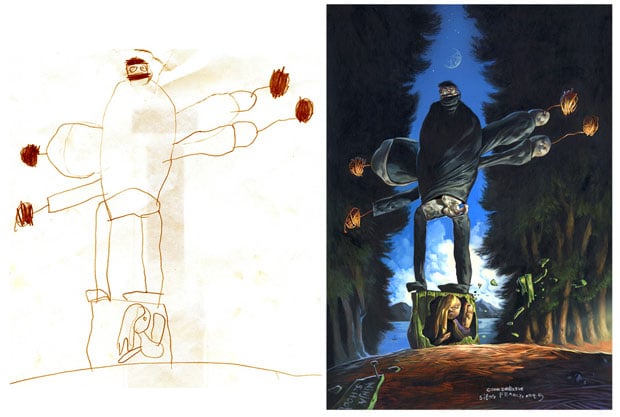
The Monster Engine is one of those projects that make me love the Internet for its ability to expose amazing creative talent to a worldwide audience. Illustrator Dave DeVries started with a simple question: What would a child’s drawing look like if it were painted realistically? In his own words:

It began at the Jersey Shore in 1998, where my niece Jessica often filled my sketchbook with doodles. While I stared at them, I wondered if color, texture and shading could be applied for a 3D effect. As a painter, I made cartoons look three dimensional every day for the likes of Marvel and DC comics, so why couldn’t I apply those same techniques to a kid’s drawing? That was it… no research, no years of toil, just the curiosity of seeing Jessica’s drawings come to life.

The Monster Engine is the 48-page outcome from that curiosity, and it looks wonderful. He describes the process as follows:

I project a child’s drawing with an opaque projector, faithfully tracing each line. Applying a combination of logic and instinct, I then paint the image as realistically as I can.

Below are some of my favorite illustrations from the project. Be sure to check out the whole gallery.

monsters3.jpg

monsters5.jpg

monsters7.jpg

ninja.jpg

monsters1.jpg

Buy “The Monster Engine” on Amazon.

The dangers of teaching without doing

I love teaching and writing about user experience and design, and have often wondered what would happen if I tried to make a full-time career out of doing that. My main fear (well, apart from the fear of failing miserably) has always been that if I stop designing and building products, those muscles might atrophy.

Bret Victor puts that fear into words in his great piece Some Thoughts on Teaching:

Can you trust a teacher whose only connection to a subject is teaching it?

How can such a teacher know if what he’s teaching is valuable, or how well he’s teaching it? (“Curricula” and “exams”, respectively, are horrendous answers to those questions.)

Real teaching is not about transferring “the material”, as if knowledge were some sort of mass-produced commodity that ships from Amazon. Real teaching is about conveying a way of thinking. How can a teacher convey a way of thinking when he doesn’t genuinely think that way?

It’s a great reminder of the value of making things - especially if we often write or talk about the process.

We might as well make beautiful things

This is one of my favorite stories in the Steve Jobs biography:

The result was that the Macintosh team came to share Jobs’s passion for making a great product, not just a profitable one. “Jobs thought of himself as an artist, and he encouraged the design team to think of ourselves that way too,” said Hertzfeld. “The goal was never to beat the competition, or to make a lot of money. It was to do the greatest thing possible, or even a little greater.”

He once took the team to see an exhibit of Tiffany glass at the Metropolitan Museum in Manhattan because he believed they could learn from Louis Tiffany’s example of creating great art that could be mass-produced. Recalled Bud Tribble, “We said to ourselves, ‘Hey, if we’re going to make things in our lives, we might as well make them beautiful.’”

See also The difference between Apple and Microsoft: product before profit.

Taste and consequences

It’s not possible to get to know a man just by reading a book about him. And yet, that’s what many of us are trying to do with the Steve Jobs biography. To be fair, we do this whenever we hear stories about people. We tend to forget that ther’s more to a person than the scraps of information we can extract about them from others. This isn’t necessarily a bad thing, but we must place our opinions in the proper context.

I realize that my thoughts on Steve Jobs are not only based on imperfect words on a page, but I’m also reading those words through the biased lens I use to perceive the world. At best, I’m getting an interpretation of a copy of who he really was. And I’m ok with that, because even feint copies of an original can teach us things, which is why we read these human stories in the first place.

So with that disclaimer out of the way, I believe that Steve Jobs’s genius was rooted in two main character traits: Insanely great taste, and an inability to compromise on that taste at all. This inspires me, but the way his unwillingness to compromise came out of him also makes me extremely uncomfortable.

Jobs’s impeccable taste was evident from very early on:

[T]he Macintosh team came to share Jobs’s passion for making a great product, not just a profitable one. “Jobs thought of himself as an artist, and he encouraged the design team to think of ourselves that way too,” said Hertzfeld. “The goal was never to beat the competition, or to make a lot of money. It was to do the greatest thing possible, or even a little greater.” He once took the team to see an exhibit of Tiffany glass at the Metropolitan Museum in Manhattan because he believed they could learn from Louis Tiffany’s example of creating great art that could be mass-produced. Recalled Bud Tribble, “We said to ourselves, “˜Hey, if w’re going to make things in our lives, we might as well make them beautiful.’”

He understood the intersection of beauty, art, and technology perhaps better than anyone before him (have you notice how recently everything is starting to look like an Apple product?). But his inability to compromise on his almost-perfect taste manifested itself in being a bit of a jerk sometimes. By now, everyone knows the stories about how mean Jobs could be to his employees. My current favorite is the anecdote of what happened when Bruce Horn decided to leave the company. It summarizes Jobs’s volatility so perfectly:

When Horn went in to say goodbye, Jobs told him, “Everything that’s wrong with the Mac is your fault.” Horn responded, “Well, actually, Steve, a lot of things that are right with the Mac are my fault, and I had to fight like crazy to get those things in.” “You’re right,” admitted Jobs. “I’ll give you 15,000 shares to stay.” When Horn declined the offer, Jobs showed his warmer side. “Well, give me a hug,” he said. And so they hugged.

This kind of story is typical throughout the book. He was able to go from “you’re doing crap work!” to “let’s hug” in less than 10 seconds. What makes me uncomfortable is how effective this erratic management style appears to have been. I almost wish we could point to Steve Jobs and say, “see how destructive it is when you’re mean to people?” But her’s the thing: it worked. The Mac team were some of the most brilliant engineers on the planet, because only the good ones were able to survive Jobs’s wrath. And Jobs knew this:

But Jobs had latched onto what he believed was a key management lesson from his Macintosh experience: You have to be ruthless if you want to build a team of A players. “It’s too easy, as a team grows, to put up with a few B players, and they then attract a few more B players, and soon you will even have some C players,” he recalled. “The Macintosh experience taught me that A players like to work only with other A players, which means you can’t indulge B players.”

Even the team themselves seemed to be ok with this style in the end (yes, they were the A players who “survived”, but still):

“As every day passes, the work fifty people are doing here is going to send a giant ripple through the universe,” he said. “I know I might be a little hard to get along with, but this is the most fun thing I’ve done in my life.” Years later most of those in the audience would be able to laugh about the “little hard to get along with” episodes and agree with him that creating that giant ripple was the most fun they had in their lives.

So the source of my extreme discomfort with the Steve Jobs story is that I so desperately want to believe that being a jerk to people isn’t a good way to get the best out of them. But Jobs showed that it certainly is a way to get extraordinary results from a smart, dedicated team. My sense is that not many people can pull this off because you have to be able to back up that behavior with the level of taste that he possessed. This could be the reason why most managers who resort to jerk behavior don’t get the same results from their teams - they have no taste.

For my part, I’m going to take the safer road and stick with the advice given in What Motivates Us To Do Great Work?:

For creative thinkers, [there are] three key motivators: autonomy (self-directed work), mastery (getting better at stuff), and purpose (serving a greater vision). All three are intrinsic motivators. Even a purpose, which can seem like an external motivator, will be internalized if you truly believe in it.

I probably won’t make as big of a dent in the universe as Steve Jobs did, but that’s going to have to be ok.

Design as opportunity to make meaningful connections

I love pretty much everything Frank Chimero writes, and his essay on the meaning of design from a few weeks back still rings in my ears:

We should care more about our craft because w’re granted an opportunity to contribute to the world. We should care more about what we say because each time we speak, ther’s someone there to listen. We should care more about our audiences because they are the ones who give our work value. We might think that design work is about you or about me or anyone else who makes it, or maybe about the things that we make and the artifacts we produce, but don’t let this way of thinking fool you. The things we make are all just excuses to speak with one another and to help one another. We are all linked, and the things that we make for each other strengthen the invisible threads that tie us all together.

Many people won’t agree with this sentiment. Many will think it’s silly to think about something as trivial as web design in this grandiose way. They’ll remind us that we’re just making web sites, not saving the world. And that’s fine - not everyone is going to care as much about design, or even understand why some of us do.

But I do care. I care because I think we have the opportunity to shape a technology that is at once exhilarating and dangerous. A technology that has the massive opportunity to bring people closer together, if we can just keep it together long enough not to destroy each other in YouTube comments and flaming blog posts.

So, yes, I care a lot about this, probably more than I should. But I’m with Frank on this: everything we do is just an excuse “to speak with one another and to help one another.”

I made this on a Mac

It’s amazing to see the outpouring of condolences and memories and stories about Steve Jobs and the effect that he’s had on our lives. What’s most telling to me is the countless people - myself included - who feel like we have a connection with him because of the products he brought into this world. That’s extraordinary.

This morning I counted the number of Apple products we have in our house (12), and I realized that Steve Jobs and those products helped me figure out what I want to do with my life. He showed us the power of beautiful design, and he built products that want you to succeed in whatever it is that you choose to make.

I think Seth Godin said it best:

Steve devoted his professional life to giving us (you, me and a billion other people) the most powerful device ever available to an ordinary person. Everything in our world is different because of the device you’re reading this on.

What are we going to do with it?

I made this on a Mac. And this Mac will continue to inspire me to make better things.

Thank you, Steve.

Update: Of course Frank Chimero would come along and say what I was trying to say, only much better:

That sadness [you feel] is for the loss of a man who unabashedly devoted his life to making things that helped others live well.

We all have that same opportunity. Take a moment to consider your job. Boil it down to its essence: you make things for other people. The most important concept to learn from Jobs is embedded in how we feel after using one of his products. That very same thing is happening now in his wake. Look closely and you will see it: wonderful experiences have an afterglow to them. The delight we find in what we do is in some way lost in the moment, but captured in our memories.

Update 2: There are so many amazing tributes coming through that it’s hard to keep up. I want to preserve the ones that spoke to me in some way, so it might as well be in this post. Here is Michael Lopp:

My first thought as I stared long and hard at Appl’s home page yesterday wasn’t a specific Steve story or one of his many insightful quotes. The thought was”¦

You are underestimating the future. You are fretting about the now; worrying about little things that don’t matter. You are wasting precious energy obsessing over irrelevant details. You don’t believe that a better future is out there and can be built, that it can exceed peopl’s expectations, because you’re spending so much time considering the truth of the present and the seemingly important lessons of the past.

You are underestimating the future because you believe you cannot see it, but you can - you’ve seen it done before.

Update 3: Ok, just one more (I think). Here is Shawn Blanc in 3rd-Party Family:

You and I are on the same team. We all are. We may link to the same articles, review the same products, develop apps for the same market, and design with the same intense perfectionism, but we are a community. Let’s continue to fight for each other, encourage each other, and work together to make amazing things.

We are the 3rd-party family of Apple nerds. Let’s make a dent.

I’ll drink to that.

"Sooner or later you will wake up screaming"

This is such a great story. In How I became a cartoonist, Tom Fishburne explains his journey from drawing cartoons as a side hobby to turning it into a successful business:

I then faced the terrifying decision of when and how to jump and leave a safe job behind to make it a real business. I found inspiration in a quote from David Hieatt: “There is a point on a runway during takeoff that a plane reaches V1 speed. Once it passes V1 it has reached the point of no return. The point where the take off cannot be aborted. The plane has to take off. Or crash.” He suggested that entrepreneurs draw their own V1 line, and then jump when they reach that point.

Here he explains how he dealt with one of his early setbacks:

When you do something entrepreneurial, sooner or later, you will wake up screaming. I discovered that I started to have pain in my wrist if I drew for longer than 20 minutes. This is a problem when you make a living with your hands. It scared me. I highly recommend that you never ever google any health issue you fear you might have. Fortunately, I was able to change my behavior by wrapping my pens in foam rubber, using ergonomic keyboards, and wearing a wrist splint. The pain went away. I learned that any setback is just a test to see how badly you want something.

There is so much honesty and wisdom in this essay - you have to read the whole thing.

Authorship and the balance of science and art in design

I really like Adrian Shaughnessy’s view on design authorship and that constant struggle to find the right balance between art and science in design. From A Layperson’s Guide to Graphic Design:

As designers we are inclined to solve the problems of our clients, but we want to do it in our own way and in our own voice.

Of course, this takes us to the essential paradox at the heart of all types of design: the urge for a personal authorial voice is considered to be antithetical to rational objective design. To be truly objective, the designer needs to remove all personal feelings from the equation and zero-in on a rational solution ”” or so we are told.

Yet there never was great design of any kind that forced the designer to eradicate his or her own voice, and all great design, the stuff that matters, has a strong personal signature which doesn’t impede functionality. Designers may not be artists, but they still want to ”” metaphorically and literally ”” sign the work they do.

(link via @justinspratt)

Why I write: noticing and sharing

Frank Chimero in Stand Clear of the Closing Doors:

Noticing is important, but what’s more important is sharing what one observes to define the edges of the experiences we share. This overlap bonds us, and the best part of paying attention is that it reminds us that we are occupying the same space at the same time as others. We are a part of the world, even in those in-between spaces.

I’ve read many books and articles about writing and why we write, but this is probably the statement that comes closest to my own feelings about writing. I want to share the things I notice in an attempt to find some of those shared experiences and the overlap that bonds us.

C.S. Lewis once said, “We read to know we are not alone.” I guess I write to know we are not alone - especially in an industry like ours that can sometimes feel very isolated.

Ok, that came out way heavier than I planned. In my defense, it’s a rainy Sunday afternoon. Anyway, here’s a video of a dancing cat to balance things out a bit.