Menu

Posts tagged “content strategy”

Solving information overload: the role of manual content curation

There’s an information overload just on articles about information overload, so you might be reluctant to spend time reading another one. However, Accessibility vs. access: How the rhetoric of “rare” is changing in the age of information abundance by Maria Popova is the best commentary I’ve seen on the topic in a long time.

The article starts off by explaining the root cause for the problem we find ourselves in: the concept of “rare” largely goes away if all information is available digitally:

W’re in the habit of associating value with scarcity, but the digital world unlinks them. You can be the sole owner of a Jackson Pollock or a Blue Mauritius but not of a piece of information ”” not for long, anyway. Nor is obscurity a virtue. A hidden parchment page enters the light when it molts into a digital simulacrum. It was never the parchment that mattered.

The consequence is that it’s now so much harder to know what pieces of information are worth our time. Just because something is accessible doesn’t mean we should access it. Maria goes on to explain why editors (or content curators) are so crucial if we want to solve this problem:

The primary purpose of an editor [is] to extend the horizon of what people are interested in and what people know. Giving people what they think they want is easy, but it’s also not very satisfying: the same stuff, over and over again. Great editors are like great matchmakers: they introduce people to whole new ways of thinking, and they fall in love.

Information curators are that necessary cross-pollinator between accessibility and access, between availability and actionability, guiding people to smart, interesting, culturally relevant content that “rots away” in some digital archive, just like its analog versions used to in basement of some library or museum or university.

I do want to add a thought on the idea of “automated curation” - what sites like paper.li are trying to do (you know, those tweets proclaiming that “The [clever name] Daily is Out!”). I simply don’t think effective automated curation will ever be possible. I agree with Angie King on paper.li:

My experience with Paper.li just proves the importance of curation over aggregation. Without an editorial eye overseeing the publication of my Paper.li page, the content loses value. I actually prefer just paging through my Twitter stream over trying to make sense of the no-context, automatically generated list of junk that displays on my Paper.li page.

In a great piece called The language of data: fear + words, Randall Snare explains why automated curation is so difficult:

Emails ”“ and other written things ”“ aren’t just filled with semantic meaning, but with subtext. Algorithms treat words like the basic components of language, while the actual basic components are often hidden ”“ elements like association, nuance, emotion and humour.

Which brings us back to the need for humans - call them editors, call them people who read a lot, call them whatever you want - to help guide us to the information that might interest us. I’d go so far as to say that our ability to grow and learn depends on it.

The welcome shift to context-based e-commerce

Des Traynor wrote an excellent article for .net Magazine called The death and rebirth of customer experience:

Customer service online has been relegated to “handling complaints”. Sites like to boast about how quick they can respond, but it’s rare you’ll hear any boast about what a great shopping experience they had online.

Online businesses are obsessed with user experience, optimisations, page rankings and much more. Yet a thousand of their customers could walk past their offices every morning, and they wouldn’t even recognise them.

In our quest towards total commerce automation, we’ve failed to bring the most important part of commerce with us. The customer experience.

The personal contact and connection that is needed to bring customer experience back to online retail reminds me of Dan Frommer’s thoughts on the intersection of commerce and editorial content. In Commerce as content, shopping through art he writes:

[T]he best wave of new e-commerce companies may also be the ones that are great content producers. That means: Clear writing, attractive photography, and good design. I haven’t done the math, but it seems to me that great content with devoted readers could be a heck of a lot more effective at generating sales than just buying banner ads on random websites.

He goes on to give some great examples of quality editorial content. Both these articles are indicative of a welcome shift away from product-based to context-based e-commerce.

Product-based e-commerce sees the product as the unit of measure, and the user experience is built around presenting products in the best possible light to convince a customer to buy them.

Context-based e-commerce sees the a customer’s unique situation as the unit of measure, and the user experience is built around delighting them based on who they are and how technology can help improve their lives. Quality, personal, context-based content serves as the bridge between product and customer.

Horace Dediu recently wrote about iCloud and, among other things, discussed what happens when “value moves from selling things to ‘getting to know you’”. That phrase is a perfect way to summarize this shift. In getting to know us, e-commerce sites can move away from just selling us stuff, and instead sell us ways to become better people.

The demise of quality content on the web

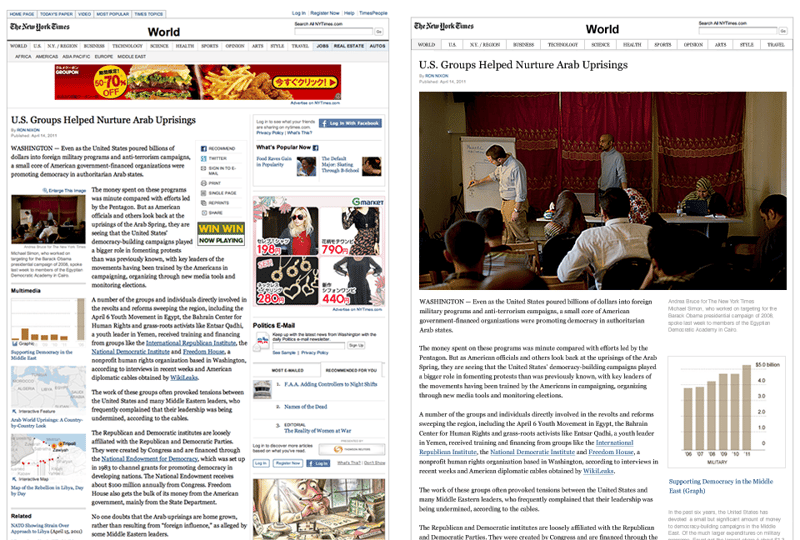
I remember exactly when I decided to stop reading Mashable. I saw the headline Facebook Users Beware: Facebook’s New Feature Could Embarrass You on Twitter, clicked through, hunted for the words of the article among the sea of ads and social sharing icons, and then closed the tab after realizing it’s just another rehash of Facebook frictionless sharing (albeit in a tantalizing way). I went back to my Twitter feed and unfollowed them.

I’m sure the article was great for traffic, though. It is the perfect linkbait title backed up by a perfect SEO-ified URL (/new-facebook-feature). Here’s a screen shot of what’s visible above the fold:

mashable-fold.jpg

You can’t see a single word from the actual article without scrolling. It reminded me of a comment that Merlin Mann recently made in his typically funny and obnoxious style:

merlin-mann.jpg

I think I’ve finally hit the limit of my tolerance for web content that’s designed to make advertisers happy. I have no problem with working hard to build an audience - I have a blog, after all. But we seem to be in this bizarre race to the intellectual bottom to write the most generic article in the world so that everyone with an Internet connection will click through. And the only purpose seems to be to keep the advertising monster fed, fat, and happy.

I’m worried that all the noise makes it increasingly difficult for quality content[1] to be seen. Worse, I’m worried that it’s discouraging the creation of quality content because what’s successful (i.e. what gets the most clicks) is mostly lowest-common-denominator blog post titles that either start with a number or end with a question mark. James Bridle sums up this problem so well in The New Value of Text:

Like over-stuffed attendees at a dull banquet, the mind wanders. We are terrified that people are dumbing down, and so we provide them with ever dumber entertainment. We sell them ever greater distractions, hoping to dazzle them further.

Or as Marco Arment put it: “Anti-intellectualism is one of my biggest fears for our society.”

Yet despite all the evidence to the contrary there is still a common refrain on the Internet that quality content will always find its way out of the depths of obscurity. Kristina Halvorson recently complained about the fact that computer-generated articles are gaining traction. Joshua Porter responded: “Re: quality content…there is always room at the top.” My response to that was cynical, but borne out of the type of regurgitation you see everywhere:

to-bokardo.jpg

I used to believe that if you write with passion and clarity about a topic you know well (or want to know more about), you will find and build an audience. I believed that maybe, if you’re smart about it, you could find a way for some part of that audience to pay you money to sustain whatever obsession drove you to self-publishing (and to do it without selling your soul in the process). There are certainly examples of that out there (Daring Fireball, Shawn Blanc, Ben Brooks, etc.), but I’m not convinced any more that such an option exists for anyone who works hard and gives it a solid go.

The problem is not that people don’t have enough time, it’s that people don’t have enough attention. Like an oil well there’s only so much there, and once the well runs dry you don’t have a lot of options:

So one effect of Peak Attention is that every human mind has been mined to capacity using attention-oil drilling technologies. To get to Clay Shirky’s hypothetical notion of cognitive surplus, we need Alternative Attention sources.

The wells of attention are being drilled to depletion by linkbait headlines, ad-infested pages, “jumps” and random pagination, and content that is engineered to be “consumed” in 1 minute or less of quick scanning - just enough time to capture those almighty eyeballs[2]. And the reality is that “Alternative Attention sources” simply don’t exist.

I don’t know where we go from here. I just know that I’ve stopped reading sites that cater more for advertisers than for me as a reader. It won’t make much of a difference, but it will hopefully help me sleep better.


  1. Of course, we’re never going to agree on what “quality content” means. It’s one of those “you know it when you see it” things, and everyone’s definition will be different. Still, my personal view is that quality content presents two or more of the following components: (1) new information, (2) interpretation of information, and/or (3) a well considered personal opinion about what the information means.  â†©
  2. Wait, who am I to decide what people should and shouldn’t read? You’re absolutely right, I can’t do that so I should get off my high horse and let people read whatever they want to read. This is an opinion piece.  â†©

Design and copy changes in the new Windows 8 "blue screen of death"

In a recent episode of The Talk Show, John Gruber and Dan Benjamin pointed out something interesting about the Windows 8 redesign of Microsoft’s well-known “blue screen of death”. First, here’s an example of what this screen currently looks like:

windows-old-blue-screen-of-death.jpg

Notice how Windows essentially accepts the blame in this situation. The title of the page says “Windows”, and they give you the cold, hard facts: An exception occurred. The application will be terminated, and you have to restart. Sucks to be you.

Compare that to the redesigned screen for Windows 8:

windows-8-blue-screen-of-death.jpg

Notice all the subtle differences here. The emoticon to put you at ease. The nice font. The assurance that they will restart the computer - you don’t have to do it yourself like in the previous version. But most of all, notice the copy changes.

Your PC ran into a problem that it couldn’t handle and now it needs to restart.” In this version Windows isn’t the culprit any more - your PC is. Your computer did something it shouldn’t be doing so it broke. “But hey,” they say, “don’t worry, Windows has your back and is swooping in to save the day!”

It’s a subtle change in design and copy, but credit where it’s due: this is pretty clever.

Slides: An introduction to user experience design

One of the talks I do at speaking events is a general introduction to the elements of user experience design. The slides are always evolving so I’ve been hesitant to upload the presentation to Slideshare since it will be outdated pretty much immediately. It’s also a presentation that relies heavily on the voice-over - it’s not really something you can just read from front to back.

Having said that, I think it’s time to put at least a version of the presentation online, with a bunch of disclaimers about how this is a simplified view of what UX is, that it requires explanation in a lot of areas, and that it’s definitely not exhaustive or the only way to think about UX. Here’s the summary:

In this talk I give an overview of the elements of User Experience Design, and more importantly, why you should care about it. The goal is to provide some baseline knowledge of the user-centered design process to equip anyone to take those skills back to their daily work and start applying it immediately. I discuss user experience research, content strategy, interaction design, and visual design, and how those elements work together to build great experiences.

So, here you go. I hope you find it useful.

Frictionless content sharing and the shifting burden of understanding

Frank Chimero reflecting on Facebook’s advances in “frictionless sharing” of content:

Any physicist knows that it’s impossible to exist in a frictionless universe, and that friction hasn’t been diminished with Facebook’s sharing model so much as transferred the work of making sense of things from the one sharing to the audience.

I recently mentioned that reducing the effort needed to share and communicate with others might be inching us closer to a post-literate society. Frank’s remark adds another consideration: the reduced effort required to share information places the burden of understanding much more on the audience than on the person sharing.

“Frictionless” sharing of what song you are currently listening to sounds interesting at first, and then it just starts to sound creepy. But even if you can get beyond the creepiness factor you’re faced with the fact that it becomes the audience’s responsibility to make sense of that information. How interesting is knowing what song I’m listening to without an explanation why I’m listening to it and what it means to me?

At what point will all this lazy sharing result in lazy audiences who can’t be bothered to go hunting for the meaning in the information? At what point does the audience become mere “consumers” of content in the true sense of the word - “to destroy or expend by use” - and end up in a similar situation as the obese passengers on the Axiom?

Deluge of Content on the Web Swamps Yahoo (and puts content creators in a tough spot)

The Wall Street Journal in Deluge of Content on the Web Swamps Yahoo:

As Web traffic explodes, Internet companies are struggling to profit off ads shown next to the articles, videos and other content offered to viewers.

It’s a simple rule of any market. The more information that is created, the more the value is reduced. And despite attempts to woo spending with bigger, bolder and more targeted ads, services that help consumers navigate that content, namely search, remain the big money makers online.

As I (and many others) have written before, it doesn’t look like display advertising is a sustainable business model for media sites going forward (and I think we can agree that it makes for a pretty bad user experience). This puts content creators in quite a predicament: how do you make money from producing content? The WSJ piece points to the central problem here:

“People tell me that content is king, but that is not true at all,” says Rishad Tobaccowala, chief strategy and innovation officer at Vivaki, the digital-media unit of Publicis Groupe SA. “Most people make money pointing to content, not creating, curating or collecting content.”

Although the value of pointing to content is indisputable, we need a better way than display ads for content creators and curators to make a living. And I don’t think we quite know what that looks like yet.

Content Designed to Manipulate Users

Back in 2004 Adam Greenfield wrote down some ethical guidelines for user experience in ubiquitous-computing settings. He starts off as follows:

Principle 1: Default to harmlessness. Ubiquitous systems must default to a mode that ensures their users’ physical, psychic and financial safety.

That might sound a little overly dramatic, but as we’ll soon see, it’s a very important principle for a designer to keep top-of-mind. Adam goes on to say this:

Principle 5. Be deniable. Ubiquitous systems must offer users the ability to opt out, always and at any point. As an absolute ethical imperative, users must be afforded the ability to make their own meaningful decisions regarding their exposure to ubiquitous perception, the types and channels of information such exposure will necessary convey, and the agencies receiving and capable of acting on such conveyance. Critical to this is the ability to simply say “no,” with no penalty other than the inability to make use of whatever benefits the ubiquitous system offers its users.

Now. Think about those principles, and then have a look at the newsletter preferences page for eBucks:

eBucks Newsletter Preferences

The text in the opt-out line reads:

I’m not concerned with my eBucks balance and I don’t think I should be the first to know about all the latest news.

It’s an interesting content approach taken by eBucks, and one I would argue violates both principles I quote above. They are basically making you feel out of touch (“be deniable”) and a little bit stupid (“default to harmlessness”) if you don’t subscribe to their newsletter. Are they also implying that you won’t be able to view your balance if you don’t subscribe? Probably not, but it can be interpreted that way.

Fast forward a few years after Adam’s article, and we now even have a name for this type of tactic. It’s a classic example of persuasion design:

Persuasion design doesn’t share User-Centered Design’s ethical neutrality. Instead, it makes an implicit but undeniable judgment that certain behaviours are preferable to others.

Persuasion design prioritises business goals above those of the user, and its values are irreconcilable with empathy, the central value of User Experience.

This is just one example, but you can see it everywhere. It might seem innocent at first, but it’s such a slippery slope to the evil of dark patterns. We need to consider the implications very carefully before we employ such techniques.

No More Banner Ads: Alternatives to Ad-Supported Media Sites

This morning I read an article about something that’s been on my mind for a while: Banner ads on media sites/blogs. In The Truth About Display Advertising, Mitch Joel writes:

Go to the website for your local newspaper. How many display ads, banners, buttons, text links, etc… do you see that are ads? Mine has over 15. That’s not in consecutive order… that’s all at once. It’s hard enough to get consumers to sit through four TV ads in a row, so what did you expect to have happen when you blast them with 15 ads on one page, all at once? Foregoing the aesthetics and the basic Marketing lesson that an ad will experience diminishing returns based on how cluttered the environment that it’s placed in is, does anyone really believe that this is the best way to advertise to consumers in the digital spaces?

No. I don’t think this is the best way to advertise to consumers. In fact, I don’t even think advertising is the best way to monetize media sites either. But are there viable alternatives? I think there are at least two business models that could work.

Distraction-Free Reading

One of my favorite services on the web is Readability. Users sign up for at a low monthly fee (minimum $5), and it then allows them to read articles in a beautiful distraction-free environment with all the ads stripped out. But here’s the best part: publishers also get something out of it:

70% of all Readability membership fees go directly to writers and publishers. Every time a subscriber uses Readability on your site, a portion of that subscriber’s fees are allocated to you. Whether in a web browser, iPhone, or just about any mobile or tablet device, Readability puts reading ”” and your content ”” at the center of the experience.

Here’s a 1-minute video that summarizes the experience:

You’ll also see that the Readability buttons are the only content sharing buttons I have on my blog apart from the Tweet button. There are many reasons for only choosing those two, but with Readability it’s simple - I think they have a fair business model where both reader and publisher win.

How would this work as a replacement for ads? Sites could integrate the “Read Later” functionality in some innovative ways. Sites that publish a lot of content could provide an ad-free home page with content snippets and “Read now/later” buttons to get to the full article. Users without a Readability (or an equivalent) account could view ad-supported full articles if they prefer. My hope is that content would win and readers would start to prefer paying small amounts of money for ad-free reading environments.

This is by no means a well-explored alternative for ad-supported sites, but it could be the beginning of something great that rewards both readers and publishers.

Business Class Subscriptions

Oliver Reichenstein recently posted another very interesting alternative to traditional paywalls on sites like the New York Times. He refers to it as Freemium for News, and the idea is that instead of paying for additional content like with traditional paywalls, you pay to get a better experience (just like paying for Business Class still gets you to the same destination, but in a much more comfortable way). Think of it as a Readability season ticket for a specific site. Here is one example he shows:

Now, think about how this might work for ad-supported sites. I would certainly pay $0.99/month to access a Business Class version of TechCrunch. Would you?

But Can Any Of This work?

Realistically, could either of these ideas provide viable alternatives to the traditional ad model for media sites and blogs? Probably not yet. But I don’t think we’re seeing enough discussion about alternatives, particularly those that focus on user experience as opposed to “monetizing traffic”. I also don’t think these ideas would ever replace ads completely (just being realistic), but at the very least it could provide an additional revenue stream that’s actually based on what users want, not on what advertisers want to push down our throats.

Let me end with something I probably should have begun with. I am no expert in the area of publishing, so it’s easy for me to back-seat-drive media sites out of their biggest source of revenue - after all, it’s not my car. I am in the lucky position where I don’t need to monetize this blog, so I don’t really have to make tough decisions about these things.

But I do hope that if I ever need to make money here, there would be a viable alternative to putting ads all over the page. I just don’t think an ad-supported User Experience Design blog is a good idea. So from the back seat I just ask those who make a living in the publishing industry: Can you please figure out how to do this so I don’t have to?

The KFM Website Redesign Project, or What's Wrong With Our Industry

I just found out about the redesign “project” (not sure what to call it) that South African radio station KFM is kicking off (thanks for the heads-up @1rene, @kerry_anne, @allankent, @wendyrobb, and many others). Here is the ad for it:

I’ll stay away from the cheap shots you could take on the ad itself, because granted, they’re admitting they need a designer. Instead, I’d like to focus on two major problems with the idea itself, and what that means for the web design industry.

1. Design is not “colours, fonts, textures, spacing, layout and images”

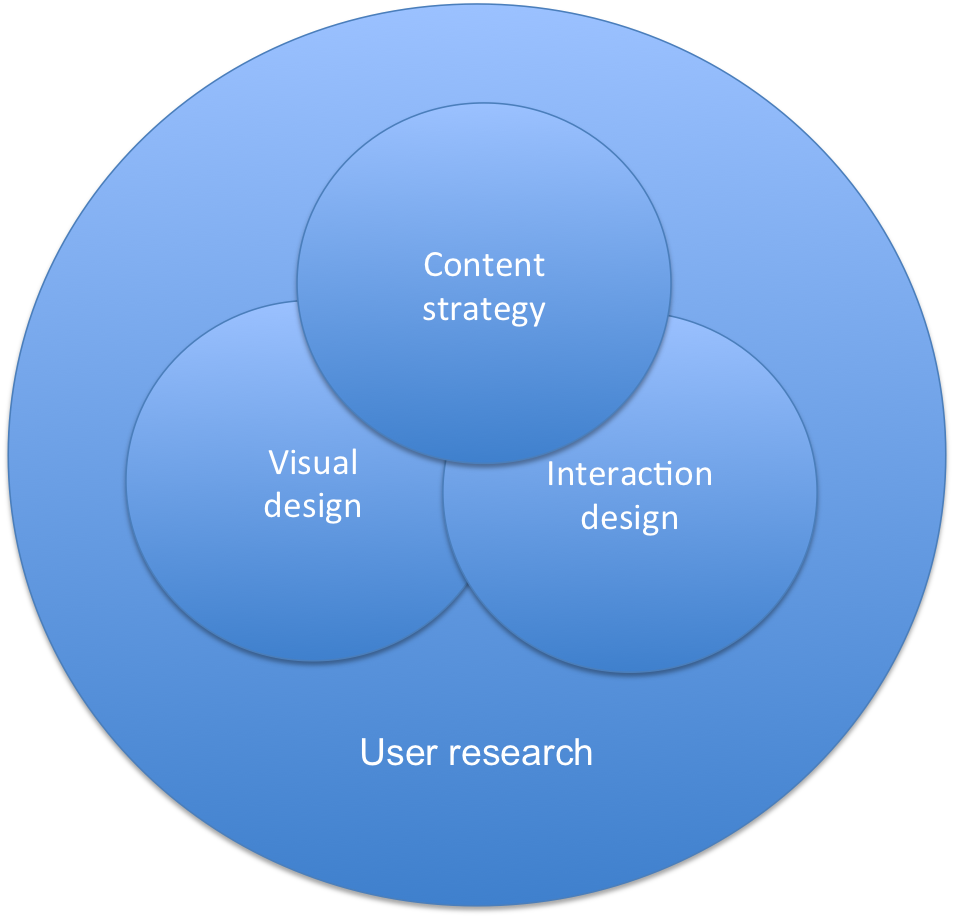
It’s really shocking that we still need to have this conversation in 2011, but guys, what you’re asking for is Visual Design. What you should be asking for is User Experience Design, which is made up of so much more than what you’re asking for:

There is no space or time to go into it here, but the point is that you need a User Experience designer to help you understand these elements, and not just give you a pretty design that doesn’t meet user needs.

  • User research helps you uncover user needs and expectations for the site.
  • Content strategy helps you define the voice and tone of your site, and writes content that meets the needs of your target visitors.
  • Interaction design helps you design an information architecture and a flow through the site that lets users accomplish their goals in the most efficient way possible.
  • Visual design provides the appropriate visual language to guide users along this ideal path that you define (and, fine, it also makes it pretty).

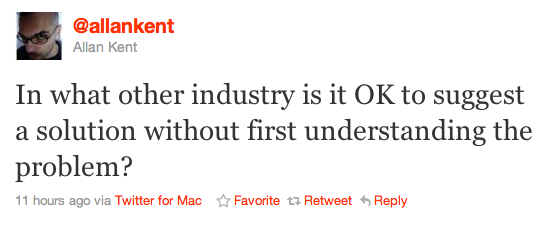
I think @allankent summed up my feelings about this issue the best:

Please KFM (and everyone else thinking about a redesign): don’t just make your site pretty. Make it something that allows your visitors to find the content they’re looking for, and enjoy it while they’re there.

2. “If you’re good at something, never do it for free.”

The second problem with this project is almost worse than the first. And that is the expectation that a designer should give up his or her time for free to work on this. Just, you know, for love of the game. The Joker’s words in The Dark Knight bears repeating:

If you’re good at something, never do it for free

If KFM is serious about a site redesign, they’ll pay for a proper redesign project, not ask people to give away their skills for free. Good design is hard, and if you paid the price it takes to become good at it, you should be compensated for your time. After GAP asked designers to redesign their logo for free a few months ago, Mike Monteiro wrote a great post on this that you must read. In Dear Gap, I have your new logo, he says:

Man, that stuff took time. A lot of time actually. And a tremendous amount of effort, as well as expertise. Expertise that came from a combination of training, which I had to pay tuition for, and experience. I’m good at this because I’ve done it a lot. Sure, ther’s some natural talent there, but by and large I’ve gotten good at my job the same way every other worker has. By experience, by focused effort and by learning from my mistakes.

So as much as I’d like to just show you the greatest logo I’ve ever made for anyone (“¦and trust me, if Paul Rand himself saw it, he would realize he was merely the Pippen to my Jordan.) I’d like to be properly compensated for it. Because I put a lot of time and effort into it. And it’s how I earn my living.

And that time and effort was used to make sure I delivered something that actually met your needs and objectives. You guys have numbers to meet. And plans for the future based on meeting those numbers. So do I.

And for the sake of full disclosure I should let you know that I’ve also frequently shopped at your stores. You sell good stuff. But never in my experience has any of your employees offered me a free pair of pants because the ones I was wearing looked bad. I wouldn’t expect them to. Their job is to sell me clothes.

My job is to sell design.

To designers: please, please don’t cheapen our industry by doing something you’re good at without compensation.

And to KFM: please don’t ask people do this work for free. I’m really happy you want to redesign your site, but you should pay UX professionals to help you do it. I guarantee you will be happy with the result.

If we’re going to move this industry forward in South Africa, we’ll need to start being serious about what design really means. And that means putting money behind the education and employment of user experience professionals.