Menu

Posts tagged “user research”

Quote: Tomer Sharon on the importance of understanding a problem

The question “How do people currently solve a problem?” is critical, because deeply understanding a problem can go a long way toward solving it with a product, feature, or service. Falling in love with a problem happens through observing it happen in a relevant context, where the problem is occurring to people in your target audience.

—Tomer Sharon, Validating Product Ideas

The ethics of "empowering" users

Katherine Benjamin wrote a fantastic essay on designing for user empowerment, and what that really means. She asks, specifically in the context of digital health, When are we empowering users, and when are we just being lazy?

The World Bank talks about empowerment in terms of two things. Firstly, they talk about enhancing an individual’s capacity to make choices. They then talk about leveraging those choices into desired actions or outcomes. […]

When we think about things like wearable devices that enable people to actualise the “quantified-self”, we are usually realising just the ability of someone to self-monitor. In other words, we can make it possible for people to take better care of themselves by developing new technologies that support self-care. However, these innovations will only help those who are genuinely interested in taking greater control of their health. This type of self-determination with regard to health is a necessary pre-condition for successful adoption of digital health solutions.

Unfortunately, all too often, in the digital health industry, we get lazy and speak as though technology itself can create that individual level of empowerment. This fails to consider the inherent power dynamics between providers and users of health services, and the role this dynamic plays in facilitating agency among the users of health services.

When we design to empower users we can’t just think about giving people the information they need to act. We also need to help them develop the desire to act on that information.

Beyoncé, Coldplay, and the myth of the “average” user

I am not qualified to talk about politics so don’t worry, I won’t. That said, Spencer Kornhaber’s essay on Beyoncé’s Radical Halftime Statement is so incredibly good (and very applicable to product design) that it’s worth discussing here. The part that I found particularly interesting is how differently Beyoncé and Coldplay view their “target markets”. Beyoncé is very focused:

But in pop and in politics, “everyone” is a loaded term. Stars as ubiquitous as Beyoncé have haters, the “albino alligators” who “Formation” informs us she twirls upon. And in a more general historical sense, “everyone” can be a dangerous illusion that elevates one point of view as universal while minimizing others. Beyoncé gets all of this, it seems. As a pop star, she surely wants to have as broad a reach as possible. But as an artist, she has a specific message, born of a specific experience, meaningful to specific people. Rather than pretend otherwise, she’s going to make art about the tension implied by this dynamic. She’s going to show up to Super Bowl with a phalanx of women dressed as Black Panthers.

Whereas Beyoncé is very specific about who her music is for (and not for), Coldplay tries to please everyone:

The poor guys of Coldplay, meanwhile, actually think they can work solely at the level of the universal. “Wherever you are, we’re in this together,” Chris Martin cried out, early on, last night. I don’t want to diss that intention, nor the take-home message at the end: “Believe in Love.” But from their first hit, “Yellow,” to their recent Holi-appropriating music video with Beyoncé, to their pan-cultural rainbow rally at Levi’s Stadium last night, their theme has only been about love to the extent that it’s been about how everyone loves colors. It’s music about being awed by the blandest kind of harmony: ROYGBIV, yeah yeah yeah!

Coldplay’s approach reminds me of this classic Sharp Suits poster:
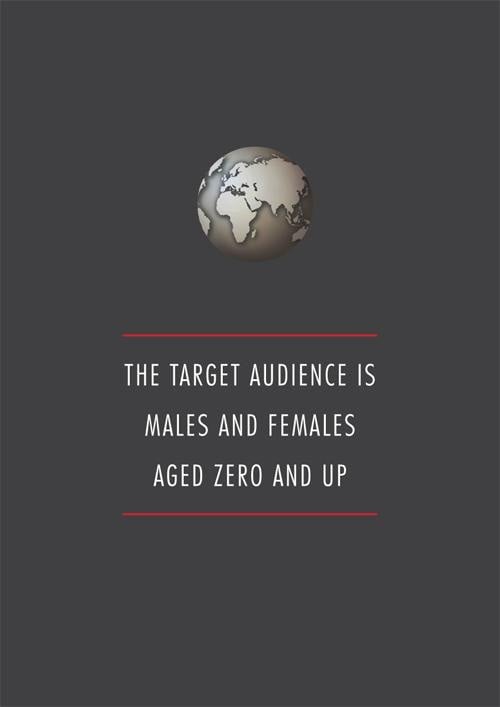
The problem with a target market of literally everyone is that you end up with a heavily compromised experience that appeals only to the very few people who identify with the “average” experience. Bringing this back to product design, this is why I’m still such a big fan of design personas. As opposed to a mythical “average” user, personas are solid people we can imagine using our product to achieve their goals. This is helpful because by focusing on a few different individuals that are closer to the edges of an experience, instead of the average, we end up catering for a larger portion of the user base:
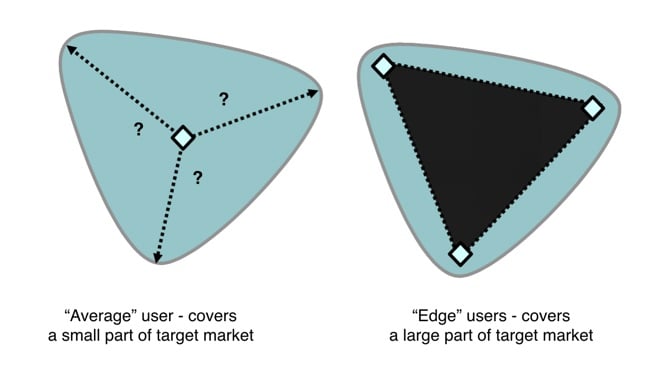
Persona edges

This is what Beyoncé does so well. She makes music at the edges, so it’s exciting and anything but bland. It’s a lesson that Coldplay clearly hasn’t learned yet.

Netflix and the problem with established interface mental models

There were some interesting Netflix articles over the past week or so. First, Nathan McAlone writes that Netflix wants to ditch 5-star ratings:

The problem, [CPO Neil] Hunt tells Business Insider, is that people subconsciously try to be critics. When they rate a movie or show from one to five stars, they fall into trying to objectively assess the “quality,” instead of basing the stars on how much “enjoyment” they got out of it.

Here’s an example. Let’s say you had fun watching a crappy movie, but still gave it a two-star rating because you know it’s not a “good” film. That presents Netflix with a problem. The system thinks you hated the movie.

I think embarrassment plays a part in this as well. Even when ratings are private, we’re worried that word might get out. For example, I’d be happy if all my Netflix recommendations consist of “Movies similar to Battleship”, but I certainly don’t want any of you to know how much I liked that terrible movie.

Related to this, McAlone also wrote about Netflix’s most important metric:

That means that the most important economic metric for Netflix is how much a TV show or movie contributes to Netflix’s ability to sign up and retain customers.

The problem is that the current star rating system doesn’t give them that metric because it’s associated with “quality”, not “enjoyment”. So I might rate Out of Africa 5 stars because I objective know it’s a good movie, but if Netflix starts recommending “Boring movies with Meryl Streep” to me, I’m out of there.

Netflix has a very difficult product design challenge ahead of them. They have to change an established user mental model (“stars=quality”) to something different (“tell us what you enjoy watching”) that will help them provide a better and more compelling service.

Why projects fail if they neglect research

Erika Hall’s The Secret Cost of Research is a great explanation of why research is essential for products to succeed:

The reason design projects that neglect research fail isn’t because of a lack of knowledge. It’s because of a lack of shared knowledge. Creating something of any complexity generally requires several different people with different backgrounds and different priorities to collaborate on a goal. If you don’t go through an initial research process with your team, if you just get down to designing without examining your assumptions, you may think your individual views line up much more than they do. Poorly distributed knowledge is barely more useful than no knowledge at all.

I can definitely attest to this. It’s exactly why I’m such a big fan of Product Discovery:

This phase always—without fail—produces insights the team finds incredibly valuable. Startups gain clarity about what to say “yes” and “no” to in their product, and large corporations learn how to go beyond customer-centricity buzzwords and discover which benefits they should be selling to their users. As just one of many examples, I was once in a workshop that revealed the executives had a completely different vision for the company than the designers and developers. It was an awkward two hours, but in the end they agreed on the tough but correct decision to suspend their e-commerce plans until some of the content areas on the site had been sorted out. It’s great to see a statement of purpose emerge from these sessions—one that finally gets an organization to agree on what the product’s focus should be.

It’s pretty remarkable how different people’s visions for a product can be, especially since there’s such a simple two-step program to fix that:

  1. Understand user needs and business goals.
  2. Talk about it, together.

Encouraging creativity at all levels of society

Back in 1979 anthropologist Michael Thompson wrote a book called Rubbish Theory. Considered ahead of its time, the book—which has been out of print for decades—explores how discarded objects can become valuable and fashionable again, and how the line between what is regarded as rubbish and what is not regarded as rubbish can be moved. In the article Highlight the power of creativity from below Lorenz Khazaleh interviews Thompson about how the book (and underlying theory) is now finally finding an audience among anthropologists and city planners.

Here is Thompson on seeing so-called “waste pickers”—people who go through trash for valuable objects—as entrepreneurs who are creating wealth:

For example, during the workshop it was said that it does not make much sense to see waste pickers as complete victims. It makes more sense to see them as small-scale entrepreneurs who are creating wealth. They are not excluded, but they are not being recognized for what they are doing. Through skilled sorting and recycling, they are giving material that others regard as worthless new value. This change of perspective has gigantic implications, and not least for climate change.

Thompson goes on:

People generally are very creative and innovative. Many anthropological case studies have shown that. If development happens, it does not happen just through large-scale and “top-down” projects, but thanks to some sort of self help at the very lowest level. But often this creativity from below is not appreciated by the authorities or the wider society. Waste pickers who are sidelined or even prosecuted by authorities are just one of many examples. So, this is a wonderful opportunity for anthropologists to jump in and try to change public policies that prevent people from helping themselves.

This is yet another example of how beneficial anthropology (and its business cousin, ethnography) is in our understanding of people and their needs.

Designing cities for citizens of all ages

Dominic Basulto wrote an excellent summary of a recent McGraw Hill Financial Global Institute report called What the world’s best cities will look like in 2030. The main point the report makes is that people in cities are aging, and we’re not really paying attention to that. There are, however, several things we can do to make sure that older people can live comfortably in our cities:

First, the city of the future should have the infrastructure and transportation links to address the needs of citizens of all generations. Second, each city should build new housing options to enable older citizens to “age in place.” Thirdly, each city should include access to community health programs with innovative medical technology for seniors. And finally, the city of the future should have plenty of opportunities for continuing work, education, arts and recreation for all ages.

This reminds me of an attempted joke I made the other day about the font size in Facebook Messenger1:

You’ll get old too, young designer. And when you can’t read your own product any more I’ll laugh so hard my teeth with fall out.

— Rian Van Der Merwe (@RianVDM) August 31, 2015

From cities to software, the evidence is all around us that if there’s one thing we desperately need to build more inclusive products, it’s a more diverse workforce. It’s very hard for us to design for people and situations that we have no experience with. We need to make sure our workplaces are more diverse, and then we need to go out and understand our users.


  1. I’m ridiculously embarrassed about that typo. 

Using ethnography to build better products

Craig Mod’s essay on doing design ethnography in Myanmar is so far my favorite piece of writing of the year. In The Facebook-Loving Farmers of Myanmar he shares some notes about the team’s visits and interviews:

There is a phrase repeated over and over again during my time in Myanmar: From no power to solar, from no banks to digital currencies, from no computers and no internet to capable smartphones with fast 3G connections. It is the mantra of consultants working in these emergent economies. And these emergent economies have one colossal advantage over the entrenched and techno-gluttonous west: There is little incumbency.

There is, however, instability—in government and currency. It’s one of the reasons why a country like Myanmar is just now getting these connections, these devices. The instability significantly increases risk for outside investors and companies. But the residual effect of that instability is a lack of incumbency and traditional infrastructure. And so there is no incumbent electric giant monopolizing rural areas to fight against solar, there is no incumbent bank which will lobby against bitcoin, there are no expectations about how a computer should work, how a digital book should feel. There is only hunger and curiosity. And so there is a wild and distinct freedom to the feeling of working in places like this. It is what intoxicates these consultants. You have seen and lived within a future, and believe—must believe—you can help bring some better version of it to light here. A place like Myanmar is a wireless mulligan. A chance to get things right in a way that we couldn’t or can’t now in our incumbent laden latticeworks back home.

It’s a long article, and it should be. There’s so much insight here, just from spending a few days with people observing, listening, understanding. I don’t understand why this truth is so hard for some product leaders to understand:

A common mistake in building products is to base them on assumptions around how a technology might be adopted. The goal of in-field interviewing in design ethnography is to undermine these assumptions, to be able to design tools and products aligned with actual observed use cases and needs.

Just imagine how different the world would be—and what incredible products we’d be able to build—if we always took the time to understand users and their needs in this way first.

Service design for airport restrooms

The Transportation Research Board (TSB) recently published a 100-page PDF called Guidebook for Airport Terminal Restroom Planning and Design. If I know anything about the readers of this site, it’s that this is the kind of stuff we live for. Service design for airport toilets? Sign us up!

Ian Bogost provides a handy summary of this delightful document in The Airport Restroom of the Future:

The TSB report ends with an appendix on the “Airport Restroom of the Future.” After a surprisingly detailed history of public toilets, the TSB concludes that gender-neutral restrooms would offer travelers the most relief. Not only would they better address evolving gender identity norms, but they would also reduce congestion, maintenance, and accessibility by foregoing the barriers that help create the constriction of today’s restrooms. The TSB’s mockup puts individual sink basins in stalls to avoid flow to a common sink area, and adds a spacious waiting area flanked by two “art vitrines.”

I doubt airports care much about this, but it’s at least nice to see the TSB investing in this kind of service design research.

A better way to approach Net Promoter

Back in my eBay days, when Net Promoter was just becoming a huge deal, there came a time when we were asked to include the measurement in our user research. Even then I was extremely uncomfortable with the simplistic nature of the measure, but I just didn’t have the experience to speak up about it. It seems that NPS is finally getting the wind taken out of its sails. The latest takedown I read is Matt LeMay’s excellent On Net Promoter and Data Golems:

This very ubiquity is a huge part of what makes Net Promoter so attractive. It’s a system with an official-sounding name that consistently produces a measurable quantitative output. The score it produces can be easily benchmarked against that of any other company. And this is why, no matter how many times it is critiqued and debunked, Net Promoter only seems to grow in power and pervasiveness. The primary value of Net Promoter is not how effectively it predicts customer loyalty, but rather how effectively it covers your ass.

The main problem with the NPS question—“How likely are you to recommend [product] to a friend or colleague”—is that it’s a data model that doesn’t fit the social model of recommending products.

But by oversimplifying the multifaceted and highly variable human context around recommendation, Net Promoter falls into one of the biggest pitfalls of the “data-driven” age: it puts forth a data model that does not accurately reflect the underlying social model. When’s the last time you thought to yourself “I am likely to recommend this product to my friends or colleagues” as opposed to something like, “I can’t wait to tell my friend Tricia about this new slow cooker because I know that she doesn’t like to cook things on the stove”?

Luckily, Matt provides some really good ways to improve the use of NPS. Is this is something you deal with in your company I highly recommend his article.