Menu

Posts tagged “startups”

12 metrics to track for B2B SaaS companies

Elena Verna has a great summary of leading metrics for B2B SaaS companies, including some really useful benchmarks. Also a good reminder that revenue is a lagging metric:

Many leaders obsess over revenue. And rightfully so, because revenue is the outcome of any business. But revenue is a lousy metric to goal the team against because it assesses past performance instead of predicting the future.

If you want to dig a little deeper on the best metrics to choose for SaaS companies, here are a few more resources:

Hyper-growth, and the power of doing more with less

David Poblador writes about The Pitfalls of Hyper-Growth: How Companies Can Do More with Less. Startups tend to operate more with a scarcity mindset at the onset, but as they grow…

As businesses grow, they often rely on flawed indicators of success that do not necessarily correlate with sustainability. One of the most common measures of success is headcount growth. Unfortunately, hiring lots of new employees can create inefficiencies, harm company culture, and reduce productivity. When hiring becomes the only tool to get the job done, it can detract from the most important things, like focusing on priorities and managing the company’s lifecycle.

David’s post led me to a fascinating interview with Jesper Kouthoofd, who is the founder of music-tech company Teenage Engineering. In the interview he talks about why they specifically avoid running after hyper-growth:

We only want to make great products and when you don’t focus only on making money and have reached a certain level, everything becomes about quality. Right now, there is a certain cultural fascination with fast growth, IPOs and so on, but I want to go slow, really slow and think long-term. It takes time to do good things. You see, this cultural phenomenon of speed and growth at all costs is displayed in every startup, they all look the same, it’s like fast food: it looks good, its taste is consistent but then you feel horrible afterwards.

This is obviously not desirable or true for all companies, but it’s worth noticing that there is more than one way to run a business.

The 4-subfunctions of growth marketing, and a good Figma example

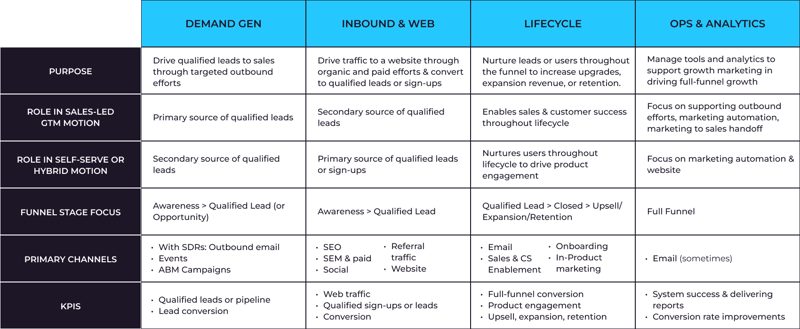
In How to organize your B2B growth marketing team Emily Kramer explains growth marketing in a way that I think I finally understand:

To support full-funnel marketing, multiple GTM motions, and all of the data and tools available, 4 sub-functions of growth-marketing are needed: Demand Gen, Inbound & Web, Lifecycle Marketing, and Ops & Analytics.

Emily also touches on the many ways that this team ideally works with Product and Engineering. It’s a highly recommended overview of this critical function in an organization.

And speaking of growth marketing… In Figma and product-led sales Jesus Requena, former head of growth marketing at Figma, shares some really interesting details on how Figma’s Growth team works with their Sales team:

We wanted to take this to the next level and learn what exact product behavior correlated with an upgrade. We partnered with our data product team, sales ops and sales leaders and created a model that surfaced around 10 data points. When two or more of these were triggered, there was a high likelihood for the account to upgrade. We showed sales and sales leaders the data and got their interest, then we tested it in a small group. Endgame, the product-led sales software, helped us display the data at account level and user-within-account level.

Engineering maturity models and the importance of a strong foundation above all else

In his article Engineering Maturity Model Mike Fisher shares how he thinks about the importance of different team capabilities when building software organizations. Despite how some maturity models—such as the Capability Maturity Model (CMM)—have been misused in the past, Mike encourages us to look past the process and focus on the principles. Here’s the important part:

[The layers] aren’t stages in that you’re never really finished with any of them but you do need to have the ones at the base stronger and more developed than the ones further up or else you are certain to run into problems. […]

While I do think of this kind of like a maturity model, they are not stages that one achieves and moves on from. These are areas that one must keep returning to and keep investing in, always from the bottom up. Getting over your skis and investing too much in the top, which is very tempting for startups, is fraught. Too many product development teams without continued investment in the infrastructure or deployment pipeline can slow everyone down, proving Brooks’s Law. The important task for Engineering leaders is to determine when and how much investment gets made into each of these layers.

To put it another way, if the base of your infrastructure and deployment pipeline is shaky, an increased focus on product development is eventually going to bring the whole house down. Click through to the article to see Mike’s full model.

When shutting down a product is the right thing to do

In Google has a company strategy, not a product strategy Jackie Bavaro argues that instead of product strategies, Google has… this:

Google’s company strategy is “Hire all the smart people.” Hire all the smart people and let them build. Hire all the smart people so they can’t work at a competitor. Hire all the smart people even if we don’t have something important for them to work on.

She goes on to argue that this is the main reason so many of Google’s products get shut down:

I think the lack of a product strategy is behind many of Google’s short-lived products. Projects like Google Wave, Google Inbox, or Stadia get the go-ahead without a deep, structured, well-reviewed plan for how they’re going to succeed and why they’re important. Some smart, ambitious person at the company spear-heads the project and pushes it through to launch. When the product isn’t a runaway success, Google cuts its losses and moves on to the next thing.

If Google didn’t start with a conviction that they needed the product, it makes sense that they wouldn’t have the stamina to keep iterating and investing. Most other companies don’t have the money to build and launch products with such little conviction and oversight. Other companies need their products to succeed, so they try harder & smarter to make the products successful.

It’s a good post (that she accurately calls “spicy”!). I found it particularly interesting because how Jackie describes Google reminds me of one of the key principles we had at Wildbit:

Businesses are product agnostic. Products are an output of a team’s skills, strengths, beliefs, and values. Companies that define themselves by what they make automatically impose limits around what they can do.

We wanted to keep working together as a team, which meant we had to create products that people love and are willing to pay for, and that is what drove us. We were always worried about being defined only by our biggest product, so we kept experimenting with different things. Sometimes it worked—DMARC Digests is still going strong. And sometimes it didn’t—the team shut down Conveyor after the final pivot just didn’t work as well as we had hoped. But in the midst of it all, our #1 principle remained intact:

Businesses exist to serve people. As a tool, businesses exist to support human constituents: the Founders, the Team, the Customers, and the Community.

When we shut down Conveyor that team didn’t leave—they moved back into the larger team to work on our other products. So as I reflect on why the decision was made to shut down (or find a new home for) some of our products over the years, I’d like to believe that we didn’t do it because we didn’t have a product strategy—we understood our audience and the problems we were solving for them very well. We did it because when it comes down to it, all products are experiments until they’re not. And when we couldn’t get experiments to a place where they supported our founders, the team, the customers, and the community well—when the situation essentially violated our company principles—we had to face that reality and act on it.

I think that’s ok, by the way. When a team has the safety to know that they won’t lose their jobs if the product they’re working on isn’t ultimately succesful, they are able to more clearly see the world for how it is. They can acknowledge when a product isn’t on a path to success, and when it’s time to move on.

I miss Google Reader and Google Inbox too. But after working in a “product-agnostic” company for 6 years I have more empathy for teams who decide to shut down products that seem to have a big following. The issue is not necessarily that those teams don’t have clear product strategies. It’s that sometimes the gap between product strategy and product reality becomes too large, and keeping the product going would end up doing a disservice to the business, the team, and customers. Strong product leadership is seeing reality, acknowledging it, and keeping the team safe during the process of shifting to a new experiment or existing product.
A framework to identify issues to unblock growth

Here’s a good analogy from Josephine Conneely to help figure out why growth might be stalling:

Imagine each of the 3 criteria pillars, Product, GTM and Org, as legs of a stool. Ideally each leg is of even height. This allows it to sturdily hold whatever is needed (in this case it’s increasing user volumes). Each leg can continue to grow (perhaps this is some sort of stool tree), and as long as the legs grow in tandem the success metrics of choice are safe. However, there may at times be an imbalance. Imagine an organisation with a great sales and marketing team who have created such demand that the product is struggling with performance issues as it scales to meet increased usage volumes. This leads to a lopsided stool, which while functioning, is not operating in manner which enables the org to capitalise on growth potential. If the product issues are not rectified, this could result in churn, reputational damage and a negative growth trajectory. Imbalance leads to lost opportunities.

Read the whole article for an illustration of the concept, and also how to use the framework in practice.

Turn customers into a coalition of defenders

I love this sentiment from Rich Ziade in the post The New MVP: The Minimum Valuable Product. He talks about what happens when customers become a coalition that shares your mission. This is written from an agency perspective, but it applies just as much to product companies:

There is no more powerful political tool than releasing good software into people’s hands. You’ll find that the burden of consensus-building and campaigning is far lighter because the thing speaks for itself. It’s something you can draft behind to keep going.

Rinse and repeat. Done right and you’ll bank some political capital. You’ll need it along the way. Mistakes will be made and you will be blindsided by who-knows-what. Ideally you’ll string together a few wins that continuously impress people. Trust increases, anxiety decreases the temperature has gone down. What were once your customers will become part of your coalition, defending your product and mission because it is now their product and mission.

“…it is now their product and mission.” That is an excellent goal we can all aspire to.

The best response to a product is “I happily give you money”

This was fun. I got to talk to the productboard team about our values and how we approach product strategy at Postmark. Here’s an excerpt from the article For Postmark, Product Excellence means enabling startups and developers to build great things:

For every feature that goes into delivery, and when considering Postmark’s product as a whole, Rian aims for customers to have two primary responses. One is: “Well that was easy.” The second is: “I don’t mind paying for this at all.”

“We want to create enough value so we’re not seen as just another app that our customers have to grudgingly pay for every month. We want to be the kind of software that we ourselves would enjoy using and paying for. I feel like that’s such a great metric: ‘I happily give you my money.’ That is the best response to a product.

Make customer success part of your product as early as possible

The co-founder and CEO of knowledge sharing tool Guru shares some great advice on product development in Mastering the Art of the Outcome: How Guru Turned Customer Success Into a Company Cornerstone. I especially appreciate his point on the importance of making customer success integral to the company very early on:

“Most young companies will hold off on investing in a customer success manager before they reach a certain annual recurring revenue. You’ll see founders working off of ratios, such as having one CSM for every one to two million in ARR, all while they’re furiously expanding the sales team,” he says. “If you want to stay outcome-oriented, that’s a huge mistake.”

In Nucci’s view, this approach overlooks a simple truth: When the contract is signed, your work is just beginning. “Dedicating a team to customer success lets you optimize for customer outcomes proactively,” he says. “If you neglect customer success, you’re setting yourself up to battle fires as they start, and potentially losing customers along the way. You don’t need me to tell you that’s not a great outcome.”

The importance of candid communication when things go wrong with your product

There’s been a bunch of Evernote post-mortems, but I did enjoy the backstory and humor of A Unicorn Lost in the Valley, Evernote Blows Up the ‘Fail Fast’ Gospel. CEO Ian Small also makes a point about honesty and candor that’s really important for product managers to understand. He talks about how customers reacted when they finally came clean about the app’s quality issues:

Customers responded to his candor with a mix of optimism and skepticism, Mr. Small said. “The fact that we were able to tell the truth — that they already knew to be true — was a change of pace, not just for Evernote but for every tech-company relationship they probably have,” he said.

How we communicate when things go wrong lays your company’s soul bare. Hide behind “sorry for the inconvenience” and other fluffy language, and customers will lose trust. Be honest and show true empathy, and you’ll build stronger relationships.

I also really like this quote:

Now Mr. Small faces the challenge of recruiting engineers to fix Evernote’s “unique collection of bugs,” when they could be riding a bullet train to riches at a newer company. Hot start-ups can spend lavishly on engineering talent; they can always raise more if they’re growing quickly. Evernote has a different, more mature goal. It expects to reach positive cash flow this year, with annual revenue of nearly $100 million. “We used to be a movement,” Mr. Small said. “When we were a movement, we weren’t a business.”

Too many companies try to build “movements” instead of sustainable businesses that provide real value to customers.

👉 Also see Ahead of Its Time, Behind the Curve: Why Evernote Failed to Realize Its Potential.