Menu

Posts tagged “startups”

Product and design in early-stage startups

Fred Wilson on what’s needed to build product in the early stages of a startup, in The Management Team While Building Product:

Building product is not about having a large team to manage. It is about having a small team with the right people on it. You need product, design, and software engineering skills on the team. And you need to be focused, committed, and driven. Management at this point is all about small team dynamics; everyone on board, working together, and getting stuff done. Strong individual contributors are key in this stage. Management skills are not a requirement. In fact they may even be a hindrance.

Startup teams always have software engineering skills on board from the very beginning - as they should. But too often you see marketing and business development skills being added before you see product/design skills. This leads down a dangerous path that too often ends in a catastrophic lack of product/market fit.

The balance we need to move the web forward

This is a great post by Anil Dash. There’s so much to learn from the Foursquare story, but my favorite part is the last paragraph. In Foursquare: Today’s best-executing startup he writes:

But perhaps most importantly, I think we need more stories that celebrate the success of what seem like small, iterative product launches, but actually reflect triumphs in unsung disciplines such as systems operations, design process, business development and product management. There are lots of loud, pointless headlines about companies getting money from venture capitalists or angel investors. What I’d love to see more of in 2012 (and beyond!) is headlines about how a few small successes with users are a demonstration of a small company outperforming and out-innovating the biggest companies in the tech industry by being focused and disciplined in their execution.

This is why I hope all the cynics are wrong when they publicly wonder when Facebook will buy Path’s design team. I’m done with Path because I couldn’t find a use for it, but some people have found a place for it. I’d much rather see Path succeed as a small, niche social network that continues to push the design envelope, than have them be gobbled up as a “talent acquisition” move.

When we design for the web we often find ourselves balancing the use of established UI patterns with trying out new ways to solve existing problems. Facebook Timeline is tilted towards the former, while Path bet heavily on the latter. Yet both approaches are important. If we’re going to move the web forward we can’t get stuck in the existing ways of doing things without also experimenting with possible better ways. If we shine a bigger spotlight on those small companies that “outperform and out-innovate the biggest companies”, then maybe we can maintain this necessary balance between design status quo and new ideas indefinitely.

If the porridge is too hot or too cold, make a fresh batch

Jeffrey Zeldman in The maker makes: on design, community, and personal empowerment:

I sometimes become impatient when members of our community spend their energy publicly lamenting that a website about cats isn’t about dogs. Their energy would be so much better spent starting bow-wow.com. The feeling that something is missing from a beloved online resource (or conference, or product) can be a wonderful motivator to start your own. I created A List Apart because I felt that webmonkey.com wasn’t enough about design and highfive.com was too much about it. If this porridge is too hot and that porridge is too cold, I better make some fresh, eh?

Sounds to me like a good mantra for 2012. Happy New Year, everyone! In the coming year, may we all make porridge that’s just right.

Dropbox and the network effect

Rachel Swaby wrote a great piece for Wired on the complex problems that Dropbox had to solve to arrive at the simple solution they have today. This sentence stopped me in my tracks:

Almost immediately, those who didn’t actively search out the solution outnumbered early adopters.

Think about that. About 100,000 early adopters signed up for the Dropbox service in the six months leading up to the official launch. But because these early adopters started sharing folders with coworkers, friends, and family, they immediately hooked an entire network of regular users into the service.

Dropbox solved a problem most people don’t know they have, and made the solution simple enough so that non-tech savvy users immediately get the beauty of it and how it can fit into their lives. That’s innovation.

Everything for free, always: how Facebook ads show us the sad state of the Internet

I don’t like anonymous sources, but this post by “a former CTO [who] was briefed on Facebook’s advertising strategy” caught a lot of people’s attention last week. This paragraph, in particular, stands out:

What most users don’t know is that the new features being introduced are all centered around increasing the value of Facebook to advertisers, to the point where Facebook representatives have been selling the idea that Timeline is actually about re-conceptualizing users around their consumer preferences, or as they put it, “brands are now an essential part of people’s identities.”

Brent Simmons had a very succinct response to that last quote:

Pukin’

I agree.

John Gruber then linked to a page that Facebook set up to explain how they make money. Facebook says that it now costs over a billion dollars a year to keep the site running. That’s a lot of money, for sure. But it’s a damn shame that advertising appears to be the only viable way for Facebook to foot that bill.

Facebook says that they have over 800 million active users, and that “more than 50% of our active users log on to Facebook in any given day.” So let’s, for argument’s sake, say that about 500 million users visit Facebook every day. If each of those users paid Facebook $2 per year, the revenue would cover the cost of running the site. Just increase that to $3 per year, or 25c per month, and you suddenly have $1.5B revenue per year (or roughly $500M profit, based on Facebook’s rough estimate of their operating costs). Let’s be clear about this: it’s the cost of one coffee per year.

Yes, of course this is naive - it would never happen. Most people aren’t willing to pay for services or content on the Internet. There is an expectation that everything should be free, and that at the same time, companies should respect our privacy and keep The Brands™ away from our personal information. It’s not a realistic expectation - something’s gotta give if no one is willing to pay for anything. But most people don’t think about it long enough to realize that.

A recent article on the Pinboard blog really resonated with me, and by the way it spread on Twitter I know it struck a chord with a lot of others too. From Don’t be a free user:

What if a little site you love doesn’t have a business model? Yell at the developers! Explain that you are tired of good projects folding and are willing to pay cash American dollar to prevent that from happening. It doesn’t take prohibitive per-user revenue to put a project in the black. It just requires a number greater than zero.

In Facebook’s case that “number greater than zero” is $3 per year (have I mentioned that it’s per year!?). But the non-geek world just don’t think about these things. They don’t think about designers and developers who create apps and need to be compensated for it to keep a service alive. They feel that 99c is too much to pay for an iOS game. They freak out every time Facebook moves some things around, still blissfully unaware that they are not Facebook’s customers, they’re just the product being sold to advertisers. All they want is their free Facebook so they can “inbox” their friends about tomorrow’s party. “Pay for this thing?”, they say. “Screw that - it’s not my problem how you keep the site up. Oh, by the way, just remember that you have to respect my privacy and you can’t show me any advertising.”

It’s terribly frustrating.

I fear we’ve painted ourselves into this free corner, and the only way out is to sell our identities to The Brands™. Steve Jobs alluded to this in his negotiations with the New York Times when he refused to give them access to user information Apple collects in the App store. From his biography:

If you don’t like it, don’t use us. I’m not the one who got you in this jam. You’re the ones who’ve spent the past five years giving away your paper online and not collecting anyone’s credit card information.

We created this culture. We’re the ones who have been giving stuff away for free for the past decade, not collecting anyone’s credit card information. We’ve conditioned users that everything should be free, always. This gives advertisers the upper hand in any negotiation, because they know that their way is the only way that most sites can make money.

Why is this such a big deal? Relevant, contextual advertising isn’t bad, right? Not in moderation, no (see The Deck). But when ads become the only way out and advertisers are the ones calling the shots, users suffer. Also, as a matter of principle I firmly believe that it’s better to pay the makers of things directly than through some convoluted ad system.

We can’t really blame Facebook for choosing this path of least resistance. It’s the hand they were dealt by the culture we’ve created. But I remain hopeful that new services will charge for what they do so that we can slowly begin to define our own identities without The Brands™ trying to tell us who we are.

Why most South African tech startups don't hire designers

It seems like everyone was looking for developers at this year’s Tech4Africa conference. We heard some fantastic startup ideas, and each pitch was usually punctuated with something like, “And if you know any good developers, please let me know.” Cennydd Bowles made the following observation after the first day of the conference:

Cennydd Tech4Africa

I understand and support the rush to find good developers because I love all the local ideas entering the market (much of my own talk at Tech4Africa was dedicated to improving developer environments). But I’m concerned about tech startups[1] going on the hunt for developers without also looking for quality User Experience Design skills at the same time[2]. In Tart Up Your Startup! Erika Hall explains the dangers of ignoring UX in startups:

You are making UX design decisions as soon as you specify anything you expect another human to interact with, as soon as you specify anything that has implications for how a human might interact with it. Of course, you are are also making system design decisions, but we assume you are comfortable with that sort of thing.

So don’t pretend like you aren’t making design decisions already. And don’t make them by omission. You cannot NOT design something. The floor of Silicon Valley is littered with the crumbling husks of great ideas””useful products and services that died in the shell before they hatched out of their impenetrable engineering-specified interfaces.

So if this is so important, why are most South African tech startups (and large companies, for that matter) not looking for UX designers? In this article I’d like to explore what I believe the three main, interconnected explanations are, and how this is actually an opportunity for the design community to prove the value we can add to product development. I’d love to hear your thoughts and observations on this topic as well. If you think I’m missing the boat, please let me know.

1. Hiring is expensive

A very legitimate concern most startups have is that hiring people costs a lot of money, and making the wrong decisions on who to get involved can be extremely costly. So naturally the first requirement is a developer who can actually build the product. It’s logical, and the prudent thing to do. The danger is that you could end up wasting a lot of money by going down the wrong path if you don’t have design skills on board from the beginning.

It also has to be said that in some cases, startups take the considered approach to, as Erika Hall puts it in her article, “Get your nerds to swot up on usability principles and muddle through, yo.” It’s definitely an option, but if it doesn’t work it can turn out to be an expensive detour.

2. Limited visibility into the value of User Experience Design

As we were discussing this topic over breakfast at the conference, @ndorfin brought up the point that for most people, Design still means Graphic Design, or more specifically, Graphic Design for print. So it’s no surprise that tech startups don’t think about the need for a designer - they don’t see the value that something like billboard design could bring to their interactive product.

UX is, of course, a much larger concept used to describe the process of understanding a market and finding solutions that work for that market. User Experience Designers solve problems by uncovering user needs and helping to create products that meet those needs. Until an understanding and appreciation of the benefits of UX become pervasive in the South African tech space, it will not be highly sought after.

I want to be very clear about this. It’s not the tech community’s fault that the benefits of UX are generally not well understood. It’s our fault. As designers it is our responsibility to show others the value of what we do in a convincing way (i.e., irrefutable evidence of revenue/conversion increases). We can’t expect people to come ask us what we do like w’re at a high school dance waiting for someone to notice us. We have to make ourselves known, and do it loudly.

3. The current maturity level of User Experience Design in South Africa

UX is still in its infancy in South Africa. In @cennydd and @boxman’s session at Tech4Africa called March of the UX Designers they shared their views on the maturity cycle of a particular skill set in an organization. They talked about six distinct stages:

  • Unrecognized
  • Interested
  • Invested
  • Committed
  • Engaged
  • Embedded

Most organizations in the US and UK have reached at least the stage where everyone is committed to making UX a priority. Some are engaging people from multiple disciplines in the process, and others go so far as to have deeply embedded cultures of Design. In most South African organizations it feels like User Experience Design is still mostly unrecognized, or at best something ther’s mild interest in (with a few notable exceptions).

Again, I want to be clear that I’m not passing judgement here. I’m simply pointing out that we are at the beginning of a natural cycle that the UK and US have gone through as well. It’s a cycle we should be aware of, but it shouldn’t paralyze us. It’s actually an exciting place to be - we have an opportunity to make a real difference to how organizations do business.

What we can do about it

Ther’s one thing I know is not an option for us as a UX community in South Africa. We can’t play the victim and go sit in a corner, drawing sketches on napkins while we complain about how no one understands us. We know that when users struggle with an interface it’s our fault, not theirs. How is this situation any different? If w’re a misunderstood or unrecognized industry, how is that not our fault, and our problem to solve?

The only way to get UX to the next level of maturity in South Africa is to do what the US and UK did: we need to become childishly loud about what we do and how we can contribute to better products that make more money. Whether you do research, write content, or spend most of your time in OmniGraffle or Photoshop, it’s time to explain to our companies, our clients, the Internet, and the public space in South Africa what UX is and what value a user-centered design process can bring. We need to make it impossible to ignore UX during product development.

If we do that effectively, maybe next year w’ll see demand for an additional skill set at Tech4Africa”¦


  1. I’m refering specifically to startups that sell physical/virtual products/services, not the agency model of selling time. â†©
  2. I’m making an and argument here, not an either/or argument - both types of skills are needed. â†©

Want to build great software? Get your culture right first.

I love the Automattic Creed that all their employees have to sign before they join the company:

I will never stop learning. I won’t just work on things that are assigned to me. I know ther’s no such thing as a status quo. I will build our business sustainably through passionate and loyal customers. I will never pass up an opportunity to help out a colleague, and I’ll remember the days before I knew everything.

I am more motivated by impact than money, and I know that Open Source is one of the most powerful ideas of our generation. I will communicate as much as possible, because it’s the oxygen of a distributed company.

I am in a marathon, not a sprint, and no matter how far away the goal is, the only way to get there is by putting one foot in front of another every day. Given time, there is no problem that’s insurmountable.

(h/t to @SwimGeek for the link)

This is going to sound like such a lame “management guru” thing to say, but it’s true: the cultural fit of the people you hire is more important than their past experience or absolute skill level. I’ve seen this time and time again. If I have a choice between hiring someone who is highly skilled in their work but doesn’t display humility and a genuine drive to learn more, and someone who knows enough to know that there is much to learn and they’re hungry to get there, I’ll choose the latter every time.

We recently went through an exercise to define our team values, and in many ways it’s similar to Automattic’s creed. I won’t bore you with the whole thing, but here are the main points. This is how we want other people to describe our team:

  • We are zealots about quality
  • We have autonomy to do what’s best for the product, its users, and our business
  • We have a high fix:complain ratio
  • We have a healthy work/life perspective
  • We are empathetic to the core

The relationship between a healthy culture and doing great work is causal, not simply correlation. Good culture is the prerequisite for great work to happen, and actually causes it. Alan Cooper recently address this issue in a great article called The pipeline to your corporate soul:

If you want to improve the quality of your website, app, or software, you need to also improve the quality of your organization. You need to ferret out the people who play politics but don’t get things done. You need to squash bureaucracy that stops innovation with doubt and red tape. You need to eliminate the energy drains, systemic distortions, and toxic people that force others to act like corporate drones instead of like entrepreneurs with a vested interest in success.

If you put a bunch of talented, energetic, ambitious people together and make it easy for them to collaborate and do great things, they will. I haven’t seen a single example of great work preceding a clearly defined and healthy culture - even if it’s just an unspoken understanding between two startup founders. Spending time on getting your culture right is worth the effort.

"Sooner or later you will wake up screaming"

This is such a great story. In How I became a cartoonist, Tom Fishburne explains his journey from drawing cartoons as a side hobby to turning it into a successful business:

I then faced the terrifying decision of when and how to jump and leave a safe job behind to make it a real business. I found inspiration in a quote from David Hieatt: “There is a point on a runway during takeoff that a plane reaches V1 speed. Once it passes V1 it has reached the point of no return. The point where the take off cannot be aborted. The plane has to take off. Or crash.” He suggested that entrepreneurs draw their own V1 line, and then jump when they reach that point.

Here he explains how he dealt with one of his early setbacks:

When you do something entrepreneurial, sooner or later, you will wake up screaming. I discovered that I started to have pain in my wrist if I drew for longer than 20 minutes. This is a problem when you make a living with your hands. It scared me. I highly recommend that you never ever google any health issue you fear you might have. Fortunately, I was able to change my behavior by wrapping my pens in foam rubber, using ergonomic keyboards, and wearing a wrist splint. The pain went away. I learned that any setback is just a test to see how badly you want something.

There is so much honesty and wisdom in this essay - you have to read the whole thing.

The implications of Amazon's Silk browser

The most interesting part of today’s Amazon announcement is not whether or not they have an “iPad killer” (ugh), but the news of the new Silk browser that will run on the Fire. The details are getting lost among all the “Is Apple dead?” talk, so I wanted to point you to a couple of important articles about the implications of Silk. Here’s a recap of what it does, from their blog:

Instead of a device-siloed software application, Amazon Silk deploys a split-architecture.  All of the browser subsystems are present on your Kindle Fire as well as on the AWS cloud computing platform.  Each time you load a web page, Silk makes a dynamic decision about which of these subsystems will run locally and which will execute remotely.

Silk will use Amazon’s EC2 service to pre-cache web browsing, and in the process return heavily compressed images to the browser. There are two things that might not be immediately clear from their announcement and accompanying video.

First, this is not a new idea (and it can have pretty negative effects on user experience). Here is Mark Wyner in Amazon Silk. Just Like AOL Used to Make:

This is quite exciting news for the laymen. But does anyone remember AOL and their promise of accelerated browsing? They, too, elected to compress images and run a proxy server to deliver websites faster.

The result was horrible. Professional web designers take great care to build websites which are optimized for speed while retaining as much quality and visual integrity as possible. When ther’s a middle man degrading our work, it causes problems.

Second, the data mining and aggregation implications are quite staggering. Here is Chris Espinosa in Fire:

But what this means is that Amazon will capture and control every Web transaction performed by Fire users. Every page they see, every link they follow, every click they make, every ad they see is going to be intermediated by one of the largest server farms on the planet. People who cringe at the data-mining implications of the Facebook Timeline ought to be just floored by the magnitude of Amazon’s opportunity here. Amazon now has what every storefront lusts for: the knowledge of what other stores your customers are shopping in and what prices they’re being offered there.

I’m sure we’ll hear more about these issues (and of course the privacy implications) in the days to come, but for now these are two very interesting posts on the implications of Silk - definitely read through them both.

Apple as "the third who benefits", or why developers shouldn't be upset

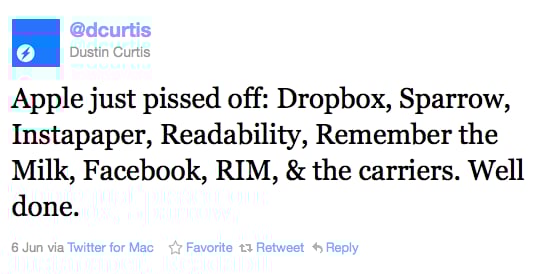
Perhaps the most succinct summary of Monday’s Apple WWDC keynote is this tweet by Dustin Curtis:

Screen shot 2011 06 08 at 9 57 47 AM

I understand the sentiment, and a lot of the post-keynote blog posts echoed this general statement. The most measured response, in my view, came from Marco Arment, the creator of Instapaper:

If Reading List gets widely adopted and millions of people start saving pages for later reading, a portion of those people will be interested in upgrading to a dedicated, deluxe app and service to serve their needs better. And they’ll quickly find Instapaper in the App Store.

I’m certainly not going to stop using Instapaper. I’m deeply invested in the service and can’t see myself moving to Safari any time soon. But that’s beside the point. Here’s the point.

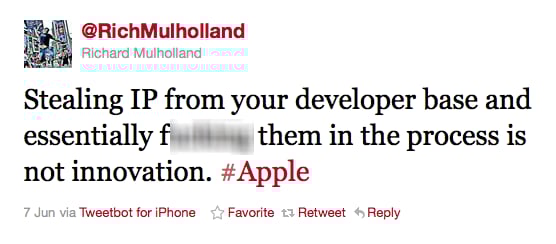
I find it strange that people are freaking out about how Apple is going after successful apps and integrating them deeply into Lion and iOS. Here’s Rich Mulholland (well, censored a little bit):

Screen shot 2011 06 08 at 10 03 12 AM

For my part, I agree much more with Justin Williams when he says:

Some people grow frustrated by Apple continually making inroads in existing developer’s territory, but it comes with being a part of the platform. The key is to ensure your product lineup is diverse enough that you can survive taking the blow Apple may offer at the next keynote.

The Theory

And this is where we have to start talking about Sociology theory (No, don’t go away, this is going to be great!). One of the key concepts in Social Network Theory is Ronald Burt’s theory of ‘structural holes’. This theory aims to explain how competition works, and argues that networks provide two types of benefits: information benefits and control benefits.

  • Information benefits refer to who knows about relevant information and how fast they find out about it. People with strong networks will generally know more about relevant subjects, and they will also know about it faster.
  • Control benefits refer to the advantages of being an important player in a well-connected network. In a large network, central players have more bargaining power than other players, which also means that they can, to a large extent, control many of the information flows within the network.

Burt’s theory of structural holes aims to enhance these benefits to their full potential. A structural hole is “a separation between non-redundant contacts” (Burt, 1992). The holes between non-redundant contacts provide entrepreneurial opportunities that can enhance both the control benefits and the information benefits of networks.

To understand the role of structural holes in this regard, it is necessary to understand the concept of tertius gaudens. Taken from the work of George Simmel, the tertius gaudens is defined as “the third who benefits” (Simmel, 1923). It describes the person who benefits from the disunion of two others. For example, when two people want to buy the same product, the seller can play their bids against one another to get a higher price for the particular product.

Structural holes are the setting in which the tertius gaudens operates. An entrepreneur stepping into a structural hole at the right time will have the power and the control to negotiate the relationship between the two actors divided by the hole, most often by playing their demands against one another.

Apple’s Strategy

This is exactly what Apple is doing, and have been doing from the start when the first iPhone came out (maybe even before). They saw the structural hole between 3rd party developers and consumers, and walked right into it. Through the app store, they built an enormous network (information benefits) where they broker the relationship between developers and users (control benefits). By providing developers with a massive audience, they became “the third who benefits.”

I also don’t think they’ve been particularly secretive about this strategy, so it shouldn’t come as a surprise to developers that if they have a one-platform strategy, and that platform is iOS, they might get disintermediated at some point.

Which brings us back to Marco Arment and Instapaper, and why I don’t think he’s in trouble. Instapaper is an ecosystem that’s intimately part of my workflow. It’s integrated with Firefox, iPhone, iPad, Twitter, Google Reader, Flipboard, Zite, … the list goes on. I’m not going to switch away, because I don’t see Instapaper as an iOS app. I see it as a solution to my reading needs.

So should developers still make iOS apps? Of course. But it’s important to realize that the product shouldn’t be the app. The product should be the problem you solve for users, on multiple platforms and in a simple, integrated way. Those are the apps that will survive (and even thrive) despite any changes that occur on Apple or another platform.