Menu

Posts tagged “startups”

RIM's corporate DNA as a reason for their demise

Charles Miller wrote an excellent post on the role that corporate DNA is playing in RIM’s demise. From “¦or are we just simply spiralling coils?:

For the years it was successful, RIM made utilitarian business phones that were really good at email. [”¦]

So when overnight, and entirely to my surprise, the smart phone market stopped being about making utilitarian business phones that were really good at email, RIM was in the worst position to deal with it because they didn’t just have to change their strategic direction, they had to change their entire corporate makeup.

The phone companies that survived the iPhone shake-up most ably were the ones whose DNA most closely resembled “We flood the market with phones built from commodity parts.” Because they were already poised to beg, borrow, steal and copy the next generation of products.

He also offers up some one-sentence DNA statements for Apple and Google, which I won’t spoil for you. It’s an article worth reading.

Oh, and Charles — really well done on the Monty Python reference.

Foursquare's bright future

Dan Frommer in Exploring The New Foursquare:

Foursquare has been evolving to a company that no longer simply answers “where are my friends?” but instead “where should I go right now?” This is smart: Everyon’s gotta eat. That’s why Explore is rapidly becoming Foursquar’s most important feature. This has always been part of the plan, I think. But it’s certainly carrying more emphasis in this new version of the app than ever before.

I think Dan hits the nail on the head here. Foursquare strikes me as a company with vision that is slowly but deliberately evolving to become the Facebook competitor everyone has been looking for. They listen to customer feedback, they’re ambitious, and they’re still having fun. That’s a killer combination.

Generosity and empathy as opportunities to disrupt

Very true words from Peter Rojas in Generosity, empathy, and disruption:

I just don’t think it’s possible to build an amazing product or app or whatever without being able to empathize with and understand the person who is supposed to be using it. On some fundamental level great design is able to get into the mindset of a user and anticipate, guide, and delight. None of that is possible without empathy.

He also sums up why companies who make complex, ugly, and bloated enterprise software should be very scared — their competitors are going to come out of nowhere:

Generosity and empathy are becoming the big blind spots not only for many big companies, but often for entire industries (like financial services) which have drifted so far from any human-centric principles that they feel ripe for real competition from companies that decide to play the game differently. You can see it in the basic lack of respect in the way customers are often treated, and you can see it in so many of the sub-par products that are being produced because no one cares enough about the end user to make them better.

Facebook post-IPO, and what it means for the wider web

I’ve collected quite a few articles about Facebook in the period immediately preceding and following the IPO, so I thought I’d share them all in a single post. These are not primarily about the IPO and the issues surrounding that process. It’s a collection of interesting (and sometimes controversial) viewpoints about where Facebook is headed, and what that means for the wider web. I don’t necessarily agree with all of it, but it’s always good to look at a variety of perspectives and then find a version of the story that you feel comfortable with.

The articles are listed in chronological order, starting with the oldest. Enjoy!

The economics of digital sharecropping:

Because Facebook’s content is created by its members, ARPU (Average Revenue Per Users) also tells us the monetary value of each member’s labor. If the average Facebook sharecropper were to be paid a revenue share for his or her work on the site, that member would make a buck and change every three months - about enough for one crappy cup of coffee. Needless to say, the amount is so small that Facebook members never think about it. The amounts only become economically interesting when, as I wrote earlier, you aggregate them on a massive scale.

I would argue, in fact, that while Facebook very much wants ARPU to grow steadily, it probably doesn’t want the number to get so large that it becomes a meaningful amount to its members. If that happened, members might start thinking about the cash value of their labor rather than just its attention value.

Back Off, Mark Zuckerberg!:

An appreciably abashed John Smith struggled to figure out how his reading habits had become public knowledge. After clicking on the Kardashian headline, he hadn’t clicked a Facebook ‘recommend’ button or anything. So why were all his Facebook friends being informed that while perusing the Huffington Post he’d surrendered to primordial yearnings?

Because at some point over the past year he had clicked a button without reading the fine print and thus had entered the world of “frictionless sharing.” In this world, if you’re on a website that permits frictionless sharing, every time you click on a headline, the site can report this behavior to your Facebook friends.

Facebook’s business model:

The good news for Facebook is there is a lot of room to target ads more effectively and put ads in more places. The bad news is that, if there is one consistent theme in both online and offline advertising, it’s that ads work dramatically better when consumers have purchasing intent. Google makes the vast majority of their revenues when people search for something to buy or hire. They don’t have to stoke demand ”“ they simply harvest it. When people use Facebook, they are generally socializing with friends. You can put billboards all over a park, and maybe sometimes you’ll happen to convert people from non-purchasing to purchasing intents. But you end up with a cluttered park, and not very effective advertising.

Facebook vs. Twitter:

In the long run, people will trust Twitter more than they do Facebook. And when it comes to building a long-term, trusting relationship with its users, Twitter will take it slowly and steadily, and in doing so, could win the race.

How Mark Zuckerberg Hacked the Valley:

Zuckerberg and his crew have made a series of high-risk moves - five hacks that have changed Silicon Valley forever ”” that were far more daring than wearing a hoodie to an IPO roadshow.

The Facebook Fallacy:

I don’t know anyone in the ad-Web business who isn’t engaged in a relentless, demoralizing, no-exit operation to realign costs with falling per-user revenues, or who isn’t manically inflating traffic to compensate for ever-lower per-user value.

Facebook, however, has convinced large numbers of otherwise intelligent people that the magic of the medium will reinvent advertising in a heretofore unimaginably profitable way, or that the company will create something new that isn’t advertising, which will produce even more wonderful profits.

After Facebook fails:

The distance between what tracking does and what users want, expect and intend is so extreme that backlash is inevitable. The only question is how much it will damage a business that is vulnerable in the first place.

There’s a Zucker Born Every Minute:

While playing on the audienc’s desire to get rich quick has often been enough to launch a tech stock into the stratosphere, it doesn’t seem to have been enough to help Facebook reach escape velocity. Why is that? Well, from a story perspective, we believe it’s because of an inherent dissonance between the gold rush mentality and the meaning of the brand.

Facebook was trying to tell both stories at the same time. The social network is about community and connectedness, while the public stock offering was all about getting rich quick. Of course, every successful brand has a human story and a money story living side by side. The question is, do the two stories complement each other in some interesting way, or do they cancel each other out?

The world is lazy and just wants to keep doing what it’s doing

Chris Dixon in The default state of a startup is failure — a short, powerful post on human behavior and entrepreneurship:

If you are starting a company and wondering why nothing good seems to happen unless you force it to happen, that’s because the world wants to stay the way it is. Customers, partners, and most of all incumbents don’t want to think hard, try new things, or change in any way. The world is lazy and just wants to keep doing what it’s doing.

He points out that because the world is lazy, no one will care about a new product you launch unless you make them.

How Yahoo killed Flickr: they didn't understand why people use it

This story has been passed around quite bit, but in case you haven’t seen it, Mat Honan’s How Yahoo Killed Flickr and Lost the Internet is a fascinating story:

This is the story of a wonderful idea. Something that had never been done before, a moment of change that shaped the Internet we know today. This is the story of Flickr. And how Yahoo bought it and murdered it and screwed itself out of relevance along the way.

It’s a well-written and thoughtful account that’s well worth the (long) read. Honan’s core argument on what went wrong is this:

All Yahoo cared about was the database its users had built and tagged. It didn’t care about the community that had created it or (more importantly) continuing to grow that community by introducing new features.

All the wrong decisions that Yahoo made can be traced back to that single issue: that they didn’t understand why people use Flickr. Instead, they made the common and fatal mistake of placing profit before product.

Unrelated, but until I read this article I had no idea that there is an app that adds cats with laser eyes to your photos. That is awesome. And now I’m really going off on a tangent, but there is a certain poetry to this 1-star review of the app:

It only gives you a small amount of cats to choose from and if you want another small amount of cat head stamps it costs 99 cents more. This app needs at least three times the number of cats to make it worthwhile. Don’t buy.

It needs at least three times the number of cats to make it worthwhile!

So, while we’re on a tangent anyway, I’ll indulge myself in posting this picture of the setting I was lucky enough to read this Yahoo article in. Vacation is hard.

Yahoo and Flickr, via Instapaper and Coffee

Why people are so upset about the Facebook/Instagram deal

Paul Ford wrote the best article I’ve seen so far on the Facebook/Instagram deal. When Your Favorite App Sells Out includes gems like this:

Unfortunately everything about Facebook defies logic. In terms of user experience, Facebook is like an NYPD police van crashing into an IKEA, forever ”” a chaotic mess of products designed to burrow into every facet of your life. The company is also technologically weird. For example, much of the code that runs the site is written in a horrible computer language called PHP, which stands for nothing you care about. Millions of websites are built with PHP, because it works and it’s cheap to run, but PHP is a programming language like scrapple is a meat. Imagine eating two pounds of scrapple every day for the rest of your life ”” that’s what Facebook does, programming-wise. Which is just to say that Facebook has its own way of doing things that looks very suspect from the outside world ”” but man, does it work.

Anyway, he goes on to explain why he thinks people are so upset about the deal. Just go ahead and read the thing - it’s worth it.

Following the herd into bad corporate culture

Sobering words from the one OMGPOP employee who didn’t go to Zynga when they were bought out. From Turning down Zynga:

It’s not easy to pass up a lucrative salary and solid benefits, of course. But I realized that ultimately I was letting myself be guided by simple inertia. I was part of a herd, and that herd was all going in one direction (and doing so with great urgency). I would really only be doing it for the sake of going with the flow, and responding to pressure to either conform to corporate expectations, or be left behind.

These are not good reasons to join a company whose values are the opposite of your own, or to compromise your ideals, or to give up control of something you rightfully own.

See also: Want to build great software? Get your culture right first.

22seven: an observation, a complaint, and a suggestion

Yesterday saw the Beta launch of a new Mint.com-type startup in South Africa called 22seven. They’re essentially aiming to give people better insight into the money they spend, and help them make better decisions about that. Or to put it in their own words:

We use smart information-gathering technology so our users can see all their financial stuff in one place. W’ve applied insights from behavioural economics so our users can better understand the way they think. And by employing principles of play, our users become more engaged, and more willingly engaged, with their money.

It didn’t take long for the banks to start freaking out about the security implications of giving your banking credentials to a third party, but there have also been some defenses of the safety of the service. Instead of rehashing those arguments, I’d like to make three quick comments about the new service.

An observation

I’ve been watching this unfold with fascination over the last 24 hours. Everyone who attended the launch event in Johannesburg seemed really impressed, but it didn’t take long for some (legitimate) concerns to arise as people started trying out the service:

My mom told me never to accept sweets from strangers and to give out my pin number… So… Yeah… Sorry 22seven…

”” Cathryn Reece (@CathrynR) January 26, 2012

That’s a sentiment I agree with, but things started to go downhill a bit from there as the tweets became more and more negative. We’re a finicky bunch of complainers, aren’t we! But as I caught myself just in time before getting sucked into the negativity vortex, a phrase jumped into my head: Schlep Blindess. As in - these guys don’t have it. In Paul Graham’s excellent essay he describes schlep blindness as the inability to identify hard problems to solve:

The most dangerous thing about our dislike of schleps is that much of it is unconscious. Your unconscious won’t even let you see ideas that involve painful schleps. That’s schlep blindness.

He ends his essay by explaining how to avoid schlep blindness:

Some ideas so obviously entail alarming schleps that anyone can see them. How do you see ideas like that? The trick I recommend is to take yourself out of the picture. Instead of asking “what problem should I solve?” ask “what problem do I wish someone else would solve for me?”

And that’s why I admire the creators of 22seven. They’re working on a problem we all want solved, but most of us are too scared to work on. And for doing that, they deserve enormous credit.

A complaint

Speaking of finicky complainers, can I be one of those for a minute? Ok, cool. Obviously my first instinct was to scrutinize the design of the site, and even though there’s a lot to like about it, I have to mention a couple of things that I believe are not implemented correctly from a UX Design perspective.

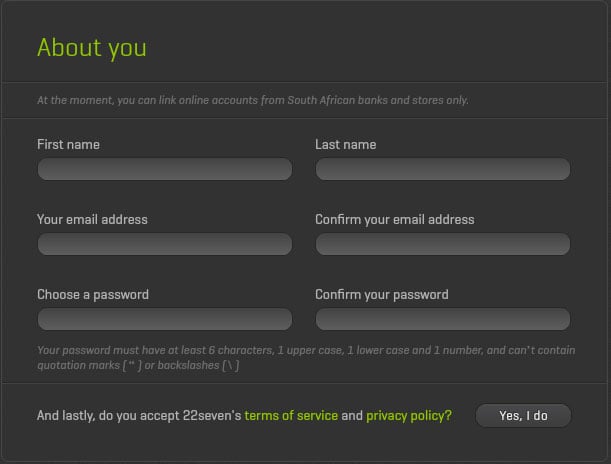
First, forcing someone to wait for a Flash (!!) animation/introduction to load when they click “Register” is just not a good thing. Users don’t have patience for that stuff. If I ask for a registration form, my expectation is to see a registration form immediately. But my main beef is with the registration form itself:
22seven-registration.jpg

Here are some of the issues:

  • The text has very low contrast with the background which makes it difficult to read. Come on, everyone - join the contrast rebellion!
  • We know that it’s bad to use multi-column layouts in forms.
  • Speaking of contrast, what stands out are the phrases “About you”, “terms of service”, and “privacy policy”, while the primary call to action (“Yes, I do”) is a grey button on a dark grey background.
  • While I’m nitpicking, if the button says “Yes, I do”, shouldn’t the title be “About me”?

We just don’t have to re-invent forms any more. The hard work has been done for us - we know how forms should be designed. And I don’t want to get into the Flash debate again, but why build this thing on a waning technology when you can build a responsive HTML web app that works on all devices?

A suggestion

Lastly, I’d like to offer a suggestion. If it is indeed true that 22seven has not met with South African banks yet, that’s a situation that should be rectified soon. In fact, my suggestion is that 22seven meets with one bank and work with them on an API solution that will allow them to access users’ banking information without having to store their credentials at a 3rd party. That’s what OAuth is for. And based on everything we know about Michael Jordaan (the CEO of FNB), wouldn’t FNB be the perfect bank to partner with on this? Once they’re on board, and FNB’s handsome and smart clients start using the service, the other banks are sure to follow.

I’d like to end where I began - on a positive note. I’m truly grateful that 22seven is tackling the banking/money management problem in South Africa in a very real and committed way. I think they vastly underestimated the backlash they would get from users when they’re suddenly asked for their online banking credentials (otherwise the web site would have been littered with trust-building explanations and images). But that’s a fixable problem, and so is my UX nitpicking - they’re not difficult issues to address.

So despite my complaining, I’m extremely excited about 22seven, and I’m rooting for them to succeed. I hope you’ll join me.

Working at a startup vs. a big company

Interesting perspective from the CEO of Ooga Labs:

In fact, I would argue that you learn the wrong things working for a big company, and that it’s actually not good experience. A good experience is when you really make something happen in the world. Big companies teach you how to work through layers of bureaucracy and how to solve problems in very risk-averse ways ”” in short, how to make something happen in their organization. A big company is not the safe career choice. It’s the risky choice. It risks your mind and your life.

This goes hand in hand with another misconception that big company jobs are more secure than startup jobs. In my experience the chances of a startup running out of money and a big company needing layoffs are roughly the same.