Menu

Posts tagged “social media”

The problem with Dribbble

Andy Mangold discusses the design decisions made by Dribbble in Dribbble is Not a Platform for Critique:

By design, Dribbble rewards style and aesthetics, not concept or context. [”¦]

The “like” button sits right next to the screenshot itself, at the top of a column of actions, above the fold on even the smallest screen. Hierarchically, this is what Dribbble has decided is important. [”¦]

Commenting however, the only way Dribbble provides for giving critical feedback on a shot, is treated much differently. The comment box is below the shot itself, and as soon as two or three comments have stacked up it’s off the bottom of the screen. Because of this, it’s not possible on most shots to look at the image while you’re typing the content of your comment.

Andy argues that Dribbble has a legitimate place “to showcase details of your work, document your style, connect with other designers, and from what I hear a decent way to find freelance jobs (if you’re popular)”, but if you’re looking for honest critique on your designs, this isn’t the place for you. His article reminded me of Jon Tan’s Taxidermista — an essay in Issue #1 of The Manual. Jon points out one of the dangers of design galleries like Dribbble:

Galleries misrepresent web design as a state, not a process. They divorce what a site does from how it looks. They celebrate style and tone, not purpose. [”¦]

By purpose I refer to the appropriateness of the style and tone. Do they fit the project? That question is rarely asked or answered by galleries. The only reaction galleries solicit is an emotional one. Like or don’t like. Hot or not.

This is the core issue with design galleries — they’re not records of a designer’s decision-making and thought process, they’re artifacts of that process. That’s useful too, of course, but not in isolation. It’s essential to know why a designer chose a certain style and tone, and how it helps to solve the core design problem. Without that context, it’s impossible to know if it’s good design.

Flipboard v Magazines

Nat Ives quotes “an executive at a magazine company” in his piece Wired and The New Yorker Pull Back on Flipboard:

“Nobody will deny that Flipboard is a beautiful product, but the question is, is it too beautiful?” the executive said. “What people want out of a magazine is exactly what they’re delivering. So if people feel like they’re getting that already, even if it’s not the same depth of content that would be in a print or monthly publication, then are they less likely to want to find it in the magazine itself?”

Wait, what? The executive acknowledges that Flipboard gives people what they want out of a magazine, so he/she is advocating that they should respond by pulling their content from Flipboard instead of, I don’t know, giving people what they want out of a magazine.

(link via @iamFinch)

Twitter: a door to the narcissistical sublime

n+1 Magazine has a wonderfully-written editorial on the ups and downs of using Twitter, appropriately titled Please RT:

Look at your Twitter feed at the wrong moment, however, or send a dumb tweet yourself, and a bad infinity opens up onto the narcissistical sublime. What tweet is that, flashing, subliminally, behind the others? In exactly 140 characters: “I need to be noticed so badly that I can’t pay attention to you except inasmuch as it calls attention to me. I know for you it’s the same.” In this way, a huge crowd of people”Š””“Š40 percent more users since last year”Š””“Šdevalue one another through mutual self-importance.

They’re referring to other people, of course. You and I are very different! It’s this part that scares me the most though, because the evidence proving their point is starting to pile up all around us:

Soon, if not yet already, it will seem pretentious, elitist, and old-fashioned to write anything, anywhere, with patience and care.

The Slow Web

Jack Cheng takes a shot at defining The Slow Web:

Timely not real-time. Rhythm not random. Moderation not excess. Knowledge not information. These are a few of the many characteristics of the Slow Web. It’s not so much a checklist as a feeling, one of being at greater ease for the web-enabled products and services in our lives.

It’s a very interesting post where he also describes some of the web sites and apps that exemplify this movement. It reminds me of Clay Johnson’s call for healthier information diets.

(link via @retinart)

Skype Advertising: because your conversations are boring

This Skype Advertising Update reads like satire:

While on a 1:1 audio call, users will see content that could spark additional topics of conversation that are relevant to Skype users and highlight unique and local brand experiences. So, you should think of Conversation Ads as a way for Skype to generate fun interactivity between your circle of friends and family and the brands you care about. Ultimately, we believe this will help make Skype a more engaging and useful place to have your conversations each and every day.

So, let me make sure I understand. Skype is worried that my conversations might not be “engaging” enough. So, instead of my daughter doing funny dances for her grandparents in the US, Skype will “generate fun interactivity” by prompting us to talk about “the brands that we care about”? Like, “Hey, how about that new Magnum ice cream flavor, eh?”

I don’t know how an idea like this manages to make it through even the mildest of corporate sanity checks.

Foursquare's bright future

Dan Frommer in Exploring The New Foursquare:

Foursquare has been evolving to a company that no longer simply answers “where are my friends?” but instead “where should I go right now?” This is smart: Everyon’s gotta eat. That’s why Explore is rapidly becoming Foursquar’s most important feature. This has always been part of the plan, I think. But it’s certainly carrying more emphasis in this new version of the app than ever before.

I think Dan hits the nail on the head here. Foursquare strikes me as a company with vision that is slowly but deliberately evolving to become the Facebook competitor everyone has been looking for. They listen to customer feedback, they’re ambitious, and they’re still having fun. That’s a killer combination.

About this curation thing

This is not a good week to be calling yourself a curator. (Um, please don’t read the description of this site in the left column.) I’m fully aware of the irony of posting a pull quote from Mitch Goldstein’s Formally Concerned, but here goes anyway:

The result of this are blogs full of nothing but other people’s stuff. Pages and pages of other peoples photographs, designs, videos, etc. This is not inherently bad, but what I get curious about is how this affects how people go about making their own work — is there room to think about something new if your mind is filled with everything else? Probably, but I would not discount the distraction of seeing an endless stream of externalized, decontextualized imagery.

I imagine the natural reaction to my opinion of this is that these Tumblr blogs act as inspiration, as a scrapbook of ideas. I question this as well, since I think true inspiration comes from the questions you ask yourself, not from constantly looking at how other people answered their own questions. I hope that the reblogging and reposting of other peoples’ work — and reblogging other peoples’ rebloggings, ad infinitum — does not take the place of actual creativity. I mean, finding cool stuff and posting it sort of feels like you are making something, right? Tumblr can provide an illusion of creation — I wonder what people would make if they were not busy making this illusion?

I’ve actually written about this before as well in the context of the “post-literate society”:

I believe [sites like Pinterest and Instagram] give users the illusion that they’re creating something without the necessary work that is required to make something good. Sharing pictures is effortless. And if we know anything about online behavior, it’s that people hate doing actual work when they can just click a button instead.

This, of course, comes off the back of Choire Sicha’s rant against people who use the word ‘curation’:

You are no different from some teen in Indiana with a LiveJournal about cutting. Sorry folks! You’re in this nasty fray with the rest of us. And your metaphor is all wrong. More likely you’re a low-grade collector, not a curator. You’re buying (in the attention economy at least! If not in the actual advertising economy of websites!) what someone else is selling””and you’re then reselling it on your blog. You’re nothing but a secondary market for someone els’s work.

I’m obviously conflicted about this, because a lot of what I do on this site is what’s considered link-blogging, adding a little bit of context and additional thought when needed. I certainly won’t call that “creating”, but I also don’t understand why there’s such a big backlash against this type of activity.

The first advice writers always give other writers is, read more. So I am comfortable with my approximately 70/30 split between posting links and writing longer, original pieces. I don’t think I’d be able to write the 30% if I didn’t spend the other 70% finding and reading great content — and why shouldn’t I share that with you? As long as the 70/30 split doesn’t become a 100/0 split, I’ll keep doing this.

On this particular issue I’m much more in agreement with Erin Kissane’s viewpoint in Bloggers and Bowerbirds:

We should stop treating the web like it’s zero-sum and start treating each other like colleagues. When people like Popova and Roth-Eisenberg show up and offer a standard, our response should not be to freak out about them wanting in on “our” cultural capital. Respecting the work of discovery doesn’t detract from respect for the work of creators. There is not a limited supply of civility and respect, so let’s stop being dicks about this stuff.

Preach it, Erin.

Be careful who you listen to

In Facebook threatens to ‘Zuck up’ the human race, Andrew Keen makes the following observation:

Sherry Turkle, Professor of the Social Studies of Science and Technology at MIT, tells us there’s a shift from an analog world in which our identities are generated from within, to a digital world in which our sense of self is intimately tied to our social media presence.

In other words, on Twitter and Facebook, we become who we follow. Or perhaps more accurately, we envy who we follow. The big problem with this is that none of us are really who we portray ourselves to be online. We are all the better, happier, more successful versions of ourselves:
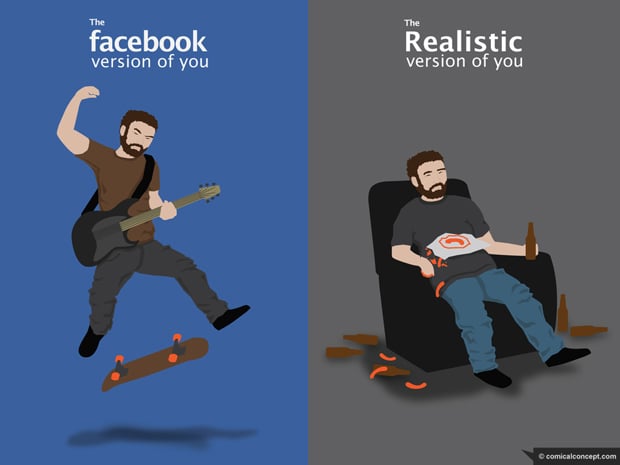
Different versions of ourselves

(Source: Comical Concept)

But even though we take in all this information from people who we know aren’t real (and sometimes don’t even like), we are incapable of stopping. There is always more to know, more to discover, another person to compare ourselves to. In Noise and Signal, Nassim Taleb explains why this is so counterproductive:

The more frequently you look at data, the more noise you are disproportionally likely to get (rather than the valuable part called the signal); hence the higher the noise to signal ratio. And there is a confusion, that is not psychological at all, but inherent in the data itself. Say you look at information on a yearly basis, for stock prices or the fertilizer sales of your father-in-law’s factory, or inflation numbers in Vladivostock. Assume further that for what you are observing, at the yearly frequency the ratio of signal to noise is about one to one (say half noise, half signal) ”” it means that about half of changes are real improvements or degradations, the other half comes from randomness. This ratio is what you get from yearly observations.

But if you look at the very same data on a daily basis, the composition would change to 95% noise, 5% signal. And if you observe data on an hourly basis, as people immersed in the news and markets price variations do, the split becomes 99.5% noise to .5% signal. That is two hundred times more noise than signal ”” which is why anyone who listens to news (except when very, very significant events take place) is one step below sucker.

Most of the information we get on social media is not just noise, it also makes us less likely to discern between what’s important and what’s not. Greg McKeown explains in The Unimportance of Practically Everything:

Social media did not create the problem of distraction, but it is clearly an amplifier. Indeed, a study [PDF] by Clifford Nass et al. at Stanford showed that heavy media multitaskers are more susceptible to interference from irrelevant environmental stimuli than light media multitaskers. Heavy multitasking may encourage even heavier multitasking because it leads to a “reduced ability to filter out interference.” Could the part of our brain that is processing deeper cogitative thought actually be atrophying in the process?

None of this would matter if activity and reward were linearly related. But we live in a world where almost everything is worthless and a very few things are exceptionally valuable. This is a counterintuitive idea. After all, the idea that 50% of results come from 50% effort is appealing. It seems fair. Yet, research across many fields paints a very different picture.

As I read through these articles it became clear to me that most of us are not being very good stewards of our time and attention. We are seduced by the lure of constant affirmation that social media promises, and blind to the reality that what we mostly get from it is a sense that we’re not as good, happy, and successful as those around us.

We have a responsibility to ourselves to follow and interact with those who support us and want to make the world a better place. And we have an obligation to cull and surrender the people and the information that make us feel inferior and stunt our growth. This is difficult, because we’ll never get rid of our fear that we might be missing out on something. But it’s necessary if we want to hang on to our sanity and our ability to tell the vital from the trivial — so that we can continue to do good work.

Of course I can’t tell you what to do. But for myself, I’m going to start ignoring constant negativity, unimportant noise, and empty criticism. I’m actively going to seek out positive, driven people and honest critique. Nassim Taleb says it well at the end of his article:

To conclude, the best way to mitigate interventionism is to ration the supply of information, as naturalistically as possible. This is hard to accept in the age of the Internet. It has been very hard for me to explain that the more data you get, the less you know what’s going on, and the more iatrogenics (“an inadvertent adverse effect or complication resulting from medical treatment or advice”) you will cause.

Be careful who you listen to, because sooner or later, they end up defining you.

If readers can find your site, they can copy and paste a URL

Oliver Reichenstein takes on the tendency to put social media sharing buttons all over a site in Sweep the Sleaze. This part in particular is something I’ve thought about as well:

If readers are too lazy to copy and paste the URL, and write a few words about your content, then it is not because you lack these magical buttons. If you provide excellent content, social media users will take the time to read and talk about it in their networks. That’s what you really want. You don’t want a cheap thumbs up, you want your readers to talk about your content with their own voice.

By the way, in case you haven’t seen it — Oliver’s team just did a gorgeous redesign of their iA site. Be sure to check out his post Responsive Typography, which goes into some of the details.

Facebook post-IPO, and what it means for the wider web

I’ve collected quite a few articles about Facebook in the period immediately preceding and following the IPO, so I thought I’d share them all in a single post. These are not primarily about the IPO and the issues surrounding that process. It’s a collection of interesting (and sometimes controversial) viewpoints about where Facebook is headed, and what that means for the wider web. I don’t necessarily agree with all of it, but it’s always good to look at a variety of perspectives and then find a version of the story that you feel comfortable with.

The articles are listed in chronological order, starting with the oldest. Enjoy!

The economics of digital sharecropping:

Because Facebook’s content is created by its members, ARPU (Average Revenue Per Users) also tells us the monetary value of each member’s labor. If the average Facebook sharecropper were to be paid a revenue share for his or her work on the site, that member would make a buck and change every three months - about enough for one crappy cup of coffee. Needless to say, the amount is so small that Facebook members never think about it. The amounts only become economically interesting when, as I wrote earlier, you aggregate them on a massive scale.

I would argue, in fact, that while Facebook very much wants ARPU to grow steadily, it probably doesn’t want the number to get so large that it becomes a meaningful amount to its members. If that happened, members might start thinking about the cash value of their labor rather than just its attention value.

Back Off, Mark Zuckerberg!:

An appreciably abashed John Smith struggled to figure out how his reading habits had become public knowledge. After clicking on the Kardashian headline, he hadn’t clicked a Facebook ‘recommend’ button or anything. So why were all his Facebook friends being informed that while perusing the Huffington Post he’d surrendered to primordial yearnings?

Because at some point over the past year he had clicked a button without reading the fine print and thus had entered the world of “frictionless sharing.” In this world, if you’re on a website that permits frictionless sharing, every time you click on a headline, the site can report this behavior to your Facebook friends.

Facebook’s business model:

The good news for Facebook is there is a lot of room to target ads more effectively and put ads in more places. The bad news is that, if there is one consistent theme in both online and offline advertising, it’s that ads work dramatically better when consumers have purchasing intent. Google makes the vast majority of their revenues when people search for something to buy or hire. They don’t have to stoke demand ”“ they simply harvest it. When people use Facebook, they are generally socializing with friends. You can put billboards all over a park, and maybe sometimes you’ll happen to convert people from non-purchasing to purchasing intents. But you end up with a cluttered park, and not very effective advertising.

Facebook vs. Twitter:

In the long run, people will trust Twitter more than they do Facebook. And when it comes to building a long-term, trusting relationship with its users, Twitter will take it slowly and steadily, and in doing so, could win the race.

How Mark Zuckerberg Hacked the Valley:

Zuckerberg and his crew have made a series of high-risk moves - five hacks that have changed Silicon Valley forever ”” that were far more daring than wearing a hoodie to an IPO roadshow.

The Facebook Fallacy:

I don’t know anyone in the ad-Web business who isn’t engaged in a relentless, demoralizing, no-exit operation to realign costs with falling per-user revenues, or who isn’t manically inflating traffic to compensate for ever-lower per-user value.

Facebook, however, has convinced large numbers of otherwise intelligent people that the magic of the medium will reinvent advertising in a heretofore unimaginably profitable way, or that the company will create something new that isn’t advertising, which will produce even more wonderful profits.

After Facebook fails:

The distance between what tracking does and what users want, expect and intend is so extreme that backlash is inevitable. The only question is how much it will damage a business that is vulnerable in the first place.

There’s a Zucker Born Every Minute:

While playing on the audienc’s desire to get rich quick has often been enough to launch a tech stock into the stratosphere, it doesn’t seem to have been enough to help Facebook reach escape velocity. Why is that? Well, from a story perspective, we believe it’s because of an inherent dissonance between the gold rush mentality and the meaning of the brand.

Facebook was trying to tell both stories at the same time. The social network is about community and connectedness, while the public stock offering was all about getting rich quick. Of course, every successful brand has a human story and a money story living side by side. The question is, do the two stories complement each other in some interesting way, or do they cancel each other out?