Menu

Posts tagged “social media”

RSS FTW

I recently tweeted that I’m fairly convinced that the most valuable (and most difficult) metric to grow in online publishing is RSS subscribers. I’d like to explore that idea a bit further.

The RSS publishing experience

Over the past few days I’ve done quite a bit of investigation to see if my hunch about the value of RSS subscribers is correct — at least on my own site. Apart from just typing in the URL, there are currently three ways to subscribe to updates on my blog: Twitter, a weekly email, and RSS. I’d like to share some metrics on each of those methods.

Since Twitter doesn’t have analytics on t.co links yet, I had to look at the bitly links on my main Twitter account as a proxy. On average, the clickthrough rate on links I post on bitly is between 2% and 3%. That’s really low. It’s also worth noting that bitly did some analysis that showed that the mean half life of a link on Twitter is 2.8 hours. That is an extremely short time before whatever you tweet pretty much disappears forever.

The weekly email performs a bit better. The open rate on that email hovers just under 20%, on average. That’s pretty decent, I think — certainly much better than posting links on Twitter.

On the RSS feed, the average reach (the total number of people who have viewed or clicked on the content in the feed) is 28%. This is by far the most engaged group of the three methods I provide to get updates on the site’s content.

From a publishing perspective, RSS subscribers are like magazine subscribers. When they invite you into their reader it means that they place some value on the content you create. They are also the people who share your content, and care enough to give constructive feedback when you suck. So if you have to look at metrics for your site or online publication, that’s where I think you should look for a reflection of its quality.

The RSS reading experience

I also want to make a few points about the RSS reading experience, and why I think it’s superior to other methods. There’s no way to keep up with all the links that come across my Twitter feed every day. But whenever I read something I like, I always go to the site’s home page to read some other posts. If I like the general theme I subscribe to the RSS feed and relax, because I don’t have to worry about accidentally missing a new post. RSS is a very “Slow Web” way of keeping up with content you don’t want to miss.

The other reason I’m such a fan of RSS is that it is a completely open platform (not Android “open” — real open). There are a multitude of ways to publish and consume feeds, and there is no lock-in whatsoever. This is why RSS has remained so strong. Dave Winer sums it up best, of course, in Protocols don’t mean much:

RSS won not because of its great design, but because there was a significant amount of valuable content flowing through it. Formats and protocols by themselves are meaningless. That’s what I say about specs. Show me content I can get at through the protocol, and I’ll say something.

Towards on open social network

I do see one big problem with RSS: there is no way to build a community around the people who subscribe to your feed. Feedburner tells me how many people are subscribed, and there is some basic aggregated demographic information, but that’s it. I’d love for RSS to give users the option to reveal their names and/or email addresses when they subscribe to a feed. This might sound creepy, but if it’s an optional setting (with an ethical default as private), I think this could be really powerful.

There are many sites that I subscribe to that I won’t mind if they know who I am. Publishers could use this information to kick off forums or email discussions around certain topics, organise local meetups, or any number of community interaction initiatives. For all this talk about “open” social networks, the idea of loose connections around an open protocol seems pretty appealing to me.

Or am I crazy?

Writing shortcuts

David Carr wrote a great post about journalism and plagiarism called Journalists on the Edge of Truth. There’s one part in particular that stood out for me:

The now ancient routes to credibility at small magazines and newspapers — toiling in menial jobs while learning the business — have been wiped out, replaced by an algorithm of social media heat and blog traction. Every reporter who came up in legacy media can tell you about a come-to-Jesus moment, when an editor put them up against a wall and tattooed a message deep into their skull: show respect for the fundamentals of the craft, or you would soon not be part of it.

Social media has levelled the playing field somewhat by enabling writers to become popular without the need for a newspaper/magazine platform. But shortcuts are always fraught with hidden traps and potholes, like letting the pressures of publishing drive you over the “remix” line to straight-up plagiarism.

Why Twitter's restrictions won't usher in a resurgence in blogging

Daniel Jalkut1 tweeted a very interesting response to the news that Twitter has revoked Tumblr’s friend-finding privileges:

All this rage against Twitter will ultimately bolster blogging: the distributed, DNS-backed social network Twitter was allegedly displacing.

— Daniel Jalkut (@danielpunkass) August 23, 2012

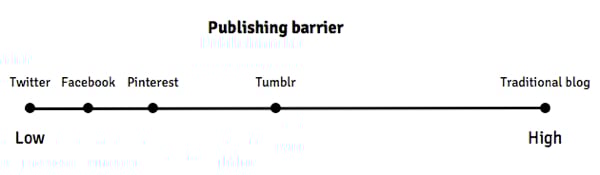
I would love nothing more than for more people to write on their own domains. I’m fully on board with the “own your data” movement, and I’m obviously a fan of blogging in general. The problem is that Twitter and traditional blogging are at complete opposite ends of what I’ll call the “publishing barrier” spectrum.

The web is a battlefield of dead blogs. So many people start one up with the best of intentions, only to realize that “If you build it, they will come” does not apply at all. Once they figure out that it’s exceptionally hard work to post frequently and build an audience, since nobody wants to read your sh*t, they abandon their efforts.

And where do they go? Twitter. Facebook. Pinterest. Tumblr. Where there is no pressure to write coherent paragraphs and then convince people that they should try to remember a URL they can’t pronounce2. The expectations for content on these sites are low, so the barrier to publishing is all but removed. Here’s how I’d plot some different publishing platforms on the spectrum:

Publishing barrier scale

We could probably argue about where to put the dots, but the basic point remains the same. The reason we won’t suddenly see a mass resurgence of “distributed, DNS-backed” blogging is that people are lazy, and we’re all looking for the path of least resistance that will make us feel like “content creators”. If Twitter does end up losing its way, we’ll find somewhere else to fill that need. We are, after all, becoming a post-literate society.


  1. The owner of MarsEdit, which I’m using to write this post (meta!) 

  2. Yes, I know. I chose badly. Too late now… 

The lightweight, non-intrusive ways of Twitter

Kyle Baxter discusses what makes Twitter great in Twitter, Utility:

[W]ith over a hundred million people on it, you can quickly find almost anyone you’re interested in, listen to them, and communicate with them, all in a very lightweight, non-intrusive way. That’s incredibly powerful, especially because what it does is allow communities to form that are incredibly intimate but also very open to others.

The whole article is great, so I encourage you to read the whole thing. I find the phrase “lightweight, non-intrusive” particularly interesting. I’m probably really late on this insight, but the core of that truth only recently struck me.

Twitter is lightweight in the sense that there is very little commitment required to write 140 characters and click the “Tweet” button. The character limit also means that you don’t feel pressured to write more (which is a complaint you hear about blogging quite a bit). And it’s non-intrusive in that you can follow/unfollow anyone, and the rules of engagement are such that whoever you talk to has very little obligation to talk back.

Imagining a future without traditional marketing

I turned off satellite TV at our home about 5 months ago. This wasn’t some moral stand against the horrors of technology. It was simply a matter of return on investment. Satellite TV is ludicrously expensive in South Africa, and my wife and I are so happy with our Apple TV setup that I couldn’t justify the cost any more. I wondered if we would have some withdrawal symptoms, but I can honestly say I’ll never go back to satellite. I do miss the odd live sporting event, but that’s not compelling enough to fork out a gazillion dollars every month just to see some guy yelling about cake.

The side benefit of this decision is that we haven’t seen a TV commercial in 5 months. Combine that with my practice of doing most of my online reading in Instapaper, and things start to get interesting. The sheer volume of advertising I used to be bombarded with forced me to tune it all out. But now that it’s a bit scarcer I notice every ad I come across. And I don’t like what I see. It’s especially jarring on Facebook, where “Promoted pages” are starting to annoy the crap out of me. I used to scroll through them without a second thought, but now I grit my teeth as they fly by.

This got me thinking about the current state of traditional marketing, and what a future without it might look like.

RIP traditional marketing

I believe that marketing as we currently know and practice it is well on its way to extinction. That’s certainly not what ad agencies want you to believe, but the evidence is all around us. Marketing is losing its ability to convince people to buy things they don’t need. Jason Calacanis sums it up perfectly in The Age of Excellence: “If your product sucks, it’s over. Transparency is a bitch.”

We discuss products and services everywhere we go, and our friends and followers are listening. “Word of mouth” marketing isn’t new, but the tools to spread our views about a company or experience are now within everyone’s reach. And boy, are we reaching. Even a cursory look at Facebook’s usage metrics shows the staggering amount of time people spend there.

What frustrates companies, of course, is that they can’t control the conversation any more. They’re powerless against an angry mob of consumers who spew vitriol about their products all over the Internet. This is ultimately a good thing, because it will slowly scare companies into taking some of their marketing budgets and spending it on making better products instead. Because that’s where profit and sustainability will come from.

This doesn’t mean I don’t want to know about new things. I still want to find out about cool products or services that I might be interested in. But I don’t want to see it on TV or in a sponsored link on my Facebook page. I want to hear about it from people I trust. That can be through a tweet or blog post about a good experience, or even a paid ad related to a topic I care about (like the advertisements on the 5by5 network).

I’m not averse to marketing messages. I’m averse to being manipulated into buying something that won’t live up to its promises. When’s the last time you read the back of your shampoo bottle? Do you believe that the right shampoo will give you “gorgeous, luxuriously soft” hair, or maybe “the hair nature didn’t”? No? Then why are we ok with these ridiculous marketing messages? Why don’t we call companies on it when they do things like promise “everything you could ever want”?

The future of marketing is product

There is no traditional marketing in the future I’d like to see. There’s no professional advertising TV spots, no billboards, no videos created to be “viral content”. Instead, companies take the money they save from paying ad agencies, and spend it on building great products.

In this future, the people who work on products aren’t faceless entities. They are individuals who hang out online, who write on their blogs about their journeys, and who are active in the industries they operate in. Since they’re focused on providing value to others, they have a large enough following so that when their product launches, they can promote it to their networks without being overbearing. And if the product is good enough, that message gets amplified through the various networks to acquire customers. If it’s not good enough, they get the negative feedback and try again.

The outcome of this vision is that the products we use are made by people we know, and promoted by those who want to spread the word about something they like. I don’t think we’re even that far from being able to create this future. I’m happily unaware of TV advertising these days, and most of the things I buy are based on recommendations on Twitter or in offline conversations.

Granted, we need more success stories to convince companies to buy fewer ads and hire more product-focused people. And we need all those product people to start contributing to their communities and talk about what they’re working on. But the puzzle pieces are all there. We just haven’t finished putting them together.
Pinterest email notifications and ethical defaults

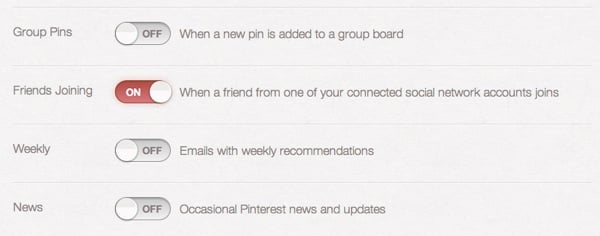
I just received an email from Pinterest to let me know that one of my Facebook friends has joined the service. I found the email odd, because I specifically remember turning off all email notifications (since I don’t use the site any more). I clicked through to “change notification preferences”, and saw this:

Pinterest default notifications

Ah, I see. This is a new “feature” Pinterest added, so they decided to turn the email notification on by default. I immediately thought of Vibhu Norby’s words:

Private is an ethical default. Public is not.

That principle should also go for email notifications from any service. “Off” is an ethical default. “On” is not. I’m picking on Pinterest because it’s the most recent example, but this has become common practice on the web. The irony is that sending me email I didn’t explicitly ask for makes me less likely to engage with a site, not more.

App.net is not about exclusion, it's about innovation

Anil Dash discusses App.net in You Can’t Start the Revolution from the Country Club:

In today’s world, where the social web is mainstream, innovating on the core values of tools and technology while ignoring the value of inclusiveness is tantamount to building a gated community. Even with the promise that the less privileged might get a chance to show up later, you’re making a fundamentally unfair system.

I am genuinely confused. If you take this argument to its logical conclusion, is he saying that everything we make should be free so that it doesn’t exclude anyone? Isn’t that how we arrived at the current situation where advertisers call the shots on major social networks?

I didn’t back App.net because I hate Twitter and want to move somewhere else. I love Twitter, and I have no problem with anyone who uses it because I get to choose whose tweets I see. I backed App.net because I want to see what innovation comes out of it. To illustrate my point, in 1970 a NASA director attempted to make the case for space travel to a Nun who asked how he could suggest spending billions of dollars on space projects at a time when so many children are starving on Earth. From Why Explore Space?:

I believe, like many of my friends, that travelling to the Moon and eventually to Mars and to other planets is a venture which we should undertake now, and I even believe that this project, in the long run, will contribute more to the solution of these grave problems we are facing here on Earth than many other potential projects of help which are debated and discussed year after year, and which are so extremely slow in yielding tangible results.

I understand that comparing an app to space travel is silly, but if you read the whole letter you’ll understand the sentiment that prompted me to back App.net. I believe that a community of passionate developers can use the platform to develop ideas that not only solve existing problems with web publishing, but also meet some as-of-yet unknown web user needs.

For me, it’s not about excluding people, or sticking it to The Man. It’s about funding a playground for innovation1.


  1. Wow, did I really just use that tired phrase? Sorry. I actually do mean it, though. 

Time to close the computer

Alex Maughan adds his thoughts to the “fast web” discussion in The Slow Web and the Thievery of Fast Lifestyles:

We are philics of immediate gratification, ticket holders impatiently awaiting our entrance into the never-ending show of serial distractions. Far too many of us are phobic of the good stuff. The stuff that takes emotional maturity. The stuff that takes time, and doesn’t constantly pat you on the back for every small thing you do. The stuff you don’t find on Facebook, Instagram, Twitter, LinkedIn, or Dribble. The stuff that requires you to exist without constant, yet ultimately spurious, forms of reinforcement; without any distractions; without the need to bolster your perceived self-worth by harvesting as many Likes as you can for every little asinine thing we spit out onto the Web. We increasingly shy away from the stuff that requires a longer form of consideration to ripen.

The post ends with some guidelines that he’s setting for himself to fight this problem. It’s worth reading.

Just over a week ago Frank Chimero tweeted, “Time to close the computer.” He then deleted his entire tweet history and unfollowed everyone he used to follow. Today that tweet is gone as well, his avatar is a dog, and he follows 3 very different people and 1 bot (@Horse_ebooks, of course).

I don’t know if that story means anything, but Frank is a pretty famous designer, and all I’m saying is that something is going on. Everywhere I look I see people behaving like they just fell off a chair on the Axiom only to realize that staring at a screen all their waking hours isn’t as fantastic as they thought it was.

Maybe it is time to close the computer.

Daring Fireball, App.net, and admitting who our heroes are

It’s not fashionable any more to have heroes. In fact, I’m scared to admit that I like anything, because I just never know if maybe, for some reason, we’re supposed to complain about that thing instead. Look at the response to App.net, for example. Much of it has been positive, but there is also an awful lot of snark and sarcasm out there — much of it from people I like and admire. So I’ve resisted the urge to confess that I backed the project, and that I like the Alpha product so far.

It’s become really hard to know what we’re allowed to like online.


I don’t remember exactly when I started to read John Gruber’s Daring Fireball, but I do remember that it had an immediate and profound effect on my view of online publishing. His efficiency with words gave me an appreciation for what web writing could be, and I started to dissect every post to try to learn as much as I could. Gruber and Merlin Mann did a talk about blogging at SXSW 2009 where they discussed the idea of Obsession times Voice:

Topic times voice. Or, if you’re a little bit more of a maverick, obsession times voice. So what does that mean? I think all of the best nonfiction that has ever been made comes from the result of someone who can’t stop thinking about a certain topic — a very specific aspect of a certain topic in some cases. And second, they got really good at figuring out what they had to say about it.

That talk — along with Gruber’s site — got me thinking: I wonder if I could do something like that? I have so many Obsessions. Could I maybe find a hidden Voice somewhere in those obsessions? It’s after hearing that talk that I decided to start taking this site more seriously. And even though Daring Fireball probably gets the equivalent of my monthly traffic in about an hour, this has still been one of the most rewarding experiences of my life. It has opened so many doors and enabled me to meet some wonderful people.


Why is it that we reach for the comforts of collective cynicism whenever someone who is not in our inner circle of coolness tries to do something new or different? In the case of App.net, someone just raised more than $500,000 from end users to build a product that’s trying to compete with Twitter. Why can’t we just, for a few moments, look past everything that might be wrong with the idea, and appreciate what an enormous accomplishment that is?

You don’t have to like Dalton Caldwell or App.net. You don’t even have to be quiet about not liking them. Really — it’s ok to not like things. But don’t be a dick about it.


Gruber linked to me once on Daring Fireball. Hey, so what if I printed out his post and framed it? I still remember opening my RSS reader on the morning of Thanksgiving 2011, and falling out of bed when I saw my name on Daring Fireball. I was floating on air for weeks. It wasn’t about the traffic — it was Thanksgiving so there was pretty much no one online. The reason I was so happy is that John Gruber — someone I decided I want to impress with my writing — noticed something I wrote, and put it on his site. Since I really want to make this thing work long term, that was the biggest encouragement I could have received.

I took the opportunity to write to John to thank him not just for the link, but for the impact he has on my writing. Here’s one part of what I said:

I appreciate and learn so much from your approach to writing — you’re authentic and to the point, which is in such contrast to much of the web. Thank you for showing so many of us aspiring writers that we don’t have to sell our souls to have an audience.

He emailed back:

Great note. Thanks!

—J.G.

The response couldn’t have been more Gruber. Even in a short email, a regular dash just isn’t good enough. It’s em dashes all the way for the guy whose Obsession times Voice is about the quest for perfection in everything we do.


I know it’s not fashionable any more to have heroes. But this week App.net got funded, and Daring Fireball turned 10 years old. So roll your eyes if you must, but I’m just going to say it.

I backed App.net, and John Gruber is one of my heroes.

The Cumulative Advantage effect explains some troubling musical trends

Duncan J. Watts in Is Justin Timberlake a Product of Cumulative Advantage?:

The reason is that when people tend to like what other people like, differences in popularity are subject to what is called “cumulative advantage,” or the “rich get richer” effect. This means that if one object happens to be slightly more popular than another at just the right point, it will tend to become more popular still. As a result, even tiny, random fluctuations can blow up, generating potentially enormous long-run differences among even indistinguishable competitors — a phenomenon that is similar in some ways to the famous “butterfly effect” from chaos theory. Thus, if history were to be somehow rerun many times, seemingly identical universes with the same set of competitors and the same overall market tastes would quickly generate different winners: Madonna would have been popular in this world, but in some other version of history, she would be a nobody, and someone we have never heard of would be in her place.

Forget about that Justin — this finally gives us a satisfactory explanation for Bieber fever. Today, the universe makes just a little bit more sense again.