Menu

Posts tagged “mobile”

iPhone 5, the local maximum, and an important lesson for startups

Last week I used a product development theory called the Kano Model to explain why it’s wrong to be disappointed with the iPhone 5. I wrote the article just before the launch event, and lo and behold, it didn’t take long for the Internet to start yawning:

Um, it’s a little bit longer. Really Apple? You spent months in court fighting Samsung and portraying yourself as the world’s only truly innovative company and this is the best you can do? A phone that looks like what would happen if phones were capable of inbreeding?

Today I’d like to explore the fallacy of this kind of disappointment further using a mathematical theory I alluded to in my previous article, Maxima and Minima:

In mathematics, the maximum and minimum of a function are the largest and smallest value that the function takes at a point either within a given neighborhood (local or relative extremum) or on the function domain in its entirety (global or absolute extremum)

More specifically, I want to discuss the idea of the local maximum within the context of product development, and how that relates to innovation. For the purposes of product development, I liken the mathematical concept of neighborhood to product. For example, the iPhone (as a product) will hit a local maximum when the current design cannot be improved any more. This isn’t necessarily the best product you can make in the entire industry, but it is the best iteration of the current product1.
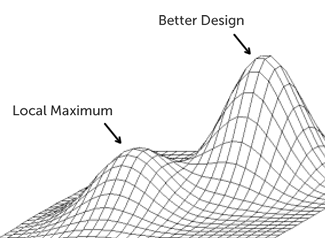
Local Maximum

(Image source: 52weeksofux)

To explore this further, we also have to differentiate between the concepts of iteration and variation. In product development, variation is a way to explore a bunch of alternative product solutions. In contrast, iteration solidifies the product idea that gets chosen. To quote Jon Kolko: “Where an iteration moves an idea forward (or backwards), a variation moves an idea left or right.” Or, to put it into the language of maxima and minima, variation surveys the landscape to help companies choose the right neighborhood (product) to move into. Iteration then helps them to find the local maximum in their chosen neighborhood.

Now, let’s look at the iPhone. Because of the Samsung trial we know that Apple did a great deal of variation work before they chose their neighborhood. See, for example, this sketch of different possible designs from a slide show on AllThingsD:

iPhone prototype

(Image source: AllThingsD)

If you dig deeper into the slide show you’ll see many variations they considered before settling on the basic design for the original iPhone.

It’s not just the hardware though, of course. There’s also iOS. As far as I’m aware there aren’t any early sketches for iOS publicly available, but I’m willing to bet a lot of money that they didn’t just sketch one thing and then designed it that way. It’s pretty safe to assume that the variation process on iOS was every bit as rigorous as for the iPhone hardware.

Once they’ve done a bunch of variation work on the hardware and software for the iPhone, Apple chose their neighborhood and started iterating. There were some major improvement jumps along the way (like iOS2, and iPhone 4), but it’s all still in the same neighborhood.

So let’s get to the crux of the matter. From an engineering perspective, variation is expensive, iteration is cheap. Especially if a product is already out there. Apple is able to give away the iPhone 4 for free because they have been iterating on the hardware for so long that they can manufacture the phones very cheaply. If the iPhone 5 was a drastically different phone (I’m talking about a completely different neighborhood), everything would have started from zero.

From a business perspective, why would Apple choose to make a very expensive move to a different neighborhood, when they know that they haven’t hit the local maximum on the current phone yet? Apple is iterating because they understand this concept, and because they know that the only thing that matters is if customers like it. As John Gruber said:

The collective yawn from the tech press was louder this year; the enthusiasm from consumers is stronger.

What does it mean for startups?

There are some important lessons for startups in the story of the iPhone evolution.

First, spend as much time and money as you can afford on variation upfront, because if you move into the wrong neighborhood, it’s really hard to change that later on. Some companies have done it successfully, like when Path completely redesigned their product from the ground up. Other companies are finding it really hard to move, as evidenced by the almost universal disdain for the new Twitter app for iPad2. And the jury is still out on whether Microsoft’s very expensive foray into the tablet OS world will be a success or not.

Second, don’t move to a new neighborhood until you’re absolutely sure that you’ve hit the local maximum right where you live. I’ll say it again - iteration is cheaper than variation. Instead of trying to rethink your product every few months/years, rather spend time to understand how you can make the current variation better. Apple is proof that this strategy pays off.

I have a feeling that Apple isn’t going to move out of their phone neighborhood any time soon. They might send some family members to buy a new house in the TV neighborhood. But when it comes to phones, they’re still on to a good thing, and they’re smart enough not to be tempted by the fake grass on the other side of the “change everything!” fence.


  1. In Is the iPhone good enough?, Horace Dediu speculates on whether the iPhone 5 has hit the local maximum yet. It’s a must-read piece. 

  2. I’m not as negative about the app as most people, because I understand where it’s coming from. The Twitter design team are most likely operating under some very specific business constraints, and they are doing everything they can to provide a good experience within those constraints. It’s a business, after all. 

Why you shouldn't be pre-disappointed with the next iPhone

The air of ‘meh’ surrounding Apple’s iPhone event this coming Wednesday is almost palpable. A wave of pre-disappointment is sweeping much of the tech blog world, with proclamations like this one from Andrew Couts:

As bored as I am by the new iPhone’s purported growth spurt, I’m not particularly interested in any of the other realistic features Apple might add to some “dream phone” either. NFC? Yawn. Quad-core processor? Psh. Wireless charging? Whatevs. All these features would be great, I suppose — but they have been done before, and will be done again and again and again by the time the iPhone 6 makes its way into the world around this time next year.

I’ve been wondering why so many people have gone all “Everything’s amazing and nobody’s happy” on Apple with this particular event. And I think the answer lies in an unlikely place: a product development theory called the Kano Model.

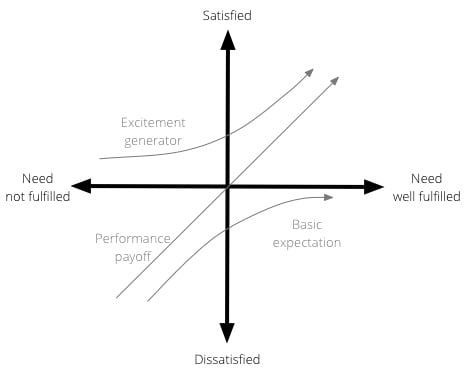
The Kano Model, developed in the 1980s by Professor Noriaki Kano for the Japanese automotive industry, is a helpful method to prioritise product features by plotting them on the following 2-dimensional scale:

  • How well a particular user need is being fulfilled by a feature
  • What level of satisfaction the feature will give users

The model is generally used to classify features into three groups:

  • Excitement generators. Delightful, unexpected features that make a product both useful and usable.
  • Performance payoffs. Features that continue to increase satisfaction as improvements are made.
  • Basic expectations. Features that users expect as a given — if these aren’t available in a product, you’re in trouble.

Here is a visual representation of the Kano model:

Kano model

Now, let’s look at the iPhone in this context. When it was first introduced it was all Excitement generators all the way. From the touch screen, to the scrolling, to the tiniest of UI details, the thing was just a joy to use from start to finish. And since no one had seen anything like it before, we thought it was a piece of magic that could do anything:

The iPhone can do anything

(Image source: Cyanide & Happiness)

Eventually the novelty wore off and the iPhone’s Excitement generators became Basic expectations since everyone started doing it (oh hi, Samsung!). But there were still plenty of Performance payoff features to work on. Continued UI refinements, 3rd party apps, enterprise support, push notifications… as those features were introduced and improved, we kept liking the device more.

This couldn’t go on forever, though. The natural evolution of most products is that the Excitement generators become harder to find, so you tend to spend more time on the Performance payoffs and Basic expectations1. For example, by the time cut-and-paste came to the iPhone, it was no longer an Excitement generator, but the most basic of expectations. All the features Andrew Couts talks about in the piece I quoted above are Basic expectations as well. John Gruber wrote about this back in May:

iOS is by no means feature-complete. But it’s getting harder to identify the low-hanging fruit — the things you just know Apple has to be working on, not just the stuff you hope they are.

There is nothing wrong with this. It’s a natural evolution of a product, and we should be happy with the incremental progress. But that’s just not good enough for us. We can’t move beyond the amazing 2007 keynote where we first saw the iPhone. That’s where Apple set the bar, and now it’s almost impossible to reach it again. So, even though every year the iPhone and iOS keep getting better and better, we become less and less impressed because we have an unrealistic expectation that everything Apple does has to fit into the Excitement generator category. It’s impossible. No one can do that ad infinitum.

We should stop hoping for an avalanche of Excitement generators in this week’s announcement of the new iPhone. Instead, we should realise that Apple is doing what any company should do with a mature product: focus on ways to increase customer satisfaction steadily with Performance payoff and Basic expectation features, without getting caught up in a wild goose chase to re-invent a product that already re-invented an industry.


  1. Also see the Local Maximum theory, which suggests that each design has a limit where it’s as effective as it’s ever going to be. 

Managing user expectations in responsive design

I can’t shake this nagging feeling that we’re changing our focus from “mobile context” to screen-size thinking and responsive design so quickly that our users won’t know what hit them. Although I fully agree with articles like Mobile Context Revisited and Design Process In The Responsive Age, I think there is a missing step we haven’t explored enough: how to change the mental models of users who have become used to separate sites on their mobile phones and desktop computers. Let me illustrate with an example.

During usability testing last week I noticed an interesting trend. It was dormant the whole time, but I just couldn’t put my finger on it until one participant explicitly articulated the problem. I asked her if she has ever visited the e-commerce site we were about to use. She told me that she’s never gone there on her desktop, but that she has browsed the mobile version of the site on her BlackBerry1. So far, so good.

But then she mentioned that when she found a product that she liked, she decided to switch from the mobile version (.mobi) of the site to the desktop version (.com) — while still on her phone — to try to buy it. Her reason? She assumed that the desktop version of the site will have more information about the product than the mobile site has.

The rest of the story gets even bleaker. She tried to force the .com version of the site, but her BlackBerry couldn’t handle it — she tried multiple times and it just kept hanging. So she gave up and never went to the site again.

The experience highlights a few assumptions made by this participant:

  • She assumed that the site will have separate mobile and desktop versions.
  • She assumed that these two versions will have different information on them.
  • She assumed that it is up to her to decide which version will best suit our needs.

Can we blame her for these assumptions? Isn’t this how we trained her to think about mobile sites vs. desktop sites? We kept building sites with reduced feature sets on mobile phones because we didn’t want to overwhelm users. We taught users that mobile sites are inferior versions of their desktop counterparts, and now we have to live with the consequences.

Now, fast forward to the future we’re all driving towards: fully responsive sites that don’t abridge content, but adjust to the screen sizes they are being served to. Considering this participant’s assumptions, you can imagine how confusing a site like that would be to her. She’ll wonder where the mobile site has gone. She’ll wonder what content she’s missing. She might try to enter .mobi and not know why the thing keeps going back to .com. She (and millions like her) has never heard the term “responsive design”, and couldn’t care less about it. We’ve cemented users’ mental models over the past few years of mobile-specific sites, and it’s going to take time to change that.

So, what can we do? When we build responsive sites, we need to communicate to users that they don’t have to worry about finding the mobile site any more — everything they need is right there. This can be as simple as a message on the home page, or relevant microcopy at key stages of the journey, like on a product page.

I’m not trying to stand in the way of responsive design or screen-size thinking over mobile context thinking. But I am arguing that most normal users will be confused by this trend, and we need to manage that. Because we don’t want incorrect user assumptions to cause lower-converting sites that end up killing organizations’ commitment to responsive design.


  1. Nope, I’m not misremembering what phone she used. 

NextDraft, and why email is still important

NextDraft is one of my favorite things on the Internet at the moment. It’s a daily newsletter with 10 interesting news stories, written by the brilliant Dave Pell. It also made me like email again, which I didn’t expect to be possible. But it makes sense now that I’ve read this great interview with Dave where he explains why email is still relevant:

Email has always been a great medium. It’s the content of most emails that’s problematic.

Email is still the killer app. It looks great on all your devices and the user experience is always exactly what you’ve come to expect. Look at the rise of Instapaper, Readability, and Pocket. People love plain, glorious, readable text. Email is also a technology that everyone understands, and it’s personal (if someone wants to respond to me, all they have to do is hit reply).

Tweets and status updates flow by and disappear into the black hole that is the Internet of five minutes ago. Interesting links and stories you find in an email newsletter are always right where you left them.

Also check out the NextDraft iPhone app. It’s fantastic.

Copying is dishonest and lazy

I like Mike Rundle’s take on the Apple v Samsung case. From his post On Design Theft:

I really don’t care about patents or trademarks or trade dress or any of that. To me, a designer, it’s just about honor. Deciding to use someone else’s pixels as your own is not just lazy, but it’s dishonest. It’s a slap in the face. And that’s why I’m glad Samsung owes Apple over a billion dollars, because so much design theft happens in the world, it’s about time someone or some company got knocked down a few pegs because of it. This victory isn’t just a victory for Apple, it’s a victory for every designer who has been ripped off by people who didn’t care or thought they could get away with it. Tonight it’s clear that sometimes they can’t.

It also reminded me of a great post by Matt Gemmell called Copycats:

The lesson of the technology industry in the past five years is that really successful products dare to NOT copy. They’re pure, in that they’re actually designed from first principles - they’re based on the problem and the constraints, without being viewed through the lens of someone’s existing attempt. You know, the kind of thing you actually wanted to work on when you got your degree and were still unsullied by the lazy, corporate machine.

Give me the Nokia/Microsoft mobile experience over Samsung/Android any day. At least they’re trying to do something different.

Why Apple is suing Samsung (and the best place to follow the case)

Jim Dalrymple in Apple’s motivation for suing Samsung:

I’m not going to say that Apple doesn’t care at all about keeping its secrets, but this is a case of dealing with the lesser of two evils. Sue Samsung now and show some old prototype photos, but stop them from copying future products; or let them continue copying. […]

Although none us know for sure what [Apple’s future] products are, if they are truly disruptive, like the iPhone and iPad, it’s in Apple’s best interests to stop Samsung now. This will effectively cut off the worst offender of companies copying its products in their tracks.

Jim clearly has a bee in his bonnet about the Apple v Samsung case, and it makes for some excellent writing and analysis. In fact, I think The Loop is by far the best site to stay up to date on what’s happening in this case.

When mobile design patterns collide

Here is a good example that shows how we still have some work to do before we’ll be able to settle on a standard set of mobile design patterns. In the Facebook iPad app, a drawer slides out if you want to see comments on a status. But once that happens, two existing iOS patterns collide.

I always try to swipe the drawer away to get back to where I was. But, of course, iOS also has a “slide to delete” pattern, so instead of the drawer disappearing, the “Delete” button comes up on swipe. The way to dismiss the drawer is to tap in the greyed-out area.

Facebook swipe

This is certainly a tough problem to solve, so I’m not trying to beat up on Facebook. It’s just an example to show that we’ll have to work through a bunch of these types of colliding patterns before we can comfortably design for mobile using established guidelines.

Apple's infiltration strategy for the enterprise market

Michael Mulvey points out an interesting distinction between Microsoft and Apple in Very Soft, his response to the news of Microsoft’s first ever quarterly loss:

The thing is, Microsoft has never been a consumer-focused company to begin with. Windows was designed for businesses, not people. Microsoft got in good early in the enterprise market in the 80’s and 90’s and that trickled down to peoples’ home computers. “I have Windows at the office, I might as well get it for home.” That left Apple out in the cold until Steve Jobs came back in 1998.

Contrast that with:

Windows PC spread from the office to the home. In the past 10 years we’ve seen the opposite: Apple products are going from the home to the office.

This is true. As BYOD (Bring Your Own Device) policies become more prevalent, corporate IT departments are finding that many of those devices are iPhones and iPads, and they just have to find a way to deal with that. It goes even further, because these devices are “gateway drugs” that end in employees dumping Windows PCs in favor of Macs (see How the Editor of Windows Magazine Became an Apple Fanboy for a good example). And before you know it you have a groundswell revolt against Microsoft Office for Mac, and a loud push to switch everything to iWork and Google Docs.

It’s a difficult situation for Microsoft, because the shift is mostly driven by masses of individual contributors — not executives. And it’s a situation that Windows 8 is not guaranteed to fix.

The real reason we're upset about Sparrow's acquisition

When the news hit that Sparrow has been acquired by Google, you could almost hear the collective sigh from those who use and love this wonderful iOS and Mac OS X email client. Many people (myself included) took to Twitter to voice our disappointment with this move, especially about the fact there there will be no additional development on the app:

We will continue to make available our existing products, and we will provide support and critical updates to our users. However, as w’ll be busy with new projects at Google, we do not plan to release new features for the Sparrow apps.

The response from many others was that we should just get over ourselves:

Sparrow doesn’t owe you anything. You paid, you got software. They can sell and/or kill it if they want. No right to complain. Sad, true.

— Matt Gemmell (@mattgemmell) July 20, 2012

Matt is right, of course — Sparrow doesn’t owe us anything. The Sparrow team did everything right: they had a great idea, they worked hard on it, and they executed well. That’s why Sparrow is a great app that serves a real need, and why it’s so successful. This is how software development should work: make a great product, and sell it to people for money. The Sparrow team deserves enormous credit for doing that.

But the issue is not that we think Sparrow “sold out.” I don’t think any of us would have turned down Google’s offer if we were in their shoes. The Sparrow team deserve their success, and it’s their software — they can do with it whatever they want. It’s also a great strategic move by Google. If the Sparrow team end up making Gmail better, Google wins. If they don’t — well, at least they’ve eliminated a competitor, and they still win.

We need to reframe this argument. The real issue is much deeper than this specific acquisition. The real issue is the sudden vulnerability we feel now that one of our theories about independent app development has failed.

You see, for a long time we’ve chanted this refrain wherever we could: If you’re not paying for it, you’re not the customer; you’re the product being sold. We point to Facebook and Delicious and ad-supported sites and lament the fact that we’re all just a set of eyeballs being sold to advertisers. So we came up with a solution. We decided that we don’t want to be free users any more. We decided that we want to pay independent developers directly so that they can have sustainable businesses and happy lives.

The philosophy is perfectly summed up in Don’t Be A Free User, a great post on the Pinboard blog:

What if a little site you love doesn’t have a business model? Yell at the developers! Explain that you are tired of good projects folding and are willing to pay cash American dollar to prevent that from happening. It doesn’t take prohibitive per-user revenue to put a project in the black. It just requires a number greater than zero. [”¦]

So stop getting caught off guard when your favorite project sells out! “They were getting so popular, why did they have to shut it down?” Because it’s hard to resist a big payday when you are rapidly heading into debt. And because it’s culturally acceptable to leave your user base high and dry if you get a good offer, citing self-inflicted financial hardship.

This is why I am a paid subscriber to services like Pinboard and Instapaper. It’s also why I paid for the both the Mac OS X and iOS versions of Sparrow. I believe in this philosophy. I believe we should pay people for the things they make, so that they can make it even more awesome.

But with Sparrow’s acquisition the cracks in the philosophy starts to appear. Marco Arment (creator of Instapaper) posted his response to the deal in Talent acquisitions:

If you want to keep the software and services around that you enjoy, do what you can to make their businesses successful enough that it’s more attractive to keep running them than to be hired by a big tech company.

But… that’s what I did. I paid full price for every version of the Sparrow app I could find. I told everyone who would listen to buy it. I couldn’t have given them more money even if I wanted to. So, as a customer, what more could I have done to keep them running independently?

This is the core of the disappointment that many of us feel with the Sparrow acquisition. It’s not about the $15 or less we spent on the apps. It’s not about the team’s well-deserved payout. It’s about the loss of faith in a philosophy that we thought was a sustainable way to ensure a healthy future for independent software development, where most innovation happens.

RIM's corporate DNA as a reason for their demise

Charles Miller wrote an excellent post on the role that corporate DNA is playing in RIM’s demise. From “¦or are we just simply spiralling coils?:

For the years it was successful, RIM made utilitarian business phones that were really good at email. [”¦]

So when overnight, and entirely to my surprise, the smart phone market stopped being about making utilitarian business phones that were really good at email, RIM was in the worst position to deal with it because they didn’t just have to change their strategic direction, they had to change their entire corporate makeup.

The phone companies that survived the iPhone shake-up most ably were the ones whose DNA most closely resembled “We flood the market with phones built from commodity parts.” Because they were already poised to beg, borrow, steal and copy the next generation of products.

He also offers up some one-sentence DNA statements for Apple and Google, which I won’t spoil for you. It’s an article worth reading.

Oh, and Charles — really well done on the Monty Python reference.