Menu

Posts tagged “mental health”

Maybe social media won't make us forever alone after all

Forever alone

Clive Thompson takes on the “social media is bad for teens” narrative in Don’t Blame Social Media if Your Teen Is Unsocial. He discusses some findings by Microsoft researcher Danah Boyd:

What she has found, over and over, is that teenagers would love to socialize face-to-face with their friends. But adult society won’t let them. “Teens aren’t addicted to social media. They’re addicted to each other,” Boyd says. “They’re not allowed to hang out the way you and I did, so they’ve moved it online.” […]

The result, Boyd discovered, is that today’s teens have neither the time nor the freedom to hang out. So their avid migration to social media is a rational response to a crazy situation. They’d rather socialize F2F, so long as it’s unstructured and away from grown-ups. “I don’t care where,” one told Boyd wistfully, “just not home.”

Thompson and Boyd are joining a growing number of authors who push back against the notion that technology makes us stupid, social media is bad for us, etc. I’m currently making my way through Thompson’s book, Smarter Than You Think: How Technology is Changing Our Minds for the Better. It’s really great so far, and I’ll write a full review when I’m done, but his core argument comes down to this:

What are the central biases of today’s digital tools? There are many, but I see three big ones that have a huge impact on our cognition. First, they allow for prodigious external memory: smartphones, hard drives, cameras, and sensors routinely record more information than any tool before them. We’re shifting from a stance of rarely recording our ideas and the events of our lives to doing it habitually. Second, today’s tools make it easier for us to find connections—between ideas, pictures, people, bits of news—that were previously invisible. Third, they encourage a superfluity of communication and publishing. This last feature has many surprising effects that are often ill understood.

Also consider Jason Feifer’s impassioned rejection of Sherry Turkle’s doom-and-gloom ideas1 in Google Makes You Smarter, Facebook Makes You Happier, Selfies Make You A Better Person:

Turkle imagines that any interaction with technology somehow negates all the time spent doing other things. She also imagines that we must devote ourselves in only one way to every task: At a dinner table, we are only serious and focused on conversation; at a memorial service, we are only mournful. That is not the way we live. It’s never been the way we live. And that’s the beauty of technology, which Turkle cannot see: We can use it for all purposes, to express joy and sadness, to have long conversations or send short texts. We made it. It is us.

I’m coming around to the idea that online connections are as real as “IRL” connections2. We’re just going through a reframing that happens every time a new technology comes along, and that’s ok. I also think we need both sides of the argument — pessimists as well as optimists — to help us work through it all and find our middle ground.


  1. Yes, I know, I’ve written about her stuff quite a bit. It’s time to start looking at the other side of the argument. 

  2. Also see my post The fetishization of the offline, and a new definition of real

Unplug all you want — it won't help

In The Disconnectionists Nathan Jurgenson takes to task those who speak about digital detoxes and the negative social effects of being online:

Op-eds, magazine articles, news programs, and everyday discussion frames logging off as reclaiming real social interaction with your real self and other real people. The R in IRL. When the digital is misunderstood as exclusively “virtual,” then pushing back against the ubiquity of connection feels like a courageous re-embarking into the wilderness of reality. When identity performance can be regarded as a by-product of social media, then we have a new solution to the old problem of authenticity: just quit. Unplug — your humanity is at stake! Click-bait and self-congratulation in one logical flaw.

Which reminds me of this tweet of the picture below and the caption, “All this technology is making us antisocial. Before everyone used to talk to each other.”

Distraction

There is nothing new under the sun… I also love this line from the article:

Disconnect. Take breaks. Unplug all you want. You’ll have different experiences and enjoy them, but you won’t be any more healthy or real.

It turns out our anti-social behavior comes not from technology, but from who we are.

We're selling our attention for far too cheap

Tom Chatfield looks at the meaning and value of our time and attention in What is the real cost of your online attention? He makes the point that we are now all amateur attention economists who have to make increasingly complex decisions about how we spend our time:

We watch a 30-second ad in exchange for a video; we solicit a friend’s endorsement; we freely pour sentence after sentence, hour after hour, into status updates and stock responses. None of this depletes our bank balances. Yet its cumulative cost, while hard to quantify, affects many of those things we hope to put at the heart of a happy life: rich relationships, rewarding leisure, meaningful work, peace of mind.

What kind of attention do we deserve from those around us, or owe to them in return? What kind of attention do we ourselves deserve, or need, if we are to be ‘us’ in the fullest possible sense? These aren’t questions that even the most finely tuned popularity contest can resolve. Yet, if contentment and a sense of control are partial measures of success, many of us are selling ourselves far too cheap.

How Facebook makes us feel inadequate

Why Generation Y Yuppies Are Unhappy is such a brilliant post. Funny, way too true, and great illustrations. It follows the story of Lucy, a fictional Gen Y yuppie who is not having such a good time right now. This part about social media sites (or what I guess is known as Facebook image crafting) really stuck with me:

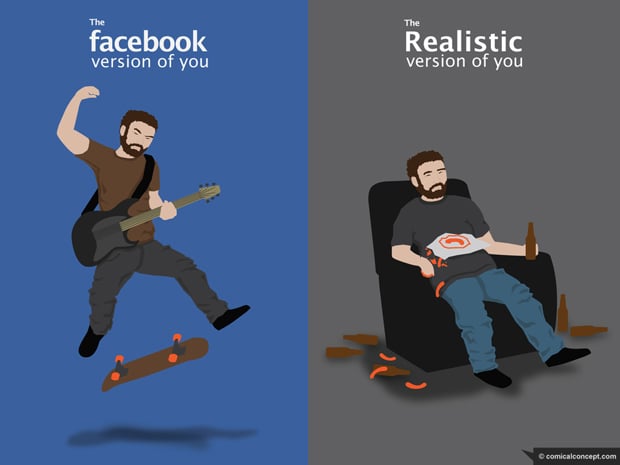
Social media creates a world for Lucy where A) what everyone else is doing is very out in the open, B) most people present an inflated version of their own existence, and C) the people who chime in the most about their careers are usually those whose careers (or relationships) are going the best, while struggling people tend not to broadcast their situation.  This leaves Lucy feeling, incorrectly, like everyone else is doing really well, only adding to her misery

So that’s why Lucy is unhappy, or at the least, feeling a bit frustrated and inadequate. In fact, she’s probably started off her career perfectly well, but to her, it feels very disappointing.

I increasingly feel like Facebook has become a cacophony of ads and fake happiness, and I’m extremely turned off by it. I’m trying out Path again (I know, hypocrisy!), and I’m enjoying the quietness and sincerity there. It’s such a stark, appealing contrast to the endless shouting on Facebook.

The real Facebook

What happens when we gut stuck doing something online

I love the phrase “getting caught in the melancholy of the infinite scroll.” That’s just one gem from Alexis Madrigal’s The Machine Zone: This Is Where You Go When You Just Can’t Stop Looking at Pictures on Facebook. He explores this strange dark side of “flow”, where we get stuck in an online activity and can’t stop doing it, even though there’s no tangible benefit:

What is the machine zone? It’s a rhythm. It’s a response to a fine-tuned feedback loop. It’s a powerful space-time distortion. You hit a button. Something happens. You hit it again. Something similar, but not exactly the same happens. Maybe you win, maybe you don’t. Repeat. Repeat. Repeat. Repeat. Repeat. It’s the pleasure of the repeat, the security of the loop.

We certainly do seem to treat “pull to refresh” like a slot machine in a casino. And the chances of winning something valuable are about the same, too.

The importance of being idle

In Idle minds L.M. Frank writes about what happens inside our brains when we’re not actively working on or thinking about something:

Some researchers now think that resting-state networks may prime the brain to respond to stimuli. “The system is not sitting there doing nothing and waiting,” says [Andreas Kleinschmidt, director of research at the French National Institute of Health and Medical Research’s Cognitive Neuroimaging Unit]. Cycling activity in these networks may be helping the brain to use past experiences to inform its decisions. “It’s incredibly computationally demanding to calculate everything on the fly,” says Maurizio Corbetta at Washington University School of Medicine in St. Louis. “If I have ongoing patterns that are guessing what’s going to happen next in my life, then I don’t have to compute everything.” He likens the activity to the idling of a vehicle. “If your car is ready to go, you can leave faster than if you have to turn on the engine.”

It makes intuitive sense that we can’t just continue to create and consume information — our brains need time to process it all. And yet we still so often celebrate 80-hour weeks and shun “downtime” because we’re so afraid of not being productive. It seems like we’re doing ourselves more harm than good if we don’t give our brains time to be idle.

Nostalgia is what it used to be

John Tierney writes about the benefits of reminiscing in What Is Nostalgia Good For? Quite a Bit, Research Shows:

Nostalgia has been shown to counteract loneliness, boredom and anxiety. It makes people more generous to strangers and more tolerant of outsiders. Couples feel closer and look happier when they’re sharing nostalgic memories. On cold days, or in cold rooms, people use nostalgia to literally feel warmer. […]

Nostalgia serves a crucial existential function,” Dr. [Clay Routledge of North Dakota State University] says. “It brings to mind cherished experiences that assure us we are valued people who have meaningful lives. Some of our research shows that people who regularly engage in nostalgia are better at coping with concerns about death.”

Of course, there’s a fine line between reminiscing about great moments, and allowing those memories to make you feel depressed. In the words of Stephen Stills:

Don’t let the past remind us of what we are not now.

Loneliness, social networks, and the power to get up

Geoff Livingston wrote a great essay called Is Existing Online a Quest of Loneliness or Giving? It’s worth reading the whole thing, but here’s an excerpt that stuck out for me:

We exist in a time where anyone can determine and create unique lives online, accountable to no one, yet visible to and dependent upon all. Digital existentialism extends the sense of modernistic distress. There are so many red herrings and lost pursuits that distract. You can drug yourself digitally with almost any pursuit, and at the end find yourself nano-famous and alone.

That last line is so spot on. I thought about it again when I saw Shimi Cohen’s excellent video The Innovation of Loneliness, which is making the rounds this week:

Later in his post Geoff says this:

We exist in the moment. Every effort spent, every tap on the keyboard provides a chance to impact an individual, contribute to the world, and add light to the picture.

Sure, efforts can lead towards darkness. Sometimes when we awaken to our outcomes, we realize the fruitlessness, or worse the destructiveness of our actions. What are you going to do, condemn yourself to the desert for a long march of hermitage? Or get up?

This is another good point. We’re all going to make mistakes. We might look at that video and feel like helpless victims. But that’s not true. We do have the power get up, to connect with people in a way that doesn’t just ignore the bad bits (I tried to do that here, and it worked out ok).

Related to this, I really enjoyed Chris Bowler’s Congestion, in which he discusses some ideas on how we might deal with this new reality of overload and over-connection:

To create is better than to consume.

But create for the few, not for the many.

Create for those you can see face to face.

Consume, but remember that the dose makes the poison.

When you consume something that is good, great, transcendent, consume it over and over … meditate on it, then act on it, be changed by it.

So much has been written about this topic, but I really like the common theme that runs through these posts and video: we are not victims of technology. We have a choice.

Focus and littered menu bars

The idea that we allow too many distractions to take our focus off the work we’re supposed to be doing is not new. And the solution — just turn things off! — is not rocket science either. But I find it interesting just how many blog posts we’ve seen about this topic over the past couple of years. Working in the Shed by Matt Gemmell is another really good one:

We act as if we take concentration for granted, yet everyone has had trouble keeping their mind on the task at hand. We litter our menubars with icons, keep notifications enabled, and run our email programs, chat apps and social media clients all day. Something’s got to give, and invariably it’s our creative output.

We can't blame the internet for our problems

By now most people have read Paul Miller’s I’m still here: back online after a year without the internet. The article is certainly deserving of all the attention it received back in May. I’m not sure what I expected — perhaps a gloating, holier-than-thou account of the virtues of going on an internet sabbatical to “find yourself”. But that’s not what this is. It’s a raw, often sad, always authentic account of a year that didn’t go at all as expected.

There is much to discuss and analyze in Paul’s experience, but I’d like to focus on this particular paragraph:

What I do know is that I can’t blame the internet, or any circumstance, for my problems. I have many of the same priorities I had before I left the internet: family, friends, work, learning. And I have no guarantee I’ll stick with them when I get back on the internet — I probably won’t, to be honest. But at least I’ll know that it’s not the internet’s fault. I’ll know who’s responsible, and who can fix it.

Paul touches on a really important point here. Over the past few years we’ve increasingly started to blame the internet or technology whenever we feel like we’re failing at being human beings. It all started with Nicholas Carr’s famous 2008 article Is Google Making Us Stupid?, a theme that is carried through in Kevin Kelly’s excellent book What Technology Wants.

These (and other) authors make great arguments, and I don’t doubt the validity of their assertions. But I do think the pendulum has swung too far away from the importance of personal responsibility. It has just become too easy to play the victim and blame technology for our own inability to resist it. Some people feel so powerless against the relentless pull of technology that they pay hundreds of dollars to go to what is essentially rehab for technology addicts. NPR tells the story in the article At Tech-Free Camps, People Pay Hundreds To Unplug:

Digital Detox co-founder Levi Felix attributes the high demand for tech-free retreats to a growing awareness of the pervasiveness of technology in our everyday lives. “People are feeling like something’s not right here,” he says.

With no iPhones or computers to distract them, campers at Camp Grounded participated in “playshops,” featuring yoga, laughing contests and writing sessions.

What the hell? “Laughing contests”? Isn’t that just called “going out to dinner with friends”? Sure, many of us find it hard to unplug, and we end up spending a lot of our time alone together1, but we can’t throw our hands in the air and blame inanimate objects for our woes. We have to take responsibility for our actions and realize that we have nothing to fear: our devices won’t become self-aware and attack us if we turn them off every once in a while.

I think Theodore Rooseveldt said it best:

If you could kick the person in the pants responsible for most of your trouble, you wouldn’t sit for a month.

Never alone

Image source: Jean Jullien


  1. This is a great book. Well worth your time.