Menu

Posts tagged “mental health”

Kids and their fascination with phones

James Fallows interviewed Linda Stone on Maintaining Focus in a Maddeningly Distractive World. This part, in particular, reminded me how destructive our technology use can be:

We may think that kids have a natural fascination with phones. Really, children have a fascination with whatever Mom and Dad find fascinating. If Mom and Dad can’t put down the device with the screen, the child is going to think, That’s where it’s all at, that’s where I need to be! I interviewed kids between the ages of 7 and 12 about this. They said things like “My mom should make eye contact with me when she talks to me” and “I used to watch TV with my dad, but now he has his iPad, and I watch by myself.”

There are many reasons why it’s important for kids to grow up around technology, but we should never forget how important it is for our kids to have our undivided attention when we’re with them.

How weather channels are turning no news into bad news

Gales Gone Wild, apart from being a great headline, is also a very interesting post by Timothy Egan on the changing role of weather sites and channels:

The scourge of 24-hour news, in which stuff that isn’t important gets its own countdown clock, is now doing to the weather what it did to public affairs and the stock market. It’s making us all a little jumpy and anxious, with a twisted view of the normal rhythms of the seasons.

Phrases like “meteorological thugs” and “cable television barker” makes this a delightful read, but Timothy also makes a scary observation:

The effect is to trivialize the real thing, to put breathless graphics and histrionics ahead of science and public safety.

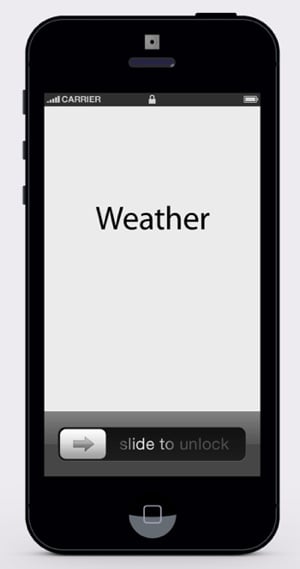
Maybe it’s time for us to tone down our love affair with weather apps. Or, just switch to Merlin Mann’s new app:

Merlin Mann minimalist weather app

Our weird and outdated definition of success

Jason Kottke once said that The Onion is often the most emotionally honest media source we have, and that was proven once again with David Ferguson’s recent article there called Find The Thing You’re Most Passionate About, Then Do It On Nights And Weekends For The Rest Of Your Life:

Because when you get right down to it, everyone has dreams, and you deserve the chance—hell, you owe it to yourself—to pursue those dreams when you only have enough energy to change out of your work clothes and make yourself a half-assed dinner before passing out.

But what I really want to talk about is Kevin Fanning’s excellent follow-up post where he tries to figure out why that Onion article struck a chord with so many people:

I think the reason this article is painful is because culturally we define success in such a weird and outdated way. There’s this idea that if you’re not doing what you’re most passionate about all the time, you’re a failure. If you aren’t making a living at it, you’re a failure. If you’re not Stephen King or Christina Aguilera, you’re a failure.

Kevin’s conclusion (among other things, that “maybe eventually we get to a place where we see that books and music and art are created by us, people who have school and day jobs and other shit we care about”) is a call to relax a bit, and be much less hard on ourselves. Read it and feel better!

Engineered to be vaguely dissatisfied

Your Lifestyle Has Already Been Designed is a punch-in-the-gut piece by David Cain. Consider this paragraph:

We’ve been led into a culture that has been engineered to leave us tired, hungry for indulgence, willing to pay a lot for convenience and entertainment, and most importantly, vaguely dissatisfied with our lives so that we continue wanting things we don’t have. We buy so much because it always seems like something is still missing.

Feeling indignant that he would insinuate that you of all people have been indoctrinated by a consumerist culture? Before you close your laptop in disgust, hear the man out. Haters gonna make some good points sometimes…

The thing that breaks us

It’s not the load that breaks you down, it’s the way you carry it.

Lou Holtz (retired American football coach, author, and motivational speaker)

I can’t stop thinking about this quote ever since I saw it on Quote Vadis. At some point over the last three or four years, life became pretty heavy. The pressures of two kids, a career, and a life that’s just public enough to invite some nastiness every once in a while can really wear you down.

So it’s easy to fix your eyes on the load. The weight, the texture, the uncomfortableness of it all.

And then I read Austin Kleon’s words of encouragement in his post On writing post-fatherhood.

You owe your kid food, safety, and love, but you also owe him your example. You give up on The Thing, and then when the kid grows up, he might give up on His Thing, too.

So don’t give up on The Thing.

The Thing in this context is writing, but it applies to so much more. It’s the dream you can’t let go of — the products you want to build, the lives you want to affect positively, the tiny dent you want to make in the universe. If we let the load break us, The Thing will never happen, and worse — our kids will watch us give up on what’s important, and maybe do the same.

I can’t let that happen.

Here’s to carrying the load better.

2013: the year of social network quitting

I can’t shake this feeling that this might be the year that quitting social networks goes mainstream. We’re not even through January, and already the posts are flooding in. Here’s Brent Simmons in Brave new network: Why I hope Apple never releases a smart watch:

I want to stay human, in other words. I want to like things in the thousand different ways there are to like things, rather than just click on a Like button. I want to say and think things that take more than 140 characters.

I want to not take a photograph, because no picture, no matter how beautifully filtered, can express what it’s like for one person to walk in the woods alone. I need to remember.

And here’s Keri Maijala in Why I’m not on Facebook:

I felt bad about myself after browsing Facebook.

I get that Facebook is like a reverse funhouse mirror that makes everything look better. It’s a sublimely distorted world filled with families and trips and drinks and straight white teeth. And I was just as guilty of perpetuating that myth, carefully choosing photos and crafting updates that supported how I wanted to be perceived: Happy, healthy, independent, adventurous, courageous, and with straight white teeth. Only half of those things are true. And ultimately, I found I felt depressed after browsing Facebook.

Or as Alex Charchar said on Twitter recently, we’re starting to get bored by our distractions. I think that’s a good thing, though. Boredom leads to creativity.

The impact of technology on kids and their development

I desperately wanted to dismiss Sherry Turkle’s answer to the question What should we be worried about? as alarmist, but she makes a terribly convincing argument about the impact that technology has on kids and their development. After discussing the issues in detail, she concludes:

Thus my worry for kindergarten-tech: the shiny objects of the digital world encourage a sensibility of constant connection, constant distraction, and never-aloneness. And if you give them to the youngest children, they will encourage that sensibility from the earliest days. This is a way of thinking that goes counter to what we currently believe is good for children: a capacity for independent play, the importance of cultivating the imagination, essentially, developing a love of solitude because it will nurture creativity and relationship.

The essay echoes Nicholas Carr’s thoughts:

We don’t like being bored because boredom is the absence of engaging stimulus, but boredom is valuable because it requires us to fill that absence out of our own resources, which is process of discovery, of doors opening. The pain of boredom is a spur to action, but because it’s pain we’re happy to avoid it. Gadgetry means never having to feel that pain, or that spur. The web expands to fill all boredom. That’s dangerous for everyone, but particularly so for kids, who, without boredom’s spur, may never discover what in themselves or in their surroundings is most deeply engaging to them.

But perhaps Stephen Hacket said it best — and most succinctly — in Why I Don’t Play Games on my iPhone:

Boredom isn’t a bad thing. But strangling it with Angry Birds probably is.

Giving your voice a chance to be heard

Craig Mod just published the first issue of his Roden Explorers Mailing List, and it’s great. He talks a bit about disconnecting from the Internet — a topic that, let’s be honest, we’re all thinking about at this time of year:

It’s REALLY fascinating to watch the language and texture of the world around you change when you disconnect. It’s also a bit sad, I guess, or hilarious, I suppose, to fetishize disconnection. But that’s the world we live in these days.

He proceeds to discuss author Susan Sontag’s book Under the Sign of Saturn, and one of the rules she made for her apartment in the 1970s:

“[It is] in this tiny room where books are forbidden, where I try better to hear my own voice and discover what I really think and really feel.”

Books! The enemy! Excise them to go: Offline!

This is such a great description of why one needs an internet diet every now and then: to better hear your own voice and discover what you really think and really feel.

We grab frantically at social network signals, news, podcasts — whatever — during all moments of downtime. Nevermind the last time we heard our voice, when’s the last time we gave our voice a chance to be heard?

The whole letter is great, so I definitely recommend subscribing to Roden Explorers.

The cure for technology overload

Dave Pell is writing on Tweetage Wasteland again, and that’s a wonderful thing. Earlier this week he called for a better media in Get Off My Stoop, and today he’s back with a very good essay on technology overload. From The Answer Is Just A Click Away:

Technology used to be a way to solve life’s little problems. Now, technology is used to solve the little problems caused by technology. On some level, we know that doesn’t make sense, but we don’t have an app to convince us. Where’s the computer algorithm to prove that the quiet walk without the phone calls is the balance?

It’s worth reading his conclusion — and subscribing to his site if you don’t already do so.

Mankind's almost infinite appetite for distractions

I recently started reading Neil Postman’s Amusing Ourselves to Death (thanks to J.D. Bentley for the recommendation). It’s great so far, and I’m sure I’ll have lots more to say once I’ve made my way through it.

Postman juxtaposes George Orwell’s “Big Brother” prophecy from Nineteen Eighty-Four with Aldous Huxley’s very different view of the future as set out in his 1931 book Brave New World. With that as backdrop, it’s amazing to think that this section from Amusing Ourselves to Death was written in 1985:

Contrary to common belief even among the educated, Huxley and Orwell did not prophesy the same thing. Orwell warns that we will be overcome by an externally imposed oppression. But in Huxley’s vision, no Big Brother is required to deprive people of their autonomy, maturity and history. As he saw it, people will come to love their oppression, to adore the technologies that undo their capacities to think.

What Orwell feared were those who would ban books. What Huxley feared was that there would be no reason to ban a book, for there would be no one who wanted to read one. Orwell feared those who would deprive us of information. Huxley feared those who would give us so much that we would be reduced to passivity and egoism. Orwell feared that the truth would be concealed from us. Huxley feared the truth would be drowned in a sea of irrelevance. Orwell feared we would become a captive culture. Huxley feared we would become a trivial culture, preoccupied with some equivalent of the feelies, the orgy porgy, and the centrifugal bumblepuppy.

As Huxley remarked in Brave New World Revisited, the civil libertarians and rationalists who are ever on the alert to oppose tyranny “failed to take into account man’s almost infinite appetite for distractions.” In 1984, Huxley added, people are controlled by inflicting pain. In Brave New World, they are controlled by inflicting pleasure. In short, Orwell feared that what we hate will ruin us. Huxley feared that what we love will ruin us.

Sounds like it was written yesterday, doesn’t it…