Menu

Posts tagged “mental health”

How to spend your life force as a product manager

I’ve been spending lots of time recently thinking about and working with my team on what I can only refer to as “how we should spend our life force.” If that sounds weird, hold on to your hats because I’m going to make it even weirder by (and I apologize in advance) throwing a 2x2 matrix into the mix. So. Come with me in this post as we discuss how our biggest strength as product managers can easily become our biggest weakness, and how we can protect our health and sanity in the midst of all the turmoil in our companies and the world at large.

First, without getting too deep into the metaphysical or get myself in trouble about things I don’t know enough about, I do think it’s import for each of us to make conscious decisions to spend our “life force” on things that make us generally feel fulfilled and bring us closer to the person we want to be. That can take many forms—a bike ride, a fun side project, a bad action show (The Night Desk is so bad good!), an interesting problem at work… those can all be good ways to spend our life force! Being on the internet too long, on the other hand, is rarely that:
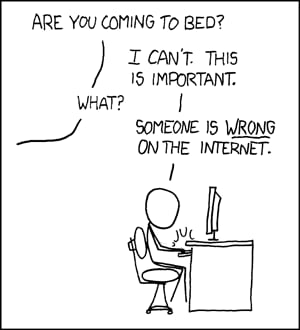
This is true at a macro level in our daily lives, but also when we zoom into how we spend our time at work. PMs in particular have this annoying habit where we tend to gravitate towards the wicked problems—a trait that makes us good at what we do, but can also be self-defeating because when we spend too much of our time depleting our life force, burnout eventually finds us.

So 2x2 matrix incoming! I think of the way we spend our life force as PMs on two dimensions: the difficulty of the task, and our likelihood of influencing the task’s success.

Some tasks fall in the easy bucket (relatively speaking—don’t @ me!). Think about things like customer interviews, collaborating with designers on a good user experience for a feature, or puttering around in JIRA making comments here and there. But then there are the difficult tasks—solving an organization’s quality problem, fixing development and deployment dependencies, understand team dynamics and creating a safe and open work environment where the whole team feels happy and fulfilled… you get the idea.

We are probably all familiar with that dimension. But the dimension we don’t always take into account is the probability that our work will actually influence the outcome of the task to ensure its success. Maybe the collaboration with the designer has a low probability of success because they report into a different org with different values. Maybe fixing development and deployment dependencies have a high probability of success because you have a really good relationship with engineering leadership and you all are highly motivated to solve the problem.

Which leads me to my main point. It’s in the combination of the ease/effort involved in a task, as well as our known sphere of influence, that we are able to make the best decisions about where to spend our life force. Let’s break out that long-promised matrix now, shall we?
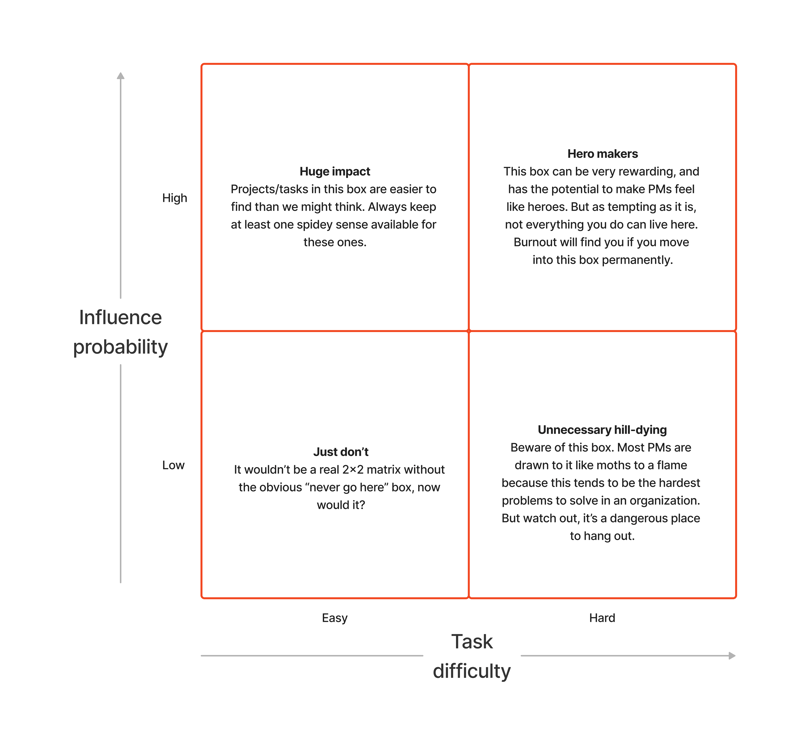
You’ll have to excuse me, I’m not good at naming things. But let’s go through these.

Just don’t

Let’s get this one out of the way first. There are tasks that are easy, that we might be tempted to pick up—especially when we’re already tired and close to burnout—that simply don’t make sense because there really is no winning.

Maybe you are a JIRA wizard, and you think it would be an easy win to redo some of your workflows. But maybe the engineering team has no interest in changing any workflows and they see no benefit in learning a new system. They dig their heals in, and before you know it you’ve spent weeks on an “easy” task that only served to erode trust between you and the engineering team.

Just don’t.

Unnecessary hill-dying

This bucket is really interesting to me because I think a lot of ambitious, smart PMs gravitate towards problems like these. We want to go for the hardest, “wickedest” problems out there, and prove to ourselves and the world that we can solve them. This is such an admirable quality, but not a sustainable way to live your work-life.

Think of our example of solving an organization’s quality problem. This is likely a really hard problem that requires coordination and buy-in across multiple teams, with a lot of resistance and meetings and meetings about meetings and meetings to talk about how bad that one meeting went. With extensive effort and superhuman patience and collaboration skills you might get to a point in 9–12 months where the quality of the organization’s output has seen a marked improvement. At that point it will feel amazing and you’ll be proud—as you should be. But it might also kill your drive, enthusiasm, and ambition and turn you into a relentless cynic.

I think we should all attempt a task like this at least once in our careers. But it is no place to build a home.

Hero makers

Oh, we love these kinds of tasks too, don’t we. Really hard problems with enough social and organizational capital to make a real difference in a reasonable time frame? That’s PM catnip right there! This box is definitely a better use of life force than unnecessary hill-dying, but we have to limit ourselves here too. Because even though the payoff / enjoyment / fulfillment of this work can be huge, so can the cost. This is difficult work that can also become addictive, and if we don’t pace ourselves and limit the number of tasks we take on in this box, burnout will find us here. So choose these carefully, and try to shift more of your life force to…

Huge impact

As we progress in our careers some tasks that used to be difficult become second nature to us. What sometimes happens is that we forget that it wasn’t always easy, so we erroneously start to think that everyone on the team already knows what we know, and we start to undervalue our contributions / knowledge.

Take a moment to think if this is happening to you. Maybe you have gotten really good at JTBD interviews, or facilitating group FigJam sessions, or getting a team to define a customer problem / business outcome effectively, or… What are the things that you can do in your sleep, but only because you’ve spent so much time on those tasks that you have a level of familiarity that others on the team simply don’t have?

Those, my friend, are high impact tasks that take very little energy/life force, and often gives you energy because of how electrifying it can be to be really good at something. You should always be on the lookout for ways to apply those unique skills to problems/opportunities where it can be really impactful. Unfortunately we can’t spend 100% of our time on tasks like these—and frankly, we shouldn’t want that, because then we’ll stop growing. But the number should definitely be more than 0% and probably closer to 20% of our time.


The main point I want to make with this post is that as PMs we generally have a lot of autonomy over how we spend our time, and that can be a blessing and a curse. A blessing because we get to prioritize our impact. A curse because we too often spend our life force on tasks that drain us and lead us towards burnout.

So take a moment to breathe, and think about the amount of time you spend in each of the life force buckets I mentioned here—and where you might need to make changes to avoid the road to exhaustion and burnout. And please, come up with better names for the buckets than I did.


Hypervigilance is not a sustainable lifestyle for leaders

In This will only take a minute the Raw Signal team shares some much-needed advice for leaders who feel like they never have time to think and reflect. This state of constant hypervigilance is not a sustainable lifestyle because:

On one level, you’re a human being. Regardless of your title or role, you are worthy of work that doesn’t wreck your health, or your happiness, or your ability to enjoy lunch away from your webcam. On another, if you’re a manager, you’re responsible for the work of a team of other human beings. If you don’t have the time to be thoughtful about your own work, the odds are very high that your team doesn’t either.

They go on to share some ideas for how to make this time to step back a priority, once you are “past the point where working a little bit more is going to clear your plate”.

The 90s, having time, and always rushing to the next thing

I’m sure every generation writes lots of articles like Freddie deBoer’s It’s So Sad When Old People Romanticize Their Heydays, Also the 90s Were Objectively the Best Time to Be Alive. But hear me out. This is the impassioned, forceful, yet balanced Gen X take I wish I had the skill and wherewithal to write. It is a balm to the nostalgic soul in a way that somehow doesn’t feel like cringey old-person fanfic.

Here he is on the experience of visiting a record store:

When you were there you were Doing Music. Now we’re never doing anything—we’re always getting through something to get to something else to get through, using various time-saving techniques that maximize the amount of time we have to get through things while keeping our attention divided into a thousand things we then get through. When you went to a record store you were intent on music, and sometimes, you’d care enough about a particular artist that you paid for their album, real money, so that the artist got a cut that was more than the .002 cents they get per stream now.

This reminds me of the question Alan Jacobs asks: What exactly are we’re rushing towards with all our 2x listening and cliff notes skim-reading?

My question about all this is: And then? You rush through the writing, the researching, the watching, the listening, you’re done with it, you get it behind you—and what is in front of you? Well, death, for one thing. For the main thing. 

But in the more immediate future: you’re zipping through all these experiences in order to do what, exactly? Listen to another song at double-speed? Produce a bullet-point outline of another post that AI can finish for you?

Maybe the 90s have a thing or two to teach us yet.

Mono no aware

What would happen if we look at time through the lens of attachment theory? That’s the question my friend Simon asks in Attachment Styles to Time. I definitely have an “anxious attachment style” with time:

An anxiously attached person to time will try to arrest it: to find comfort again in a space where time felt distant. A coping strategy is to try and keep things the way they were. To hold onto people and places even if you aren’t present anymore.

The framing also reminds me of the Japanese phrase Mono no aware:

Mono no aware (物の哀れ), lit. ‘the pathos of things’, and also translated as ‘an empathy toward things’, or ‘a sensitivity to ephemera’, is a Japanese idiom for the awareness of impermanence (無常, mujō), or transience of things, and both a transient gentle sadness (or wistfulness) at their passing as well as a longer, deeper gentle sadness about this state being the reality of life.

That is also basically what the entire “synthwave” genre is about so if you’d like to hear what that concept sounds like as a song, just make your way over to Los Angeles by The Midnight.

Link roundup for January 29, 2023

Distractions, monk productivity, and the importance of “between-time”

Sometimes the internet seems to think about the same things at the same time. Last week we were all in on meetings (see here, here, here, and here), and this week we’re all talking about distractions. Here are three excellent articles about this topic that all came across my feeds this week.

First, there is a new interview with the father of deep work, Cal Newport (NYT gift article link). He talks about context switching and “slow productivity”—and it’s really good:

I’m trying to develop this notion of productivity that’s based on, at the large time scales, the production of things you’re proud of and that have high impact, but on the small time scale, there’s periods where you’re doing very little. […] So how do you actually work with your mind and create things of value? What I’ve identified is three principles: doing fewer things, working at a natural pace, but obsessing over quality. That trio of properties better hits the sweet spot of how we’re actually wired and produces valuable meaningful work, but it’s sustainable.

Matt Reynolds has a catchy title in Wired: Easily Distracted? You Need to Think Like a Medieval Monk. It’s a fun exploration of how medieval monks were, as he calls them, “the original LinkedIn power users” who kept trying to one-up each other with how distraction-free they were living:

These kinds of stories reminded monks just how hard it was to stay focused. They weren’t expected to be concentration machines. They too would come up short every now and then. “Acknowledging that upfront is a kind of compassion,” says Kreiner. “Monks are really good at being compassionate to each other, and to how hard it was to really follow through on stuff.” Freeing ourselves from distraction is really difficult. We don’t have to feel awful about not always matching up to our lofty goals.

And finally, in a short read Mandy Brown talks about the importance of Between-time:

We live in a world full of distractions but short on breaks. The time between activities is consumed by other activities—the scrolling, swiping, tapping of managing a never-ending stream of notifications, of things coming at us that need doing. All that stuff means moments of absolutely nothing—of a gap, of an interval, of a beautiful absence—are themselves absent, missing, abolished.

If I had to find a thread through all these pieces, it would be this:

  • Not every moment needs to be filled with work that produces output. Cal Newport calls this working at a natural pace: “one with more variability in intensity than the always-on pace to which we’ve become accustomed.”
  • Everyone gets distracted. Have some grace for yourself, and others. And try to distinguish between “distractions” (filling time with stuff) and “between-time”—those real breaks that we all need but get so little of.

The one thing missing from UX today? Hope

This is a wonderful essay by Vivianne Castillo that encourages designers to hold fast to the belief that things could be better for users—and for themselves. From The one thing missing from UX today? Hope:

Today, it’s clear that many designers are feeling overwhelmed, disillusioned, and even unsafe within their organizations—and design leaders are recognizing that conversations around burnout and stress aren’t quite cutting it. I’ve found a deep sense of comfort in the words of American activist, grassroots organizer, and abolitionist Mariame Kaba: “Hope doesn’t preclude feeling sadness or frustration or anger or any other emotion that makes total sense. Hope isn’t an emotion…Hope is not optimism. Hope is a discipline… we have to practice it every single day.” 

Kaba’s quote is a reminder that the answer to feeling hopeless isn’t toxic positivity or forced optimism. The answer is to make our engagement with hope a discipline because of what’s at stake if we don’t: namely that designers will begin to believe that a better future is not possible within our lifetime.

She goes on to provide examples of how to uphold a comittment to hope in creative, human-centered ways, specifically as it relates to values of belonging, integrity, and power.

Product managers are responsible for team safety

Matt LeMay’s post on how to build safety into team communication might not immediately seem that relevant to product management, but Why is Psychological Safety at Odds With the way we Work? is an excellent reminder for all of us:

Now let’s talk about the product managers who are willing to take on the individual risk that comes with creating psychological safety for their teams. These product leaders often don’t have the opportunity to step into those big “visionary” roles – not because they lack vision, but because they are so busy doing the emotional labor of cleaning up after the other product leaders who are making those big, lofty promises. These are the product leaders who earn the trust and respect of their teams by helping leadership understand the real-world trade-offs that go into actually delivering products, even when leadership doesn’t want to hear about it. And here’s the thing: over time, they actually train company leadership to be better! They sharpen their organization’s focus by saying, “You can have this OR you can have that. Which is more important given our goals and constraints?” These product leaders deliver so much value to the companies they work for, and the truth is, they don’t always get rewarded for it.

Over the years I have become more and more convinced that team safety is the most important job a product manager has.

“There should be no guilt for refusing to work hysterically”

Katy Cowan’s interview with Frank Chimero is really great from start to finish, and covers so much ground on design and technology and how to think about our work. Frank’s view on the importance of not overworking yourself is refreshing, and we’ll hopefully continue to see more of this kind of thinking:

It’s really easy to think that not working full bore is somehow failing your teammates or that withholding effort is poor work ethic and moral weakness. That thought is worth interrogating, though, and it all seems kind of ridiculous once you get it out in the open. There should be no guilt for refusing to work hysterically.

The dangerous rise of “crazy-busy” product managers

Over the past few months I have become fascinated by what I like to call “crazy-busy PM” thinking in the product management world. I’m sure you’ve seen a few tweets or articles about this yourself, but here’s a small sample, all from fairly big voices/blogs in the industry.

From 15 Things You Should Know About Product Managers:

It is common to go through the whole day as a PM, and get absolutely nothing done. Your calendar is stacked. The meetings are booked. There is a ton of talk, but nothing seems to have actually happened (outside of a bunch of new items for you to follow up on). Meanwhile your team is sitting there with important questions, you have two-hundred unanswered emails in your inbox, Slack is firing off notifications left and right, and you have a doctor’s appointment at 4:30pm you have to get to (because you’ve missed your appointment three times in a row). It is frenetic.

From The State of Product Leadership 2019:

The best PMs I know are crazy-busy humans who often seem caught in a precarious equilibrium between enthusiasm and frustration.

From Emotional Debt:

Being a product manager can be like riding a bike, except the bike is on fire – you’re on fire, everything is on fire. That’s how our days can feel. We have to take care of our product, our team, perhaps our finances. Our schedules are full from looking after other people or things. And these things invariably drive emotions; we care passionately about our products, we can love and loathe our stakeholders, and we feel an almost parental-like responsibility for our teams.

I think it’s time to have a real discussion about this, and the damage this kind of thinking is doing — not just to the individuals who work in such environments, but also the industry as a whole. In this article I’d like to discuss why I believe this is such harmful thinking, and what we — and you — as individual product managers can do about it.

Why “crazy-busy PM” thinking is harmful

First, it needs to be said that if your days are “frenetic” and “you’re on fire, everything is on fire,” you cannot possibly be doing your job well. That’s not my opinion, that’s just how your body works. There’s plenty of research and science around this, with the most succinct and relevant explanation probably being Cal Newport’s book Deep Work:

Then there’s the issue of cognitive capacity. Deep work is exhausting because it pushes you toward the limit of your abilities. Performance psychologists have extensively studied how much such efforts can be sustained by an individual in a given day. In their seminal paper on deliberate practice, Anders Ericsson and his collaborators survey these studies. They note that for someone new to such practice (citing, in particular, a child in the early stages of developing an expert-level skill), an hour a day is a reasonable limit. For those familiar with the rigors of such activities, the limit expands to something like four hours, but rarely more.

So the first thing to realize about “crazy-busy PM” thinking is that it is, quite literally, making you do sub-par work. In such environments you don’t have time or space to be thoughtful in your questions, feedback, and responses. So you are selling yourself short, first and foremost.

The second way this is harmful is to the future of the industry in general. Who in their right minds would look at a sentence like “it’s like riding a bike, except the bike is on fire – you’re on fire, everything is on fire” and go, “oh, that sounds great, sign me up.” How are we going to attract deep strategic thinkers to the role if that’s the expectation? We are doing the entire future of product management (and, not to be dramatic, but quality products in general) a disservice by perpetuating this myth that to be a good PM, you have to be a “crazy-busy human.”

How to be a more balanced product managers

If you are in a role like this, the first thing I want to say is that it doesn’t have to be this way. It’s possible to change your environment. The way I look at it, your personal workflow is a product just like any other product you’re managing. And if your product is dysfunctional, you have to prioritize making it better.

Let me be clear that I’m not saying product management isn’t a stressful job. I know that it is, and our ability to care deeply about what we make is an essential characteristic of the job. But the irony is that “crazy-busy” works directly against that care. So we have to change it.

How do we do that? By viewing your workday through the same lens you approach all your projects. If a project/feature is going off the rails, there are two, and only two options: increase the timeline, or reduce the scope. A “crazy-busy PM” lifestyle means you are off the rails, and you need to do one of those two things to get it back on track.

Increase the timeline

First, you can increase the timeline. Give yourself — and everyone else — more time to do the things they need to do. Argue for more realistic timelines. Explain how it will result in higher quality products and happier and more effective teams. I often find that teams run at the speed of the product manager. So this might be as simple as just you slowing down. The rest of the team will follow.

Reduce the scope

The other option is to reduce the scope of what you do. There are two primary ways I can see that happening.

First, delegate more of your tasks to the rest of the team. Do you collect all feature request? Set up a system for the team to submit them in a central place (we use productboard, but anything will do), and look at it at a designated time. Are you doing a bunch of first-line support? Great, keep doing that! But also get some developers involved. They’ll understand customers better and lighten your workload at the same time.

The point is to think about areas where you do all the work or where you’re a bottleneck and you don’t need to be. In our case at Postmark, I frequently got overwhelmed with spec writing. So we changed that. The lead designer/developer on a project now writes the first draft of the spec (we have a really nice template), and the rest of the team (including me) comes in afterward to ask questions and polish to the doc. The added benefit? Those team leads now have a way better understanding of the work they’re about to do, and they also feel a strong sense of ownership.

The second way to reduce scope is to split the product, and hire another PM. The best time to hire a new PM is just before they become “crazy-busy”. I want to reiterate that “crazy-busy” is not a sustainable position for a company to be in, and in these environments PMs will burn out (and do sub-par work while they’re at it). If none of the other things in these recommendations is an option where you work, you have to hire more PMs. Your company depends on it.


I understand the need for framing the PM role like it’s a constant rat race that no one except us understands. We want to feel like we do important work, and we want to be valuable to our companies. But I have to say, “crazy-busy PM” thinking is not the way to go about that.

We chose to do a job that requires a very particular set of skills, just like every other technology job. So, with apologies, I submit that we are not that special. The way to prove our value is to build amazing products that customers love. But that shouldn’t be our only metric. The safety, efficiency, and happiness of our teams (and ourselves) is an essential part of that. Let’s not kill ourselves in the name of good product. It’s not necessary, and in fact, it’s extremely counter-productive.


Update on April 21, 2019: Also check out the follow-up post where I share our template and answer a couple of questions I received about this article.