Menu

Posts tagged “mental health”

When video games > work

The Economist has an in-depth and very interesting feature about people1 who forego regular employment to live with their parents and play video games instead. The kicker that Escape to another world closes with is quite something…

A life spent buried in video games, scraping by on meagre pay from irregular work or dependent on others, might seem empty and sad. Whether it is emptier and sadder than one spent buried in finance, accumulating points during long hours at the office while neglecting other aspects of life, is a matter of perspective. But what does seem clear is that the choices we make in life are shaped by the options available to us. A society that dislikes the idea of young men gaming their days away should perhaps invest in more dynamic difficulty adjustment in real life. And a society which regards such adjustments as fundamentally unfair should be more tolerant of those who choose to spend their time in an alternate reality, enjoying the distractions and the succour it provides to those who feel that the outside world is more rigged than the game.


  1. Well, young men… 

Deep Work and the power of attention

Craig Mod’s How I Got My Attention Back is one of those essays that I think will become a classic. It strikes that rare and difficult balance of talking about technology dependence without falling into the “ALL TECHNOLOGY BAD!” trap we often see in similar pieces. There’s so much that resonated with me, but this part in particular stood out:

The more I thought about my attention the more I thought about the limits to human scale. How technologies inevitably amplify ourselves — the best and worst parts — in a way that is almost impossible for us to comprehend. How that scale is so easily co-opted to attenuate our attention with the worst possible diet of high-sugar, high-carb nothingness.

I also appreciated the point he makes that as much as we tend to blame ourselves for being too “weak-willed” to give up Facebook or Twitter, we have to remember that there are thousands of people on the other side of that product who are trying to figure out new and innovative ways for us not to give it up. He quotes from Bianca Bosker’s Addicted to Your iPhone? You’re Not Alone:

“You could say that it’s my responsibility” to exert self-control when it comes to digital usage, he explains, “but that’s not acknowledging that there’s a thousand people on the other side of the screen whose job is to break down whatever responsibility I can maintain.” In short, we’ve lost control of our relationship with technology because technology has become better at controlling us.

I’ve had my own struggles with this over the past year as I dealt with a huge personal loss. In the end, my re-entry to a more sustainable online presence came from a very unlikely source: a book I would never have read if someone didn’t force me…

Our CEO sent us all a copy of Deep Work: Rules for Focused Success in a Distracted World and asked us to read it. I expected to snigger my way through it but boy, was I wrong. It is a fantastic plea for taking back our attention at work, and it provides some really useful guidelines on how to do that. For my part, the idea of “work blocks” is one I’ve taken to heart, and it’s done wonders for my productivity. I also bit the bullet on RescueTime, and it really is as good and useful as everyone says it is.
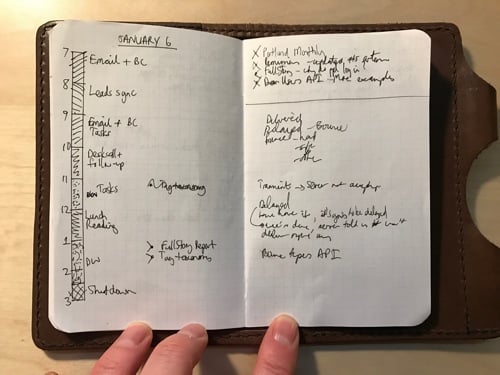
Work blocks

For more on work blocks and other non-digital productivity methods, check out Chris Bowler’s excellent resource on Working with Pen & Paper.

So I guess my one recommendation is, read Deep Work. Even if (or maybe especially if?) you don’t usually like business books. You won’t be disappointed.

Resilience is not just about luck

Maria Konnikova digs into the research on How People Learn to Become Resilient:

[Developmental psychologist Emmy Werner] found that several elements predicted resilience. Some elements had to do with luck: a resilient child might have a strong bond with a supportive caregiver, parent, teacher, or other mentor-like figure. But another, quite large set of elements was psychological, and had to do with how the children responded to the environment. From a young age, resilient children tended to “meet the world on their own terms.” They were autonomous and independent, would seek out new experiences, and had a “positive social orientation.” “Though not especially gifted, these children used whatever skills they had effectively,” Werner wrote. Perhaps most importantly, the resilient children had what psychologists call an “internal locus of control”: they believed that they, and not their circumstances, affected their achievements. The resilient children saw themselves as the orchestrators of their own fates. In fact, on a scale that measured locus of control, they scored more than two standard deviations away from the standardization group.

The problem with #blessed

Kate Bowler’s Death, the Prosperity Gospel and Me is the best thing I’ve read this year so far. It’s funny, sharp, and deeply moving. Kate recently got cancer, some time after writing an academic book on the prosperity theology phenomenon in many American churches. Prosperity theology—the idea that “good” faith in God can make you rich and keep you healthy—is an immensely damaging philosophy, and Kate addresses this with poise and clarity.

I hesitate to quote anything from the essay because you really should read the whole thing, but one of my favorite paragraphs deals with the recent rise of the #blessed hashtag:

Over the last 10 years, “being blessed” has become a full-fledged American phenomenon. Drivers can choose between the standard, mass-produced “Jesus Is Lord” novelty license plate or “Blessed” for $16.99 in a tasteful aluminum. When an “America’s Next Top Model” star took off his shirt, audiences saw it tattooed above his bulging pectorals. When Americans boast on Twitter about how well they’re doing on Thanksgiving, #blessed is the standard hashtag. It is the humble brag of the stars. #Blessed is the only caption suitable for viral images of alpine vacations and family yachting in barely there bikinis. It says: “I totally get it. I am down-to-earth enough to know that this is crazy.” But it also says: “God gave this to me. [Adorable shrug]. Don’t blame me, I’m blessed.”

I am thankful for people like Kate who, instead of saying “Everything happens for a reason,” says “Life is really hard—and yet, I still believe.”

The power of a secret in the age of over-sharing

When everything about your life is out in the open, there is power in keeping some of it secret. The ironic side-effect of social media is that it makes it easier to hide. When people think that you share everything, they don’t expect you to keep anything secret.

I recently went on a brief trip to South Africa to visit family, and I stayed (mostly) off social media. It felt weird—I felt this strange guilt, like I was “hiding” something because so many of my friends didn’t even know I was in the country. I know it was the right thing to do considering the circumstances of my visit, but still. Our minds can be deceptively cruel to us.

Anyway, I started thinking about it because Jim Farber explores this from a celebrity standpoint in his really interesting article The New Celebrity Power Move: Keeping Secrets:

Meanwhile, the stars get to both circumvent the media and to float an image of utter transparency through their promiscuous use of social media. In fact, that may only obscure them further. “Digital media creates this notion that we can know everything,” [Kathleen Feeley, co-editor of a scholarly study of celebrity gossip] said. “But it’s still a performance. It just creates a false intimacy.”

The audience’s belief in social media as the most direct route to a star exacerbates “the expectation that everyone will tell everything,” said Daniel Herwitz, a professor at the University of Michigan who wrote “The Star as Icon.” “Against all that, it becomes totally extraordinary when somebody doesn’t tell. On one hand, the public is in awe of the fact that the star, for the moment, resisted the system. But they’re also disappointed, as if somebody let them down. ‘Why didn’t I know this? The media dropped the ball!’”

“Why didn’t I know this”, also known as Why wasn’t I consulted?

Automated empathy in healthcare

This is an interesting story on the topic of algorithmic empathy1. In Hospitals Employ Email ‘Empathy’ To Help Doctors And Patients Keep In Touch Barbara Feder Ostrov discusses a program that sends patients automated emails to ask them how they’re doing:

Doctors can send daily emails with information timed to milestones in surgery prep and recovery and ask patients or caregivers for feedback on specific issues patients may face during recovery.

The doctors may write their own email scripts, as Newport Orthopedics’ physicians did, or use the company’s suggested content. An online dashboard helps doctors and administrators keep track of which patients are doing well and who might need more follow-up care. Patients can also communicate with office staff about medications and office visits. Their responses to daily emails can trigger a call from the doctor’s office.

A patient might see this message: “How are you? Let me know so I can make sure you’re okay. I have four questions for you today.”

The program has had some promising results, but I’d be interested to know if patients are aware that the messages are automated. To put it another way, is it ethical for doctors to send automated, health-related messages that look like they’re individually crafted?


  1. See Personal AI assistants: the battle and the war

Why sad songs make us feel good

Princess Ojiaku summarizes some recent research on Why sad songs can be feel-good and noise music can be nice:

Sad music might make people feel vicarious unpleasant emotions, found a study published last year in Frontiers in Psychology. But this experience can ultimately be pleasurable because it allows a negative emotion to exist indirectly, and at a safe distance. Instead of feeling the depths of despair, people can feel nostalgia for a time when they were in a similar emotional state: a non-threatening way to remember a sadness.

I guess this is the reason we love to immerse ourselves in all kinds of books and stories as well. It’s a safe way to experience unsafe things. Or, as C.S. Lewis put it, “We read to know we are not alone.”

Online chat therapy for online addiction

Sarah Kessler sets out to treat an unproved disorder with an unproven form of therapy, and lived to tell the tale. From What I Learned In 12 Weeks Of Therapy For Social Media Addiction, about using online chat therapy provider Talkspace:

Though everyone says they’re addicted, [Roni Frank, co-founder of Talkspace] says, they aren’t necessarily motivated to solve the problem. She compares it to cigarettes. “In the early years, people were smoking like crazy,” she says, “and at some point, everybody started to be aware of how harmful it is. I think the same thing will happen with social media, and how it is basically promoting poor mental health.”

Social media therapy is not the only aspect of Talkspace that has yet to be fully embraced by the mainstream. The idea that therapeutic help can come from an app, in general, has been met with some skepticism. “Developing a relationship with your patients in online therapies can be a problem, because you can’t see emotional cues,” Madalina Sucala, a clinical psychologist at the Icahn School of Medicine at Mount Sinai who has researched how clinicians feel about e-therapy, told The Verge, “and sometimes you can’t convey empathy.”

Filing this in my ever-growing “what a time to be alive” category.

That Dragon, Cancer: a game that explores faith, hope, and love

Tomorrow, a game called That Dragon, Cancer becomes available to play. The premise is heartbreaking:

An immersive narrative videogame that retells Joel Green’s 4-year fight against cancer through about two hours of poetic, imaginative gameplay that explores faith, hope and love.

Earlier this month Wired did an incredible profile on the creator of the game: Joel’s dad, Ryan Green. From Jason Tanz’s A Father, a Dying Son, and the Quest to Make the Most Profound Videogame Ever:

Over time, That Dragon, Cancer became Green’s primary method of dealing with Joel’s illness, as well as a way for him to preserve a connection to his son, whom he struggled to get to know. In real life, Joel couldn’t talk about his feelings, leaving Green to guess at his thoughts and emotions. Joel’s reaction to radiation therapy was particularly puzzling. Children usually hated being placed on the gurney inside the giant linear accelerator, resisted the anesthetic, fought and clawed at their parents and doctors every time they entered the room. But Joel loved it. He grew impatient in the waiting room, and his face lit up when the doctors came to get him, more excited than his parents had ever seen him. Green couldn’t know just why Joel was so enthusiastic about undergoing the anesthesia, but he wrote a scene imagining the adventures Joel might be experiencing in his mind—riding animals made of stars, giggling and tearing across the cosmos.

It is an incredible story—equal parts sad and inspiring. This game scares me—I’m not sure I have the strength to play it. Here’s the trailer…

Norman, the boring anti-hero

Halfway through his day at work, Norman yawned.

“Oh no, don’t start doing that!” a coworker joked.

Norman chuckled. “Yeah, I know.”

“Rough night?”

“You could say that,” Norman lied.

Norman didn’t have a rough night. Norman had gotten eight hours of restful sleep. Norman was just always a little tired.

That’s a story from The Life of Norman, a reddit thread where thousands of people tell boring stories about the fictional Norman’s boring life. And it’s fascinating. From Michell Woo’s The Life of Norman (and the Rise of Boring):

Now, all day, every day, redditors construct the intricacies of the life of this unremarkable man, mostly in 500 words or less. Reading through the titles feels like watching paint dry. Norman goes into his office building. Norman makes a steak for dinner. Norman receives a text message. Norman does the laundry. Norman meets a friend and they talk about how they both used to enjoy opening Microsoft Paint, drawing some squiggles, and coloring in the spaces. Life of Norman is possibly the most action-deficient fanfiction series in existence—and that’s what makes it so compelling to its creators and audience.

Why are people drawn to this? One possible reason:

After writing 40 stories about Norman and following his journey so closely, [Cameron Crane, a moderator of the Life of Norman subreddit] believes he’s drawn to the character partly because he’s an example of what he doesn’t want for his life. Redditors will sometimes tell him that they’re grateful for Norman, sharing with him that they’ve been depressed and stuck in a rut and that Norman serves as a wake-up call.

That’s true for him, too. “At the heart of it, I think I’m just afraid, afraid of becoming Norman,” Crane says. “Norman isn’t a role model. It’s okay to be like Norman, but you shouldn’t accept it. He’s comfortable, and the only way to get ahead in life is to make yourself uncomfortable.”