Menu

Posts tagged “mental health”

Most people feel just as boring as you do

Joshua Gross’s post Nothing is Quite What it Seems struck quite a nerve for me:

In this world of constant communication, it’s easy to feel as though everyone else’s life is amazing, while you’re still sitting there eating cereal in your underwear.

Of your 2,000 Facebook friends and 300 people you follow on Twitter, it’s inevitable that some small percentage are doing something interesting at any given moment.

Looking at it the other way around, though, the vast majority of people are sitting around wondering why they seem boring, just like you.

As a father to a 3-year old, I feel particularly boring these days as the exotic photos fly by on Instagram. Joshua’s post reminds me of Sherry Turkle’s phrase “Who will hold a brief for the real?”, which I referenced in this post.

Curiosity doesn't kill

I’ve had Esther Dyson’s article Technology’s Mental Frontier on my mind for a few days now. She raises some great points about education and technological advancement:

Indeed, perhaps the biggest culture/value challenge of all is short-term thinking. Around the entire planet, we are approaching some kind of singularity, with the market pandering to our fundamental short-term natures by offering us instant gratification and long-term destruction.

Education does the opposite. It enables us to improve our lot by building things — using first fire and wood, and now computers and machines — to overcome our physical limitations and to create technology to extend and enhance our lives. Will technology and learning prevail, or will our susceptible, long-evolved weaknesses overcome us?

I think she raises a question that is more important than we might think. One of the things I worry about is that the instant gratification Esther talks about is making us less likely to be curious about increasingly difficult problems. I’m not arguing that Google is making us stupid. Instead I’m arguing that the ability to get answers to almost any question we can dream up has consequences. By filling our brains with easy answers we become less likely to go after those wicked problems — problems that are “difficult or impossible to solve because of incomplete, contradictory, and changing requirements that are often difficult to recognize”.

To combat this issue we need to cultivate curiosity in our schools and workplaces. Cap Watkins recently mentioned how curiosity is one of his hiring requirements:

If you’re intensely curious, I tend to worry less about other skills. Over and over I watch great designers acquire new skills and push the boundaries of what can be done through sheer curiosity and force of will. Curiosity forces us to stay up all night teaching ourselves a new Photoshop technique. It wakes us up in the middle of the night because it can’t let go of the interaction problem we haven’t nailed yet. I honestly think it’s the single most important trait a designer (or, hell, anyone working in tech) can possess.

Sara Wachter-Boettcher also talks about this in her article On Content and Curiosity:

Curiosity keeps us hungry. It leads us to tackle new challenges when the easy questions have all been answered. It makes us wonder how things could be better — even when they are, if we’d just pause to admit it, pretty damn good already.

If answers come to us too quickly too often, we lose that essential sense of curiosity that drives us to solve difficult problems. If you don’t believe me, just spend some time with a 3-year old. Sometimes when I build puzzles with my daughter I get carried away and help a little bit too much. My daughter always responds by slowing down her own efforts, eventually declaring that she can’t do it. But when I hold back, and give her just enough guidance instead of solving the problem myself, her curiosity — the need to see that final picture — takes over until she forces herself to figure it out.

We need to cultivate this on two levels. First, we need to guard ourselves against a loss of curiosity. Skip Google and think instead. Don’t use an app to help you with Words with Friends (it’s ok, we’ve all done it). Solve the problem the long, hard, stupid way every once in a while.

Second, we need to do everything we can to grow curiosity in those we have influence over — employees, co-workers, kids, etc. And how do we do that? I think Antoine de Saint-Exupéry said it best in his French poem Dessine-moi un bateau1:

If you want to build a ship, don’t drum up people together to collect wood and don’t assign them tasks and work, but rather teach them to long for the endless immensity of the sea.

I’ll let your curiosity drive you to figure out what the “endless immensity of the sea” looks like for your situation.


  1. Link via Kevin Kelly 

Shutdown routines

I’m intrigued by the idea of a shutdown routine to end the day’s work:

At the end of the work day, I would look over my calendar and tasks. I would then check in on where I stood on my major projects (which, at this point, meant my thesis). After taking in all this information, I would come up with a smart plan for the remainder of the week. […]

The shutdown, however, was not enough by itself. The ruminating part of my mind would still fire up and propose worries about broken proofs and knife fights. This brings me to the second part of the ritual. Whenever I began ruminating on my work schedule after my shutdown, I wouldn’t engage the specifics of the rumination, but instead respond to myself with some variant of the following: “I completed my schedule shutdown ritual today. I wouldn’t have allowed myself to complete the process if I didn’t trust that my plan makes sense. Therefore, I’m not worried.”

I’ve been trying out a version of this for the past few days, and I like it so far. Before leaving the office I take out my notebook and write down everything I’m worried about, and how I plan to deal with it tomorrow. And then I close the notebook and my laptop and go home. So far I haven’t been able to switch off completely, but I think it’s helping a little bit. Try it out, maybe it works for you.

(link via @retinart)

Time to close the computer

Alex Maughan adds his thoughts to the “fast web” discussion in The Slow Web and the Thievery of Fast Lifestyles:

We are philics of immediate gratification, ticket holders impatiently awaiting our entrance into the never-ending show of serial distractions. Far too many of us are phobic of the good stuff. The stuff that takes emotional maturity. The stuff that takes time, and doesn’t constantly pat you on the back for every small thing you do. The stuff you don’t find on Facebook, Instagram, Twitter, LinkedIn, or Dribble. The stuff that requires you to exist without constant, yet ultimately spurious, forms of reinforcement; without any distractions; without the need to bolster your perceived self-worth by harvesting as many Likes as you can for every little asinine thing we spit out onto the Web. We increasingly shy away from the stuff that requires a longer form of consideration to ripen.

The post ends with some guidelines that he’s setting for himself to fight this problem. It’s worth reading.

Just over a week ago Frank Chimero tweeted, “Time to close the computer.” He then deleted his entire tweet history and unfollowed everyone he used to follow. Today that tweet is gone as well, his avatar is a dog, and he follows 3 very different people and 1 bot (@Horse_ebooks, of course).

I don’t know if that story means anything, but Frank is a pretty famous designer, and all I’m saying is that something is going on. Everywhere I look I see people behaving like they just fell off a chair on the Axiom only to realize that staring at a screen all their waking hours isn’t as fantastic as they thought it was.

Maybe it is time to close the computer.

Don't let negative voices drown out the Will O’ the Wisps

This week’s episode of the Back to Work podcast with Dan Benjamin and Merlin Mann really struck a chord with me. In Scream, Poop, and Run they have a long discussion about an article by Jad Abumrad called The Terrors & Occasional Virtues of Not Knowing What You’re Doing. There is one part in particular, where Merlin talks about not listening to people who tell you what you can’t do, that I keep replaying in my head:

There are so many voices that you are going to hear — some of them actually outside your head — so many voices that you are going to hear about what you should be doing differently, what you’re doing wrong, what you’ll never be capable of, what you’ll always suck at, and you’ve got to not listen to those voices.

The people who constantly tell you what you shouldn’t do are typically really good at not doing things. And that is a virus they are very happy to spread. They are people who just don’t make stuff, they are people who don’t do stuff, and they are more than happy to try to pull the entire world down to their level of not making and not doing. And that’s something to watch out for. Because if you listen too much to all those other voices, they’ll eventually become your voice. And that’s the voice that’s going to be with you all the time.

That’s the voice you’ll go to sleep with, and it’s the voice you’ll wake up with, and if you listen to it too much, it’s going to drown out the tiny voices. And the tiny voices are like the little Will O’ the Wisps in Brave, these little blue lights, saying, “Try this way. Come this way. Come this way.” And those little blue lights — or the tiny voices — you’re only going to hear that if you’re not being drowned out by all the things that say that you’re not even worthy of having your own Wisps.

Those are very loud voices — especially if you make stuff for the Internet. It’s just always there — it’s a constant din of people telling you what you should be beside yourself. And that’s the worst advice in the world.

The whole episode is great. Have a listen.

The unnecessary existential reassurance of busyness

Tim Kreider in The ‘Busy’ Trap:

Busyness serves as a kind of existential reassurance, a hedge against emptiness; obviously your life cannot possibly be silly or trivial or meaningless if you are so busy, completely booked, in demand every hour of the day. [”¦] More and more people in this country no longer make or do anything tangible; if your job wasn’t performed by a cat or a boa constrictor in a Richard Scarry book I’m not sure I believe it’s necessary. I can’t help but wonder whether all this histrionic exhaustion isn’t a way of covering up the fact that most of what we do doesn’t matter.

Trust me. You need to read this article.

The dad I am

The dad you want to be

A few months before my daughter was born I created a virtual list in my head called “The dad I want to be”. The list got constant attention as I added, edited, and deleted stuff while I waited in line somewhere or lay awake at night. It was a good list, and I was proud of it. And then, on the morning of my daughter’s birth, I lost the list.

At first there was just no time to look at it, so I put it in a brain compartment somewhere for safe keeping. One evening a few weeks later I looked for it, but I couldn’t find it. I searched around for a while, but then there was a dirty diaper, and, you know. One thing led to another.

Today, more than two years later, I still haven’t found that list. To be honest, I stopped looking for it a long time ago, because I realized something very important. I realized that it doesn’t matter how many idealistic, theoretical guidelines you come up with before you become a parent. Once your first child is born, you just become the dad you’ve always been inside. The one that most resembles a personality that’s been shaped by years of experiences and the people around you. Some are lucky — they’re natural parents who slip into the new role comfortably. Others have a harder time with the transition, and end up making weird and scary realizations about themselves. I’m part of the latter group.

Nothing is more humbling than the day-to-day experiences of being a parent. Nothing is more effective at shining a spotlight on all on’s flaws and shortcomings as a human being. But luckily that’s not the only side of the story. Parenting is also a fantastic catalyst for personal change.

Those of us who spend the first few months of parenting with a look of total bewilderment in our eyes learn to do things a little differently. Slowly and with painstaking effort, I started to chip away at all the things that were not “The dad I want to be”. I failed constantly, but then one day I had a small victory over my instincts. The small victories eventually turned into big ones, until one day I realized that I’d just made it through a tantrum and managed to put our daughter to sleep without becoming flustered or losing my cool. I celebrated with a mental high five, and then I got back in the game immediately, because becoming a better dad is not a journey with a neat ending.

I wish someone told me this before we had children, so I’m telling you this now. Throw out your preconceived ideas of what it means to be a dad. You’re already a dad, and ther’s nothing you can do about it at this point. But once your child is born, don’t beat yourself up when you discover that the dad you are is not exactly the dad you want to be. Instead, identify the things you don’t like, and fix them. One minuscule, frustrating, gratifying step at a time.

Be careful who you listen to

In Facebook threatens to ‘Zuck up’ the human race, Andrew Keen makes the following observation:

Sherry Turkle, Professor of the Social Studies of Science and Technology at MIT, tells us there’s a shift from an analog world in which our identities are generated from within, to a digital world in which our sense of self is intimately tied to our social media presence.

In other words, on Twitter and Facebook, we become who we follow. Or perhaps more accurately, we envy who we follow. The big problem with this is that none of us are really who we portray ourselves to be online. We are all the better, happier, more successful versions of ourselves:
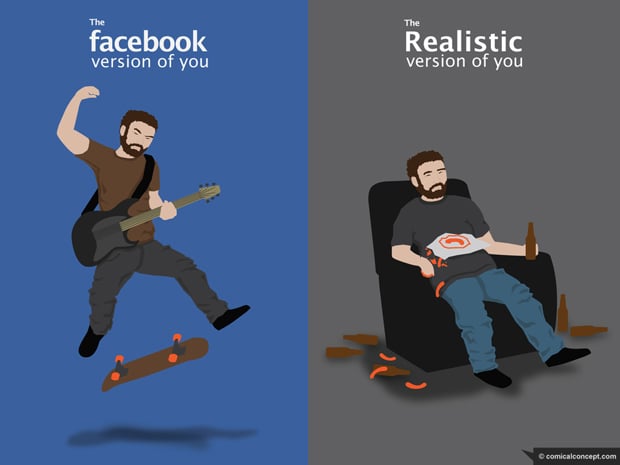
Different versions of ourselves

(Source: Comical Concept)

But even though we take in all this information from people who we know aren’t real (and sometimes don’t even like), we are incapable of stopping. There is always more to know, more to discover, another person to compare ourselves to. In Noise and Signal, Nassim Taleb explains why this is so counterproductive:

The more frequently you look at data, the more noise you are disproportionally likely to get (rather than the valuable part called the signal); hence the higher the noise to signal ratio. And there is a confusion, that is not psychological at all, but inherent in the data itself. Say you look at information on a yearly basis, for stock prices or the fertilizer sales of your father-in-law’s factory, or inflation numbers in Vladivostock. Assume further that for what you are observing, at the yearly frequency the ratio of signal to noise is about one to one (say half noise, half signal) ”” it means that about half of changes are real improvements or degradations, the other half comes from randomness. This ratio is what you get from yearly observations.

But if you look at the very same data on a daily basis, the composition would change to 95% noise, 5% signal. And if you observe data on an hourly basis, as people immersed in the news and markets price variations do, the split becomes 99.5% noise to .5% signal. That is two hundred times more noise than signal ”” which is why anyone who listens to news (except when very, very significant events take place) is one step below sucker.

Most of the information we get on social media is not just noise, it also makes us less likely to discern between what’s important and what’s not. Greg McKeown explains in The Unimportance of Practically Everything:

Social media did not create the problem of distraction, but it is clearly an amplifier. Indeed, a study [PDF] by Clifford Nass et al. at Stanford showed that heavy media multitaskers are more susceptible to interference from irrelevant environmental stimuli than light media multitaskers. Heavy multitasking may encourage even heavier multitasking because it leads to a “reduced ability to filter out interference.” Could the part of our brain that is processing deeper cogitative thought actually be atrophying in the process?

None of this would matter if activity and reward were linearly related. But we live in a world where almost everything is worthless and a very few things are exceptionally valuable. This is a counterintuitive idea. After all, the idea that 50% of results come from 50% effort is appealing. It seems fair. Yet, research across many fields paints a very different picture.

As I read through these articles it became clear to me that most of us are not being very good stewards of our time and attention. We are seduced by the lure of constant affirmation that social media promises, and blind to the reality that what we mostly get from it is a sense that we’re not as good, happy, and successful as those around us.

We have a responsibility to ourselves to follow and interact with those who support us and want to make the world a better place. And we have an obligation to cull and surrender the people and the information that make us feel inferior and stunt our growth. This is difficult, because we’ll never get rid of our fear that we might be missing out on something. But it’s necessary if we want to hang on to our sanity and our ability to tell the vital from the trivial — so that we can continue to do good work.

Of course I can’t tell you what to do. But for myself, I’m going to start ignoring constant negativity, unimportant noise, and empty criticism. I’m actively going to seek out positive, driven people and honest critique. Nassim Taleb says it well at the end of his article:

To conclude, the best way to mitigate interventionism is to ration the supply of information, as naturalistically as possible. This is hard to accept in the age of the Internet. It has been very hard for me to explain that the more data you get, the less you know what’s going on, and the more iatrogenics (“an inadvertent adverse effect or complication resulting from medical treatment or advice”) you will cause.

Be careful who you listen to, because sooner or later, they end up defining you.
Finding what really matters: an essay on the online economy of sharing

I have a feeling that we live too much of our lives through other peopl’s eyes. It seems as if w’ve changed our definition of what is worthy and real to accommodate an economy based on the currency of sharing. It’s an economy that measures an event’s value by the number of likes and retweets it gets. An economy that changes our decision-making because we start to seek out the things that have the highest “sharing value”, while we shun the quiet, everyday activities that make up a life.

As I graze through my Facebook feed tonight, I munch on the extraordinary and exciting lives of others. A live performance in San Francisco. A hike in Cape Town. A business success in Miami. A funny and clever thing someon’s son said. And of course, the photos. The endless, happy photos of dancing, mountains, wine, exotic travels, more wine, and lots and lots of babies. Everyone is having an amazing time in an amazing world.

Twitter shows me something slightly different. I see people who are drowning in success and ambition, and I can’t help but envy them. Through Twitter I see how smart everyone else is. And as inspirational as that is most of the time, I sometimes look at how high the bar seems to be set and then I just want to sit down and rest for a while.

Everyone knows that’s not the whole story, of course. No one says “I’m lonely” on Twitter. No one uses Facebook to post their deep, dark thoughts about marriage or parenting or work or the future or the past. We all know it’s not real but we have to keep up the facade. If one of us were to break down, we would all lose the ability to believe we are who we pretend to be, and that’s not something w’re prepared to do.

Maybe it’s time for a change. Maybe it’s time to stop consuming so much of other peopl’s perfectly manicured public lives, and start producing just a little bit more. I wonder what would happen if we measured the value of an activity not by how great the photo opportunity would be, but by what value it would add to those we’re with - our family and friends.

I guess I’m just worried that if I keep looking at my life through other peopl’s eyes, I might go blind to the things that really matter.

Think Different (as long as enough people will like it or retweet it)

In Facebook’s Philosophy Kyle Baxter makes a good point about what happens when sharing something becomes part of doing it:

Once the sharing is a part of the doing, you no longer consider whether to do something in the isolation of whether you want to do it. When sharing is a part of the package, you also consider how whatever it is you’re doing will reflect on you. You’ll consider what the general public’s, or your network’s, standards are for it.

Nick Bradbury makes a similar point in The Friction in Frictionless Sharing:

In the past the user only had to decide whether to share something they just read, but now they have to think about every single article before they even read it. If I read this article, then everyone will know I read it, and do I really want people to know I read it?

When you think this all the way through the implications are quite bleak. The theory is that the more we share about our lives, the more we tend to take into consideration what people might think of us before we do something. But it’s not just a passive “I wonder what they’ll think of me”. Figuring out what to do next becomes an obsession, a constant search to answer the same question over and over: what can I do that will get me the most likes or retweets?

It’s a dangerous game - one where we’re not just trying to hang on to our reputations, but actively using our knowledge of what our network “likes” to guide our lives. “Think different” becomes “Think different in a way that will generate the most engagement with my personal brand.” Maybe the value of Allen Salkin’s philosophy that “there is something magical about a life less posted” is that it frees us to live our own lives again.