Menu

Posts tagged “marketing”

Everything doesn't need to be automated

In Human Intervention as a Competitive Advantage Derek Sivers makes the case that automation isn’t always the best option:

When everyone else is trying to automate everything, using a little human intervention can be a competitive advantage. The problem is when business owners see it as a cost, instead of an opportunity. Trying to minimize costs, instead of maximize income, quality, loyalty, happiness, connection, and all those other wonderful things that come from real human attention.

You can buy a fancy phone routing system, so people have to listen to 9 options, choose option 5, then listen to 6 more options, or you can hire a charming person to pick up the phone on the first ring, and make a great impression. Which one do you think will win you new fans? […]

I know what you’re thinking — how does this scale? Derek explains that in the post as well…

[Sponsor] Wufoo

I’d like to thank Wufoo for sponsoring the Elezea RSS feed this week. I use Wufoo as the contact form on Elezea, and it works great.

Wufoo? Who? It’s a web application that lets you build amazing online forms for your websites.

We host everything. We build the backend. You get an easy, fun and fast way to collect and analyze data, and it even integrates with many payment systems.

With Wufoo you get…

  • Over 200 pre-made templates & themes from our form gallery
  • Ability to customize branding with your own logo and themes to match
  • Integration with over 50 web apps including WordPress, MailChimp, Basecamp, Stripe, etc.
  • Support for beautiful typography with custom fonts and Typekit integration

Just because you’re working with forms and data doesn’t mean you have to do it without personality or style. Gathering information from your users is exciting, why shouldn’t your tools be exciting too?

Experience the difference. Sign up for Free and get started with Wufoo today.

Sponsorship by The Syndicate

[Announcement] Elezea is joining The Syndicate

You may have seen a sponsored post here last Monday, and wondered what’s going on… Well, that was a test we ran with the good folks at The Syndicate ad network. And I can now announce that as of this week I’m officially joining the network, which includes many sites I read every day — like Shawn Blanc, TightWind, and Behind Companies.

What this means is that you’ll see one sponsored post per week, usually on a Tuesday. These posts will be clearly marked with the [Sponsor] signifier so you can tell ad content from other articles. They are high quality ads, so I also hope that you’ll find the sponsored posts useful, and visit their sites when you find something that interests you. For example, the sponsor this coming week is Wufoo — the company that I already happen to use as the contact form on Elezea.

I’m happy to answer any questions or comments you might have about this. I can assure you that being part of this network will push me to work even harder to produce good content throughout the week, to make it all worth your while.

As always, thank you for reading, and enabling my writing habit.

The hype, benefits, and dangers of Big Data

A Readlist of all the articles referenced in this post is available here. Readlists allow you to send all the articles to your Kindle, read them on your iOS device, or download it as an e-book.

Despite the overly alarmist title, Andrew Leonard’s How Netflix is turning viewers into puppets1 is a fascinating article on how Netflix uses Big Data in their programming decisions:

“House of Cards” is one of the first major test cases of this Big Data-driven creative strategy. For almost a year, Netflix executives have told us that their detailed knowledge of Netflix subscriber viewing preferences clinched their decision to license a remake of the popular and critically well regarded 1990 BBC miniseries. Netflix’s data indicated that the same subscribers who loved the original BBC production also gobbled down movies starring Kevin Spacey or directed by David Fincher. Therefore, concluded Netflix executives, a remake of the BBC drama with Spacey and Fincher attached was a no-brainer, to the point that the company committed $100 million for two 13-episode seasons.

The article also asks what this approach means for the creative process, something I’ve written about before in The unnecessary fear of digital perfection, so I won’t rehash that argument here.

What’s interesting to me about the rise in Big Data approaches to decision-making is the high levels of inaccuracy inherent to the analysis process. Of course, this is something we don’t hear about often, but Nassim N. Taleb recently wrote a great opinion piece about it for Wired called Beware the Big Errors of ‘Big Data’, in which he states:

Big-data researchers have the option to stop doing their research once they have the right result. In options language: The researcher gets the “upside” and truth gets the “downside.” It makes him antifragile, that is, capable of benefiting from complexity and uncertainty — and at the expense of others.

But beyond that, big data means anyone can find fake statistical relationships, since the spurious rises to the surface. This is because in large data sets, large deviations are vastly more attributable to variance (or noise) than to information (or signal). It’s a property of sampling: In real life there is no cherry-picking, but on the researcher’s computer, there is. Large deviations are likely to be bogus.

He gets into more detail on the statistical problems with Big Data in the article, and his book Antifragile looks really interesting too.

Since I haven’t written about Big Data before, I also want to reference a few articles on the topic that I enjoyed. Sean Madden gives some interesting real world examples in How Companies Like Amazon Use Big Data To Make You Love Them2. But over on the skeptical side, Stephen Few argues in Big Data, Big Deal that “interest in big data today is a direct result of vendor marketing; it didn’t emerge naturally from the needs of users.” He also makes the point that data has always been big, and that by focusing on the “bigness” of it, we’re missing the point:

A little more and a little faster have always been on our wish list. While information technology has struggled to catch up, mostly by pumping itself up with steroids, it has lost sight of the objective: to better understand the world—at least one’s little part of it (e.g., one’s business)—so we can make it better. Our current fascination with big data has us looking for better steroids to increase our brawn rather than better skills to develop our brains. In the world of analytics, brawn will only get us so far; it is better thinking that will open the door to greater insight.

Alan Mitchell makes a similar point in Big Data, Big Dead End, a case for what he calls Small Data:

But if we look at the really big value gap faced by society nowadays, it’s not the ability to crunch together vast amounts of data, but quite the opposite. It’s the challenge of information logistics: of how to get exactly the right information to, and from, the right people in the right formats at the right time. This is about Very Small Data: discarding or leaving aside the 99.99% of information I don’t need right now so that I can use the 0.01% of information that I do need as quickly and efficiently as possible.

What I think we should take from all of this is that our ability to collect vast amounts of data comes with enormous predictive and analytical upside. But we’d be foolish to think that it makes decision-making easier. Because Big Data does not take away the biggest challenge of data analysis: figuring how to turn data into information, and information into knowledge. In fact, Big Data makes this harder. To quote Nassim again:

I am not saying here that there is no information in big data. There is plenty of information. The problem — the central issue — is that the needle comes in an increasingly larger haystack.

In other words: proceed with caution.


  1. Link via @mobivangelist 

  2. It’s interesting that the phrasing of both this headline and the Netflix one implies that companies are using Big Data to persuade us to do things against our will. But I can’t figure out if that’s a real fear, or just clever linkbait. 

The dirty world of Facebook EdgeRank Optimization

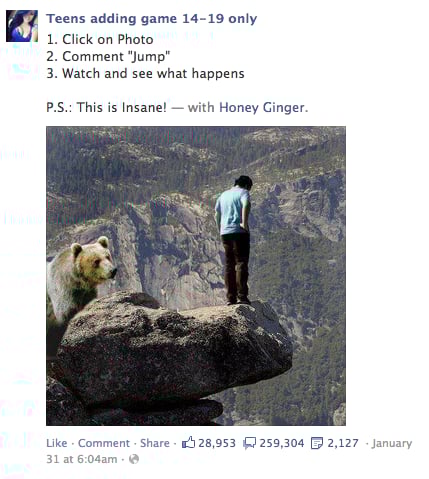
I’ve been seeing more and more scams like this one in my Facebook News Feed:

Dirty Facebook EdgeRank Optimization

You only have to think about it for 4 seconds to realize that making a comment on a photo on the web will result in you watching and seeing absolutely diddly-squat (“P.S.: This is not Insane after all!”). And yet, in this particular case, 259,304 people thought about it for 3 seconds or less, commented, waited and saw nothing, and then moved on to the next thing.

The question is, why do Page admins do this? What’s the use of tricking people into commenting on photos, especially when they’ll realize right away that they’ve been made to look like a fool? Well, because there’s money in it, of course.

This is a pretty transparent scam to beat Facebook’s EdgeRank system — the algorithm that Facebook uses to determine what articles should be displayed in a user’s News Feed. When someone comments on a picture it makes it more likely that the picture will show up in their friends’ News Feeds, so it’s an easy way for a Page to gain more exposure very quickly.

Once these Pages have built up hundreds of thousands of “Likes” using the scam, they usually do one of two things. They either start punting things they want to sell, or they sell the Page itself to a business that changes some of the details and uses it as their instantly enormously popular brand Page.

This is obviously pretty dirty, and also nothing new — we’ve had black hat SEO and dark patterns since the dawn of the web. But what I can never understand about the people who use these tactics is why they don’t long for the satisfaction and personal growth that comes from doing real work and reaping the rewards of that. Why create a community of people who couldn’t figure out that you’re scamming them, as opposed to a real community that values your company and what you do? I’ve written about this before in my defense of doing things the hard way:

When we do things the hard way, we invest in ourselves in the best possible way. We kick off an endless cycle of learning and mastery that helps us grow and lead fulfilling lives of purpose. When we take shortcuts, we become mere pretenders. We learn how to play the part, but there is no substance or continued growth. The instant gratification makes us build the house of cards ever higher, which brings anxiety about the whole thing coming tumbling down. Why would we shortchange ourselves like that?

So what can we do about these scams? Well, for one, obviously don’t comment on it. But I also recommend clicking on the little arrow on the right and hiding the post. That will tell EdgeRank that the person who commented on the photo is not worth paying attention to, so in time you’ll see less and less of those kinds of posts. Who says we can’t all be EdgeRank Optimization specialists?

Banner blindness and you

Joaquin (no last name?) talks about ad banner blindness in The non-click generation:

See, the point is, I know this ad is always in that space, I know what it does, I know its intentions, and I know the methods. It’s invisible to me because I know so much about it.

That’s nothing new, of course, but the article did remind me of Mike Lacher’s extremely funny I Am the One Who Clicks Banner Ads:

While you check the weather, I find out why California dermatologists hate the one weird skin care secret discovered by a stay-at-home mom. While you read the New York Times, I rollover for more information about how to get my diabetes under control. While you search IMDB, I click for showtimes, tickets, and behind-the-scenes videos for Think Like a Man. Page after page, banner after banner, I click and I click.

Oh, and while you’re on McSweeney’s, you might as well check out I’m a Social Media Community Manager!:

What is a Social Media Community Manager? Oh sorry, I didn’t hear you over the sound of how hip my job is.

The Internet would be so much less weird and fun without McSweeney’s.

American Airlines brand identity, and collaborative outrage

Original American Airlines logo designer Massimo Vignelli comments on the redesigned logo:

Styling is very much emotional. Good design isn’t—it’s good forever. It’s part of our environment and culture. There’s no need to change it. The logo doesn’t need change. The whole world knows it, and there’s a tremendous equity. It’s incredibly important for brand recognition. I will not be here to make a bet, but this [new logo] won’t last another 25 years.

Dustin Curtis on the redesign:

It is too bad that such a great, enduring identity was placed into such careless hands. […] After forty-six years, one of the finest corporate brands in history has been reduced to patriotic lipstick.

Paul Ford, last December, in The Emergence of Crowdsmashing Logos and Rebranding:

People don’t like their stories messed with. You expect a certain continuity, and when the opposite happens—Dylan going electric, season two of Friday Night Lights—you react out of proportion to external measures of the offense but very much in proportion to the internal anxiety and anger you might feel. […] It’s not just that some lines and colors have changed—possibilities have been taken away. No wonder people want to go to their windows and yell “I’m mad as hell, and I’m not going to take gradient blends anymore.”

For the first time, the question “I wonder who else hates this?” has an immediate answer, and people who see the arc of their lives flattened by bad branding can find each other and grieve over the lost logotypes of youth.

I’m not saying I like the American Airlines rebrand. But boy, does the response once again show how the Internet is an incredible tool for collaborative outrage.

Paying for the product doesn't guarantee anything

Derek Powazek pulls apart the saying “If you’re not paying for the product, you are the product” in his post I’m Not The Product, But I Play One On The Internet. His conclusion:

We can and should support the companies we love with our money. Companies can and should have balanced streams of income so that they’re not solely dependent on just one. We all should consider the business models of the companies we trust with our data.

But we should not assume that, just because we pay a company they’ll treat us better, or that if we’re not paying that the company is allowed to treat us like shit. Reality is just more complicated than that. What matters is how companies demonstrate their respect for their customers. We should hold their feet to the fire when they demonstrate a lack of respect.

This is, of course, in response to the Instagram TOS debacle, which resulted in an update from Instagram to clarify their terms in a post with the “please stop shouting at us!” title Thank you, and we’re listening. But as Faruk Ateş points out in What Instagram did wrong:

Bad language is merely a symptom of the bigger mistake they made. Their failure lies in not acknowledging—or understanding—the change in expectations that took place amongst their users when they sold themselves to Facebook for a billion dollars. […]

Once you sell to a frequently-criticized juggernaut like Facebook, users’ expectations change from supportive to skeptic, and, especially because of Facebook’s long history of privacy-related mishaps, you may very well lose all benefit of the doubt amongst some of your users.

Oh, how many PR disasters could be avoided if companies would learn to respect their users, and be more in touch with their needs and goals…

People care about stories, not products

Here’s an important reminder that tools don’t matter as much as we think they do. What matters is how the tools enable people to accomplish their goals. From Chana Joffe-Walt’s Why Legos Are So Expensive — And So Popular (my emphasis added):

But Lego did find a successful way to do something Mega Bloks could not copy: It bought the exclusive rights to Star Wars. If you want to build a Death Star out of plastic blocks, Lego is now your only option.

The Star Wars blocks were wildly successful. So Lego kept going — it licensed Indiana Jones, Winnie the Pooh, Toy Story and Harry Potter.

Sales of these products have been huge for Lego. More important, the experience has taught the company that what kids wanted to do with the blocks was tell stories. Lego makes or licenses the stories they want to tell.

No one cares about your product as much as you do. But they do care about their stories. And understanding that can help you make better products.

E-commerce sites as editorial outlets

Marcelo Somers is in the process of writing a great series on e-commerce. Part 2 is called Sell the Hole, Not the Drill – A Guide to eCommerce Content Strategy:

The failure of eCommerce is that the functionality has been designed to sell, but sites have overlooked the opportunity to build relationships with their customers and genuinely make their lives better. Most online shopping engagements only make customers’ wallets lighter. […] eCommerce sites must start blurring the line between being an editorial site and a place for commerce.

I completely agree with this. I’ve written about it before, and called the approach context-based e-commerce:

[Where product-based e-commerce sees the product as the unit of measure], context-based e-commerce sees a customer’s unique situation as the unit of measure, and the user experience is built around delighting them based on who they are and how technology can help improve their lives. Quality, personal, context-based content serves as the bridge between product and customer.