Menu

Posts tagged “culture”

Technology and personal responsibility

In Technology as Savior, J. D. Bentley tells a great story about flossing (yep, FLOSSING), and technology’s impact on our ability to take responsibility for our actions:

We eschew per­sonal respon­si­bil­ity out of lazi­ness with the expec­ta­tion that, some­how, “tech­nol­ogy” and “sci­ence” has — or will find — a way out, what­ever the cost.

The pull quote doesn’t do it justice, this is a post you have to read in its entirety.

Valve and GitHub: the beginning of true user-centered organizations

Two articles on company culture caught my eye last week, both about what it’s like to work in organizations with no formal structure and communication. First, from the always excellent Design Staff, Design at Valve: collaborating and innovating in a flat organization is an interview with one of the designers at Valve:

It’s everyon’s job at Valve to recruit peers to help ship an idea. If I’m unable to recruit an engineer to help me ship an idea, it probably means either the idea isn’t solving an important problem, or it’s just not timely given our current priorities and ongoing projects. As individual contributors, w’re each constantly asking ourselves “Where is my time best spent?” The answer changes as projects ship and as new opportunities emerge.

For these self-selecting project teams to work, it’s important that we keep up on the various efforts happening around the company. Ther’s no top-down communication, so this typically happens by chatting with one another over lunch, or checking in with people to learn what’s happening.

Second, Brandon Keepers wrote about what it’s like to work at GitHub, and it struck me as remarkably similar to Valve’s culture:

Anarchy works wonderfully in a small group of individuals with a high level of trust. Everyone at GitHub has full access and permission to do whatever they want. Do great things and you earn respect. Abuse that freedom and you violate everyon’s trust.

Each person at GitHub has the responsibility to sell their ideas to the rest of the company. I quickly learned that if I can’t get anyone else interested in the project that I want to work on, then either I poorly articulated my vision, or more likely, it does not benefit the company. You can still work on it, but you will likely be working alone.

Both posts are worth reading, because they also explore some of the challenges of working in such environments. The teams seem well aware of the downsides of the cultures they’ve created, and they’re working hard to address those because the upsides vastly overshadow the downsides for them. And I guess that’s the key phrase — for them. I don’t think this type of environment will work in every company, but it’s encouraging to see how systems based solely on trust and self-governance can create productive environments and (extremely) happy employees.

For both companies, the measure of success is the quality and value of the products they ship to customers. That is fantastic, and could be the beginnings of a new era of true user-centered organizations. We need more experimentation that does away with conventional hierarchies and corporate structures so that we can find new ways to create value for our users.

Sharing books and music: not as similar as we might think

Nicholas Carr looks at the differences between customers who buy/share books vs those who buy/share music, specifically within the context of piracy. In Books ain’t music he notes:

The unauthorized copying of songs and albums did not begin with the arrival of the web or of MP3s or of Napster. It has been a part of the culture of pop music since the 1960s. There has been no such tradition with books. Xeroxing a book was not an easy task, and it was fairly expensive, too. Nobody did it, except, maybe, for the occasional oddball. So, even though the large-scale trading of bootlegged songs made possible by the net had radically different implications for the music business than the small-scale trading that had taken place previously, digital copying and trading didn’t feel particularly different from making and exchanging tapes. It seemed like a new variation on an old practice.

His observations are fascinating. It shows that even though record labels certainly deserve their share of the blame when it comes to the dismal state of the commercial music industry, the history and context of music sharing has an enormous part to play in the rise of modern-day music piracy. The publishing industry has a very different historical context, so we can’t just apply the “lessons” from the music industry to the challenges introduced by digital books.

The real value of the information age: restoring humanity to the way we work

In The Great Big Opportunity Matt Salisbury talks about subsidiarity — the idea that decisions are better made where they have immediate effect:

There has been a lot of talk about the advent of the “information age.” For the first time since the industrial revolution, we have experienced a real disruptive change in business context. The age of communication is now, but if you pay too much attention to the technology, you’ll miss what’s really happening.

What’s “really happening” is that we now have the chance to work like humans instead of machines.  Communication and information’s advance is restoring subsidiarity to our brave new world.

I like his conclusion:

Ultimately, the information age is not about the information. It’s about human dignity and happiness informing how, where, and why we work.

What it means to live here, now, on the Internet

I came across Piotr Czerski’s essay We, the Web Kids through a great collection of quotes on James Bridle’s site. It’s the kind of essay that I think everyone who does anything on the Internet should read. It’s a pitch-perfect collection of thoughts on what it means to live here, now, on the Internet. For example:

We grew up with the Internet and on the Internet. This is what makes us different; this is what makes the crucial, although surprising from your point of view, difference: we do not “˜surf’ and the internet to us is not a “˜plac’ or “˜virtual spac’. The Internet to us is not something external to reality but a part of it: an invisible yet constantly present layer intertwined with the physical environment. We do not use the Internet, we live on the Internet and along it. If we were to tell our bildungsroman to you, the analog, we could say there was a natural Internet aspect to every single experience that has shaped us. We made friends and enemies online, we prepared cribs for tests online, we planned parties and studying sessions online, we fell in love and broke up online. The Web to us is not a technology which we had to learn and which we managed to get a grip of. The Web is a process, happening continuously and continuously transforming before our eyes; with us and through us. Technologies appear and then dissolve in the peripheries, websites are built, they bloom and then pass away, but the Web continues, because we are the Web; we, communicating with one another in a way that comes naturally to us, more intense and more efficient than ever before in the history of mankind.

His views on the idea that we don’t want to pay for things are also spot-on:

This does not mean that we demand that all products of culture be available to us without charge, although when we create something, we usually just give it back for circulation. We understand that, despite the increasing accessibility of technologies which make the quality of movie or sound files so far reserved for professionals available to everyone, creativity requires effort and investment. We are prepared to pay, but the giant commission that distributors ask for seems to us to be obviously overestimated. Why should we pay for the distribution of information that can be easily and perfectly copied without any loss of the original quality? If we are only getting the information alone, we want the price to be proportional to it. We are willing to pay more, but then we expect to receive some added value: an interesting packaging, a gadget, a higher quality, the option of watching here and now, without waiting for the file to download. We are capable of showing appreciation and we do want to reward the artist, but the sales goals of corporations are of no interest to us whatsoever.

I know I probably say this too much, but this is a must-read.

On criticism, cynicism, and how to turn John Cage quotes into Internet jokes

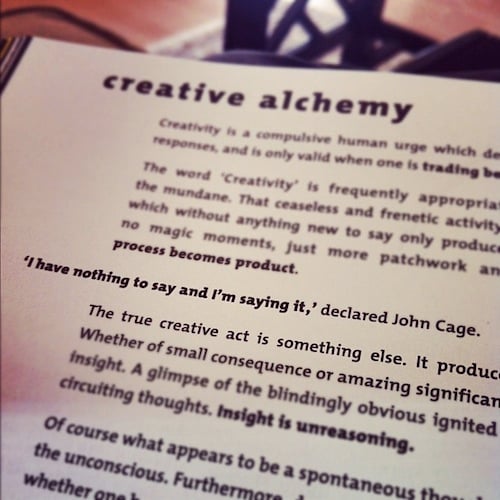
A couple of weeks ago I read this quote by John Cage in The Art of Looking Sideways:

I have nothing to say and I'm saying it

I have nothing to say and I’m saying it. Is your mind racing about all the ways that statement applies to life on the Internet? Yeah, me too. In fact, the phrase immediately made me think of a joke I could make on Twitter, which I wrote down right away. But I wanted to get my facts right, so I started reading up on John Cage - as you do when you’re on vacation. This is where I ask you to please stick with me as we go on a brief detour about the nature of criticism.

My rabbit-hole journey into the world of John Cage led me to a great 2004 essay by Joe Dacey called John Cage Defined in the 1950s. It outlines how the phrase “I have nothing to say and I’m saying it” comes from his “Lecture on Nothing”:

In this lecture, he outright tells the listener that the lecture has no point and will go nowhere, “I am here and there is nothing to say. If among you are those who wish to get somewhere, let them leave at any moment”. He implores the audience to enjoy each and every moment of the lecture even though he admits that it is pointless. He advocates that, “Our poetry now is the realization that we possess nothing. Anything therefore is a delight (since we do not possess it) and thus need not fear its loss” and “It is not irritating to be where one is. It is only irritating to think one would like to be somewhere else”.

It’s not just you - that is a weird thing to do. What fascinates me most about Cage is that he never bothered to reflect on any criticism of his work. Ever.

Cage mostly ignored criticism he received believing that most people didn’t understand why he composed the music he composed. In fact, he saw society as “one of the greatest impediments an artist can possibly have” to creating good art. After receiving a review for a concert he gave in Seattle that stated the performance was “ridiculous,” Cage’s responded that he had no interest in the review because he “knew perfectly well it wasn’t.”

Knowing when to ignore criticism and when to listen to it is one of the hardest skills to learn, and so easy to get wrong. On the one extreme is the John Cage approach, where you view all criticism as bogus or not worthy of your attention. On the other extreme there are people (and companies) who change course with every little piece of feedback they get, regardless of its merit.

But somewhere in between is a happy medium where you use criticism as a springboard to ask yourself tough questions. If you’re a designer, those questions might be things like, “Why did I put this button here?” or “Why might someone find this interface confusing?”. Those are excellent questions to ask yourself. If you can answer them, and defend the decisions you made, you can move on to the next thing. If your questions lead you to make some changes, well, that’s great too because your end result is going to be a better product.

I like the way The 99 Percent approaches the process of finding this middle ground in their article On Criticism, Cynicism & Sharpening Your Gut Instinct:

Criticism is doubt informed by curiosity and a deep knowledge of a discipline related to your work. Whether the criticism you receive is constructive or not, it comes from knowledge. Informed insights like “I’m not sure someone would ever pay that much” or “you may not want to outsource that given the high-touch required” may cause you to question your approach.

By contrast, cynicism is a form of doubt resulting from ignorance and antiquated ways. Industry experts will often express doubt based on an ingrained muscle memory of past experiences that handicaps their vision for the future. Cynical statements like, “People will never read a book on a computer” or “Why would anyone want to put their rolodex online?” are famous doubts expressed by experts with handicapped vision.

Their advice is simple: Savor criticism, shun cynicism. That seems like a sound approach to me.

Anyway, I mention all of this to ensure you of the accuracy of the joke I ended up making:

“I have nothing to say and I am saying it” - John Cage in his 1949 lecture on posting Foursquare check-ins to Twitter

— Rian van der Merwe (@RianVDM) May 14, 2012

You are, of course, welcome to disagree and send me your criticism.

How Yahoo killed Flickr: they didn't understand why people use it

This story has been passed around quite bit, but in case you haven’t seen it, Mat Honan’s How Yahoo Killed Flickr and Lost the Internet is a fascinating story:

This is the story of a wonderful idea. Something that had never been done before, a moment of change that shaped the Internet we know today. This is the story of Flickr. And how Yahoo bought it and murdered it and screwed itself out of relevance along the way.

It’s a well-written and thoughtful account that’s well worth the (long) read. Honan’s core argument on what went wrong is this:

All Yahoo cared about was the database its users had built and tagged. It didn’t care about the community that had created it or (more importantly) continuing to grow that community by introducing new features.

All the wrong decisions that Yahoo made can be traced back to that single issue: that they didn’t understand why people use Flickr. Instead, they made the common and fatal mistake of placing profit before product.

Unrelated, but until I read this article I had no idea that there is an app that adds cats with laser eyes to your photos. That is awesome. And now I’m really going off on a tangent, but there is a certain poetry to this 1-star review of the app:

It only gives you a small amount of cats to choose from and if you want another small amount of cat head stamps it costs 99 cents more. This app needs at least three times the number of cats to make it worthwhile. Don’t buy.

It needs at least three times the number of cats to make it worthwhile!

So, while we’re on a tangent anyway, I’ll indulge myself in posting this picture of the setting I was lucky enough to read this Yahoo article in. Vacation is hard.

Yahoo and Flickr, via Instapaper and Coffee

Jumping to conclusions about how the brain jumps to conclusions

In The Irrationality of Irrationality Samuel McNerney discusses cognitive bias from an interesting angle. What if all the popular psychology books about this phenomenon, like Dan Ariely’s Predictably Irrational and Daniel Kahneman’s Thinking, Fast and Slow, are actually complicit in strengthening some of our incorrect biases? He says:

People seem to absorb these books uncritically, ironically falling prey to some of the very biases they should be on the lookout for: incomplete information and seductive stories. That is, when people learn about how we irrationally jump to conclusions they form new opinions about how the brain works from the little information they recently acquired. They jump to conclusions about how the brain jumps to conclusions and fit their newfound knowledge into a larger story that romantically and naively describes personal enlightenment.

His observations on the power of narrative are also really interesting.

A story about Miles Davis and the nature of true genius

I’ve been listening to Kind of Blue all week. More specifically, I have the 180g vinyl copy of the Miles Davis jazz classic on constant rotation. It’s an album that never gets old and therefore needs no specific reason to be listened to, but in this case I do have one. See, I’m reading Frank Chimero’s excellent book The Shape of Design at the moment, and he references Kind of Blue quite a bit. It’s this passage in particular that sent me back for another listen:

Kind of Blue is unequivocally a masterpiece, a cornerstone to jazz music created in just a few short hours by altering the structure of the performance. The musicians accepted the contributions of one another, and ventured out into a new frontier, using their intuitions as their guides. Davis amassed a stellar group of musicians, and with a loose framework of limitations to focus them but plenty of space for exploration, he knew they would wander with skill and play beyond themselves.

This is such a great description of the album, and as Chimero points out in his book, an apt metaphor for meaningful creative work. I started going down the rabbit hole a bit more (thanks, Wikipedia!), and eventually found Stephen Thomas Erlewine’s review of the album. He says:

Why does Kind of Blue possess such a mystique? Perhaps because this music never flaunts its genius. Yet Kind of Blue is more than easy listening. It’s the pinnacle of modal jazz - tonality and solos build from the overall key, not chord changes, giving the music a subtly shifting quality.

Ok, hold on a second. Did you catch that? This music never flaunts its genius. What an interesting way to put it, and I’ve been thinking about that phrase all week. I’ve been wondering what it means not to flaunt your genius, and why we find it so compelling in the rare cases that we stumble upon such genius.

As I dug deeper into my own obsession with Kind of Blue, I realized that my truth lies somewhere in the middle of Chimero and Erlewine’s respective takes on it. I think what draws me to this album is the enormous restraint that each of these brilliant musicians show. Just look at the members of the sextet: Miles Davis, Bill Evans, Jimmy Cobb, Paul Chambers, John Coltrane, and Julian “Cannonball” Adderley. They were all extraordinary musicians at the top of their games, and yet they came together and produced a piece of work that doesn’t feel strained or over the top. There is a sense of comfort - of rightness - to every note on the album.

But why am I so drawn to this restraint? I think it’s because we all know instinctively that restraint is so much harder than flaunting, and therefore takes much more skill. Consider social media - the perfect platform for flaunting your undeniable awesomeness. I was just at a conference yesterday where one of the speakers stopped for a moment so we could all tweet how awesome he is. Yes, of course he was making a joke, but it’s precisely the non-absurdity of the idea that makes the joke funny. The speaker was simply exaggerating behavior we see online every day.

But here’s the thing. Telling people how awesome you are is easy. You don’t even have to be awesome to tell people how great you are. It’s the unwritten rules of the game: online, we get to be the versions of ourselves that we wished we were in real life. And it’s easy to do so. On Twitter, talking is easy; shutting up is the hard part.

And this brings me to the point of this little journey: what having Kind of Blue on endless rotation for the past few days has taught me. Three things:

One, be exceptional at something. These musicians didn’t just show up and play some tunes. They spent years and years practicing and honing their respective crafts. They weren’t all great at everything, but they were exceptional at their chosen instruments. These days we call it being T-shaped, but I think the point is simple: pick one or two instruments, and become really good at playing them through continuous learning and practice.

Two, give others room to shine. On Kind of Blue these giants of jazz somehow manage never to step on each other’s toes. Instead, they know when it’s time to play a solo and when it’s time to hang back and be the support for whatever is going on in the foreground. Ubuntu says that “a person is only a person through other people”, and we’d be well served to remember that philosophy in our work. We are stronger - and we can accomplish more - once we know when it’s time to lead, and when it’s time to make others look good.

Let’s not be afraid to celebrate the successes of others, and partner with people we feel threatened by. If Coltrane didn’t think he was good enough for Miles Davis - or that he’s much better and deserved more solo time - we wouldn’t have had the album they ended up giving us.

Three, proceed with cautious courage. Kind of Blue marked a change in recording style for Miles Davis:

In 1953, the pianist George Russell published his Lydian Chromatic Concept of Tonal Organization, which offered an alternative to the practice of improvisation based on chords and chord changes. Abandoning the traditional major and minor key relationships of classical music, Russell developed a new formulation using scales, or a series of scales, for improvisations: This approach led the way to “modal” in jazz. Influenced by Russell’s ideas, Davis implemented his first modal composition with the title track of his studio album Milestones, and his first sessions with Bill Evans, 1958 Miles. Satisfied with the results, Davis prepared an entire album based on modality

Notice the progression here. George Russel brings modality to jazz music. Miles Davis then tries it out on a single track. Once he tested it and liked the results, he proceeded to record a full album in that style. Davis recognized a change in musical styles and embraced it, but he did so with cautious courage - testing his ideas on a small scale first before going all out.

There are so many ways we can apply this idea to the work we do. On the one end of the spectrum, think of industries like music, movies, and publishing - industries that are in trouble because they refuse to embrace the digital changes that happened despite their attempts to stop it. On the other end, think of products that are launched without an audience or a purpose, stuck in endless cycles of “pivoting”. Somewhere in the middle lies the Miles Davis approach: recognize opportunity and go for it, but do so in a measured, careful way.

Maybe Kind of Blue has something very specific to teach us about the nature of true genius. It shows that there is a kind of magic to things that are made by exceptional people who are not in need of the false security that flaunting so often provides. And maybe this is the message that all jazz music tries to teach: make great things with your friends, and don’t be afraid to let them have the spotlight every once in a while. If it’s good, your recognition will come. Just ask Miles Davis.

We don't do art

Well, boom:

Don’t you think it is weird that every designer you come across says they like minimalism? Minimalism is an art term that designers tried to bring over into our realm. We don’t do art. We engineer solutions and if that solution is anything more than “˜minimal’ then it usually means we lost a battle with a client.