Menu

Posts tagged “culture”

I accidentally made some New Year's resolutions

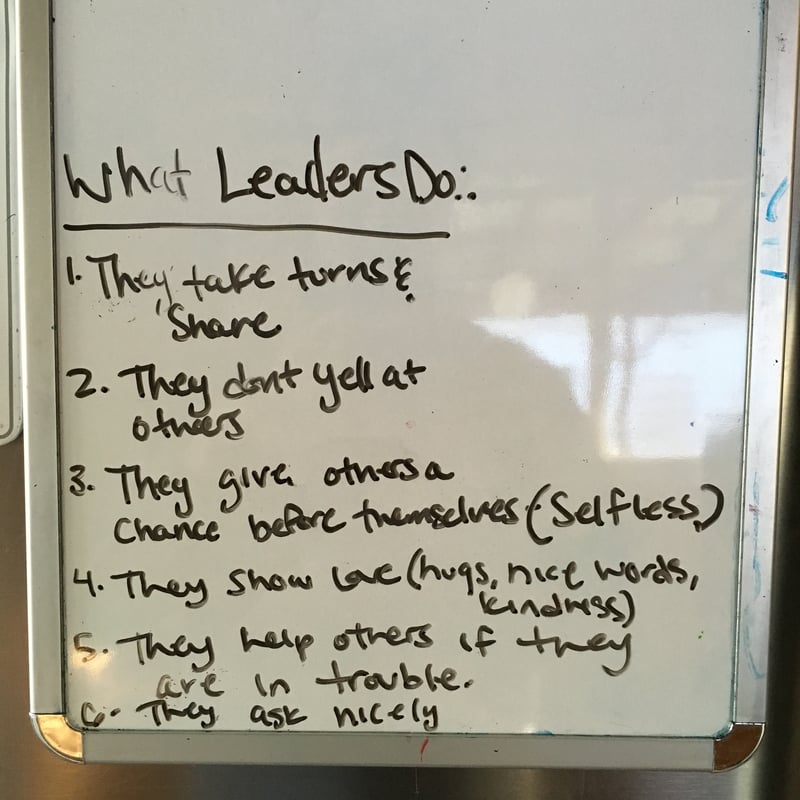
I’m pretty unsentimental about things like birthdays and new years, but I’m also only human and sometimes things sneak up on you unexpectedly. Earlier this week I was standing in our kitchen, staring into space as I waited for the water to boil, and suddenly my eyes focused on this—a series of guidelines my wife wrote down for our 6-year old daughter during the course of a particular trying day with her:

I looked at it, and then I saw it, and then I read it. And then I read it. And I realized that as silly as I usually think New Year’s Resolutions are, that’s some pretty good advice so what the hell, goals are good, right? So here they are, my 2016 resolutions:

  1. Care less about getting credit for things, care more about sharing victories (and defeats) with the people around me.
  2. Get angry a lot less, because anger just leads to yelling and yelling leads to the Dark Side. Or something.
  3. Be first less. Whether it’s getting on the bus or dividing up work on a project, let others go first. It’s not only the nice thing to do, I’ll probably end up learning a few useful new skills working on things I don’t normally work on.
  4. I should probably not hug my co-workers all the time, but I certainly want them to know how much I appreciate them. So I’ll tell them that more often. And my family will get a lot more hugs.
  5. Actively seek out places and projects where I can lend a helping hand. And—very important—don’t forget #1.
  6. Say “please” and “thank you” all the time—not only with words, but with how I live my life.

The power of making things

Jon Kolko wrote a wonderful personal essay called Look, I Made a Thing: Confidence in Making:

If you stick with it, through the years of shitty ashtrays and embarrassing critiques and rejections, you start to learn that making things is powerful, mostly because on the way to making things, you build confidence. You can take on problems that are out of your league. You can become a teacher with no teaching experience. You can make money and provide value. You can lead a conversation, advance an idea, and drive specificity where there were only vague generalities.

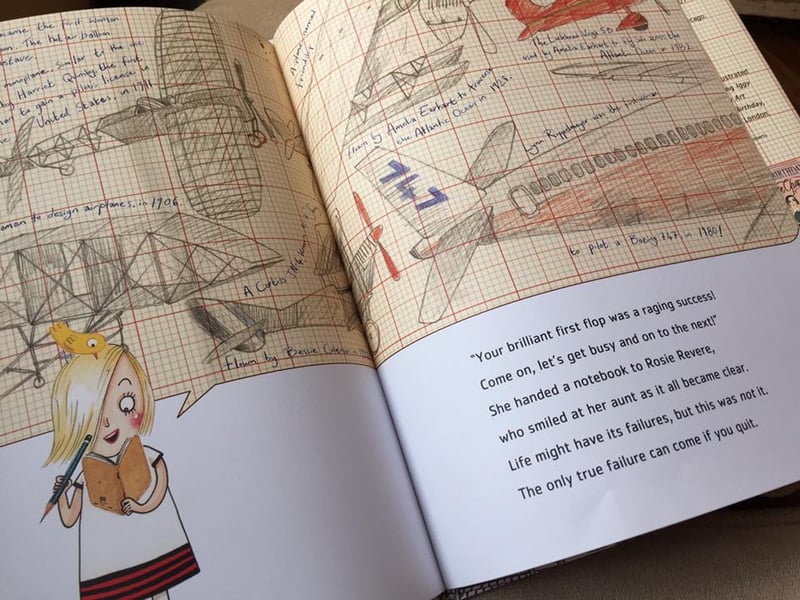
This idea—that just because you’re not good at something right now, it doesn’t mean you can’t become good at it—is something I try to instill in my daughters as well. And in doing that, I end up lecturing myself in the process too. One of my favorite books to read my daughters is Rosie Revere, Engineer by Andrea Beaty and David Roberts, because it explains this concept in language even I can understand…

Developers: our best source of true innovation

I find the common meme of “Oh, that’s ugly—a developer must have designed that” pretty misguided (and I’m not even a developer). The reason is that most developers I know have exceptional ideas (and taste). So these words from Marty Cagan really resonated with me:

I consider this mindset of the product owner (or more generally, the CEO or stakeholders) as the only one that can determine what to build, as toxic to teams, and a major reason for the lack of innovation. I’ve tried to explain many times that often the best single source of true innovation are our engineers. That doesn’t mean every engineer is going to be like this, but the mindset where no engineers can do this is a very serious problem. The engineers are working with the technology every day and are in the best position to see what’s just now possible. They are also disproportionately very bright people. When you combine this deep knowledge of technology, with a first-hand experience of the customer problems, great products can result.

“The best single source of true innovation are our engineers.” True that.

How to continue to make good products as organizations grow

In my latest column for A List Apart, called The Distance to Here1, I discuss a theory I’ve had for a while now:

The larger the distance between people who build a product and people who make decisions about the product, the harder it is to make a good product.

The post goes into detail on how I think companies can continue to make good products as they grow.


  1. Anyone else old enough to get the reference? 

Advice for people who thought flying was fun and then realized how awful it is

I really enjoyed Craig Mod’s How to survive air travel and Cennydd Bowles’s Advice for people who aren’t exactly afraid of flying but aren’t exactly unafraid of flying either. That said, I don’t agree with all their points, so I thought I’d keep this thing going by writing about my own self-imposed list of travel rules. If you learn one thing from all these lists, let it be this: people who spend time on airplanes think about being on airplanes a lot.

In my opinion the main ingredient to a reasonably bearable flying experience is to spend as little time in the airport and on the plane as possible. Anything you can do to minimize the time you spend getting from origin to destination will have a direct effect on keeping your rage levels under control. So that’s the lens through which my advice should be seen. It’s all about minimizing the pain.

So, here we go.

If you travel in the US, sign up for TSA Pre. It costs $80, it lasts 5 years, and it lets you get through security without removing any clothes or laptops. The line is also always shorter than the general security line, so it rarely takes more than 5 minutes to get through.

Set an alarm to remind you when it’s time to check in online. That way you can usually get a reasonable seat (more on seats later), and you can avoid lines at the airport (more on that later, too).

Never check luggage. If you have a long trip and don’t think you can fit everything into a carry-on bag, make a plan. Go to a laundromat half-way through the trip. Wash clothes in the shower. Just do whatever it takes to avoid standing in check-in lines. Remove the ability for an airline to lose your bag or make you miss a connection. Don’t wait 30 mins at baggage claim when you could have been at your destination already. People who check their luggage is where the phrase “sometimes bad things happen to good people” comes from. I use a Tumi Alpha 2 International Expandable Carry-On and I really like it.

There is one big area where I diverge from Craig and Cennydd’s advice. They tell you to get to the airport way early. I’m telling you to get there dangerously close to your flight. I aim to be at the airport 45 minutes before the flight leaves. That gives me just enough time to get through security and walk up to the gate without standing in any lines (remember: you’re checked in already and you have TSA Pre). This is a dangerous art, but worth pursuing. The holy grail is getting out of the cab and walking straight on to your plane without having to stop or run once.

Bring your own food. Airport shops always have lines, and airplane food is gross.

Choose an aisle seat, always. As far to the front as possible, always. The photos you get from the window seat will get you over the “20 likes” barrier on Instagram, but it’s not worth it when you have to go to the bathroom and the person next to you has their 17” Dell laptop open and is working on an intricate Excel spreadsheet. Also, aisle seats get you out of the plane faster.

Noise-canceling headphones are more magical than they appear. It’s amazing how the lack of constant droning in your ears helps to reduce fatigue. I like the Bose QuietComfort 20i headphones because they have a button you can push that lets you hear announcements/flight attendants without removing the headphones.

And finally, the most important piece of advice I can give you: If at all possible, avoid flying altogether.

Work and identity (and the machines)

Michael Sacasas has an interesting viewpoint on the “machines are taking our jobs” argument. In Machines, Work, and the Value of People he argues that since we’ve so closely linked our value as human beings to the work we do, the issue of machines taking over hits us pretty hard:

So, to sum up: Some time ago, identity and a sense of self-worth got hitched to labor and productivity. Consequently, each new technological displacement of human work appears to those being displaced as an affront to the their dignity as human beings. Those advancing new technologies that displace human labor do so by demeaning existing work as below our humanity and promising more humane work as a consequence of technological change. While this is sometimes true–some work that human beings have been forced to perform has been inhuman–deployed as a universal truth, it is little more than rhetorical cover for a significantly more complex and ambivalent reality.

SimCity and the virtues of games about societal issues

On the surface, Ian Bogost’s Video Games Are Better Without Characters is a nostalgia piece about SimCity:

Such was the payload of SimCity: not a game about people, even though its residents, the Sims, would later get their own spin-off. Nor is it a game about particular cities, for it is difficult to recreate one with the game’s brittle, indirect tools. Rather, SimCity is a game about urban societies, about the relationship between land value, pollution, industry, taxation, growth, and other factors. It’s not really a simulation, despite its name, nor is it an educational game. Nobody would want a SimCity expert running their town’s urban planning office. But the game got us all to think about the relationships that make a city run, succeed, and decay, and in so doing to rise above our individual interests, even if only for a moment.

But later on it turns into a strong argument for games that are about bigger issues in society. Games not about fighting one’s way out of a prison or getting off a deserted planet, but games that focus on living systems, politics, and the economy. Great article.

Using process for good

Kate Heddleston makes some great points in The Null Process:

When people say they don’t want process, what they’re really saying is they don’t want formalized process. There is really no such thing as “no process.” A process is simply the steps it takes to complete a task, so if a task is completed then by definition a process was used. Without formalized process everyone does things their own way, and there is no documentation for how problems are solved. This informal, undocumented process is the “null process,” and, if used incorrectly, the null process can have major implications for a company.

This reminds me of two things. The first is Rebekah Cox’s definition of Product Design:

Design is a set of decisions about a product. It’s not an interface or an aesthetic, it’s not a brand or a color. Design is the actual decisions.

What this implies is that everything you do in product design has a consequence. So just “letting things happen” is also a decision. It’s just a pretty bad one. Maybe that should be called “null design.” I don’t know, I’m not good at naming things1.

The second is Michael Lopp’s The Process Myth. The whole thing is great, but this quote in particular has always stuck in my mind:

Engineers don’t hate process. They hate process that can’t defend itself.

Also this advice:

Healthy process is awesome if it not only documents what we care about, but is willing to defend itself. It is required to stand up to scrutiny and when a process fails to do so, it must change.

For more reading on what it takes to build good processes (because let’s be honest, what else are you going to do on a Friday night?), I recommend Adam Wuerl’s Avoiding Process Hell and Jeff Gothelf’s Applying Product Thinking to Process Improvement.


  1. Just look at my URL. Seriously, what was I thinking. 

The politics of sunlight

Emily Badger wrote a very interesting article on the politics of sunlight and shade in urban design. From In the shadows of booming cities, a tension between sunlight and prosperity:

For cities, shadows present both a technical challenge — one that can be modeled in 3-D and measured in “theoretical annual sunlight hours” lost — and an ethereal one. They change the feel of space and the value of property in ways that are hard to define. They’re a stark reminder that the new growth needed in healthy cities can come at the expense of people already living there. And in some ways, shadows even turn light into another medium of inequality — a resource that can be bought by the wealthy, eclipsed from the poor.

The ethics of slot machine design

Andrew Thompson in Engineers of Addiction, a fascinating profile on the psychology of slot machines:

Game [slot machine] designers are charged with somehow summoning the ineffable allure of electronic spectacle — developing a system that is both simple and endlessly engaging, a machine to pull and trap players into a finely tuned cycle of risk and reward that keeps them glued to the seat for hours, their pockets slowly but inevitably emptying.

In other words, their job description is to make people win just enough so that they come back long enough to lose big. I just can’t wrap my head around that.