Menu

Posts tagged “creativity”

The benefits of giving an album a chance

Robin Sloan often seems to speak the words that are in my soul, and this time he really got to me. He bought a cassette tape of the new album by the band OOF and then wrote about the experience of albums vs. playlists:

I bought the cassette tape to play in my car and I’m glad, because it prompted me to listen to the album straight through, which, if I’m being honest, I might never have done on my laptop.

What happened (and this always presages a good experience with art) was that I surrendered to the strangeness, and the strangeness started to make sense. I entered OOF’s world, rather than insisting the band fit into mine, which is, of course, the demand of the Spotify playlist.

You’ve got to give things a chance. You’ve got to let them seep into your brain. […] OOF does not seem, to me, a band made for Spotify playlists. It seems a band made for cassette tapes in the car — for the decision, snap-thunk-whir, to give them a chance, and the slow but sure surrender to the dream of their world.

To be fair, not all albums are worth it—and that’s fine. But giving every album a chance to be worth it is something I think we should all do more of.

Better to light a candle than curse the darkness

I love this sentiment from Austin Kleon:

I am big on being a “curious elder”—and one way, I think, to expand the curious elder idea is to not just be curious about what young people are into, but to also share your curiosity about the world in a way that is generous but without expectation. To point out the things you think are good… just in case somebody, maybe even somebody younger, is looking for them.

I’ll go ahead and keep sharing the things I like, and I hope everyone else does too.

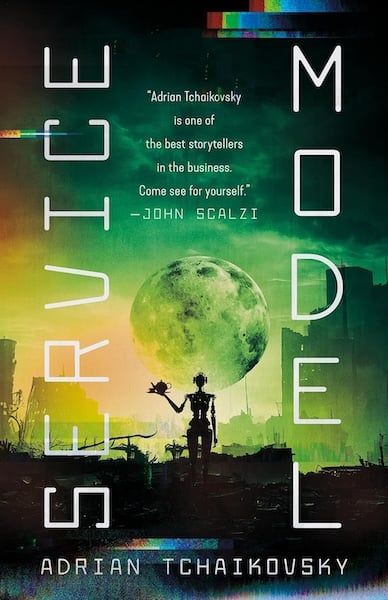
Quick Review: Service Model by Adrian Tchaikovsky

I recently finished the book Service Model by Adrian Tchaikovsky, and thoroughly enjoyed it. There’s a little bit of a lull around the 60%–80% mark, but overall it’s a solid 4.5 stars for me. Mostly because the main character is a robot who isn’t sure if he has become self-aware or just imagining things, and he certainly isn’t sure if he even wants that. It is a wonderful premise (albeit clearly inspired by the Murderbot series), and Uncharles is probably my favorite robot character in a novel in a long time. The dude is just incredibly relatable—here are some things he says or thinks in the book:

I wish to report an error in the way that everything works.

The world, as I have witnessed it, is a place lacking in efficiency, rationality, and cleanliness. I am driven to find a place in it nonetheless.

He sat down because, having decided that there was absolutely no reason to do anything ever again, he would cause less damage to himself and his surroundings when he eventually toppled over from a seated position, rather than from standing.

I do not feel I have greatly profited from seeing the world.

I suggest that ‘kind and ordered’ is a better goal. It is possible that the world was once both kind and ordered. It is possible that it may be so again. Perhaps you will make it so.

I, for one, would like to sign up for helping to make this a “kind and ordered” world.

Anyway, it’s a wonderfully funny and delightfully poignant sci-fi story that is about robots but actually really about humans. What’s not to like.
Service Model

Why the mysterious love affair between video games and giant elevators may begin with Akira

This is a fun bit of gaming history:

The thing about games, particularly Japanese games, is that they exist in a symbiotic relationship with manga and anime. When I spoke to Uemura-san, the engineer of the NES, he said ‘Once hardware developed to the point where you could actually draw characters, designers had to figure out what to make. Subconsciously they turned to things they’d absorbed from anime and manga. We were sort of blessed in the sense that foreigners hadn’t seen the things we were basing our ideas on.’

Balancing your inputs

As someone who is currently reading Slow Productivity and also watching Shōgun, I concur with this point from Austin Kleon:

During a recent phone call, my friend Matt Thomas told me he likes to take a high/low approach to balancing his input, which started when he was in grad school reading dense theoretical texts by day and chasing them with movies like Fast Five at night. I’ve currently got a good combo going: I’m reading Middlemarch and binge-watching Bridgerton. (As the poet Donald Hall wrote in Essays After Eighty, everybody who works with their brains all day needs to lighten up a bit at night: “Before Yeats went to sleep every night he read an American Western. When Eliot was done with poetry and editing, he read a mystery book.”)

Author Martha Wells discusses the origins and meaning of Murderbot

If you’re a fan of the Murderbot series (and if you haven’t read it, get on it!) you will absolutely love this recent keynote speech by author Martha Wells at the annual Jack Williamson Lecture at Eastern New Mexico University. She describes how Murderbot came to be, what it’s really about, and where the story sits within sci-fi and our world in general:

There are a lot of people who viewed All Systems Red as a cute robot story. Which was very weird to me, since I thought I was writing a story about slavery and personhood and bodily autonomy. But humans have always been really good at ignoring things we don’t want to pay attention to. Which is also a theme in the Murderbot series.

I won’t ruin the ending by quoting the final paragraph, I’ll just say that this is my favorite thing I’ve read in a long time, and you should savor every word.

‘End of the world vibes’: why culture can’t stop thinking about apocalypse

I admit that I love post-apocalyptic books and movies. So I feel more than a little bit chastised by ‘End of the world vibes’: why culture can’t stop thinking about apocalypse:

“Such convictions in the mouths of safe, comfortable people playing at crisis, alienation, apocalypse and desperation, make me sick,” complains the protagonist of Saul Bellow’s 1964 novel Herzog. “We must get it out of our heads that this is a doomed time, that we are waiting for the end, and the rest of it … Things are grim enough without these shivery games … We love apocalypses too much.”

Read on for more choice quotes from olden times that make the case that “the only way to manage a dread of the future is to remember that the past was no picnic”.

To Own the Future, Read Shakespeare

I’ve always said that when I grow up I want to write like Paul Ford. Well, I’m all grown up now. I still don’t write like Paul Ford, and he still writes absolute gems like To Own the Future, Read Shakespeare—in my opinion the final word on the value of the humanities:

A programmer sneers at the white space in Python, a sociologist rolls their eyes at a geographer, a physicist stares at the ceiling while an undergraduate, high off internet forums, explains that Buddhism anticipated quantum theory. They, we, are patrolling the borders, deciding what belongs inside, what does not. And this same battle of the disciplines, everlasting, ongoing, eternal, and exhausting, defines the internet. Is blogging journalism? Is fan fiction “real” writing? Can video games be art? (The answer is always: Of course, but not always. No one cares for that answer.)

Generative image AI as reading companion

A friend recently mentioned that he is feeding DALL•E prose from the fantasy novels he is reading, and asking it to create images of the scenes. This sounded like an excellent idea to me and since I am currently re-reading Lord of the Rings (this beautiful edition), I’ve been doing the same. It has genuinely enhanced my enjoyment of the book to create “text-accurate” images of the characters and scenes as I read.

Here are a few of my favorites (yes, I’m still in Fellowship)…

Tom Bombadil exactly as he appears the first time in the book:

Aragorn the first time he is fully described:

Frodo when he encounters the Ringwraiths on Weathertop. I forgot about the red sword (since the movies gave their swords a blue glow):

In case anyone is interested, here is the prompt I’m using:

Please generate images of the description below. Create one image in each of the following styles:

- **Surrealistic Photorealism**: Combining hyper-realistic details with surreal elements to create a dreamlike yet sharply detailed image. - **Gothic or Dark Romanticism**: Emphasizing darker, more mysterious elements of the description, with a focus on emotion, nature, and the macabre.2. **Magical Realism**: Blending realistic and fantastical elements in a way that treats the extraordinary as everyday, enhancing the mystical aspects of the description.

I then choose the style that seems most appropriate, and sometimes add/remove some details. It’s a fun experiment, you should try it!

Short review: Ascension by Nicholas Binge

I’m on a bit of a break right now (LinkedIn update here if you’re interested), and while I’m figuring out how to spend my time wisely I’ve been reading a lot of sci-fi. The latest book I finished—and really enjoyed—is Ascension by Nicholas Binge:

An enormous snow-covered mountain has appeared in the Pacific Ocean. No one knows when exactly it showed up, precisely how big it might be, or how to explain its existence. When Harold Tunmore is contacted by a shadowy organization to help investigate, he has no idea what he is getting into as he and his team set out for the mountain.

My best attempt at describing this would be it’s like Event Horizon on a mountain, with some really interesting existential philosophy thrown in. Some quotes I liked and highlighted:

There’s no such thing as starting fresh: new beginnings all contain the old ones bundled up inside of them. Starting fresh means not having a history anymore; it means not having an identity.

And…

“Do you know why Sisyphus keeps climbing,” Thomas asked, looking up at me, “even though he knows he’ll always end up back at the start?” John’s last words—echoing back at me across space and time. “Why?” He smiled and stood up. “Because that’s what life is. A constant climb. Eternal growth. The continual battle against entropy. It doesn’t matter what the destination is, or what’s at the top; all that matters is that you keep climbing. That’s what it means to be alive, Harold. That’s what it means to be human.” He turned away from me, walking off into the night.

If you’re in the mood for some smart spacey sci-fi horror, give this one a go!