Menu

Posts tagged “writing”

To design without thinking

Linds Redding’s A Short Lesson in Perspective is essential reading for anyone in the creative industry - particularly those who make things for the web. He laments the loss of time to think and reflect about designs before they go out the door:

Pretty soon, The Overnight Test became the Over Lunch Test. Then before we knew it, we were eating Pot-Noodles at our desks, and taking it in turns to go home and see our kids before they went to bed. As fast as we could pin an idea on the wall, some red-faced account manager in a bad suit would run away with it. Where we used to rely on taking a break and “stretching the eyes” to allow us to see the wood for the trees, we now fell back on experience and gut feel. It worked most of the time, but nobody is infallible. Some howlers and growlers definitely made it through, and generally standards plummeted.

It’s a strikingly honest essay about the creative process and the pressures of working on the Internet today.

Ideas of March 2012

This is my contribution to Chris Shiflett’s Ideas of March initiative, which encourages people to write about why they like blogs.

My love of writing comes from a love of problem-solving. There is a sense of pride and accomplishment in finding the right words to say something. And yet, great writing has an inherent unattainability to it that keeps me ever searching. There are good ways and bad ways to communicate something, but there is never a best way. It’s like a video game in the sense that you can level up by writing often, but it’s not a game you can ever beat. There is no big boss fight at the end that proves that you are now the best writer you can be. What keeps me going is the nagging sense that the last thing I wrote could have been written much better, so I’d better keep trying.

There are many benefits to writing, of course. Most importantly, it’s a problem solving technique in itself. By taking the time to structure your thoughts and your words in a way that other people need to understand, you tend to get a better understanding of what’s going on in your head. Clive Thompson addresses this well in The art of public thinking:

The process of writing exposes your own ignorance and half-baked assumptions: When I’m writing a Wired article, I often don’t realize what I don’t know until I’ve started writing, at which point my unanswered questions and lazy, autofill thinking becomes obvious. Then I freak out and panic and push myself way harder, because the article is soon going before two publics: First my editors, then eventually my readers. Blogging forces a similar clarity of mental purpose for me. As with Wired, I’m going before a public. I’m no longer just muttering to myself in a quiet room. It scarcely matters whether two or ten or a thousand people are going to read the blog post; the transition from nonpublic and public is nonlinear and powerful.

Writing in public continues to help me gain clarity about my thoughts and problems. That I expected. But I didn’t expect it to give me such a sense of community. The past few months have been especially gratifying, ever since I’ve been invited to become a contributor to Smashing Magazine. Through that process I’ve met amazing people, and through them, I think I’ve become a better writer. Which in turn helps me to solve problems better. It hardly seems fair that I gain so much from this community. If you’ll allow me the use of a ridiculous phrase, the ROI on my writing seems preposterously high.

I started my first blog on Windows Live Spaces in 2003. I’d just moved to the US and needed a way to feel connected to friends and family in South Africa. It’s 2012 now, and I don’t write on Windows Live Spaces any more. I also don’t live in the US any more. I’ve moved homes and countries and blogging platforms way too many times over the past 9 years. But looking back over many false starts and wrong turns in life and in blogging, I’m grateful for the thread of words that runs from my beginnings on Spaces, through the detour on Blogger, and now my own home on this domain. Somehow, those words anchor me.

So maybe writing this has once again shown me the error in my original thinking, just as it’s done so many times before. I was wrong in my opening paragraph. I don’t write because I love problem-solving. I write to know that I am here.

The vomit draft

This is such a gem of an interview with Andy Ihnatko that it’s hard to pick just one section to quote, but I’ll go with this one:

What’s your advice to new writers?

Build your whole workflow around the “vomit draft.” When you create a blank document, empty your mind of any expectations or aspirations. Just start typing. Never edit anything. Just get it all out of you and into the document. Type, type, type until you get to the end. The results will be horrible, but the hardest work is done: you’ll have taken a nebulous idea out of your head and created something that really exists. Then you fix, fix, fix.

Such great advice - I’ve started doing this on all longer pieces.

The pursuit for perfection

I love this line from Sweet Maria’s Coffee Library:

Espresso is fussy. It is the pursuit for perfection by a person who is driven by minutiae.

It’s not just Espresso that’s fussy. Design is fussy too. So is writing, drawing, painting, or any other creative pursuit you can think of. It is all “the pursuit for perfection by a person who is driven by minutiae”. And this pursuit is usually undertaken by unreasonable people.

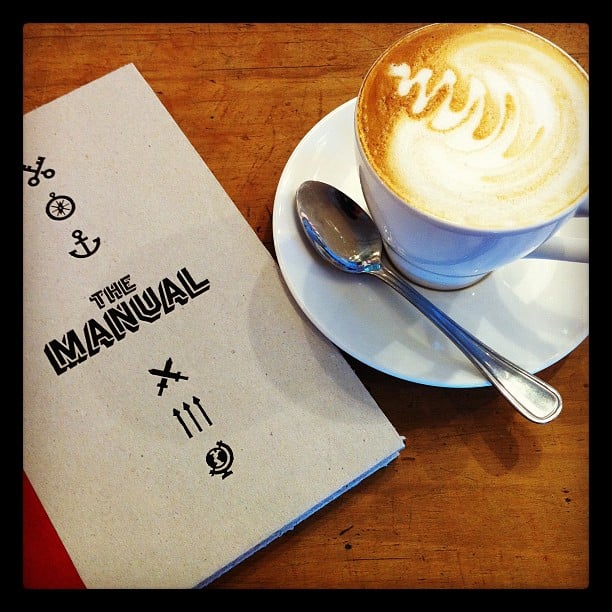
Speaking of coffee (a huge passion that’s pretty hard to merge with a blog on design and technology), I guess this is as good an excuse as any to post this recent photo, taken at Melissa’s Food Shop in Cape Town:

the-manual-melissas.jpg

Remember, always read the manual.

Wake up and start producing

Clay Johnson wants us to write 500 Words before 8am:

Starting your day as a producer means that your information consumption has meaning: the rest of the day means consuming information that is relevant to what it is that you’re producing. Waking up as a producer frames the rest of your habits. You’re not mindlessly grazing on everyone’s facebook’s statuses. You’re out getting what it is you need to get in order to produce. Waking up as a producer is procrastination insurance.

“Procrastination insurance.” I like that. This is tricky when you have a 2-year old that you want to read stories to in the morning, and you also need to get a run in before work. But there are other ways to apply this principle. I write most of my longer pieces at night when the family is already in bed. This is not ideal, but I do most of the planning in my head early in the morning while doing other tasks. I also tend to do a lot of design work in the shower - it’s uninterrupted time to think about a problem and come up with possible solutions. Maybe I’m rationalizing, but I choose to view this morning thinking time as part of producing and providing focus for the day to come.

Smashing Magazine, and the community that sustains me

In what still feels like a dream that I’ll someday wake up from, I’ve been extremely privileged to become a contributor to Smashing Magazine. I haven’t written about it here before because I’m not really a fan of meta posts, and like I said, I’m still waiting to wake up and discover that it’s not real. But I do want to express a few thoughts on the experience so far, and acknowledge some of the people who make the magazine happen behind the scenes.

The opportunity to write for Smashing Magazine fell in my lap out of nowhere. One of my favorite designers and writers, Francisco Inchauste, contacted me out of the blue after reading some of my articles here on Elezea, and asked if I’d be interested in contributing to a new UX area on Smashing that he was starting up. I tried to play it cool, but really, how is that even a question? Of course I jumped on the opportunity, and so far it’s been a fantastic learning experience.

I am extremely impressed by the editing process at Smashing Magazine. It not only results in great content on the site, but it provides extremely valuable feedback to writers to help us get better at it. The first step is usually a discussion between Francisco and I about the idea for the article, followed by 2-3 drafts that he gives feedback on. Once Francisco is happy with the draft, each article goes through two blind reviews by people in the industry who are usually experts in the topic you’re writing about.

The feedback that comes from Francisco and the team of reviewers is always smart and constructive, and results in better articles across the board. To be honest, I feel like I get more out of the process than Smashing does. I get to hone my writing skills - all they’re getting is an article! But hey, as long as they’re ok with that deal, I’ll take it.

So, on to a brief summary of what I’ve written about so far, and some of the things I’ve been thinking about for the future. In my first two articles (part 1, part 2) I talked about the organizational challenges of doing user experience in large organizations, and how we can work better together. In The Data-Pixel Approach To Improving User Experience I shifted gears and applied some of Edward Tufte’s data visualization principles to web design.

I am currently very interested in the connection between architecture and web design. I’m trying to read up on architecture as much as I can, and I continue to be struck by the similarities between the history of architecture and the current arc of web design. In Designer Myopia: How To Stop Designing For Ourselves I tried to scratch the surface of that, but there’s still so much more to be said. I really believe that the history of architecture can tell us a lot about the future of web design, and I hope to explore some of that in upcoming articles.

My next article cued for publishing is also the first one inspired by my 2-year old daughter, so I’m particularly excited about seeing that one come out. I want to thank Francisco, Vitaly, and the entire Smashing Magazine team for giving me the opportunity to write for such a great publication, and making me feel part of the Design community that sustains me every day.

It's time to find your voice

I’ve been following the recent back-and-forth about blog comments closely, since I have the same question about this blog: should comments be turned on or off? I even mentioned recently that I’m going to turn comments off for a while and see how it goes.

Matt Gemmell is driving/documenting the debate in the most articulate way, and his recent post on pseudonyms is another example of that. Even though the conversation now mostly appears to have run its course, it occurred to me that the root of this debate is related to what Paul Ford calls the fundamental question of the web:

“Why wasn’t I consulted,” which I abbreviate as WWIC, is the fundamental question of the web. It is the rule from which other rules are derived. Humans have a fundamental need to be consulted, engaged, to exercise their knowledge (and thus power), and no other medium that came before has been able to tap into that as effectively.

The Internet gives people this idea that if they can’t respond directly to something someone else said on a web site, their fundamental right to be consulted is violated. And that’s just not true - we don’t have a right to be consulted on everything that happens around us. What is true, however, is that we all have a voice, and that finding that voice is extremely important for our own development.

So the thing is, we’re having the wrong discussion. We shouldn’t be arguing about whether comments should be turned on or off on a blog. What we should be talking about is how all of us can spend more time finding our own obsession and voice, and how we can share that with the world. Tom Standage argues that writing is the greatest invention:

It is not just one of the foundations of civilisation: it underpins the steady accumulation of intellectual achievement. By capturing ideas in physical form, it allows them to travel across space and time without distortion, and thus slip the bonds of human memory and oral transmission, not to mention the whims of tyrants and the vicissitudes of history.

So forget about comments - it doesn’t matter whether you have them turned on or not. The real question is which one of the many available options you’re going to choose to start writing and owning your voice.


Update: Reader Greg Mathes asks in an email, “What’s so important about finding our own voice?” To answer, I’d like to quote Clive Thompson in The Art of Public Thinking:

The process of writing exposes your own ignorance and half-baked assumptions: When I’m writing a Wired article, I often don’t realize what I don’t know until I’ve started writing, at which point my unanswered questions and lazy, autofill thinking becomes obvious. Then I freak out and panic and push myself way harder, because the article is soon going before two publics: First my editors, then eventually my readers. Blogging (or tumbling or posterousing or even, in a smaller way, tweeting) forces a similar clarity of mental purpose for me. As with Wired, I’m going before a public. I’m no longer just muttering to myself in a quiet room. It scarcely matters whether two or ten or a thousand people are going to read the blog post; the transition from nonpublic and public is nonlinear and powerful.

Creepy content

“Content” Creep is an important article by Drew Breunig. I try to shy away from the word “must-read”, but this is probably as close as it gets. Breunig takes a step back to analyze the constant stream of web content we see every day, and he draws some interesting macro conclusions about the current state and future of publishing on the web.

He starts off by explaining the problems with the word “content” itself, and goes on to use the content farm “company” Demand Media as an example of the problem with measuring quality in web publishing:

Unfortunately, even if we assume page views are capable of measuring quality Demand’s business model prevents them from doing so. Because Demand’s “approach is driven by consumers’ desire to search for and discover increasingly specific information across the Internet”, page views are only capable of reflecting how well Demand’s “content” has been optimized for search engines. If a piece appears in search results, is clicked by a user, and closed because the writing is shoddy, Demand is only able to measure everything before the click. At best the page views metric can measure the quality of the headline. At worst they reflect the SEO tricks employed by a site.

Or to put it more succinctly:

Demand has created an environment which incentivizes SEO hacks more than good writing.

This is so true, and results in the type of ad-infested web sites I’ve written about before as well. Breunig goes on to explain what he calls the impending “content crunch”, and the need to adjust business models to account for quality. His conclusion is spot on:

It’s hard to believe a single word could slate an entire industry for failure. On its own, the word “content” is merely awkward. But as a unit of measurement, “content” affects business is real ways. Ignoring the variables audiences care about in order to populate Excel spreadsheets incentivizes weak writing short on substance and attention spans. All this would be tremendously depressing if it wasn’t creating an enormous opportunity for people with the courage to look beyond the numbers, where it’s too messy to measure, and invest in journalism, videos, photography, and art people might actually enjoy.

A site that immediately comes to mind as an example of the kind of courage Breunig speaks of is the brilliant Brainpickings - “a human-powered discovery engine for interestingness, culling and curating cross-disciplinary curiosity-quenchers, and separating the signal from the noise to bring you things you didn’t know you were interested in until you are.”

The article and Breunig’s main conclusions remind me of one of Clay Johnson’s points in his book The Information Diet:

Just as food companies learned that if they want to sell a lot of cheap calories, they should pack them with salt, fat, and sugar””the stuff that people crave””media companies learned that affirmation sells a lot better than information. Who wants to hear the truth when they can hear that they’re right?

The problem lies not just with the content farms, but also with us - the people who click on the links because it gives us more of what we want (even if it’s not good for us). The only solution to this problem is something that sounds like a pipe dream - expecting readers to be more conscious about the information they allow into their lives so that content farming ceases to be effective. In Johnson’s words:

The first step is realizing that there is a choice involved. As much as our televisions, radios, and movie theaters would have us believe otherwise, information consumption is as active an experience as eating, and in order for us to live healthy lives, we must move our information consumption habits from the passive background of channel surfing into the foreground of conscious selection.

For bonus points, read A long sentence is worth the read - it’s also a really good related discussion on the topic:

Enter (I hope) the long sentence: the collection of clauses that is so many-chambered and lavish and abundant in tones and suggestions, that has so much room for near-contradiction and ambiguity and those places in memory or imagination that can’t be simplified, or put into easy words, that it allows the reader to keep many things in her head and heart at the same time, and to descend, as by a spiral staircase, deeper into herself and those things that won’t be squeezed into an either/or.

Beautiful.

Mark Twain's excellent 19th century guidelines for writing on the web

We just don’t rant like we used to. Sure, there have been some good ones recently, but we have lost the art of being angry and highbrow at the same time - a skill that gives the rant a deliciously icy, brutal feel. For example, when you read something like Mark Twain’s 1895 rant about the rules of fiction, the current crop of angry that comes across our Twitter feeds feels a bit Mickey Mouse.

One of Mr. Twain’s specific complaints in the aforementioned rant is about the rules of good dialogue in fiction. As I read through it, I realized it provides a scarily perfect contrast to the language used on many web sites today:

[When] the personages of a tale deal in conversation, the talk shall sound like human talk, and be talk such as human beings would be likely to talk in the given circumstances, and have a discoverable meaning, also a discoverable purpose, and a show of relevancy, and remain in the neighborhood of the subject at hand, and be interesting to the reader, and help out the tale, and stop when the people cannot think of anything more to say. But this requirement has been ignored from the beginning of the “Deerslayer” tale to the end of it.

That’s unfortunately not what most of the web sounds like - but this paragraph from 1895 contains some of the best guidelines we have for effective web writing. Web site and application copy should:

  • Not sound robotic.
  • Use words that two people would use in everyday conversation.
  • Not be gibberish words strung together to sound fancy, but mean something to normal people.
  • Not just exist to fill up space, but have an identifiable purpose for being on that page and in that context.
  • Be relevant to the flow the user is currently in.
  • Be interesting and help tell the story.

It would seem that Mark Twain was one of our first (and best) web Content Strategists.

Craggy rocks: content strategy and the art of language design for the web

They paddled a little further, then Salty looked through his telescope again.
”A pirate ship!” he cried. “Let’s have a battle.”
“Oh dear,” said Button. “I don’t want to meet a pirate.”
“Don’t worry,” said Salty. “I’ll be the hero.”
But when they got close they found that the pirate ship was just a craggy rock.

- Angela McAllister, Salty and Button

I picked up Salty and Button for my 2-year old daughter on a whim. I just felt like we both needed a break from Winnie the Pooh. He’s a nice enough bear, but the dude’s got some serious honey issues. Much to my delight the book quickly became my daughter’s favorite, and we’re now reading it several times a day.

Yesterday something interesting happened. My daughter suddenly became fixated with one specific part of the story. The two friends think they see a pirate ship, but it ends up being just a rock. “Wher’s the craggy rock?”, she keeps asking. “Let’s go find it!” And when we find the page she points to it and says the words “craggy rock” over and over, with obvious delight.

I am now convinced that she does this just because she loves saying the words. She loves the way they sound, and the way the phrase rolls off her tongue. Craggy rock is no cellar door, but it’s pretty close. Seeing my daughter delight in language for its own sake fills me with so much joy. It reminds me of a story I just read in Clay Johnson’s excellent The Information Diet. He quotes Helen Keller, the renowned deaf-blind activist, as she describes her first experience with language:

We walked down the path to the well-house, attracted by the fragrance of the honeysuckle with which it was covered. Someone was drawing water and my teacher placed my hand under the spout. As the cool stream gushed over one hand she spelled into the other the word water, first slowly, then rapidly. I stood still, my whole attention fixed upon the motions of her fingers. Suddenly I felt a misty consciousness as of something forgotten - a thrill of returning thought; and somehow the mystery of language was revealed to me. I knew then that “w-a-t-e-r” meant the wonderful cool something that was flowing over my hand. That living word awakened my soul, gave it light, hope, joy, set it free! There were barriers still, it is true, but barriers that could in time be swept away. I left the well-house eager to learn. Everything had a name, and each name gave birth to a new thought. As we returned to the house every object which I touched seemed to quiver with life. That was because I saw everything with the strange, new sight that had come to me.

I can see this realization in my daughter’s eyes as she continues to learn new words. She’s learning that everything has a name, and that names can be beautiful.

I recently wrote about about some problems I have with language the New York Times used in one of their emails. On the Hacker News thread for the post this comment appeared:

Honestly, this just seems like nitpicking. Your main complaint about their email is that their apology isn’t phrased in the vernacular? Don’t we have better things to do with our time than complain about things like this?

The comment got to me more than it probably should have. Is the commenter right? Is it a waste of time to nitpick language? My daughter’s love for the phrase craggy rock makes me think that it’s a worthy cause to fight, after all. At the risk of stating the absolute obvious, language is the soul of civilization. We have to not just protect it, but help it thrive. We have to find the joy and the power in the names of things. In Patrick Rothfuss’ epic fantasy novel The Name of the Wind he describes the power of language like this:

“What do you mean by blue? Describe it.” I struggled for a moment, failed. “So blue is a name?” “It is a word. Words are pale shadows of forgotten names. As names have power, words have power. Words can light fires in the minds of men. Words can wring tears from the hardest hearts. There are seven words that will make a person love you. There are ten words that will break a strong man’s will. But a word is nothing but a painting of a fire. A name is the fire itself.”

So, here’s the point I’m trying to make.

Those of us who write for the web need to remember that the words we choose are not just about comprehension, but also about feeling. Phonaesthetics teach us that the sound of certain words and sentences have an inherent pleasantness or beauty (euphony), while others can be quite unpleasant (cacophony). Just as a typeface (the artistic representation or interpretation of characters) adds emotion to letters, word aesthetic can be in total harmony with other design elements.

Beauty in design isn’t just the job of visual design. Content strategy has a specific role to play in creating the desired aesthetic of a web site. And beauty is quite important in a changing landscape where aesthetic longevity is the new product expiration date. So the next time you write a paragraph for the web, ask yourself the following question:

Will the sound of these words make that one guy’s 2-year old daughter’s face light up?

Update 1/4/2012: “Nick” emailed and pointed me to the fascinating essay Politics and the English Language, where George Orwell discusses “language as an instrument for expressing and not for concealing or preventing thought”, particularly in politics. He ends with some great writing tips.