Menu

Posts tagged “writing”

Wish list for a mobile WordPress publishing platform

I was encouraged to read these words by Matt Mullenweg in his post Radically Simplified WordPress:

As John Borthwick put beautifully today, “A tablet is an incredible device that you can put in front of babies or 95-year-olds and they know how to use it.” How we democratize publishing on that sort of platform will not and should not work like WordPress’ current dashboard does. It’s not a matter of a responsive stylesheet or incremental UX improvements, it’s re-imagining and radically simplifying what we currently do, thinking outside the box of wp-admin.

This is great news, and I’d like to offer my 2 cents on what an ideal mobile WordPress platform might look like. Because despite several attempts I haven’t been able to figure out a good workflow for publishing to WordPress from my iPhone or iPad.

Let’s take this post as an example. I read Matt’s article in Instapaper. I used the awesome “Create Note in Simplenote” feature to send the above quote to my preferred writing app. I am writing these words in Simplenote for iOS using Markdown. Writing down the words is a breeze; geting those words to my blog is a mission (and usually results in a big time delay). I’m going to wait until I get home, open my laptop, and wait for nvALT to sync with the text I entered into Simplenote. Then I’ll copy the Markdown into MarsEdit, add some URL and keyword specifics, and hit Publish.

The WordPress iOS apps are not helpful to me, because they don’t allow you to add custom fields and URLs. For example, for link posts I have a custom field that turns the title of the RSS entry for that post into a link that takes the reader directly to the original article. I can’t do that in the iOS app.

But here’s the thing - I don’t want a better WordPress iOS app. I don’t even want a mobile-optimized WordPress Dashboard. Instead, I want all the apps I already use to integrate seamlessly with the WordPress backend. So my ideal mobile WordPress experience is this: make it dead easy for text editor apps to publish to WordPress.

Once I’m done writing this post in Simplenote I would like to tap a link that says “Publish to WordPress.” I would then like to see a customizable dialog that lets me add/edit all the fields I have chosen to include, hit Post, and be done. It could work similar to Tumblr integration on Instapaper, except with customizable fields:
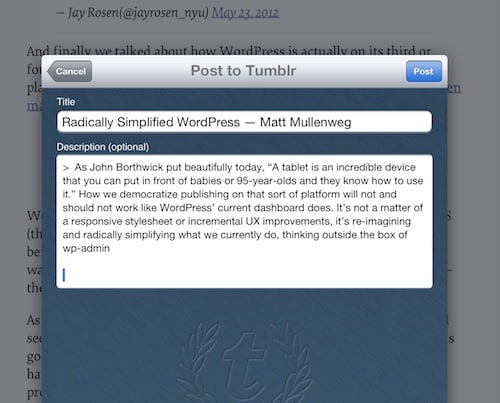
Instapaper and Tumblr integration

Maybe this is already what the WordPress team is thinking about - I certainly hope so. Either way, I know that this kind of seamless integration would truly free us to publish from anywhere, and will put a final nail in the coffin of the “iPad is only for consuming” argument.

It would be great to get more insight from the WordPress team on what they’re working on for mobile.

Comic Sans: designed in response to inappropriate font usage

I’ll probably never get tired of articles about Comic Sans. And as far as they go, Jenny Ambrose’s What’s the Deal with Comic Sans? is a pretty good one. Here is Comic Sans designer Vincent Connare in his own words:

There was no intention to include the font in other applications other than those designed for children. The inspiration came at the shock of seeing Times New Roman used in an inappropriate way.

I love the irony of this. As Ambrose points out:

Here we are in 2012, discussing the usage appropriateness of a typeface created in 1994, which was in turn created in response to that very same typography appropriateness problem.

And round and round we go. Also see my small contribution to this debate.

When infographics (data art) masquerade as data visualization

I’m a big fan of Stephen Few and his approach to data visualization. His book Show Me The Numbers: Designing Tables and Graphs to Enlighten has been immensely helpful in my work as a user researcher, and I’ve been lucky enough to attend one of his excellent seminars. So I’ve been really interested to hear his viewpoint on the latest Infographic craze that’s taking the pageview world by storm.

I am personally not a fan of the Infographics that are passed around on Twitter every day. Most of them are confusing and only meant to drive eye candy-derived traffic with no intention to communicate data clearly. I think we pretty much hit rock bottom with this Mashable monstrosity called “The Internet Is Ruining Your Brain”. For some fun reading, also see Dan Frommer’s How Infographics Are Ruining The Web, and Megan McArdle’s Ending the Infographic Plague.

But now, Stephen finally weighed in on his blog with a very sensible argument about the nature of data visualization, and where common web infographics fit into that universe. He starts his article Data Art vs. Data Visualization by making an important distinction:

There are as many definitions of data visualization as there are definers, but at the root of this term that has been around for many years is the goal that data be visualized in a way that leads to understanding. Whatever else it does, it must inform. If we accept this as fundamental to the definition of data visualization, we can judge the merits of any example above all else on how clearly, thoroughly, and accurately it enlightens.

By data art, I’m referring to visualizations of data that seek primarily to entertain or produce an aesthetic experience. It is art that is based on data. As such, we can judge its merits as we do art in general.

He goes on to give three reasons why it’s harmful when data art masquerades as data visualization.

Blogging is an attitude (and a privilege)

Jim Dalrymple in Blogging is not a thing, it’s an attitude:

Readers connect with a blogger. They know things about them, they laugh together and sometimes argue over points in a story. It’s a give and take relationship that not everyone can handle.

Blogging is not about being stiff and rigid in your writing, but being flexible and flowing with ideas. It doesn’t matter if everyone agrees with your thoughts. In fact, that would be really boring ”” but you write it anyway.

I completely agree with Jim, and it’s one of the main things I’ve learned in the few months that I’ve been writing more on this site. Conventional blogging wisdom says that you have to pick a topic and stick with it. I read this advice all over the web, so I used to think about it all the time. I worried about the topics I covered, and whether or not I’m “allowed” to publish something if it doesn’t quite fit my One Chosen Topic. Oh, and I worried a great deal about what that One Chosen Topic should be. Writing lost its fun and became stressful.

I no longer believe that this conventional wisdom is true. I think that people follow blogs primarily because they connect with the authors and their views in some way, not because of the specific topics they cover (although of course that does play a part). It’s why I keep coming back to The Loop, Daring Fireball, The Brooks Review, Shawn Blanc, etc. It’s why I don’t mind when Marco Arment reviews LED light bulbs.

I might not always agree with these authors, but I have a genuine affinity for them, and I respect their views. They’re not faceless organizations, but human beings that write about things that interest them. And because they do it well, they get me interested in a much more diverse set of topics (like baseball). They prompt me to think more critically, and that spurs additional thoughts that feed into my own writing.

I also like this quote from Michael Lopp from his article Please Learn to Write:

Your readers are far more critical than the Python interpreter. Not only do they care about syntax, but they also want to learn something, and, perhaps, be entertained while all this learning is going down. Success means they keep coming back - failure is a lonely silence.

I think when it comes down to it, it’s the constant fear of the lonely silence that drives us to become better writers. But that’s a much better fear to have than wondering about what you’re allowed to put on your site. I’m in no position to give writing advice, but I’ll tell you what has made my experience worthwhile.

I feel like writing more has helped me find my voice. And I am becoming more comfortable with raising that voice about a continuously expanding range of topics. Sometimes it’s good, sometimes it’s not so good. But there has been a big pay-off in persisting: a small, growing community of readers that I appreciate and enjoy immensely. They tell me when I’m full of crap, and they tell me when I write something they like. That’s an incredible privilege, and why I love the blog format so much. So if you’re one of those who keep coming back and provide the occasional piece of feedback: thank you.

Ok, this turned out much longer than I planned. I actually just wanted to send you to Jim’s post. So don’t forget to go read it.

The necessity of risk and failure in the creative process

There’s an interesting discussion on The Verge entitled Filters vs. failure: Instagram’s perfect messes could spell trouble for creativity. Joshua Kopstein argues that the problem with Instagram and other digital creation tools like Paper is that it removes the ability to make mistakes. It’s virtually impossible to take a bad picture on Instagram, and he believes that this is a problem for creativity in general:

By removing risk we have fundamentally changed the nature of the medium, or technically speaking, switched to an entirely different one. Because the process is now streamlined and offers near-infinite forgiveness, the way we approach a camera has changed drastically from tools defined by limited exposures and semi-predictable chemicals, and the resulting product always reflects that.

Instagram’s foremost blasphemy isn’t that it “ruins” images or misrepresents reality ”” it’s that it mines another medium for selective, aesthetic purposes despite being unable to represent the processes and risks that define that medium. The software curates, emulates and packages appropriated qualities that its creators consider desirable, creating a risk-free detour that fast-tracks the creative process.

Kopstein also links to a very interesting article by Derek Holzer called Schematic as Score: Uses and Abuses of the (In)Deterministic Possibilities of Sound Technology. Holzer discusses the move from analog to digital creation in the music industry, and makes a similar point about the absence of risk in the creative process:

I consider it axiomatic that, for any art work to be considered experimental, the possibility of failure must be built into its process. I am not referring to the aestheticized, satisfying glitches and crackles valorized by Kim Cascone, but to the lack of satisfaction produced by a misguided or misstepped procedure in the experiment, whether colossal or banal. These are not errors to be sought out, sampled and celebrated, but the flat-on-your-ass gaffs and embarrassments that would trouble the sleep of all but the most Zen of musicians or composers.

The presence of failure in a musical system represents feedback in the negative, a tipping point into anti-climax, irrelevance, the commonplace, the cliche or even unintended silence. Many artists try to factor out true, catastrophic failure by scripting, scoring, sequencing or programming their work into as many predictable, risk-free quanta as possible ahead of time. But this unwelcome presence also guarantees the vitality of that hotly-contested territory ”“ the live electronic music performance.

The resulting compositions from the most “easy” and “simple” software tools are often nothing more than “digital folk” art ”“ the endless and endlessly similar permutations which are possible merely from the tweaking of a few basic presets. Perhaps the artistic tragedy of the digital age lies in the social and economic pressure to immediately release “results” which barely get beyond this initiatory phase.

I find these discussions fascinating. Sweeping generalizations are dangerous, of course, but I do agree that taking the risk out of creativity also makes it much harder to make something truly great. I see this in my own creative pursuits as well. I love writing first drafts of pieces. I absolutely hate editing those pieces to become something that’s worth publishing. But it’s in the editing process - which is basically the discovery and correction of failures - that the opportunity for doing good work really presents itself.

If software came along that magically made every first draft look acceptable, writers would lose out on the surprising spurts of creativity that come from the editing process. And I think this is the same for Instagram and electronic music. If we can walk any direction we want and never get a course correction, how will we get where we need to go?

George Orwell on writing: we're all vain, selfish, and lazy

My wife just emailed me this quote on writing. I can’t figure out if she’s encouraging me or insulting me. Ah, the wonderful mysteries of marriage.

All writers are vain, selfish and lazy, and at the very bottom of their motives lies a mystery. Writing a book is a long, exhausting struggle, like a long bout of some painful illness. One would never undertake such a thing if one were not driven by some demon whom one can neither resist nor understand.

George Orwell, Why I Write

How research findings are distorted for the sake of journalism

I was reading an article called The Internet’s Battle For Our Digital Souls on Big Think when I stumbled on this sentence:

We get approximately the same type of pleasure from talking about ourselves on social media as we do from having sex.

That just didn’t sit right with me. I’ve posted plenty of updates on Facebook and Twitter, and it definitely didn’t… ok, I’ll stop there. I don’t want this to get awkward. All I’m saying is that this doesn’t feel right. So I decided to trace the statement back to the original study that it’s talking about, to see what’s going on.

The post on Big Think appears to be a rehash of an article in the LA Times called Study helps explain why we over-share on Facebook, Twitter. The first thing I found interesting is that their conclusion about the sex thing is a little more measured:

In a series of experiments, the researchers found that the act of disclosing information about oneself activates the same sensation of pleasure in the brain that we get from eating food, getting money or having sex. It’s all a matter of degrees of course, (talking about yourself isn’t quite as pleasurable as sex for most of us), but the science makes it clear that our brain considers self-disclosure to be a rewarding experience.

The LA Times links back to the original research paper, which has the decidedly less sexy title Disclosing information about the self is intrinsically rewarding (PDF link). The paper explains that the study was about whether or not people would give up money to talk about themselves (my emphasis added):

Just as monkeys are willing to forgo juice rewards to view dominant groupmates and college students are willing to give up money to view attractive members of the opposite sex, our participants were willing to forgo money to think and talk about themselves.

The word “sex” appears six times in the 6-page paper, and only once in the context that these other news stories use it. The “Discussion” section starts off as follows (my emphasis added):

Despite the frequency with which humans disclose the contents of their own thoughts, little has been known about the proximate mechanisms that motivate this behavior. Here, we suggest that humans so willingly self-disclose because doing so represents an event with intrinsic value, in the same way as with primary rewards such as food and sex. Intriguingly, findings also suggested that both parts of “self-disclosure” have reward value. Although participants were willing to forgo money merely to introspect about the self and doing so was sufficient to engage brain regions associated with the rewarding outcomes, these effects were magnified by knowledge that on’s thoughts would be communicated to another person, suggesting that individuals find opportunities to disclose their own thoughts to others to be especially rewarding.

Note that they talk about “rewards”, not “pleasure” like in the news stories. The core research hypothesis is that sharing about ourselves has intrinsic value. To quote from a different section (my emphasis added):

Interestingly, a number of earlier researchers have put forward the hypothesis explicitly tested here — that self-disclosure will act as an intrinsic reward; however, despite calls to do so, this notion has not previously been tested empirically. As such, the current study validates a long-standing hypothesis that self-disclosure arises — at least in part — from the subjective value associated with it.

No mention of sex there, whatsoever. It’s also important to know what the phrase “intrinsic value” means in the philosophical sense of the word, because it’s essential to understanding the results of the study:

The intrinsic value of something is said to be the value that that thing has “in itself,” or “for its own sake,” or “as such,” or “in its own right.”

So let’s be very clear about what this research shows. The hypotheses tested (and confirmed) is that people like talking about themselves on social media because it has intrinsic value. In other words, we like sharing because it’s enjoyable for its own sake as a social activity. They make the point (in passing) that this is similar to other activities with intrinsic value such as food and, yes, sex. It’s not that posting on Facebook makes you feel the same way that having sex does. It’s that all these things share a common thread: the subjective, intrinsic value that they possess.

But hey, that message isn’t nearly going to rack up the same number of page views as saying that “We get approximately the same type of pleasure from talking about ourselves on social media as we do from having sex.” I read so many “a new study suggests that…” articles that I just take at face value. Today I decided to read the actual research paper, and realized what kind of distortions happen the further you get from the source of a story. I’ll certainly be a lot more cautious about these kinds of stories going forward. Welcome to the new age of journalism, I guess.

Is it time to stop writing headlines that end in question marks?

Betteridge’s Law of Headlines states the following:

Any headline which ends in a question mark can be answered by the word ‘no’.

Ian Betteridge explains his theory as follows:

The reason why journalists use that style of headline is that they know the story is probably bollocks, and don’t actually have the sources and facts to back it up, but still want to run it.

Betteridge’s point is that if a story had enough proof and citations, the headline would be assertive. Consider the latest story on TechCrunch, as of this writing: “Warren Buffett Is A Punk”. Regardless of its journalistic appeal, doesn’t that sound much better than “Is Warran Buffett A Punk?”. Headlines end in question marks when the authors want to retain a certain measure of deniability if their story turns out to be false (“Will iOS 6 Be Able To Make You Coffee?”).

However, lately these headlines have morphed into something beyond just a mixture of deniability and laziness: pure link bait. Consider a few randomly selected headlines from the last week:

  • Should Celebrities Create Their Own Branded Social Networks?
  • Could in-store navigation tech be a shopper’s worst nightmare?
  • Samsung Galaxy S III: Is the Screen Its Achilles Heel?

The idea is to get people interested enough to click through, and then make them scroll past the ads until the answer (usually, “no”) is revealed in the last paragraph. It’s effective, but I just don’t think it should be done. Unfortunately I don’t have a business reason for my opinion, but I do have a reader reason.

I believe in respecting your audience’s intelligence, and not wasting their time. I believe in stating an article’s thesis and/or purpose clearly in the title, and trusting that if it’s interesting enough, the people you want on your site will click through and read it.

So, is it time to stop writing headlines that end in question marks? I’m going to break Betteridge’s Law and say, unequivocally, yes.

What if you had made different choices about your life?

The best article I read all week is Eric Puchner’s The Cooler Me. Puchner wondered what his life would have been like if he had made different choices, so he set off to find his doppelgänger to see what he’s missing out on. The results are funny and poignant, and it’s just such a well-written article. If you’re a parent, I think you will particularly enjoy it.

It’s very long, and hard to quote from, but here are just a couple of paragraphs as a teaser:

For some reason, I told [my doppelgänger] Kyle about how I’d asked my daughter recently what she wanted to be for Halloween, and she’d said “a confused chicken.” This apparently meant dressing up like a chicken but pretending not to know what she was. I couldn’t help thinking she’d hit upon a deep ontological truth: the idea that who you were would be obvious to everyone else but yourself.

And shortly thereafter:

There’s a reason we drift toward attachment, I think, as we get older - attachment to people, to work, to things. As death moves closer, we try our hardest to dig in. We pound in the stakes so that our tents don’t blow away. Still, it makes sense to me that the perceptions we once had of ourselves would be hard to cast off. We miss our youth, our freedom — which is not the same thing as wanting it back. We may think it is, but it’s not. We’re all confused chickens.

But please, do yourself a favor and carve out some time this weekend to read the whole thing.

Jumping to conclusions about how the brain jumps to conclusions

In The Irrationality of Irrationality Samuel McNerney discusses cognitive bias from an interesting angle. What if all the popular psychology books about this phenomenon, like Dan Ariely’s Predictably Irrational and Daniel Kahneman’s Thinking, Fast and Slow, are actually complicit in strengthening some of our incorrect biases? He says:

People seem to absorb these books uncritically, ironically falling prey to some of the very biases they should be on the lookout for: incomplete information and seductive stories. That is, when people learn about how we irrationally jump to conclusions they form new opinions about how the brain works from the little information they recently acquired. They jump to conclusions about how the brain jumps to conclusions and fit their newfound knowledge into a larger story that romantically and naively describes personal enlightenment.

His observations on the power of narrative are also really interesting.