Menu

Posts tagged “writing”

The New York Times non-apology, and the end of lazy marketing language

Yesterday I received an email from the New York Times in which they told me, “Our records indicate that you recently requested to cancel your home delivery subscription.” They proceeded to use a phrase that bears an uncanny resemblance to something I told a girlfriend who dumped me when I was 15: “We do hope you’ll reconsider.”

Here’s the problem: I canceled my subscription 3 years ago. No big deal though, mistakes like this happen all the time. I hit the Archive button and forgot about it. But this morning I woke up to another email from the Times, this one with the subject line “CORRECTION: Important information regarding your subscription.” One of the paragraphs read as follows:

This e-mail was sent by us in error. Please disregard the message. We apologize for any confusion this may have caused.

I find passive voice non-apologies like this frustrating and insulting - worse than the original mistake, because it somehow manages to avoid taking responsibility for what happened. And it looks like I can finally move on from the idea that I’m the only one who feels this way. Here’s Clinton Forry:

“This e-mail was sent by us in error.” -New York Times email. I’ll just sit here and wait for an apology for that use of passive voice.

”” Clinton Forry (@wd45) December 28, 2011

And John Holdun:

JUST ONCE I’d like a big company to omit their “We apologize for any inconvenience this may have caused” in favor of a “Sorry.” ”” John Holdun (@johnholdun) December 28, 2011

In Subscribing to The New York Times, a post about the paper’s subscription pricing, Khoi Vinh alludes to a recurring pattern in their email communications:

In the run up to my subscription expiring, the company had been sending me promotions that were urgent in their warnings but exasperating in their vagueness. Each email was unequivocal about the number of days that remained in my subscription, but the renewal rates were only hinted at.

“Urgent in their warnings but exasperating in their vagueness.” That’s a great description.

This is a big deal. Content Strategy has become mainstream, and more and more businesses are finding out that it’s more effective to talk to their customers like real people (and get to the point quickly). Yet too many old school companies continue to speak to us in that patriarchal tone, assuming that since they clearly know what’s best for us we’ll just go ahead and click that “Buy now” button (if we can find it, because we’re not that smart you see). That’s why the Times didn’t just say this in their “apology” email:

Yesterday we made a mistake and sent you an incorrect email about your subscription. We’re sorry about that. You can delete the email.

The problem is that we’re starting to notice when we’re being talked down to. This has very real implications for marketing, where traditional slogans like “Your savings start here!” and “Unbeatable service!” lose their power to pull the wool over our eyes if they’re not backed up by something real. I recently lamented the laziness of the slogan “Everything you could ever want. And more. For less.” I wondered what it would cost for some happiness and a toilet made out of solid gold, because if you take that slogan at face value I should be able to get that, right?

The lesson to companies is simple: We’re smarter than you think. Be honest about the product or service you provide, and just say “sorry” when you made a mistake. We’ll love you for it.
Disagreeing, comments, and 2012

I know I shouldn’t write meta-posts. I really enjoy reading such posts by the writers I follow, but for some reason it feels presumptuous of me to do the same. But hey, it’s the end of the year and no one is reading anything anyway. So I thought I’d let you know about two things that have been on my mind about my writing here.

Disagreeing

I enjoy arguing. But I mean that not in the way most of the Internet means it. I mean it in the way the Dictionary means it:

Give reasons or cite evidence in support of an idea, action, or theory, typically with the aim of persuading others to share on’s view.

I don’t just enjoy writing such arguments, I also enjoy reading them - particularly if someone is making an argument against one of my opinions. But I really dislike mean-spirited fights online, so much so that I’ve had to close comments on a couple of posts this year because things just got too rowdy.

After particularly contentious fighting in the comments section of a post I usually vow to stick to writing non-controversial stuff, but before I know it I’m back to arguing (again, in the sense of “giving reasons in support of an idea”). I finally realized that I should just run with that instinct and not try to censor myself. But from here on out I’m going to set very specific rules for myself on how I’m allowed to argue. And for that I turn to Paul Graham.

In his brilliant post How to Disagree, Paul goes through what he calls the “Disagreement Hierarchy”, or “DH”. I’m not going to restate what he said - you should definitely click through and read that post. I’ll just say that my commitment to myself (and to you) is that I will always argue/disagree at levels DH5 or DH6 of the Disagreement Hierarchy. As Paul says, it results in better arguments and happier people:

But the greatest benefit of disagreeing well is not just that it will make conversations better, but that it will make the people who have them happier. If you study conversations, you find there is a lot more meanness down in DH1 than up in DH6. You don’t have to be mean when you have a real point to make. In fact, you don’t want to. If you have something real to say, being mean just gets in the way.

Arguing (yes, in the Dictionary sense of the word) is important because we all learn from it. But we have to rise above name-calling (DH1) and skip all the other levels to a point where we do the hard work and disagree in a way that moves the conversation forward. That’s what I hope to do here.

Comments

Oh, comments. I’ve gone back and forth on this so many times. Sometimes I leave comments open, other times I close them. Sometimes I close comments on a post, get called out on Twitter about it, and then open it up again. It’s confusing and it’s causing me headaches. So I’ve made a decision to close comments on all posts, at least for a month or so, or until someone writes a convincing argument on why sites should have comments (please use DH5 or DH6 in your argument).

To me, the most convincing argument yet to not having comments is Matt Gemmel’s post Comments Off. I can’t say it better than he did, so please go read his thoughts on the issue. For me, the biggest reason is what Matt calls the burden of moderation. It takes a really long time to moderate comments, especially if a post gets popular while I’m sleeping and I wake up to 40 comments that I have to read through to make sure no one called someone else an idiot. As Anil Dash said, if your website is full of assholes, it’s your fault, so moderating comments is not something you can just ignore. It has to be done.

I’ve had to get up at 5am way too many times to spend an hour deleting comments and asking people to be nice to each other. That’s time I could have spent (1) sleeping, or more importantly, (2) writing something new. So I’m going to give the no comments thing a go and see what happens.

As Matt says in his post, this doesn’t mean I don’t want feedback. We’ve already established that I enjoy arguing, so I also enjoy reading peopl’s counter-arguments (or support, of course). So like Matt, I also hope to get the following types of feedback:

  • A tweet to let me know if you agree/disagree and why.
  • A post on your own site using DH5 or DH6 to agree/disagree with something I said.
  • An email if you don’t want to say anything publicly.

I will link to responses that are DH5+ and add to the conversation (even if it makes me look stupid for writing something). I’m not turning off comments to discourage engagement disagreement, I’m turning it off to help me sleep better and give me more time for writing (this is a side project, so I need all the extra time I can get).

2012

So those are some of my thoughts about what you might see here in 2012. For bonus points, go read this excellent post on how to make a better Internet, and what to do about things that annoy you. For me, lesson #9 will probably become my writing goal this year:

Stop reading bad writing. Keep writing good writing.

I’m not there yet, but I do enjoy trying. Thanks for coming with me.

The dangers of teaching without doing

I love teaching and writing about user experience and design, and have often wondered what would happen if I tried to make a full-time career out of doing that. My main fear (well, apart from the fear of failing miserably) has always been that if I stop designing and building products, those muscles might atrophy.

Bret Victor puts that fear into words in his great piece Some Thoughts on Teaching:

Can you trust a teacher whose only connection to a subject is teaching it?

How can such a teacher know if what he’s teaching is valuable, or how well he’s teaching it? (“Curricula” and “exams”, respectively, are horrendous answers to those questions.)

Real teaching is not about transferring “the material”, as if knowledge were some sort of mass-produced commodity that ships from Amazon. Real teaching is about conveying a way of thinking. How can a teacher convey a way of thinking when he doesn’t genuinely think that way?

It’s a great reminder of the value of making things - especially if we often write or talk about the process.

No more unedited first drafts

Mandy Brown in Babies and the Bathwater, a great article for the first edition of Contents Magazine:

Something about the nature of digital content seems to give us permission to slack off editorially. Digital formats are routinely marked by slapdash editing and nonexistent proofreading””a sign of how little anyone cares. Many online publications rearrange content based on the needs of machines rather than people. As the web forces us to speed up our publishing process, editing is often the first thing to be thrown out.

This is one of my pet peeves as well. Publishing is cheap, but that doesn’t mean we don’t have to do it right. I like how Merlin Mann puts it in Better:

What worries me are the consequences of a diet comprised mostly of fake-connectedness, makebelieve insight, and unedited first drafts of everything.

Words continue to matter more and more. Let’s not forget to edit them.

Please let this not be the future of reading on the web

In The Pummeling Pages, Brent Simmons sums up the experience of reading on the web, which is something I’ve become increasingly frustrated with as well:

I was there because I just wanted to read something. Words. Black text on a white background, more-or-less. And what I saw ”” at a professional publication, a site with the purpose of giving people something good to read ”” was just about the farthest thing from readable.

The site has good writing. But the pages do everything possible to convince people not to try. “Don’t bother,” the pages say. “It’s hopeless. Oh ”” and good luck not having a seizure!”

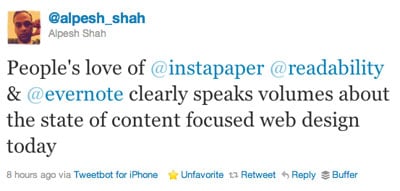
I see the sentiment echoed everywhere, including tweets like this one by Alpesh Shah:

alpesh.jpg

Just to be clear about what we’re talking about, here are a few examples that illustrate why there is such a growing frustration with reading on the web.

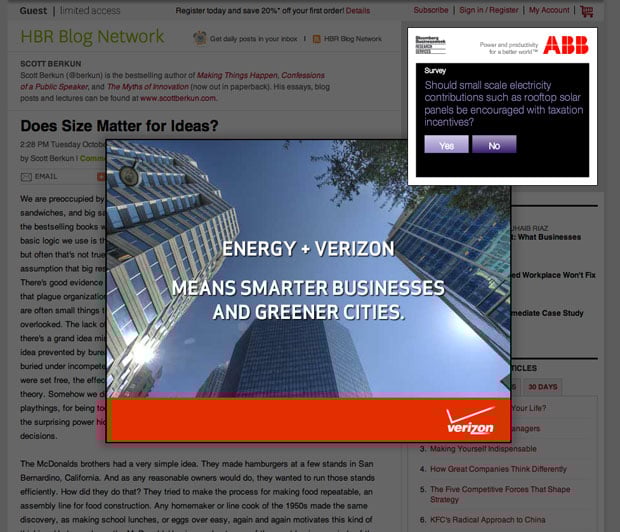
First, here is an article on Harvard Business Review that not only blocks me from reading anything until I click to dismiss the ad, it also messes with the other ads on the page:

HBR.jpg

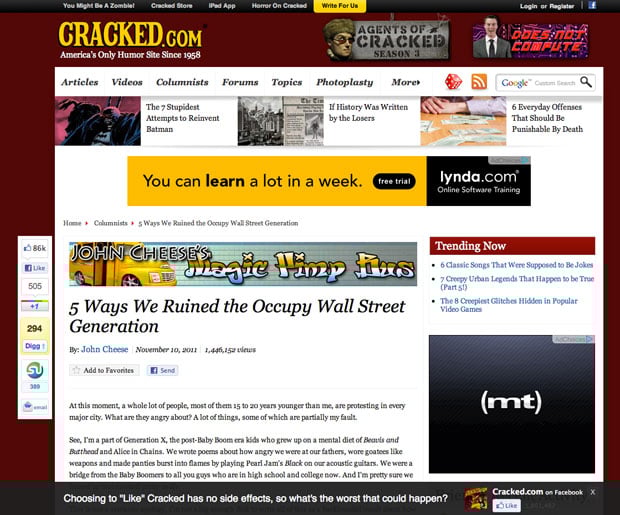
Here’s a story from Cracked.com, where in my unscientific estimation about 15% of the page above the fold is devoted to the actual text of the article:

cracked.jpg

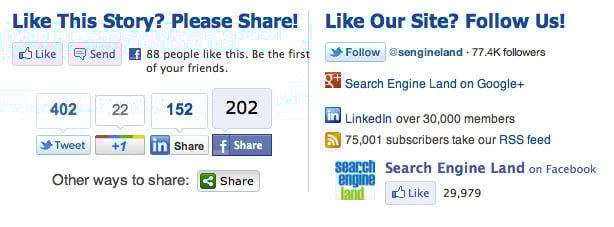
And finally, an example from Search Engine Land that illustrates the following sentiment in Brent’s article:

They’re filled with ads and social-media sharing buttons ”” and more ads. And Google plus-onesies and Facebook likeys. And also more ads. Plus tweet-this-es. Plus ads. (And, under-the-hood, a whole cruise-ship-full of analytics. The page required well-more than 100 http calls.)

sel.jpg

Is this the future of reading on the web? I sincerely hope not. I keep reminding myself of these words by Jeffery Zeldman:

Most of all, I worry about web users. Because, after ten-plus years of commercial web development, they still have a tough time finding what they’re looking for, and they still wonder why it’s so damned unpleasant to read text on the web ”” which is what most of them do when they’re online.

The scary thing is that Zeldman wrote that in 1999 (he revised the post slightly in 2005). And many years later the experience of reading text on the web seems to be getting worse, not better. As I wrote in The demise of quality content on the web, I’m worried that the wells of attention are being drilled to depletion by linkbait headlines, ad-infested pages, “jumps” and random pagination, and content that is engineered to be “consumed” in 1 minute or less of quick scanning ”“ just enough time to capture those almighty eyeballs.

As advertising clickthrough rates continue to drop, the ads become more desperate and invasive, and readers are starting to notice and do something about it. I’m doing the majority of my reading in RSS and Instapaper where I can read in peace without being pummeled by distractions.

The thing is, there are better ways to make money from writing - ways that are more respectful of readers. Ad networks like The Deck come to mind, as well as the growing number of sites that offer memberships (like The Loop and Daring Fireball).

It’s time for publishers to think different.

Solving information overload: the role of manual content curation

There’s an information overload just on articles about information overload, so you might be reluctant to spend time reading another one. However, Accessibility vs. access: How the rhetoric of “rare” is changing in the age of information abundance by Maria Popova is the best commentary I’ve seen on the topic in a long time.

The article starts off by explaining the root cause for the problem we find ourselves in: the concept of “rare” largely goes away if all information is available digitally:

W’re in the habit of associating value with scarcity, but the digital world unlinks them. You can be the sole owner of a Jackson Pollock or a Blue Mauritius but not of a piece of information ”” not for long, anyway. Nor is obscurity a virtue. A hidden parchment page enters the light when it molts into a digital simulacrum. It was never the parchment that mattered.

The consequence is that it’s now so much harder to know what pieces of information are worth our time. Just because something is accessible doesn’t mean we should access it. Maria goes on to explain why editors (or content curators) are so crucial if we want to solve this problem:

The primary purpose of an editor [is] to extend the horizon of what people are interested in and what people know. Giving people what they think they want is easy, but it’s also not very satisfying: the same stuff, over and over again. Great editors are like great matchmakers: they introduce people to whole new ways of thinking, and they fall in love.

Information curators are that necessary cross-pollinator between accessibility and access, between availability and actionability, guiding people to smart, interesting, culturally relevant content that “rots away” in some digital archive, just like its analog versions used to in basement of some library or museum or university.

I do want to add a thought on the idea of “automated curation” - what sites like paper.li are trying to do (you know, those tweets proclaiming that “The [clever name] Daily is Out!”). I simply don’t think effective automated curation will ever be possible. I agree with Angie King on paper.li:

My experience with Paper.li just proves the importance of curation over aggregation. Without an editorial eye overseeing the publication of my Paper.li page, the content loses value. I actually prefer just paging through my Twitter stream over trying to make sense of the no-context, automatically generated list of junk that displays on my Paper.li page.

In a great piece called The language of data: fear + words, Randall Snare explains why automated curation is so difficult:

Emails ”“ and other written things ”“ aren’t just filled with semantic meaning, but with subtext. Algorithms treat words like the basic components of language, while the actual basic components are often hidden ”“ elements like association, nuance, emotion and humour.

Which brings us back to the need for humans - call them editors, call them people who read a lot, call them whatever you want - to help guide us to the information that might interest us. I’d go so far as to say that our ability to grow and learn depends on it.

The demise of quality content on the web

I remember exactly when I decided to stop reading Mashable. I saw the headline Facebook Users Beware: Facebook’s New Feature Could Embarrass You on Twitter, clicked through, hunted for the words of the article among the sea of ads and social sharing icons, and then closed the tab after realizing it’s just another rehash of Facebook frictionless sharing (albeit in a tantalizing way). I went back to my Twitter feed and unfollowed them.

I’m sure the article was great for traffic, though. It is the perfect linkbait title backed up by a perfect SEO-ified URL (/new-facebook-feature). Here’s a screen shot of what’s visible above the fold:

mashable-fold.jpg

You can’t see a single word from the actual article without scrolling. It reminded me of a comment that Merlin Mann recently made in his typically funny and obnoxious style:

merlin-mann.jpg

I think I’ve finally hit the limit of my tolerance for web content that’s designed to make advertisers happy. I have no problem with working hard to build an audience - I have a blog, after all. But we seem to be in this bizarre race to the intellectual bottom to write the most generic article in the world so that everyone with an Internet connection will click through. And the only purpose seems to be to keep the advertising monster fed, fat, and happy.

I’m worried that all the noise makes it increasingly difficult for quality content[1] to be seen. Worse, I’m worried that it’s discouraging the creation of quality content because what’s successful (i.e. what gets the most clicks) is mostly lowest-common-denominator blog post titles that either start with a number or end with a question mark. James Bridle sums up this problem so well in The New Value of Text:

Like over-stuffed attendees at a dull banquet, the mind wanders. We are terrified that people are dumbing down, and so we provide them with ever dumber entertainment. We sell them ever greater distractions, hoping to dazzle them further.

Or as Marco Arment put it: “Anti-intellectualism is one of my biggest fears for our society.”

Yet despite all the evidence to the contrary there is still a common refrain on the Internet that quality content will always find its way out of the depths of obscurity. Kristina Halvorson recently complained about the fact that computer-generated articles are gaining traction. Joshua Porter responded: “Re: quality content…there is always room at the top.” My response to that was cynical, but borne out of the type of regurgitation you see everywhere:

to-bokardo.jpg

I used to believe that if you write with passion and clarity about a topic you know well (or want to know more about), you will find and build an audience. I believed that maybe, if you’re smart about it, you could find a way for some part of that audience to pay you money to sustain whatever obsession drove you to self-publishing (and to do it without selling your soul in the process). There are certainly examples of that out there (Daring Fireball, Shawn Blanc, Ben Brooks, etc.), but I’m not convinced any more that such an option exists for anyone who works hard and gives it a solid go.

The problem is not that people don’t have enough time, it’s that people don’t have enough attention. Like an oil well there’s only so much there, and once the well runs dry you don’t have a lot of options:

So one effect of Peak Attention is that every human mind has been mined to capacity using attention-oil drilling technologies. To get to Clay Shirky’s hypothetical notion of cognitive surplus, we need Alternative Attention sources.

The wells of attention are being drilled to depletion by linkbait headlines, ad-infested pages, “jumps” and random pagination, and content that is engineered to be “consumed” in 1 minute or less of quick scanning - just enough time to capture those almighty eyeballs[2]. And the reality is that “Alternative Attention sources” simply don’t exist.

I don’t know where we go from here. I just know that I’ve stopped reading sites that cater more for advertisers than for me as a reader. It won’t make much of a difference, but it will hopefully help me sleep better.


  1. Of course, we’re never going to agree on what “quality content” means. It’s one of those “you know it when you see it” things, and everyone’s definition will be different. Still, my personal view is that quality content presents two or more of the following components: (1) new information, (2) interpretation of information, and/or (3) a well considered personal opinion about what the information means.  â†©
  2. Wait, who am I to decide what people should and shouldn’t read? You’re absolutely right, I can’t do that so I should get off my high horse and let people read whatever they want to read. This is an opinion piece.  â†©

Frictionless content sharing and the shifting burden of understanding

Frank Chimero reflecting on Facebook’s advances in “frictionless sharing” of content:

Any physicist knows that it’s impossible to exist in a frictionless universe, and that friction hasn’t been diminished with Facebook’s sharing model so much as transferred the work of making sense of things from the one sharing to the audience.

I recently mentioned that reducing the effort needed to share and communicate with others might be inching us closer to a post-literate society. Frank’s remark adds another consideration: the reduced effort required to share information places the burden of understanding much more on the audience than on the person sharing.

“Frictionless” sharing of what song you are currently listening to sounds interesting at first, and then it just starts to sound creepy. But even if you can get beyond the creepiness factor you’re faced with the fact that it becomes the audience’s responsibility to make sense of that information. How interesting is knowing what song I’m listening to without an explanation why I’m listening to it and what it means to me?

At what point will all this lazy sharing result in lazy audiences who can’t be bothered to go hunting for the meaning in the information? At what point does the audience become mere “consumers” of content in the true sense of the word - “to destroy or expend by use” - and end up in a similar situation as the obese passengers on the Axiom?

Facebook Open Graph and the post-literate society

Here’s Mashable in an article with a title that sounds like it was created in a random buzzword generator: Facebook Open Graph Seeks to Deliver Real-Time Serendipity:

Facebook felt constrained by the Like button because it was an implicit endorsement of content. Facebook wants users to share everything they are doing, whether it’s watching a show or hiking a trail, so it decided to create a way to “express lightweight activity.”

So in essence they’re saying that clicking the Like button is too much of a commitment; the action is too heavy. We need something a little more indifferent and “lightweight”.

With the Like button you already didn’t have to use words. With Facebook Open Graph you grant permission to an app once, and then it silently and passively starts broadcasting what you’re doing. No thinking required.

By continuing to reduce the effort needed to share and communicate with others we seem to inch ever closer to a post-literate society.  In his essay Like, the Post-Literate Society, James Shelly discusses this phenomenon and quotes Bruce W. Power:

What happens to thinking, resistance, and dissent when the ground becomes wordless?

He goes on to say this:

Thus I ponder: do we become a post-literate society at the moment we manifest an incapacity to discuss our own potential status as such? If so, are we already there?

These are good questions on a day like today.

The inventions that prevent information from vanishing

James Gleick provides a very interesting excerpt from his book The Information in the article How Information Became a Thing, and All Things Became Information. In the excerpt he discusses the inventions that allow us to record and preserve information (like the transistor and the “bit” as unit of measure), and how this fundamentally changed society:

The information produced and consumed by humankind used to vanish””that was the norm, the default. The sights, the sounds, the songs, the spoken word just melted away. Marks on stone, parchment, and paper were the special case. It did not occur to Sophocles’[1] audiences that it would be sad for his plays to be lost; they enjoyed the show[2].

Now expectations have inverted. Everything may be recorded and preserved, at least potentially: every musical performance; every crime in a shop, elevator, or city street; every volcano or tsunami on the remotest shore; every card played or piece moved in an online game; every rugby scrum and cricket match.

It looks like a great book. James, if you’re out there, when will the Kindle edition be available?


  1. The Wikipedia entry on Sophocles is fascinating.↩
  2. Speaking of enjoying the show↩