Menu

Posts tagged “writing”

A few thoughts on the Elezea redesign

Earlier today a new design for Elezea went live. This is about the 5th or 6th redesign since I started the site, but it’s the first one that I think deserves a moment to stop and reflect a bit. With this redesign, I feel like the site finally grew up to become what it always wanted to be. I try to stay away from meta posts because I understand they’re mostly interesting to me, and no one else, but I trust you’ll forgive me for doing it just this once.

I had two major goals with this redesign:

  • To have a design that’s completely focused on the reading experience.
  • To improve site speed and performance dramatically.

With these two goals in mind, I asked my friend Alex Maughan to help me with designing and building a custom WordPress theme to accomplish these goals. He did an absolutely stellar job, and I can’t thank him enough. This design makes me happy. Thank you, Alex.

But let’s talk a little bit about each goal.

A design focused on reading

There is one single thought that became the driving force for what I wanted to accomplish with this design, and that’s Jeffrey Zeldman’s quote from 1999 (I’m afraid the original post doesn’t exist on Adobe’s site any more, so I’ll have to link to Zeldman’s discussion of it):

Most of all, I worry about web users. Because, after ten-plus years of commercial web development, they still have a tough time finding what they’re looking for, and they still wonder why it’s so damned unpleasant to read text on the web — which is what most of them do when they’re online.

I discussed this issue in detail in an earlier post called Please let this not be the future of reading on the web, so I won’t rehash everything again here, except to say - yes, it’s damned unpleasant to read text on the web.

And yet, that’s (finally) changing as more and more sites strip away all the fluff - and make their sites responsive. Speaking of Zeldman, his own site is a very interesting experiment to try to rectify this issue. Other sites that are doing a great job at providing good reading experiences include Contents Magazine, the iA blog, and Marco Arment’s blog. So I wanted a site that provides an enjoyable reading experience, regardless of device or situation. With that in mind, here are some of the reasons behind the design decisions we made:

  • A header that explains what the site is about (set the context), then gets out of the way once you start reading.
  • A typeface that’s elegant and focused on readability - we decided to go with Adobe Garamond Pro. (Yes, Typography Is The Foundation Of Web Design)
  • A color scheme that not only fits the logo, but also feels similar to the calming Sepia schemes that many reading apps (like Amazon Kindle and Instapaper) provide natively.
  • A sidebar that sits off to the right - not in your face, but there if you need it - and is focused on what I consider the main calls to action on the site: subscribing to article updates. Everything else is secondary, as it should be.
  • My favorite feature: a responsive design that scales down well to small screens, to ensure a consistently pleasant reading experience on all devices. No matter how prevalent responsive design becomes, I think I’ll always see it as a kind of magic.
  • And finally, there’s an appropriate space for one of the well-designed ads from the User Experience Ad Pack. These ads are not only relevant to the stuff I write about, it also covers my hosting costs. I recently switched to the more expensive (but much more reliable) mediatemple, and I’m very happy so far.

The end result is, I hope, a site that’s focused on words, ideas, and readers. As it should be.

Improved performance

In a recent post I said the following:

I often wish I could move all my link-sharing off Twitter and onto this site, but I know that’s not really possible, because the readership isn’t quite there yet. But I much prefer not just tweeting a link, but also adding some thoughts, or even just trying to set the context so people can decide if it’s a link they would be interested in, or not.

I mentioned this to Alex, and said that if we can get the site to be extremely fast, I might be able to start moving all my link sharing here. He saw that as a challenge, and went to work… So what we have now is the following:

  • The site is now only a fraction of the size it used to be. It should also have faster server response times from a PHP processing and DB query point of view, as there is much less server side processing required to generate the site.
  • W3 Total Cache handles all the site’s caching.
  • I use Amazon Cloudfront as CDN.
  • I also run CloudFlare on top of everything, and I’m really happy with that service so far.

Ok, I think I’ve rambled on long enough. The TL;DR of this whole post is this. I’m really excited about this design, I hope you like it, and thank you Alex!
The virtues of short emails and long conversations

Eric Spiegelman writes about the virtue of brevity in email:

Long emails are, more frequently than not, the worst. When you send someone an email, you make a demand on their time. If you use more words than necessary, you waste their time. Sure w’re talking maybe a fraction of a minute, but given the number of emails the average person sends in a day those fractions add up pretty quick.

This makes intuitive sense, and anyone who gets a lot of email would agree. I’ve even tried to adhere to the Five Sentences philosophy for a while — with not much success.

But there’s something in me that wants to resist this move to get rid of all the “fluff” in email. Sure, it makes you less productive if you have to read through a bunch of stuff that’s not relevant — but I wonder if there’s a danger that the way we talk in email will spill over to the way we talk to our friends and family. Just like “LOL” jumped from text messaging and IM to enter our vernacular in all kinds of weird forms like “For the lulz”1.

Patrick Rhone recently wrote an article called Twalden (it’s worth reading just to discover why he chose that title), where he discusses why he’s taking a break from Twitter:

Ultimately, I don’t know if what Twitter has become is for me, or the people I care about, or the conversations I wish to have. The things I want to know are “happening” — like good news about a friend’s success, or bad news about their relationship, or even just the fact they are eating a sandwich and the conversation around such — I wish to have at length and without distraction. Such conversations remain best when done directly, and there are plenty of existing and better communication methods for that.

The phrase at length and without distraction really stuck with me. When’s the last time you had a discussion at length and without distraction? It seems to become rarer and rarer these days. I’m not trying to draw a causation effect between short, get-to-the-point emails and the general distractedness of our everyday conversations. I’m just saying that it’s probably ok to say “Hi!” and “Thank you” in emails every once in a while, because it’s nice to be nice.


  1. Ok, maybe I just hang out with really weird people. 

Design wants more from us than just solving problems

Matthew Butterick recently did a TYPO Talk in Berlin that completely blew me away. In Reversing the Tide of Declining Expectations he discusses how we have come to expect way too little from design, with the consequence that most design on the web is complete crap:

And that’s really what I mean tonight by declining expectations. This idea of what happens when we defer to technology, instead of standing on its shoulders. What happens when we choose convenience over quality. Eventually, w’re going to forget what quality was like.

One of the most interesting parts in Matthew’s talk is where he challenges the conventional wisdom that design is about solving problems. He believes that “solving problems is the lowest form of design” — here’s why:

Because what does design want from us, as designers? Does it only want a solved problem? I think it wants more. I think it wants us to take these items that are sort of mundane or boring on their own—like an annual report, or a website shopping cart, or a business card—and it wants us to fill them up. Fill them with ideas, and emotions, and humor, and warmth. Really everything that’s in our hearts and minds. Design wants us to invest these items with our humanity. And the problem that we’re solving—that’s really just the context where that happens.

I don’t want to quote from the talk too much, because you really have to experience the whole thing — it is such a great reminder to have the courage to create better things.

You can watch the video or read the transcript.

(transcript link via @jbrewer)

The value of experiences "around the edges of Twitter"

Andre Torrez wrote a great piece about how his online habits are starting to change. From We met on the Internet:

I’ve been posting about this a bit, but I think my time off pushed me even further along to where I was going. I won’t say “off Twitter”, but I feel like focusing more on things around the edges of Twitter.

And maybe I am just looking for examples””seeing patterns where there are none””but a few things have appeared that makes me feel like other people are feeling the same way.

He goes on to cite some examples of this pattern — Mike Monteiro’s Evening Edition, Dave Pell’s excellent NextDraft, and Dustin Curtis’s Svbtle network.

I’ve also recently found myself yearning for these kinds of off-Twitter experiences that are more substantial, without closing the door on Twitter completely. Now I finally have a phrase for that, thanks to Andre: they’re things around the edges of Twitter.

I often wish I could move all my link-sharing off Twitter and onto this site, but I know that’s not really possible, because the readership isn’t quite there yet. But I much prefer not just tweeting a link, but also adding some thoughts, or even just trying to set the context so people can decide if it’s a link they would be interested in, or not. That’s an “around the edges” experience, since Twitter would still remain central to my workflow, but it wouldn’t be the main activity. Maybe one day I’ll get to do that.

Anyway, that’s quite a tangent. Please read Andre’s excellent post, and think about what that means for you. Does Twitter still add the value to your day that it used to? Bitly did some research recently and found that the average half-life of a link on Twitter is 2.8 hours. After that, it’s pretty much lost forever. Is that ok with you, or are you also starting to cherish the slower, more deliberate communities where you’re allowed to pause and take a breath before moving on to the next thing?

(link via @Mike_FTW)

Typography, invisible design, and windows to words

In 1955 Beatrice Warde wrote an essay on typography, book publishing, and advertising called The Crystal Goblet, or Printing Should Be Invisible. It is one of the best descriptions of the concept of invisible design I’ve ever read. I pretty much want to quote the whole thing, but I’ll stick with this gorgeous paragraph, and let you click through for the rest:

The book typographer has the job of erecting a window between the reader inside the room and that landscape which is the author’s words. He may put up a stained-glass window of marvelous beauty, but a failure as a window; that is, he may use some rich superb type like text gothic that is something to be looked at, not through. Or he may work in what I call transparent or invisible typography. I have a book at home, of which I have no visual recollection whatever as far as its typography goes; when I think of it, all I see is the Three Musketeers and their comrades swaggering up and down the streets of Paris. The third type of window is one in which the glass is broken into relatively small leaded panes; and this corresponds to what is called “˜fine printing’ today, in that you are at least conscious that there is a window there, and that someone has enjoyed building it. That is not objectionable, because of a very important fact which has to do with the psychology of the subconscious mind. That is that the mental eye focuses through type and not upon it. The type which, through any arbitrary warping of design or excess of “˜colour’, gets in the way of the mental picture to be conveyed, is a bad type. Our subconsciousness is always afraid of blunders (which illogical setting, tight spacing and too-wide unleaded lines can trick us into), of boredom, and of officiousness. The running headline that keeps shouting at us, the line that looks like one long word, the capitals jammed together without hair-spaces — these mean subconscious squinting and loss of mental focus.

(link via Retinart)

More on coffee houses and creativity

I got an interesting email from Surat Lozowick about my post on coffee houses and creativity. He pointed me to a piece he wrote called Working at the coffee shop: the right environment and the right distractions — a very interesting post that concludes with a great perspective on the issue:

Creativity does not exist in a vacuum; experiences, conversations, reading, writing, the constraints of time and the distractions of life are just as important as quiet moments of focus. And conveniently, the coffee shop is there to provide them.

He also links to Conor Friedersdorf’s Working Best at Coffee Shops, in which Conor presents four possible theories to answer the question, “Why are many telecommuters most efficient in noisy public places with lots of distractions?” It’s worth a read not just for his theories, but also for this goose bump-inducing Ernest Hemingway quote:

It was a pleasant cafe, warm and clean and friendly, and I hung up my old water-proof on the coat rack to dry and put my worn and weathered felt hat on the rack above the bench and ordered a cafe au lait. The waiter brought it and I took out a notebook from the pocket of the coat and a pencil and started to write.

It annoys and inspires me in equal parts when I see language like that — simple and elegant, yet dripping with meaning and emotion. So jealous.

A guide to good RSS feed citizenship for blog publishers

I do most of my online reading through RSS, and I don’t think I’m alone. For the most part this is a good reading experience, but there are a few things publishers can do to make it even better. So if you publish a blog, here are three proposed guidelines for RSS feeds:

  1. Have an RSS feed and make it easy to subscribe. Contrary to popular belief, Twitter did not kill RSS. It’s alive and well. So please don’t bury or hide the feed — it should be easy to find the link and subscribe. Also, do some work on your feed - use a service like Feedburner to customize it (and give you analytics on your subscribers).

  2. Unless it’s central to your revenue model, don’t provide article excerpts only. I understand that there are subscription sites that require payment to get access to full RSS feeds — that’s a conscious business decision, so if it works, great! But for the rest of us, RSS excerpts are a bad idea. It places the burden on anyone following your shared items to click through to see the article, and that slows people down. As a general rule (with the above stated exception), please provide a full feed - you’ll grow your audience and eventually get those click-throughs because of it.

  3. Remove the metadata from your feed URLs. If I do click through to an article to comment, share it on Twitter, etc., a URL like this looks bad and makes sharing harder to track: http://uxmag.com/design/debating-the-fundamentals?utm\_source=feedburner&utm\_medium=feed&utm\_campaign=Feed%3A+UXM
    +%28UX+Magazine%29.

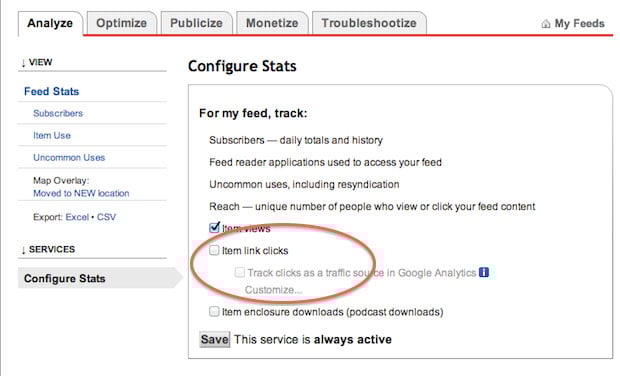
    The stuff after the ”?” is added by Feedburner so you can get detailed analytics on item link clicks. But unless you really want to see where your RSS feed clicks come from you don’t need this level of detail. All you need to know is the number of Item Views in your feed — the rest of your analytics can come from Google Analytics. It’s very easy to turn this tracking off to remove the metadata and make your URLs more friendly. In Feedburner, go to “Configure Stats” and uncheck the “Item link clicks” box. Here’s a screen shot:

feedburner URLs

In Luke Wroblewski’s new project Future Friendly, they discuss their thinking around universal content:

Well-structured content is now an essential part of art direction. Consider how it can flow into a variety of containers by being mindful of their constraints and capabilities. Be bold and explore new possibilities but know the future is likely to head in many directions.

If you publish content on the web it’s not future friendly to ignore and/or limit its use in RSS, which is one of the most important containers we have at our disposal.

The popular news is not the best news

Scott Berkun in The idiot theory of news:

Non-news, news without context, is easy to generate. It takes less skill as a journalist to write these stories. Often these stories are more popular than better written stories about important things. The popular news is not the best news. The popular anything is rarely the best anything. The way we see the world is shaped by what sells best as news, rather than what will give us a realistic perspective on the world and our place in it.

(link via @iamFinch)

Data-driven book publishing and the possible decline of risky writing

The Wall Street Journal has an interesting piece on the data mining of e-book reading habits. In Your E-Book Is Reading You they discuss, for example, what Barnes & Noble has learned from Nook data:

Barnes & Noble has determined, through analyzing Nook data, that nonfiction books tend to be read in fits and starts, while novels are generally read straight through, and that nonfiction books, particularly long ones, tend to get dropped earlier. Science-fiction, romance and crime-fiction fans often read more books more quickly than readers of literary fiction do, and finish most of the books they start. Readers of literary fiction quit books more often and tend skip around between books.

The article goes on to discuss how publishers are now using this kind of data to guide everything from the subject matter to the length of future publications. The whole thing makes me a little uncomfortable — I think I agree with Mr. Galassi here:

Others worry that a data-driven approach could hinder the kinds of creative risks that produce great literature. “The thing about a book is that it can be eccentric, it can be the length it needs to be, and that is something the reader shouldn’t have anything to do with,” says Jonathan Galassi, president and publisher of Farrar, Straus & Giroux. “We’re not going to shorten ‘War and Peace’ because someone didn’t finish it.”

I realize there is a hint of hypocrisy in my feelings about data-driven book publishing. As a practitioner of user-centered design I am a big proponent of data-driven decisions (this presentation by Joshua Porter is a constant companion). But this feels different. I guess I’m worried that publishing books with the explicit purpose of satisfying some imaginary, averaged-out reader drone will pull us all towards a safe middle ground where no risk is allowed.

In my version of a nightmare scenario, my 2-year old daughter will be awash in Dora the Explorer books with no access to dangerous, crazy stories like Oh, The Places You’ll Go or Where The Wild Things Are. I don’t think a data-driven approach to publishing would have let those books see the light, and that would have been a tragedy.

Here’s to writers who take risks.

Designing for readability

Bryan Larrick critiques the new Kindle app for iPad in Improved Reading Experience? No. I particularly like his points on how design impacts readability:

It’s hard to overstate the importance of healthy margins and whitespace in good design. [”¦] The words are the most important aspect of a book. That’s intuitive. But, presentation is very important. Having ample margins helps the eye flow over the text and makes it easier to move from one line to the next while reading. Making the margins smaller in the app hinders the ease with which the eye can move over the page, making the book harder to read, not easier. Also, it’s just ugly.

So obvious, yet so often ignored on web sites and in apps.