Menu

Posts tagged “writing”

Why Twitter's restrictions won't usher in a resurgence in blogging

Daniel Jalkut1 tweeted a very interesting response to the news that Twitter has revoked Tumblr’s friend-finding privileges:

All this rage against Twitter will ultimately bolster blogging: the distributed, DNS-backed social network Twitter was allegedly displacing.

— Daniel Jalkut (@danielpunkass) August 23, 2012

I would love nothing more than for more people to write on their own domains. I’m fully on board with the “own your data” movement, and I’m obviously a fan of blogging in general. The problem is that Twitter and traditional blogging are at complete opposite ends of what I’ll call the “publishing barrier” spectrum.

The web is a battlefield of dead blogs. So many people start one up with the best of intentions, only to realize that “If you build it, they will come” does not apply at all. Once they figure out that it’s exceptionally hard work to post frequently and build an audience, since nobody wants to read your sh*t, they abandon their efforts.

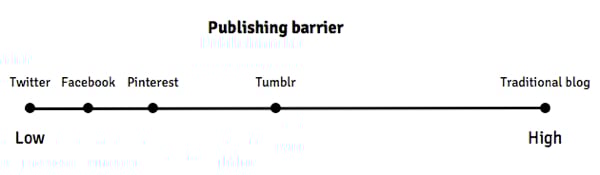
And where do they go? Twitter. Facebook. Pinterest. Tumblr. Where there is no pressure to write coherent paragraphs and then convince people that they should try to remember a URL they can’t pronounce2. The expectations for content on these sites are low, so the barrier to publishing is all but removed. Here’s how I’d plot some different publishing platforms on the spectrum:

Publishing barrier scale

We could probably argue about where to put the dots, but the basic point remains the same. The reason we won’t suddenly see a mass resurgence of “distributed, DNS-backed” blogging is that people are lazy, and we’re all looking for the path of least resistance that will make us feel like “content creators”. If Twitter does end up losing its way, we’ll find somewhere else to fill that need. We are, after all, becoming a post-literate society.


  1. The owner of MarsEdit, which I’m using to write this post (meta!) 

  2. Yes, I know. I chose badly. Too late now… 

The morning email is my enemy

Letters of Note continues to be a source of endless delight. Monday’s letter is another great example. In The morning mail is my enemy, E.B. White describes with painstaking clarity how distractions ruin our ability to be creative. It was written in 1961, but replacing “mail” with “email” makes it feel like it was written yesterday:

So in the long run, although I’m not immune to praise and to friendliness, I get impatient with the morning mail, because it is, in a sense, my enemy—the thing that stands between me and a final burst of creative effort. (I’m sixty-one and working against time.)

The lightweight, non-intrusive ways of Twitter

Kyle Baxter discusses what makes Twitter great in Twitter, Utility:

[W]ith over a hundred million people on it, you can quickly find almost anyone you’re interested in, listen to them, and communicate with them, all in a very lightweight, non-intrusive way. That’s incredibly powerful, especially because what it does is allow communities to form that are incredibly intimate but also very open to others.

The whole article is great, so I encourage you to read the whole thing. I find the phrase “lightweight, non-intrusive” particularly interesting. I’m probably really late on this insight, but the core of that truth only recently struck me.

Twitter is lightweight in the sense that there is very little commitment required to write 140 characters and click the “Tweet” button. The character limit also means that you don’t feel pressured to write more (which is a complaint you hear about blogging quite a bit). And it’s non-intrusive in that you can follow/unfollow anyone, and the rules of engagement are such that whoever you talk to has very little obligation to talk back.

Daring Fireball, App.net, and admitting who our heroes are

It’s not fashionable any more to have heroes. In fact, I’m scared to admit that I like anything, because I just never know if maybe, for some reason, we’re supposed to complain about that thing instead. Look at the response to App.net, for example. Much of it has been positive, but there is also an awful lot of snark and sarcasm out there — much of it from people I like and admire. So I’ve resisted the urge to confess that I backed the project, and that I like the Alpha product so far.

It’s become really hard to know what we’re allowed to like online.


I don’t remember exactly when I started to read John Gruber’s Daring Fireball, but I do remember that it had an immediate and profound effect on my view of online publishing. His efficiency with words gave me an appreciation for what web writing could be, and I started to dissect every post to try to learn as much as I could. Gruber and Merlin Mann did a talk about blogging at SXSW 2009 where they discussed the idea of Obsession times Voice:

Topic times voice. Or, if you’re a little bit more of a maverick, obsession times voice. So what does that mean? I think all of the best nonfiction that has ever been made comes from the result of someone who can’t stop thinking about a certain topic — a very specific aspect of a certain topic in some cases. And second, they got really good at figuring out what they had to say about it.

That talk — along with Gruber’s site — got me thinking: I wonder if I could do something like that? I have so many Obsessions. Could I maybe find a hidden Voice somewhere in those obsessions? It’s after hearing that talk that I decided to start taking this site more seriously. And even though Daring Fireball probably gets the equivalent of my monthly traffic in about an hour, this has still been one of the most rewarding experiences of my life. It has opened so many doors and enabled me to meet some wonderful people.


Why is it that we reach for the comforts of collective cynicism whenever someone who is not in our inner circle of coolness tries to do something new or different? In the case of App.net, someone just raised more than $500,000 from end users to build a product that’s trying to compete with Twitter. Why can’t we just, for a few moments, look past everything that might be wrong with the idea, and appreciate what an enormous accomplishment that is?

You don’t have to like Dalton Caldwell or App.net. You don’t even have to be quiet about not liking them. Really — it’s ok to not like things. But don’t be a dick about it.


Gruber linked to me once on Daring Fireball. Hey, so what if I printed out his post and framed it? I still remember opening my RSS reader on the morning of Thanksgiving 2011, and falling out of bed when I saw my name on Daring Fireball. I was floating on air for weeks. It wasn’t about the traffic — it was Thanksgiving so there was pretty much no one online. The reason I was so happy is that John Gruber — someone I decided I want to impress with my writing — noticed something I wrote, and put it on his site. Since I really want to make this thing work long term, that was the biggest encouragement I could have received.

I took the opportunity to write to John to thank him not just for the link, but for the impact he has on my writing. Here’s one part of what I said:

I appreciate and learn so much from your approach to writing — you’re authentic and to the point, which is in such contrast to much of the web. Thank you for showing so many of us aspiring writers that we don’t have to sell our souls to have an audience.

He emailed back:

Great note. Thanks!

—J.G.

The response couldn’t have been more Gruber. Even in a short email, a regular dash just isn’t good enough. It’s em dashes all the way for the guy whose Obsession times Voice is about the quest for perfection in everything we do.


I know it’s not fashionable any more to have heroes. But this week App.net got funded, and Daring Fireball turned 10 years old. So roll your eyes if you must, but I’m just going to say it.

I backed App.net, and John Gruber is one of my heroes.
To those who love the web

There are many kinds of people trying to make a living online. There are those who love retail and want to use the Internet to find efficiencies in merchandising and supply chain management. There are those who love the preciseness of search algorithms and want to do everything they can to figure out how to level up in that game. There are those who see the potential of selling “eyeballs” to advertisers and are desperately trying to grab enough of our attention to make that work.

Those are all perfectly fine ways to spend your days. But it’s not what drives me.

Then there are those who love the web. They understand that it’s people all the way down. That the real value of the things we make is in the shared experiences we get to have. They are passionate, critical, creative, opinionated, and cynical. Sometimes arrogant and not nice — but never apathetic. Never lazy enough to let something they care about get away with being less than great.

Those are the people I stand with.

We believe that the quality of what we put out there reflects on all of us. Flipboard and Clear make us all look good. Color makes us look like idiots, and we can’t stand it. When our own work doesn’t live up to our standards of quality for whatever reason, we lose sleep over it. We can’t shut up when we see the Internet being used as a game to be won, an endless well of content to “repurpose” for a quick ad buck, a way to trick people into clicking a link they don’t want to click on. It makes us obnoxious, yes, but we can’t just stand there and do nothing. For we will not have that sh*t. We will not have it.

To those who make a living online because they love the web: I stand with you.

Small and boring ideas

If you secretly enjoy snarky writing as much as I do, you should read Paul Constant’s post called Yesterday, I Went to the American Idol for Startups. It Made Me Want to Die. It’s a scathing and funny rant about lazy, unimaginative use of language in business, and yet he ends with quite a poignant remark:

You can do anything you want with an idea. It can be as big as you want. It doesn’t have to solve a minor problem that nobody ever really realized was a problem. It doesn’t have to fit into something the size of a button crammed into a “folder” the size of a button on a screen the size of a playing card. But everywhere I look, I see tiny little ideas, ideas that are almost petty in their inconsequentiality. And I come back to those cliches, and I think the real problem is in how little thought goes into the language these people use. When the language you employ to communicate your ideas is small and boring, your ideas are going to be small and boring. And when all your ideas are small and boring, your future gets dimmer and dimmer and more claustrophobic until it’s finally just a pinpoint of light on a dark screen, in danger of going out at any time.

Meaningful writing

Dmitry Fadeyev reflects on the purpose of writing in Give Sight:

Meaningful writing has a purpose beyond that of simple entertainment or of generating conversation. Its purpose is to improve society, to improve our life, by teaching us certain truths that the author has learned. John Ruskin puts it well in his essay on books, Of Kings’ Treasuries, by saying that good books give us sight. By teaching us what to look for, and the value of those things, we learn to tell apart the good from the bad, to pass better judgements using our sharpened vision. We grow and become wiser. And that is the only sort of writing that ever improves us as people because all the rest, information and entertainment, it just passes by and leaves us in the same state that we are when we first come into contact with it.

I completely agree with this viewpoint, and that results in a constant struggle as I try to weigh the demands of long-form writing with the demands of, you know, having a day job. The compromise that many of us in this situation goes for, to keep the much-needed momentum of writing going (what Alex Charchar calls “act the pro”), is to share links and quick thoughts, interspersed with some long-form writing when inspiration and a brief excess of time collide.

I’m particularly self-conscious about the dangers of this approach after reading Marcelo Somers’s piece The Linkblog Cancer:

Our job as independent writers isn’t to be first or even to get the most pageviews. It’s to answer the question of “so what?”. Taken as a whole, our sites should tell a unique story that no one else can, with storylines that develop over time that help bring order to the chaos of what we cover.

That’s what I want to happen here, but I know I often fall short. I’ll keep doing it though, because I have hope that, taken as a whole, there is a thread running through the links I post and the essays I write, and that when I look back at it in a few years, that thread will spark some new and interesting ideas. We’ll see.

We can learn a great deal from children's books

I usually avoid articles called “What [X] can teach us about [Y]”, but despite myself I really enjoyed Maria Konnikova’s What Grown-Ups Can Learn From Kids’ Books. It’s a thoughtful essay that gets to the core of The Little Prince, Alice in Wonderland, and Winnie-the-Pooh:

“When you wake up in the morning, Pooh,” Piglet asks him as their adventures near an end, “what’s the first thing you say to yourself?”

“What’s for breakfast?” Pooh answers. “What do you say, Piglet?”

“I say, I wonder what’s going to happen exciting today?” responds Piglet.

Pooh thinks it over. “It’s the same thing,” he says. And as adults, we can at last appreciate just how right he is.

If I were to write an article like this, I would add two books to the list. First, I would mention how Where The Wild Things Are taught me that being king of whatever you’re doing isn’t what life is about:

And Max the king of all the wild things was lonely and wanted to be where someone loved him best of all. Then all around from far away across the world he smelled good things to eat so he gave up being king of where the wild things are.

And then I’d talk about Oh, The Places You’ll Go!, and how it probably contains some of the best advice on life and business that you’ll ever read:

And when things start to happen, don’t worry. Don’t stew. Just go right along. You’ll start happening too.

Except when they don’t. Because, sometimes they won’t.

I’m afraid that some times you’ll play lonely games too. Games you can’t win ‘cause you’ll play against you.

But since I didn’t write such an article, you should definitely read Maria’s. It’s really great.

Limiting our own potential (and another essay project to follow)

Just as Alex Charchar’s excellent 31-day Exercise in Short & Quick Essays came to an end, one of my other favorite writers, Dmitry Fadeyev, started his own An Essay a Day project. I love these projects, and I wish I had the guts to do something similar. Here’s an excerpt from one of Dmitri’s first posts in the series, called The Road to Hyperborea:

And even when people do break away and achieve what we thought ourselves impossible, we label them “geniuses” and thus once again create an artificial wall between us and them, drawing ever more constraints over our potential. Nietzsche warned us against this by saying that our impulse to label the most productive of us as “geniuses” — and that is what they are, productive individuals who have built up enough experience and have created enough material from which they can select the very best — relieves us of the pressure to compete with them. The label lifts them above our playing field, separates them from us, so that the benchmarks they’ve created no longer apply to us. It’s a declaration of surrender.

That’s a solid kick in the pants to stop limiting our own potential just because there are so many others out there who are better than us. Dmitri is a fantastic writer, so I highly recommend following his month-long essay journey.

How to change someone's mind on the Internet

Natalie Wolchover asks Why Is Everyone on the Internet So Angry?, and along with the usual anonymity/distance explanations, she makes the following point:

And because comment-section discourses don’t happen in real time, commenters can write lengthy monologues, which tend to entrench them in their extreme viewpoint. “When you’re having a conversation in person, who actually gets to deliver a monologue except people in the movies? Even if you get angry, people are talking back and forth and so eventually you have to calm down and listen so you can have a conversation,” [professor of psychology Art] Markman told Life’s Little Mysteries.

It reminds me of the John Mayer song (sorry!) Belief where he says, “Is there anyone who ever remembers changing their mind from the paint on a sign?” I don’t even know why we think these angry comment-section monologues might change anyone’s mind, but then again, we might not be doing it to convince anyone but ourselves. After all, most angry comments on the web can easily be explained using Paul Ford’s WWIC (“Why Wasn’t I Consulted?”) concept. But I digress.

Right after I read Natalie’s article, I read a post on the 37signals blog called What are questions?, in which Jason Fried paraphrases a discussion he had with Clay Christensen:

Questions are places in your mind where answers fit. If you haven’t asked the question, the answer has nowhere to go. It hits your mind and bounces right off. You have to ask the question – you have to want to know – in order to open up the space for the answer to fit.

If you aren’t curious enough to want to know why, to want to ask questions, then you’re not making the room in your mind for answers. If you stop asking questions, your mind can’t grow.

I think that the main reason why comment-section monologues are so ineffective to change people’s viewpoints, is that it provides answers for questions that no one is asking. Clay is right: if you’re not asking yourself why you believe the things you believe, you’re not going to listen to anyone’s answer telling you that you’re wrong.

Imagine a comment thread where, at the end of every reply, the commenter says something like, “But I might not be right about this… does anyone have any arguments to prove me wrong?” I know what you’re thinking: “LOL, that will never happen.” Of course it won’t. But online discourse would be so different if each of us allowed for the possibility that we might not be right about something. If we made a question-space just big enough for an answer that could change our minds.

We can dream about a such a world, right?