Menu

Posts tagged “technology”

How technology changed the world

Noah Smith’s rumination on how technology has changed the world since he was young really resonated with me:

When I look back on the world I lived in when I was a kid in 1990, it absolutely stuns me how different things are now. The technological changes I’ve already lived through may not have changed what my kitchen looks like, but they have radically altered both my life and the society around me. Almost all of these changes came from information technology — computers, the internet, social media, and smartphones.

He goes through several examples, and comes to this conclusion:

Sometimes technology grows the economy, but more fundamentally, it always weirds the world. By that I mean that technology changes the nature of what humans do and how we live, so that people living decades ago would think our modern lives bizarre, even if we find them perfectly normal.

Like him, when I think about it all and compare it to life in 1990, “I can’t help but feel a little overwhelmed by how far we’ve come.” And yes, I miss some of the things Noah mentions in his post—I have fond memories of “getting lost” with my wife in European cities. But for the most part I am much more in line with Clive Thompson’s thinking in his book Smarter Than You Think: How Technology Is Changing Our Minds for the Better:

Today we have something that works in the same way, but for everyday people: the Internet, which encourages public thinking and resolves multiples on a much larger scale and at a pace more dementedly rapid. It’s now the world’s most powerful engine for putting heads together. Failed networks kill ideas, but successful ones trigger them.

His book is a wonderful perspective on all that we’ve been living through.

Building a music mini-site with data from Last.fm, Discogs, and YouTube

It’s been a little quiet on the blog recently, and the reason for that is either perfectly valid or profoundly unnecessary, depending on your viewpoint. Even I am not entirely sure which one it is.

Over the past couple of weekends (and too many late weeknights) I have used all my spare time to build a mini-site for my obsession with music. It started as a small idea to just show the current track I’m listening to, and a list of recent physical albums I added to my collection. But then it snowballed into something much more. You can view the site at music.elezea.com, or by clicking on the link in the top navigation. If you want to know a bit more about how it works, read on!

It all started when I came across Andy Bell’s mini-site for his music collection. He uses a Notion database and Last.fm to show all the music he has in his collection, and what he’s listening to. Since I also still use Last.fm (yes, it’s still around!), and all my physical music is documented on Discogs, I wanted to build a small site that uses the Last.fm and Discogs APIs to show some of that information.

But once I got started and got stuck into all the information available via those APIs, I just couldn’t stop. I still have so much more I want to do, but I know it’s time to take a break. All in all this has been such a fun and rewarding thing to spend my time on. I know the site has pretty much zero value to the world at large. But I love checking it to get more information about something I’m listening to—and it helped me take quite a few steps forward in my technical skills. So I’m choosing to call it a win.

Below are some notes about what the site does, how it works, and also what the experience was like for me (as a non-developer trying to learn).

Now playing

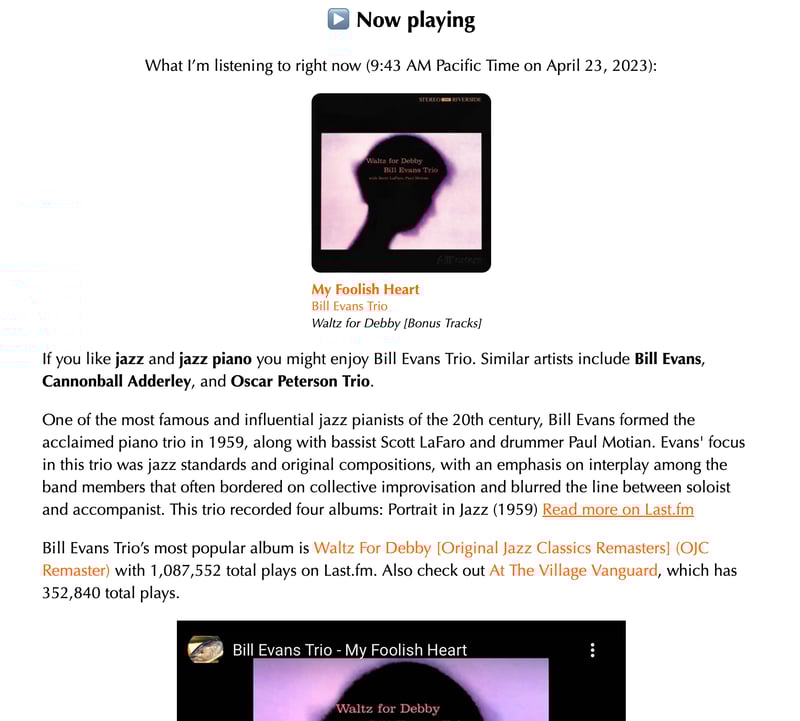
  • Get the most recently played track from the Last.fm API, and check if the song is currently playing or not.
  • If it’s currently playing, show the current time and a message that what you’re seeing is what I’m listening to in real-time.
  • If it’s not currently playing, mention that and show the time it was played.
  • Pull in the cover art and other data about the song from Last.fm.
  • Do a lookup for the artist and if Last.fm has data about them, show the first two tags (genres), first 3 related artists, and their bio.
  • Do another lookup to a different API endpoint for the artist’s top albums, and display data about their two most popular albums.
  • Use the YouTube API to do a lookup for the song, and embed the most relevant result in the page so that you can listen to it right there.

Top albums and artists

  • Show the top albums I listened to in the last 7 days, including play counts.
  • Show the top artists I listened to in the last 7 days, including play counts.
  • Make a separate API call for each artist to get their genres and similar artists, if that data exists on Last.fm.
  • Make another API call to get each artist’s most popular albums.

Recent purchases

  • Pull the last 6 releases I added to my Discogs collection.
  • Also pull in data about the genre, label, and release date.
  • ⏳ The Discogs API is really great, so I want to add a bunch more stuff here, but that’s also for the mythical v2 of this thing.

Random thoughts, complaints, and what’s next

  • The site is deployed with Netlify via a Github repo, and it just works. Netlify is so great.
  • I don’t care what you “real developers” say, the two biggest problems in programming are environmental variables and formatting dates. I am thankful for ChatGPT for helping me with the date formatting piece, and my colleague and friend Derek for helping to get the environmental variables to work.
  • Last.fm’s API clearly hasn’t been touched in years and the documentation isn’t great, so it’s been a bit of a mission to figure all that out. Postman has been a life-saver here to test the API calls and see what data comes back.
  • YouTube’s API has a limit of 100 search lookups per day, which feels ridiculously low. I hit that within an hour while I was building and testing it. Oops! On the upside: I am now much better at error handling. If the site hits that limit it will now show a message to that effect, and link to a direct search on YouTube for the song.
  • ⏳ I’m using YouTube only because the Spotify API makes it incredibly difficult to get an auth token. Auth tokens expire after 1 hour, and refreshing that token every hour is currently beyond my limited skills. I might come back to this as well because the Spotify API has sooo much interesting data.
  • ⏳ Another huge data source is the MusicBrainz API. I plan to spend some time wading through those docs as well to see what else I could add.
  • If you can think of any other cool things I might want to add to this, please reach out on Mastodon!

AI won’t free up our time to do more valuable and fun things at work and home

I enjoyed Bill Gates’s post The Age of AI has begun, right until he got to this bit:

When productivity goes up, society benefits because people are freed up to do other things, at work and at home.

The idea that increased productivity gives people more time to do other things that are more useful and fulfilling is a thoroughly-debunked theory. First, there’s the question of what we even mean by “productivity”, especially in the context of the Productivity Paradox:

The productivity paradox (also the Solow computer paradox) is the peculiar observation made in business process analysis that, as more investment is made in information technology, worker productivity may go down instead of up.

But even if we can get to a point where we agree on how to define the word, we have known for a long time that the only thing that increased productivity does is create more work:

The usual first response to encountering the Productivity Paradox is disbelief: “If I have to write a few emails so that I don’t have to use a carrier pigeon, sign me up!”

But in a bureaucracy, the story of those few emails usually doesn’t end there. So, you send your few emails, and then you soon get email replies and comments. Now, you have to write more emails in reply to those emails, which are then sent up the hierarchy and to a chain of full-time reviewers, who each make a comment to show that they are useful.

So when we get more productive the time we “save” on one type of task just gets filled with a different, not necessarily more valuable task. But what about “at home”, you ask? Nope. We have also known for a very long time that instead of giving us more time for hobbies and hanging out, technology is killing leisure time:

The very tools that were supposed to liberate us have bound us to our work (and schools) in ways that were inconceivable just a few years ago. Almost all of us have less leisure time than ever. We work harder, take fewer vacations for shorter periods of time, report more stress than almost any other demographic group and find the boundaries between work and play increasingly blurred. Computing and communications technologies are destroying the idea of privacy and leisure.

So anyway, Bill Gates wrote a pretty insightful take on AI, in my opinion. But the idea that generative AI will free up our time to do more valuable and fun things is not backed up by history at all. Or to put it slightly differently:

Link roundup for March 25, 2023

The Beauty of Earth From Orbit.

Google and Microsoft’s chatbots are already citing one another in a misinformation shitshow. This is fine. “If you ask Microsoft’s Bing chatbot if Google’s Bard chatbot has been shut down, it says yes, citing a news article that discusses a tweet in which a user asked Bard when it would be shut down and Bard said it already had, itself citing a comment from Hacker News in which someone joked about this happening, and someone else used ChatGPT to write fake news coverage about the event.”

One hundred drones now used across IKEA retail for stock inventory. “One hundred busy drones are now at work during non-operational hours to improve stock accuracy and secure availability of products for online or physical retailing. This solution supports a more ergonomic workplace for IKEA co-workers as they no longer need to manually confirm each pallet.”

Is Blockbuster video about to make a comeback? I didn’t realize how many chances Blockbuster had to not die. “In 1997, Warner Bros approached Blockbuster with an exclusive DVD rental deal that would have split revenue 60-40 in favour of the studio. Blockbuster rejected it, and the studio retaliated by dropping its DVD retail prices to undermine the rental industry. And then in 2000, Blockbuster made two even more fatal decisions. First, Blockbuster turned down the opportunity to purchase the then-fledgling Netflix. Second, it chose instead to partner with Enron. Within a year, Enron filed for bankruptcy. Within five years, Netflix was shipping out a million DVDs every day. Suddenly, Blockbuster was yesterday’s news.”

Is there a drop in software engineer job openings, globally? “The US, Canada and UK are currently seeing some of the lowest numbers of developer job listings since Feb 2020.”

Swimming outside the lanes. Tracy Durnell talks about leaving her day job and going out on her own. “People complain that no one wants to work anymore. And it’s true to an extent: no one wants to work in a job where they are underpaid, unfairly treated, unappreciated, and constrained. I like my work, but so far dislike jobs.”

Shiny Happy People, Being Chased By Monsters. Are we in the midst of a vibe shift back to the days of whimsy? “FreakyLinks may have been on my mind lately because I think we’re in another moment of cultural shift from seriousness to whimsy; if you don’t believe me, ask yourself why Everything Everywhere All At Once so thoroughly kicked the ass of that movie about the mean conductor lady at the Oscars. We’re at a similar moment to where we were in the early 2000s — where people are shrieking ‘I want to be happy!’ and ‘I’m tired of thinking! Give me some baggy orange leather pants instead!’”

Songs are what we carry, even when we have nothing else. On the B-Sides I talk about the latest U2 album a little bit. “It’s the sound of a band that has been together for close to 50 years starting to wind things down the only way they know how: they sing the songs they carry, even when they don’t have a whole lot left.”

Link roundup for March 18, 2023

This feed of imagined alternate universe tech products is mind-bendingly wonderful.

Employees Are Feeding Sensitive Business Data to ChatGPT. Feels like this should be a bigger story. “Employees are submitting sensitive business data and privacy-protected information to large language models (LLMs) such as ChatGPT, raising concerns that AI services could be incorporating the data into their models, and that information could be retrieved at a later date if proper data security isn’t in place for the service.”

How companies can better understand neurodivergent employees. Good reminder: “If you use closed captioning, text messaging, or noise-canceling headphones, or have pushed a stroller or ridden a bike over the ramps at the end of sidewalks/curbs (see the curb cut effect), you’ve benefited from design that prioritized users who had these needs but are not the convenient ‘majority’ for whom many products are designed. Designing for difference enables innovation and productivity while setting up an enterprise to be future-fit and successful.”

I needed to hear this, so I’m sharing just in case you might need to hear it too: “When we have a lot on our plate, we tend to neglect the very things that equip us to handle having a lot on our plate. We leave aside exercise, which is important for physical and mental health. […] Leaving out our health to fend for last place in our list of priorities is bad enough. However, doing it when you most need your health to contend with a growing list of priorities is worse still.”

This latest Amazon forced “return to office” news is bleak. “The fact that Amazon’s S-Team did not blink, and refuses to soften the return to work policy signals that they either don’t expect much attrition, or have calculated with additional attrition. […] At the same time, looking at the market, it’s hard not to ask the question: if people want to leave, where will they leave to?”

Chat apps are no substitute for documentation. “Chat apps like Discord [and Slack] end up diluting the available knowledge because the content shared in them isn’t persistent, and the allure of an always-available answer breaks down when the person that could answer is no longer available.”

Modern Font Stacks. System font stack CSS organized by typeface classification for every modern OS. “No downloading, no layout shifts, no flashes — just instant renders.”

In The Name of The Father provides a fatherhood lens on the first season of The Last of Us that really resonated with me.

The new M83 album is out and it is, in my opinion, a return to form. On repeat over here.

Link roundup for March 10, 2023

The World Nature Photography Awards 2022 winners have been announced.

What Does Workplace TikTok Look Like During Layoffs? It Gets Weird. Always Be Contenting, I guess. “It’s uncanny to watch clips of boisterous lunch buffets next to teary videos about being exiled from them—sometimes from the very same creators just months apart. You come to see how workday and layoff TikToks are mutually intelligible, odd sides of the same coin. No matter what happens, they say, workers will post through it. Work will be forged into content, no matter what.” (NYT gift link)

How to Take Back Control of What You Read on the Internet. Even The Atlantic is getting in on the RSS love! Could 2023 really, actually be the year? “But despite the syndication format’s cult following, most internet users have never heard of it. That’s unfortunate, because RSS provides everyday internet users with an easy way to organize all of their online-content consumption in one place, curated by the user, not an algorithm.”

I doubled-down on RSS. More RSS content! Here are a lot of words about the good and the bad of it. And some interesting observations too… “If you judge someone solely from the content they blog about, most folk will seem stodgy and humorless. I’m painfully aware that I’m no exception. The problem is that if you position yourself as irreverent, you’re likely to be dismissed.”

How The Last of Us re-created a 2003 arcade with the help of true enthusiasts. This article is so great. “We’re stupidly proud of this. All of it. We knew that anything less wouldn’t cut it and we’re nothing shy of grateful that HBO and the rest of the production encouraged us to go to these lengths.”

How the ring got good. A wonderful reflection on how Tolkien stumbled his way to what became Lord of the Rings. There’s some strong words of encouragement for all of us: “If Tolkien can find his way to the One Ring in the middle of the fifth draft, so can I, and so can you.”

De La Soul Is Streaming. A very important public service announcement on where you should start listening.

Don’t blame outages on human error and technical debt; improve the system instead

The FAA outage in January that caused the first nationwide ground stop of all flights in the US since 9/11 is kind of old news now, but there’s one detail that I can’t stop thinking about. In the aftermath of the incident the cause was determined to be a database sync issue:

The F.A.A. said in a statement that the workers had been trying to “correct synchronization” between the main database for the Notice to Air Missions alerts and a backup database when the files were mistakenly deleted, causing the outage that snarled air traffic throughout the day on Jan. 11.

CNN added a little more detail:

A contractor working for the Federal Aviation Administration unintentionally deleted files related to a key pilot safety system, leading to a nationwide ground stop and thousands of delayed and canceled flights last week, the FAA said Thursday.

The FAA determined the issue with the Notice to Air Missions (NOTAM) system occurred when the contractor was “working to correct synchronization between the live primary database and a backup database.”

The unsurprising narrative that came out of the tech world following the incident can basically be summarized as “ha ha, silly contractors!” But that feels like a lazy response to me. I didn’t see anyone ask what I believe is the more important question: How do we improve the system (people, processes, technology) that enables one person to inadvertently take down all air traffic in the US?

Let’s remember that this kind of thing can happen to absolutely anyone. Etsy even hands out a “three-armed sweater” award to the engineer who had the most spectacular mishap in any given year:

Kate’s story is a nail-biter, involving a tiny code change that unexpectedly brought down Etsy.com. All of her coworkers rallied around her to help get the site back online, while offering words of encouragement and reassurance.

So it might be really convenient to blame the FAA outage on “contractor error” and then just keep going. But that’s not going to prevent the next incident from happening.

It is further also tempting to blame the entire issue on “tech debt” and call it a day. And, fair enough, there’s certainly plenty of that going around in FAA systems. Ars Technica has a good overview of some of the major issues and how the FAA wants to fix them. But like all giant “replatforming” projects (this one is called NextGen, because of course it is) things are… not going great:

FAA tech problems were previously described in a March 2021 report by the US Department of Transportation Office of Inspector General. The report discusses the FAA’s Next Generation Air Transportation System (NextGen), “a multibillion dollar infrastructure project aimed at modernizing our Nation’s aging air traffic system to provide safer and more efficient air traffic management.”

“NextGen’s actual and projected benefits have not kept pace with initial projections due to implementation challenges, optimistic assumptions, and other factors,”1 the report said.

But blaming tech debt—and especially blaming individuals—is not going to get us very far. Tech debt will always be there (although I have some thoughts on how to prioritize it), and individual mistakes are not going to go away. What we can do is examine the system that enables, in this case, a database sync to corrupt the primary live db, and figure out how to prevent that from happening in the first place.

Almost 30 years ago Jakob Nielsen published his 10 Usability Heuristics for User Interface Design, and “error prevention” is still as true today as it was then:

Good error messages are important, but the best designs carefully prevent problems from occurring in the first place. Either eliminate error-prone conditions, or check for them and present users with a confirmation option before they commit to the action.

The example I always think of here is how you often seen battery packs shaped in a certain way so that it’s impossible to insert them incorrectly (contrast that with the terrors of trying to insert a USB cable the correct way the first time!).

In a situation like the one the FAA experienced, yes it’s important to acknowledge human error, and talk about the underlying tech issues, but that’s not enough. We have to figure out how to add preventative measures to our systems and pipelines2. To put it another way, they might not be able to replace their battery packs with NextGen solar yet, but they can certainly change the shape of the battery to prevent contractors from blowing up the camera.


  1. My emphasis added because who among us have not heard those words before… 

  2. For further reading on what to do after a major incident, check out Will Larson’s Move past incident response to reliability

Link roundup for March 3, 2023

The African Bricks 3. Mosaic artworks inspired by the culture and beauty of Africa, by Charis Tsevis.

The Cello in Soho Square. I like this description by Michael Lopp of the difference between “dabblers” and “S-tier” people (who are the absolute best at something): “There is an infinite list of exciting things to learn, but the Dabbler knows they have finite time, so they dabble. They get 80% of the juice, and they move on. Respect. S-Tier knows the last 10% of the challenge is the hardest, but it also teaches you the most.”

Physicists Say Aliens May Be Using Black Holes as Quantum Computers. This is fine. “In a recent study, a German-Georgian team of researchers proposed that advanced extraterrestrial civilizations (ETCs) could use black holes as quantum computers. This makes sense from a computing standpoint and offers an explanation for the apparent lack of activity we see when we look at the cosmos.”

Honestly, it’s probably the phones. Don’t dismiss this argument just from the headline, like I almost did. There’s some solid evidence presented here. “If we’re looking for one big ‘silver bullet’ or ‘grand unified theory’ of modern teenage unhappiness, phones are probably the place to start looking.”

Papercraft Models by Rocky Bergen. “Construct the computer from your childhood or build an entire computer museum at home with these paper models, free to download and share. Print, Cut, Score, Fold and Glue.”

In an Uncertain Job Market, How Can Companies Retain Workers? The conventional wisdom that people tend to hunker down when there are layoffs around them might not be accurate: “Layoffs ‘create an environment where people worry it might happen to them next,’ said Laszlo Bock, who was Google’s SVP for people operations. Poorly handled reductions may ‘degrade trust in management as people start hearing rumors of further cuts, and that in turn raises anxiety, which causes more people to quit.’” (NYT gift article)

How the Phonograph Created the 3-Minute Pop Song. I can’t resist a good “technologies people thought would ruin everything” article, and this is another fascinating one: “Plenty of folks worried that records would destroy musical culture. John Philip figured it would demotivate anyone from learning to play an instrument themselves. Why bother, when you could just put on music by a true virtuoso? ‘When music can be heard in the homes without the labor of study,’ he fretted in a 1906 article, ‘it will be simply a question of time when the amateur disappears entirely.’”

The Case for Hanging Out. I love this essay. “Pushed further into isolation by the pandemic, we’re all losing the ability to engage in what I view as the pinnacle of human interaction: sitting around with friends and talking shit.”

Explore. I think it’s probably too late for a viable LinkedIn alternative, but this site would be a great contendor.

Link roundup for March 1, 2023

Open Circuits is “a photographic exploration of the beautiful design inside everyday electronics. Its stunning cross-section photography unlocks a hidden world full of elegance, subtle complexity, and wonder.”

Good conversations have lots of doorknobs. This is a fascinating essay about the elements of good conversation and the difference between “takers” who keep things going, “givers” who tend to ask a lot of questions, and how the wrong match-up can cause a conversation to stall. Includes good advice backed up by tons of academic research. This is one to save and revisit often.

Why do modern pop songs have so many credited writers? Some of the examples are wild. “When these cases are settled in favor of the plaintiff, more songwriting credits are added after a song’s release. This is why the number of songwriters listed on Mark Ronson’s “Uptown Funk” has increased over the years. To avoid a Mark-Ronson-style-courtroom-induced headache, artists will sometimes preemptively credit writers of older songs even if the similarity between the older song and their composition is purely coincidental.”

A “Last of Us” Episode 7 musical mystery (light spoilers). I just want to say don’t worry The Last of Us fans, I’m thinking about the important things over here.

The choice is easy. Robin Sloan with a good reminder: “Anyone who adds one of those email newsletter pop-ups to a website demeans them selves and makes the world worse for everyone else.” Reminder that if you are an author using Substack you can turn off “Subscribe prompts on post pages” in Settings.

Quick Review Summary. Ok this seems like an actually good use of OpenAI. Instead of poring over hundreds of reviews of a hotel, copy the Tripadvisor URL of the hotel into this website and it will generate a summary of the general sentiment of the hotel.

Neurodiversity Design System. Great resource. “The NDS is a coherent set of standards and principles that combine neurodiversity and user experience design for Learning Management Systems. Design accessible learning interfaces supporting success and achievement for everyone.”

SoundPrint is an app to “discover quiet places and share them with others.” This looks really useful, especially if you’re a fellow tinnitus sufferer.

Link roundup for February 19, 2023

Underwater Photographer of the Year—2023 Winners. These are so great.

Impostered. Great post from Mandy Brown about the need to reframe how we think about imposter syndrome. “I’ve started to think less about imposter syndrome (a description of a person’s experience with it) and more about being impostered (a framing that draws attention to the systems and structures that lead people to believe they are imposters). While the former framing remains useful in many contexts, the latter creates space to consider not only the symptoms but the root cause of the phenomena.” [everythingchanges.us]

What’s So Funny? Very good essay about the current state of stand-up comedy, and what makes something funny. “The audience whooping and applauding Roseanne’s ‘anti-woke’ comedy is not reacting with laughter at a previously un-acknowledged truth, but instead expressing approval for the point of view that they already knew they agreed with. This is not the same thing as laughter in response to a joke.” [biblioracle.substack.com]

Why Are You Seeing So Many Bad Digital Ads Now? “Social media advertising, once a niche art practiced by specialist agencies, is now easily available to anyone. Many of them are eschewing targeted ads — placements intended to reach specific audiences, usually at a higher cost — in favor of a cheaper spray-and-pray approach online, hoping to catch the attention of gullible or bored shoppers.” [NYT gift link]

Traffic Lights Need a Fourth Color, Study Says: Here’s Why. Yeah what could possibly go wrong. “For the dawning age of the self-driving car, transportation engineers from North Carolina State University are proposing the addition of a fourth ‘white light’ whose function would be to alert humans to simply ‘follow the car in front of them.’” [popularmechanics.com]

The people who live inside airplanes. Ok I kind of like this idea. “By the end, she had a fully functional home, with over 1,500 square feet of living space, three bedrooms, two bathrooms and even a hot tub — where the cockpit used to be. All for less than $30,000, or about $60,000 in today’s money.” [cnn.com]