Menu

Posts tagged “technology”

My notes from Oliver Rippel's NetProphet talk on "The current state & future of e-commerce in Africa"

These are my notes from Oliver Rippel’s talk at NetProphet 2011. Oliver is the CEO of MIH, a group company overseeing African and Middle East online properties like Mocality and kalahari.net.

The state of e-commerce in Africa

  • As soon as e-commerce becomes more than 1% of retail sales, that’s when it becomes mainstream
  • US not the most successful e-commerce market - Korea is, with 9% of retail sales online. US is at 4%
  • E-commerce in Africa is still nascent:
    • Egypt - 22% Internet penetration, less than 0.01% online retail penetration
    • Nigeria - 29% Internet penetration, less than 0.01% online retail penetration
    • South Africa
      • 6 million Internet users, 12% penetration
      • 0.4% online retail penetration
      • 16.7% credit card penetration
      • 14 e-commerce sites in Top 100 SA sites

Positive e-commerce macro-indicators in Africa

  • Big average projected real GDP growth
  • There is a growing middle class of 320m Africans
  • High mobile penetration (World average: 60%; South Africa: 92%)
  • The promise of accessible and affordable broadband Internet is there

Lessons for building a winning e-commerce business in Africa

MIH’s focus is on the full e-commerce value chain The brands cover the whole purchase cycle: awareness, interest, decision, action, post sale, resale

  • Embrace mobile
  • Leverage offline
    • Go where the users are - online marketing on its own simply won’t work
    • Go to shopping malls and put up posters - whatever works
  • Cash is king
    • 50m million banks accounts in Africa, 95% of transactions are cash-based
    • The only mobile payment system that is scaling is M-Pesa in Kenya: P2P payments
    • They are converting a cash economy into a digital economy, so that can now also be used for e-commerce
  • Build trust
    • Open marketplace model is inadequate in low trust early stage environment - unlike eBay
    • Instead, MIH uses controlled marketplaces that reduce barriers for buyers by building a trusted brand

How long can BlackBerry hang on to its smartphone market in South Africa?

BlackBerry maker Research In Motion just cut their earnings guidance for Q1 2011, blaming slower sales. Even as the future of RIM looks bleak from a US perspective, you wouldn’t think so looking at the South African market. BlackBerries are simply everywhere. I’ve always wondered why BlackBerry has such a large portion of the SA smartphone market, and I can think of two four reasons:

  1. Most BlackBerry contracts come with unlimited free data, which (to my knowledge) no other smartphone handset does at a reasonable cost.
  2. When it comes to business users, it’s still the only phone trusted by corporate IT departments.
  3. A capable smartphone at a reasonable price (although an influx of cheaper Android and Nokia phones might make this a moot point). (Thanks Steyn for pointing this one out in the comments)
  4. The popularity and cost-effectiveness of BBM (although WhatsApp largely takes this away as a selling point). (Thanks Stafford for pointing this one out)

Now, here’s where it gets interesting. The latest earnings guidance cut clearly spells big trouble for RIM, and in a great blog post on Forbes, Eric Jackson lists 10 questions he would ask CEO Jim Balsillie based on that news, including the following:

Your bullish analysts used to say “yes, the US business is dying but International is going to keep growing.” You seemed to be saying last night that demand is drying up in Latin America too.  Does that mean the US was a sign of what is to come for your future International growth?

Now combine that with a recent IDC report that predicts Africa would become the first truly post-PC continent:

IDC estimates that in South Africa, 800,000 PCs were shipped in 2010 and the number is expected to decline by about four percent annually to reach 650,000 by 2015. Meanwhile, 1.3 million handsets were shipped in 2010 and that rate is expected to increase at a compound annual growth rate (CAGR) of nine percent to reach 2 million annually by 2015.

You have to ask yourself: how long can BlackBerry keep its apparent dominance in the smartphone market in South Africa? As mobile demand increases it appears that they will simply be unable to produce hardware that can keep up with consumers’ ever increasing smartphone requirements.

The “How Angry Birds would look on a BlackBerry” joke is funny, but there is certainly some truth behind the joke. As the line between work and life continues to blur, you don’t want a business phone that can also make calls. You want a personalised handset that can also be used for work. This is something RIM simply hasn’t figured out how to do, so they continue to double down on the “corporate security” angle. As Slate recently pointed out in a review of the PlayBook:

The incoherence, I think, is a sign of something deeper: Research in Motion doesn’t know what kind of company it wants to be. It made its fortune selling gadgets to chief information officers””IT guys who wanted to give their employees access to office e-mail on the go, but only in a way that accorded with corporate security policies. When they talk about RIM’s strengths, the company’s leaders like to point to their “CIO friendliness.”

The trouble is, being friendly with CIOs doesn’t matter as much as it used to. Nowadays people don’t ask the tech guy which mobile gadgets pass muster. Instead, tech guys look to employees to decide which gadgets to support. RIM’s strategy””to infiltrate companies as a first step to becoming a mass-market hit””has been eclipsed by the Apple approach, which is to infiltrate schools and homes, and then hope that regular people nag their IT guys to let them use iPads at work, too.

Meanwhile, Nokia appears to have given up on the US, but they’re coming for Africa in full force:

Nokia is already working with developers in several African countries and Peng feels that Nokia’s next big growth opportunity is to go beyond bringing affordable voice and SMS to delivering affordable web and applications.

“Rural populations live their lives largely outside of the reach of high quality services; through solutions like Nokia Data Gathering, we are already supporting field workers to collect, send and receive information quickly and securely via a mobile phone helping circumvent infrastructural challenges and speed up data collections needs in sectors such as health, agriculture, environmental conservation, population census and emergency services,” added Peng, in a press release sent after her speech.

It might not happen in the next few months, but I think there is a dangerous trend on the horizon for RIM. Between mobile handset growth in SA, trouble in the US market, and huge competition on the way, there’s a perfect storm brewing in BlackBerry land.

The problem with fluid layouts, summed up in one screenshot

We’ve received quite a few questions about why we changed kalahari.net from a fluid layout to a 960px fixed width layout. There are pros and cons to both approaches, and Smashing Magazine did a great job of explaining those trade-offs in Fixed vs. Fluid vs. Elastic Layout: What’s The Right One For You?

For me, the most important reason to use a fixed layout is that it allows you to have full control over the experience and what the user sees on the screen.

But since a picture is worth a thousand words, I guess you can sum up the problem with fluid layouts with a single screenshot:

Incorporating the right business and technology needs into product requirements (Product Managegement series, Part 3)

This is the third post in a series I recently started on software development and the role of the Product Manager.  If you haven’t already done so, it might be a good idea to read Part 1 (Overview) and Part 2 (How to ensure that product requirements are informed by user needs) before your read on.  This post continues the discussion on Product Requirements and the different sources that should feed into requirements.

In Part 2 of this series I discussed the role of user needs in product requirements, and in this article I’d like to talk about the role of business needs and technology needs, and making sure that the right balance is struck when incorporating these (often loud, often conflicting) voices in the organization into what gets built.  So, let’s dive in…

Business needs

When I was at eBay, we often heard the mantra from our executive team, “If you fix the user experience, you fix the business.”  Lovely words, but when it comes time to decide what to build, “Fix the business” usually comes first.  This is, of course, not a bad thing, but unfortunately the best user experience often means taking revenue-generating features out of the product.  Would we have banner ads if UX really was king?  Don’t think so…

Still, you have to make money.  That is, after all, the point of the business.  The trick is to understand the difference between good revenue streams and bad revenue streams, and opt for the good ones as much as possible.  A good case study on this is eBay’s interesting approach to photos in product listings on the site.  eBay started charging users to add photos to their  listings pretty much from the very beginning.  This was back in 1995, and in those days storage wasn’t dirt cheap, so it was a natural thing to do.

As the years went by, and more and more photo sharing services popped up that allows users to upload and stores pictures for free, this approach became increasingly frustrating for users.  The other side of the story is that it’s actually in eBay’s best interest for users to upload photos of their items — items with photos convert way better than those without photos.

Still, it took many months to convince the executive team to make it free for users to upload photos of their items.  This is an example of a bad revenue stream — it brings in money, but to the detriment of users and the overall success of the business.  When it comes to adding revenue streams to your product, the important question should always be: are you doing this so people will buy it, or are you doing this so people will want to use it and be willing to pay for it****?

In a recent interview on Microsoft and tablets, Steve Ballmer said the following:

And so we are working with [our] partners, not just to deliver something, but to deliver products that people really want to go buy.

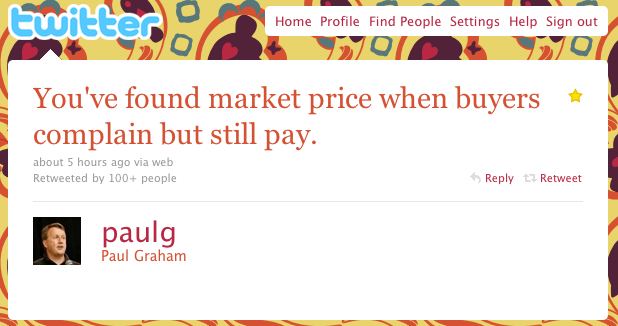
And in that lies the core of what’s wrong with Microsoft — the difference between making products users want to buy vs. making products they want to use.  When you make products people want to use, charging for the value it brings (i.e., looking for good revenue streams), becomes so much easier.  Approaching it from the more negative side, I guess you could also say it like this:

Technology needs

One of the dangers of product roadmaps and the PM’s role is that back-end maintenance and optimization can start to take a back seat.  This is a huge mistake, best explained through the metaphor of technical debt. In Steve McConnel’s great post on this topic, he defines technical debt as follows:

The first kind of technical debt is the kind that is incurred unintentionally. For example, a design approach just turns out to be error-prone or a junior programmer just writes bad code. This technical debt is the non-strategic result of doing a poor job.

The second kind of technical debt is the kind that is incurred intentionally. This commonly occurs when an organization makes a conscious decision to optimize for the present rather than for the future. “If we don’t get this release done on time, there won’t be a next release” is a common refrain””and often a compelling one.

He goes on to explain why this can become a problem:

If the debt grows large enough, eventually the company will spend more on servicing its debt than it invests in increasing the value of its other assets. A common example is a legacy code base in which so much work goes into keeping a production system running (i.e., “servicing the debt”) that there is little time left over to add new capabilities to the system. With financial debt, analysts talk about the “debt ratio,” which is equal to total debt divided by total assets. Higher debt ratios are seen as more risky, which seems true for technical debt, too.

Technical debt isn’t always wrong — quick hacks to get a product out the door is often the right choice.  But as with most debt, it’s important to start paying it off in small chunks as soon as it’s incurred, before you get into too much trouble.  If you’re interested in this topic, also read Andrew Chen’s great post called Product Design debt vs. Technical Debt.

Striking the right balance

Now that we’ve discussed user needs, business needs, and technology needs, the obvious question is: how do you decide what to build now vs. later vs. not at all?

For that, the right answer is unfortunately, in my experience, the traditional cop-out answer: it depends. It depends mainly on the following factors (in no particular order):

  • The level of user engagement and involvement.  If users are screaming for a particular feature, or if there are rumblings around “why haven’t you done anything for us recently?”, it could be a good time to up the level of customer needs you meet.
  • The stage of the product in its lifecycle. If the product is just at the beginning, customer needs will most likely come first.  As the product matures, technology and business needs become more important and should start taking precedence.
  • The financial state of the business.  If there are ways to add good revenue streams, those opportunities should always be taken.

Depending on where the business is on each of these 3 factors, the different inputs might be weighted differently. If the product is going through a growth spurt with lots of buzz, more attention could be placed on user needs. If the product is mature and making good money, technical needs might get more weight.

Exactly how this is balanced in each version/release of the product has no clear answer, and it’s where the art of product management comes in. But one thing is for sure — none of these needs can be ignored for any extended period of time. Take too long to pay down technical debt, and your platform will become bloated and unable to scale. Focus on making money too much, and users will fall out of love with your product.

Successful products have clear product management leaders who are able to take all the different requirements inputs, place it into context with other external and internal pressures, limits, and opportunities, and design a product vision and a (flexible) product roadmap that ultimately increases product/market fit (which I mentioned briefly in Part 2 of this series).

But what do product requirements look like, and what is the Product Manager’s role in that process?  That will be the topic of the next post…

Why the Kindle is a better e-reader than the iPad

I just read an interesting New York Times article on “social reading” (Yes, People Still Read, but Now It’s Social), and it got me thinking about the future of reading, and the e-reader battle that’s currently going on, particularly between the iPad and Amazon’s Kindle.  And then I upgraded my Kindle software to v2.5 this morning, and it made it clear to me why I think the Kindle is a far superior reader to the iPad.

No one will deny that the iPad’s iBooks app has a nicer user experience than the Kindle.  It’s colorful and pretty, it has a nice bookshelf, you can turn the pages with your fingers, and, uh…  Well, that’s where it stops.  The two major issues with iBooks are:

  • Since it’s a back lit display, it starts hurting your eyes when you read for too long.
  • The battery life is, you know, not ideal…

Now consider the Kindle.  Though not as pretty to look at, you can tell that Amazon decided to focus on the reading experience.  You don’t have to plug it in all the time, and you can read it for hours without hurting your eyes.  But it is v2.5’s forays into social reading that really starts to set the device apart.  There are two features in particular that I think are brilliant:

  • First, Amazon allows you to opt in to viewing popular highlights. This allows you to see when passages of a book you’re reading were highlighted by others who have read the same book.  It’s like a virtual book club, but instead of trying to get 6 people to agree on a book to read, you can connect with 100’s of readers who are already reading the same book.  This kind of connection really is where the Internet is at its most useful.
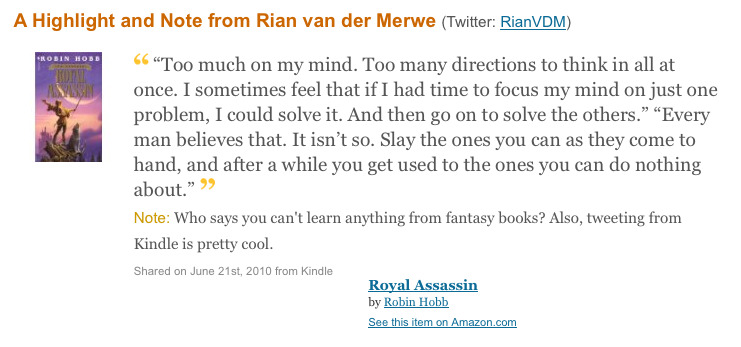
  • Amazon also allows you to link your Twitter and Facebook accounts to your Kindle.  This means that you can highlight a passage that you’re reading, and share it with your followers, like I did this morning:

That is powerful.  It not only allows you to share what you’re reading and thinking about in real time, but it’s also great business for Amazon, since it provides a way for your followers to purchase the book right away.  Of course, even the Kindle packaging tells you that this is an experience built around passionate readers:

The differences between the iPad and the Kindle have larger implication as well, particularly in the field of Product Management.  Look, the iPad is gorgeous, it really is.  But it is an experience designed to contain so many different uses, that it is not possible to focus on doing one particular thing (like reading a book) extremely well.  The Kindle is singularly focused on readers, and that is why it beats the iPad hands down as an e-reader.

Dropbox did exactly the same thing to beat out their competitors — they focused on making file sharing as easy and convenient as possible.  They didn’t have all the features, but they made sure the features they do have has a superior user experience.  On that note, if you haven’t watched this 23-minute talk by Dropbox’s CEO where he discusses their business model, you really should.  It is inspiring and well worth it.

South African tech industry: don't succumb to Goldilocks syndrome

Hey, South African tech industry?  Meet me behind the rugby field at 15:00.  We need to talk.

I’ve been back in South Africa for 3 months now after 6 years working in Silicon Valley, and I think I finally figured out what’s been bothering me about the tech industry here ever since I got back.  The problem is that we have some serious Goldilocks issues going on right now.

This one is too cold

The first problem we have is a severe inferiority complex.

Remember: just because we’re not in Silicon Valley doesn’t mean we don’t know what we’re doing.  Like Morpheus says in The Matrix: “Some things are true whether you believe in them or not.”  We’re good at what we do.  We’re really good.  Why does it matter if anyone knows it at this point?  They will, soon enough.

I know that many of those dudes in San Francisco treat us like the little brothers of the world — adorable but not to be taken seriously.  But that doesn’t mean we have to grovel.  Who cares what they think?  Haven’t you heard?  Silicon Valley is dead.  You can be brilliant anywhere.  So we might as well be brilliant in the most beautiful place on earth.

This one is too hot

But we also have a second problem.  Some of us tend to overcompensate.  You see, since we have this inferiority complex, there is a danger in wanting to “show them a thing or two.”  So we livetweet from events that we’re not attending.  We write reviews of products we haven’t seen.  We fight about what the definition of a startup is, as if that matters.  We show up at conferences and give talks on who we are instead of what others can learn from our experience.

No, not cool.  There is no need to overcompensate.  We have some very unique skills, and we have the benefit of the element of surprise.  No one thinks the next Facebook is going to come from South Africa.  Let’s keep it that way — don’t let them know we’re here!

This one is just right

But there is an alternative.  We can make great products, build great companies, and take over the world without anyone even knowing where we’re from.  Does it matter where WooThemes are from?  It matters to us.  It doesn’t matter to anyone they sell their products to.

So, please.  Stop being apologetic about our skills.  Stop wishing we were Silicon Valley.  Stop pretending to be in Silicon Valley.

Instead, follow Seth’s advice.  And forgive me for quoting verbatim, but no one says this better than him:

Yes, I know you’re a master of the web, that you’ve visited every website written in English, that you’ve been going to SXSW for ten years, that you were one of the first bloggers, you used Foursquare before it was cool and you can code in HTML in your sleep. Yes, I know that you sit in the back of the room tweeting clever ripostes when speakers are up front failing on a panel and that you had a LOLcat published before they stopped being funny.

But what have you shipped?

What have you done with your connection skills that has been worthy of criticism, that moved the dial and that changed the world?

Go, do that.

On Google Buzz, online privacy, and where we go from here.

Google Buzz is really messing with my brain.  All my other social media activities fit nicely along the private-public continuum we all have to juggle.  But Buzz feels like an invasion of my personal space.  By infiltrating the most private of online communications (email), it’s also daring me to move that privacy line a little bit, and let people in on conversations that they really have no business in being a part of.  One of the few positive reviews I’ve read about Buzz so far is this tweet by my friend G-J:

Good point, but Tweetie for the iPhone already threads Twitter conversations, and I use Twitter lists to keep up with people in my closer network.  So I’m just not sure what to do with it, and that makes my brain hurt.

Privacy and the public persona

This issue, as well as the widely reported privacy gaps in Google Buzz, are just the latest in a growing conversation about privacy on the web.  Facebook’s recent updated privacy settings created quite a stir, and out of all the gazillion blog posts discussing it, none was more insightful than the brilliant Danah Boyd’s article Facebook’s move ain’t about changes in privacy norms.  It is a must-read for anyone interested in this topic.  In the article she says the following (my emphasis added):

There isn’t some radical shift in norms taking place. What’s changing is the opportunity to be public and the potential gain from doing so. Reality TV anyone? People are willing to put themselves out there when they can gain from it. But this doesn’t mean that everyone suddenly wants to be always in public. And it doesn’t mean that folks who live their lives in public don’t value privacy. The best way to maintain privacy as a public figure is to give folks the impression that everything about you is in public.

That last sentence really stuck with me.  It is so true.  Just because people divulge intimate details of their lives online, doesn’t mean everything they do is public.  Joshua Porter recently tweeted the following:

Ain’t that the truth…

But what if I want to maintain my privacy in public?

Another interesting story in this same vein — and a great example of the uncharted waters of online privacy — is that of designer Dustin Curtis.  I’ve been following his blog every since he blogged about the fascinating chain of events following his redesign of the American Airlines website.  That made him a bit of a celebrity in the world of web design, but it turned out to be nothing compared to what happened next.  On the day of the Apple iPad launch, he posted some very real-looking (but very fake) photos of the iPad.  It quickly sent the Internet into a frenzy and got him coverage on Mashable, TechCrunch and The Washington Post, among other places.

The next day he tweeted, simply:

Dustin Curtis: 1, Internet: 0.

Well played, sir.  Well played.  What’s interesting is what happened next, though.  He got a lot of attention from this stunt, and his Twitter follower count exploded.  He created an air of mystery leading a lot of people to wonder who he is.  It even led to a question on Quora with some amusing Chuck Norris-type answers: “Who is Dustin Curtis?”  The post on Quora prompted this tweet from him:

The answer is, of course, pretty straight-forward.  If you create a public and controversial persona, and in doing so amass over 13,000 followers on Twitter, people are going to want to find out more about you.  And, as a recent Times article pointed out:

When you make your private life public, when you seek attention in that broad a manner, you’re inviting not just the cool and the loving, but the angry and aggrieved.

And that is where online privacy get tricky.  We already talked about how public people value there privacy very much.  But at some point, people are going to assume that because you live a lot of your life in public, you have no need to be private, and won’t mind people digging around in your personal life (since there is no personal life any more).  But that’s clearly not the case, as Dustin points out in his tweet.

Facebook as theater

In a similar vein, I have to say that I have become increasingly uncomfortable with public conversations on Facebook.  And by that I mean girls who write “I miss you” on their boyfriends’ walls, people making coffee arrangements on each other’s walls, etc.  Once conversations that should be private are undertaken in a public forum, they become theater — meant for the onlookers more than the participants.  And that’s troubling.

Yes, there are legitimate cases (mostly for the sake humor) to have public conversations on Facebook.  But if you decide to write on someone’s wall and not send an email or a text, you are doing it so that other people can see it.  And that hurts the authenticity of the interaction.

So it’s not just that the lines between what is public and what is private are getting blurred.  It’s also that what is acceptable in the public realm is changing, as proven by those “I have to go to the bathroom” status updates I’m sure we all see occasionally in our news feeds.

Where do we go from here?

There are no universally agreed upon guidelines for what should be public and what should remain private online.  I’m pretty sure there will never be.  But I do believe that where that line is drawn should be a conscious decision by every person who goes online.  You can’t share every detail of your life online and then expect people to leave you alone.  You can’t go on Facebook, not change your privacy settings, and then complain if some of your photos leak out.  On the flipside, you can’t build a blog audience by writing articles that don’t expose your opinions in some way.

But wherever that line is drawn, it is extremely important that there is a point where your life stops being public.  The article Danger online: Perils of revealing every intimate moment puts it this way:

Concerns, though, are growing about the decline of the private self. Many people are questioning the wisdom particularly of blogs in which ordinary people write regular updates about their children and spouses, and they are asking whether we are surrendering our privacy too easily.

Or to put it another way, from another great article on the topic, Party On, but No Tweets:

We are fighting against this whole idea that everything people do has to be constantly chronicled. People think that every thought they have, every experience ”” if it is not captured it is lost.

When you let go of the pressure to chronicle, you are free to enjoy the moment for what it is, without the pressure of getting that picture up on Twitpic.

Don’t get me wrong — I think it is possible to build fantastic communities online by living public lives — both for business and personal purposes.  And I am definitely not going to stop blogging or shut down my Twitter account.  However, more and more I am finding myself agreeing with another sentence buried in that last article: There is something magical about a life less posted.

Netflix doesn't know me: How I lost faith in recommendation engines

When Netflix first came out with their movie recommendations, I thought it was a great idea. I started rating movies I’d seen — good and bad — confident that the brain behind it all will do its magic and recommend some hidden movie gems that will, you know, change my life. Well, I’m still waiting for those movies. And to be honest, I’ve become a little bit frustrated with the whole thing.

Describing the latest example I encountered will reveal how much I liked a movie that I probably have no business liking, but I’m willing to sacrifice a little bit of my reputation in the name of science, or whatever this is…

The first problem I encountered is a pure UI issue, and has to do with how Netflix shows the star movie ratings on their pages. As an example, this is what I see for the movie August Rush in my queue:

You would assume that the customer average rating is just over the 3-mark, right? Well, looking at it closer, it turns out that Netflix shows you a rating they call “Our best guess” (3.4 in this case), instead of showing you the customer average (4.1 in this case):

Here’s the problem. I loved this movie. I’m giving it 4 stars. But since Netflix doesn’t know that I have a soft spot for modern musicals (despite how highly I rated the movie “Once”), the “Netflix brain” didn’t think I would like this movie as much as the average customer.

This is a problem you see often on sites where the UI does not give proper user feedback about what it’s showing you.  It took me a few weeks to realize they’re showing me “Our best guess” in search results, and not the true customer average. Now I have to mouse over to see the true average every time. Why? Because I don’t trust the brain any more. (By the way, this is just one example, but as I’ve looked into it more, I realized it’s a systemic problem for me — Netflix’s best guess is rarely in line with my tastes).

Incidentally, on Amazon.com, the average user rating is 4.5 out of 5 stars. Pretty good. So this is the problem then. There is such a wide range of tastes out there that it’s hard to know who to trust. This is the problem Netflix is trying to solve — let’s look at “users like you” and then show you that average instead of the overall average. You’re therefore initially more inclined to believe the “best guess” rating provided by Netflix, than the average consensus provided by all users. It’s a good idea, but the implementation doesn’t seem to be there yet.  (The discussion about the validity of 5-star ratings in general is a separate and very interesting discussion).

I say all this to make a simple point — it appears that the collective wisdom of all users does a better job of predicting if I will like a movie than the recommendation engine provided by Netflix. The question is whether it would ever be possible for recommendation engines to get to know you well enough based on your preferences. Maybe if it takes into account not only your movie interests, but also music, books, online activity, etc.? Yes it sounds creepy, but how else would Netflix know how much I like strange modern musicals?

Email is dead. Long live email.

There has been growing discontent with email over the past year or so, but it appears that many people’s hatred for this particular form of communication has now finally started to boil over.  Several articles and blog posts over the past few weeks lamented the death and/or evilness of email in no uncertain terms.  In this post I go into a few highlights from said email hatemail, followed by some thoughts on why we shouldn’t be so fast to close down our email accounts.

The problem with email is…

First, a disclosure.  The excerpts below are just that: excerpts.  While I attempt to keep the context and the original intentions of the authors intact, I encourage you to read all these articles in their entirety.  They’re not only thoughtful and well-written, but they also lay a solid foundation for what I think is a very worthy and much-needed debate.

In the article Why Email No Longer Rules”¦, the Wall Street Journal announces that email is king no more:

But email was better suited to the way we used to use the Internet””logging off and on, checking our messages in bursts. Now, we are always connected, whether we are sitting at a desk or on a mobile phone. The always-on connection, in turn, has created a host of new ways to communicate that are much faster than email, and more fun.

Caught up in Google Wave frenzy, Techcrunch laments the following in Google Wave And The Dawn Of Passive-Aggressive Communication:

Google Wave is not just a service, it is perhaps the most complete example yet of a desire to shift the way we communicate once again.  For many of us, email is simply not cutting it the way that it used to. It’s a sedentary beast in a fast-moving web. It uses old principles for management, and this is leading to overload.

Sticking with Techcrunch, in Relevance Over Time, Nik Cubrilovic argues that email sacrifices relevance in order to present items in a chronological order:

Chronological order needs to be abandoned in favor of relevance. Without relevance, our ability to manage large sets of information is inefficient. The technology for relevance exist today, for eg. spam filters are able to tell us what we definitely don’t want to read. Real world information retrieval and organization is based on relevance, either what somebody else believes is relevant to us, or what we decide is relevant. Newspaper stories are not laid out in the order that events took place and libraries do not catalog their books in the order they were published.

Jeff Atwood, in a post entitled Email: The Variable Reinforcement Machine, explains why he think email kills productivity:

Oh, sure, we delude ourselves into thinking we’re being extra-productive by obsessively checking and responding to our email, but in reality we’re attending too frequently to our own desire for gratification and sabotaging our own productivity in the process.

Why email is essential in business communication

After reading each of these articles, the same question kept coming to mind: How do these authors use email? They certainly don’t use it the same way I do.  Because I simply cannot imagine replacing email with Twitter and Facebook - and even Google Wave.  As far as I can tell, here are the major complaints about email:

  1. Email is not real-time enough. I don’t understand this complaint at all.  How is Twitter more real-time than either sitting at your desk with your email client open, or checking your BlackBerry for new messages?  Yes, Google Wave lets you see people type in real-time, but do we really need that?
  2. Email is not dynamic enough. I don’t want email to be dynamic.  Email is a way to communicate static thoughts.  Tools like Google Docs, Dropbox, and Versionshelf are there for collaboration.  But email is a linear record of events and discussions, which is essential if we want to preserve any kind of sanity in business communication.
  3. Email is chronological, not relevant. This complaint perplexes me the most.  If email isn’t relevant, you may want to write different emails, or just spend a little time setting up a few filters to get rid of Hilton HHonors statements and other useless newsletters.  Chronology brings order.  Even though the most important things might not be at the top of your inbox,  timestamp is an important element in helping us separate the urgent from the important.
  4. Email reduces productivity. More than being on Twitter all day reduces productivity?  I’d like to see how productive people are who do business in 140 characters.

In short, I’m just not ready to give up email.  It serves as a very effective To Do list for me.  It allows for accurate and extensive documentation when needed, as well as quick decision-making with a variety of stakeholders.  Long live email.

How to increase the value you get out of social media

A common complaint about social networks is that they insulate us by only showing us information we’re already likely to agree with. This solidifies our existing confirmation biases and makes us less likely to see the value of other viewpoints. It’s a legitimate concern, but we only have ourselves to blame. The problem is that if we don’t follow enough people from different types of networks, we’re always going to see the same type of information over and over.  And in this fundamental point also lies the best way to get the biggest benefit from social media.  So stick with me as we discuss some sociology theory, which I promise will lead to some practical implications in the end.

First, a little background on Structural Hole Theory.

Structural Holes Defined

Ronald Burt’s theory of “structural holes’ is an important extension of social network theory, which argues that networks provide two types of benefits: information benefits and control benefits.

  • Information benefits refer to who knows about relevant information and how fast they find out about it. Actors with strong networks will generally know more about relevant subjects, and they will also know about it faster. According to Burt (1992), “players with a network optimally structured to provide these benefits enjoy higher rates of return to their investments, because such players know about, and have a hand in, more rewarding opportunities”.
  • Control benefits refer to the advantages of being an important player in a well-connected network. In a large network, central players have more bargaining power than other players, which also means that they can, to a large extent, control many of the information flows within the network.

People with a lot of followers on social media have a high degree of Control benefits — they are often extremely influential in their fields, and in unique positions to have control over certain conversations on the web. But being an influencer doesn’t guarantee that you will have strong Information benefits , because you tend to get the same news over and over again if you don’t do a bit of work on expanding your network in a very deliberate way.

Burt’s theory of structural holes aims to enhance both these benefits to their full potential. A structural hole is “a separation between non-redundant contacts” (Burt, 1992). The holes between non-redundant contacts provide opportunities that can enhance both the control benefits and the information benefits of networks. The figure below shows a graphical representation of this definition.

The concept of non-redundant contacts is extremely important, and refers to contacts who give you access to networks you aren’t already part of. Now let’s look at how Mr. Scoble can increase the Information benefits he gets from Twitter.

Optimizing the benefits of networks

There are several ways to optimize structural holes in a network to ensure maximum information benefits:

  • The size of the network. The size of a network determines the amount of information that is shared within the network. A person has a much better chance to receive timely, relevant information in a big network than in a small one. The size of the network is, however, not dependant merely on the number of actors in the network, but the number of non-redundant actors. In other words, it’s not just about how many people you follow on Twitter, it’s also who you follow.  Pretty straight-forward, but let’s continue.
  • Efficient networks. Efficiency in a network is concerned with maximizing the number of non-redundant contacts in a network in order to maximize the number of structural holes per actor in the network. It is possible to eliminate redundant contacts by linking only with a primary actor in each redundant cluster. This saves time and effort that would normally have been spent on maintaining redundant contacts.  What this basically means is that if you follow people who all follow each other, your network isn’t very efficient and you need to get rid of some people.
  • Effective networks. Effectiveness in a network is concerned with “distinguishing primary from secondary contacts in order to focus resources on preserving primary contacts” (Burt, 1992:21). Building an effective network means building relationships with actors that lead to the maximum number of other secondary actors, while still being non-redundant.  This means that if 10 people give you access to the same network of information, only follow the most important one — their voice will be clearer and not drowned out by the others.
  • Weak ties. In his 1973 paper entitled “The strength of weak ties”, Mark Granovetter (Granovetter, 1973) developed his theory of weak ties. The theory states that because a person with strong ties in a network more or less knows what the other people in the network know (e.g. in close friendships or a board of directors), the effective spread of information relies on the weak ties between people in separate networks. “Weak ties are essential to the flow of information that integrates otherwise disconnected social clusters into a broader society” (Burt, 1992). This basically means that to get more out of Twitter, you need to figure out where your network is weak, and then follow those people who give you access to additional clusters. Building and maintaining weak ties over large structural holes enhances information benefits and creates even more efficient and effective networks.

So here’s the bottom line: to achieve networks rich in information benefits it is necessary to build large networks with non-redundant contacts and many weak ties over structural holes. Some of these information benefits are:

  • More contacts are included in the network, which implies that you have access to a larger volume of information.
  • Non-redundant contacts ensure that this vast amount of information is diverse and independent.
  • Linking with the primary actor in a cluster implies a connection with the central player in that cluster. This ensures that you will be one of the first people to be informed when new information becomes available.

How to get the most out of social media

If we apply these theories to Twitter and other social media networks, we quickly realize it is not the sheer number of “friends” in your network that count, it is the diversity of the people in your network that is most important. If you only have links to people in your immediate group of friends or colleagues, it will be difficult to get new information, since everyone will pretty much know the same things. This is not to say that you have to start following all those random spammers on Twitter, but it does mean that people with who you have “weak ties” will often provide you with new information and therefore more benefits than your “strong ties”.

So here’s how to make sure you get the most out of social media:

  • Identify the information networks you want to have access to (for me, it’s information about user experience design and product management).
  • Go through your following list and see where the overlap is — if there is a lot of resharing going on of the same people, follow the person who gets reshared the most.  This will reduce your Twitter stream but still get you the information you need (and faster than before).
  • Once you’ve reduced your following list, make your network as large as possible with the “weak ties” who will give you access to all the information you need.

These theories show that we can reduce the number of people we follow while actually getting more Information benefits from social media. We will get new information faster, we will get it only once or twice, and the information we get will be more diverse.

References

Burt, Ronald S. (1992). Structural Holes: The Social Structure of Competition. Cambridge: Harvard University Press. Granovetter, M. S. (1973). “The Strength of Weak Ties.” American Journal of Sociology 78: 1360-1380.