Menu

Posts tagged “technology”

Facebook is entangled in about a fifth of the web

I don’t want to quote too much from Matthew Berk’s fascinating URL analysis because it’s worth reading the whole thing. So I’ll just tease the following line from Study of ~1.3 Billion URLs: ~22% of Web Pages Reference Facebook:

It’s taken roughly a decade for Facebook to not only accrue roughly a billion users, but to entangle itself in about a fifth of the Web.

Ok, maybe one more bit, where he talks about the implications of all this traffic flowing through proprietary web properties:

Increasingly, people and organizations will seek to write themselves not to Web sites, but to the big “platforms” (APIs) like Facebook and Twitter. And more and more, Web sites are being rewoven into those social networks, whether by simple inclusions of “like” or “+1” buttons, or through more complex reflections of social connection. [”¦]

My key takeaway here is that although Facebook may know about a sizable portion of the Web, the Web barely knows anything about what’s inside of Facebook.

Check out the full post.

The information architecture of Smart TVs

Sam Grobart is not a UI designer — he’s a technology blogger for the New York Times. And in Good Features Demand Good Design he succinctly articulates one of the most difficult aspects of our jobs, and one of the cornerstones of Information Architecture:

But all the features in the world don’t mean a thing if you can’t present them in a welcoming, intuitive way. Take a look at that Smart TV interface: there are 26 places you can go, and that’s before you scroll to another page. The tangled mess of cables behind my TV may have disappeared, but ther’s a new source of confusion right on my screen. [”¦]

I’m no user-interface expert, but it would seem to me that you want to present viewers with a few, limited supercategories ”” not everything all at once.

The day of the Information Architect might be over, but Information Architecture is alive and well.

A guide to good RSS feed citizenship for blog publishers

I do most of my online reading through RSS, and I don’t think I’m alone. For the most part this is a good reading experience, but there are a few things publishers can do to make it even better. So if you publish a blog, here are three proposed guidelines for RSS feeds:

  1. Have an RSS feed and make it easy to subscribe. Contrary to popular belief, Twitter did not kill RSS. It’s alive and well. So please don’t bury or hide the feed — it should be easy to find the link and subscribe. Also, do some work on your feed - use a service like Feedburner to customize it (and give you analytics on your subscribers).

  2. Unless it’s central to your revenue model, don’t provide article excerpts only. I understand that there are subscription sites that require payment to get access to full RSS feeds — that’s a conscious business decision, so if it works, great! But for the rest of us, RSS excerpts are a bad idea. It places the burden on anyone following your shared items to click through to see the article, and that slows people down. As a general rule (with the above stated exception), please provide a full feed - you’ll grow your audience and eventually get those click-throughs because of it.

  3. Remove the metadata from your feed URLs. If I do click through to an article to comment, share it on Twitter, etc., a URL like this looks bad and makes sharing harder to track: http://uxmag.com/design/debating-the-fundamentals?utm\_source=feedburner&utm\_medium=feed&utm\_campaign=Feed%3A+UXM
    +%28UX+Magazine%29.

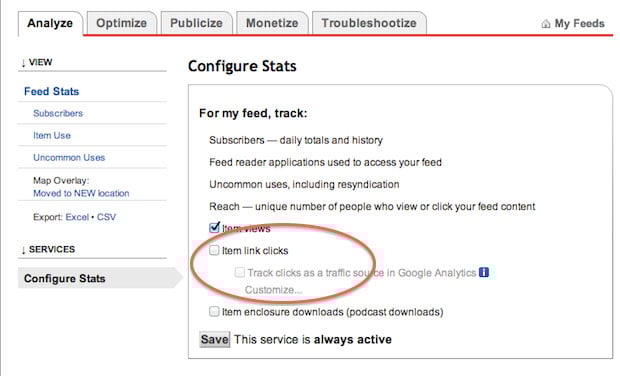
    The stuff after the ”?” is added by Feedburner so you can get detailed analytics on item link clicks. But unless you really want to see where your RSS feed clicks come from you don’t need this level of detail. All you need to know is the number of Item Views in your feed — the rest of your analytics can come from Google Analytics. It’s very easy to turn this tracking off to remove the metadata and make your URLs more friendly. In Feedburner, go to “Configure Stats” and uncheck the “Item link clicks” box. Here’s a screen shot:

feedburner URLs

In Luke Wroblewski’s new project Future Friendly, they discuss their thinking around universal content:

Well-structured content is now an essential part of art direction. Consider how it can flow into a variety of containers by being mindful of their constraints and capabilities. Be bold and explore new possibilities but know the future is likely to head in many directions.

If you publish content on the web it’s not future friendly to ignore and/or limit its use in RSS, which is one of the most important containers we have at our disposal.

Google's lack of user understanding

I’m linking to Sam Biddle’s Does Google Have Any Social Skills at All? with some caveats. I’m not a fan of headlines like that (here’s why), and there are way too many hyperbolic, trolling statements like “Nobody really uses Google+”. Still, the article makes some good points about Google’s lack of understanding of their users:

The keynote sounded one futuristic clarion call after another: Glass, the wearable computer; Google Now, a smartphone system that provides intricately tailored life information; the Nexus Q, a social media streamer; and a fancy new way to throw parties with Google+. But underneath each of these feats of technology you could see a hollow, lurching weirdness that makes you wonder: Who will use any of this stuff besides the actors in Google’s promo videos? [”¦]

In each case, Google has balanced on golden fingers a product — clearly with a lot of time, thought, and money behind it — that just doesn’t seem to jibe with the way we actually live our lives. There isn’t any lack of effort or innovation here, but rather a gaping disconnect between the way data geeks and the rest of us see the world.

I know Google does a lot of user research on their flagship products, but it doesn’t look like they do any Product Discovery or user need analysis on these new products. Maybe they’re genius designers, so they don’t need to do research. Or maybe not.

Data-driven book publishing and the possible decline of risky writing

The Wall Street Journal has an interesting piece on the data mining of e-book reading habits. In Your E-Book Is Reading You they discuss, for example, what Barnes & Noble has learned from Nook data:

Barnes & Noble has determined, through analyzing Nook data, that nonfiction books tend to be read in fits and starts, while novels are generally read straight through, and that nonfiction books, particularly long ones, tend to get dropped earlier. Science-fiction, romance and crime-fiction fans often read more books more quickly than readers of literary fiction do, and finish most of the books they start. Readers of literary fiction quit books more often and tend skip around between books.

The article goes on to discuss how publishers are now using this kind of data to guide everything from the subject matter to the length of future publications. The whole thing makes me a little uncomfortable — I think I agree with Mr. Galassi here:

Others worry that a data-driven approach could hinder the kinds of creative risks that produce great literature. “The thing about a book is that it can be eccentric, it can be the length it needs to be, and that is something the reader shouldn’t have anything to do with,” says Jonathan Galassi, president and publisher of Farrar, Straus & Giroux. “We’re not going to shorten ‘War and Peace’ because someone didn’t finish it.”

I realize there is a hint of hypocrisy in my feelings about data-driven book publishing. As a practitioner of user-centered design I am a big proponent of data-driven decisions (this presentation by Joshua Porter is a constant companion). But this feels different. I guess I’m worried that publishing books with the explicit purpose of satisfying some imaginary, averaged-out reader drone will pull us all towards a safe middle ground where no risk is allowed.

In my version of a nightmare scenario, my 2-year old daughter will be awash in Dora the Explorer books with no access to dangerous, crazy stories like Oh, The Places You’ll Go or Where The Wild Things Are. I don’t think a data-driven approach to publishing would have let those books see the light, and that would have been a tragedy.

Here’s to writers who take risks.

When will we be satisfied with technology?

John Carey makes an interesting observation about the Macbook Pro with Retina Display in Progress:

Photography is a place where philosophy and technology mix with art and its ease of entry has diluted its user base to the point of over saturation. While chemistry and technology have always been a central pillar in this space, I fear it could drag it down even further unless we start to greet some of this forward momentum with at least a whisper of skepticism. I guess the best way to break this down is simply to ask, when will we ever be satisfied? When will sharp be sharp enough, or big be big enough? When do we reach the point within some areas of consumer technology where we are making progress simply for the sake of progress?

Just when I thought maybe we’re starting to come to terms with certain technological advancements and actually enjoy ourselves within our technically enhanced lives I have been quickly reminded that it will never end. I don’t mean to be overly pessimistic but you have got to admit it does feel a big daunting at times does it not? It is a subject I have long explored on these pages and I know I am not alone.

Even though he’s speaking from a photographer’s perspective, it’s easy to relate to John’s point. Yesterday, while the Google I/O keynote was going on, my only emotion was relief. I was relieved that I’m so securely locked up in Apple’s Prisonâ„¢ that I couldn’t care less about all the tweets and live blogs about Google Glass and the Nexus 7. I was relieved that I’m not a reporter for Engadget or The Verge, who have to live and breathe every single new thing that comes out day after day after day. Most of all, I was relieved that it wasn’t another Apple keynote, because those take up all my time and attention since I ABSOLUTELY HAVE TO KNOW WHAT I’M ABOUT TO MISS OUT ON.

All this to say that I empathize with John’s mixed feelings about the Retina MacBook Pros. I, too, want more from technology while knowing that more isn’t necessarily what we need. What we need are bicycles for the mind, and to do that, we need some time to practice so we can take the training wheels off. Could it be that continuing to invent better bicycles all the time are actually preventing us from riding the damn things?

When we build, let us think that we build forever

I remember when Wilson Miner’s talk When We Build first hit the web with a bang — for days you couldn’t open Twitter without seeing a link to it. I don’t know why, but I just never got around to watching it until today. It is, in a word, extraordinary. I generally don’t want to post things that you’ve likely seen before, but I need to make an exception on this one, just in case some of you procrastinated like I did.

It’s not really possible to summarize, but if I had to, I’d say that the talk is loosely based on John Ruskin’s words from his 1849 book The Seven Lamps of Architecture:

When we build, let us think that we build forever. Let it not be for present delight nor for present use alone. Let it be such work as our descendants will thank us for; and let us think, as we lay stone on stone, that a time is to come when those stones will be held sacred because our hands have touched them, and that men will say, as they look upon the labor and wrought substance of them, “See! This our father did for us.”

If you can make 40 minutes to watch this, you won’t regret it.

Surface and the perils of "no compromise"

Jim Dalrymple in The Surface and the iPad:

From what I’ve seen, it seems to me that Microsoft is trying to do a similar type of dance with the Surface that it did with previous tablets. The company is trying to convince consumers that this device can be a computer and a tablet at the same time. Based on the sales of the iPad, I’m not sure that’s what consumers really want.

Exactly. This is the core of the problem with Microsoft’s “no compromise” strategy. As Kieran Healy pointed out in his response to that approach:

Uncompromising designers make products that will not appeal to everyone, or be of equal use to everyone, or do everything equally well. On the other hand, IT products advertised to consumers as having “no compromises” try to please everyone all of the time. From the perspective of the Dieter Ramses of this world, Sinofsky’s repeated use of the phrase “no compromises” means exactly the opposite of what it says — and more or less guarantees that the product will actually be riddled with design compromises, all made in an ultimately futile effort to keep everyone happy.

Or to summarize using John Gruber’s words:

[C]ompromises enforce simplicity and obviousness in design.

Maybe we’ll all be proved wrong about this. But I just don’t see how a tablet that doesn’t know if it’s a tablet or a computer won’t be confusing to users.

(By the way, speaking of Jim Dalrymple — you have to check out this Tumblr site dedicated to his awesome beard)

Give Microsoft some credit. Or don't. Up to you.

Despite the fact that we have no details on the price, the ship date, or the battery life, Dan Frommer takes a positive stance on the new Microsoft tablet. From Microsoft Finally Has A Tablet Business Model With Surface:

But give Microsoft credit for evolving with the times, both in terms of product design and business model. It may fail, but it’s at least learning to play the right game.

Ok — good on you, Microsoft. But there’s also a counter-argument. In the words of John Gruber talking about the Samsung Chromebook:

F*** that. This is the big leagues. There is no credit for trying.

Begone, technological cynicism

Andre Torrez decided that enough is enough — he will stop getting caught up in the endless complaining and criticizing whenever any new technology is released. From I give up:

But somewhere in between that new iPad, the unserviceable laptop non-story, and that idiotic comment about the new Retina displays something in my brain snapped. I give up. I surrender. The war is over. I can’t care about this stuff anymore. Getting annoyed at the pace of technology is fruitless for me. Being cynical about any new bit of technology that doesn’t fit into my view of how stuff should work has been a dragging anchor in my life.

For some reason, after reading his post I can’t get this related philosophy out of my head: