Menu

Posts tagged “social media”

Forget about ads and privacy, Facebook Home is about identity

There’s certainly a lot of hand-wringing going on about Facebook Home. And although there is some truth to articles like Facebook Home — My Personal Hell and Why Facebook Home bothers me: It destroys any notion of privacy, I feel like making this story’s headlines about how boring Facebook is and how it’s just another step towards evil corporations owning all our data is missing out on what’s really important about this announcement. The much more interesting question is this: How does Facebook Home impact identity?

Perhaps the best analysis I’ve seen about Facebook Home is a tweet written by Rebekah Cox back in January 2011:

The first company to fully execute on embedding your identity into your phone (making a truly first class experience) wins the next decade.

— R. Marie Cox (@artypapers) January 29, 2011

Rebekah expands on this in her post Mobile Identity, in which she concludes:

A mobile experience that truly represents your identity — in a way that both resembles and enhances an in-person conversation but still affords you control over how you portion out your attention and provides context — could tie the knot for the myriad communication channels available.

That certainly sounds like an accurate description of what Facebook is trying to do with this new product. Now add to that Dan Frommer’s analysis in Who’s Going To Buy The Facebook Phone?:

What about those millions of people who have bought Android phones who don’t really care that they’re Android phones, or even smartphones? […] My guess is that many — most? — of these people are Facebook users, and could easily see some utility in having Facebook features highlighted on their phones. And — bonus — Facebook’s software looks good. Much better than the junk that ships with typical low-end Android devices.

Put these two things together — identity and easy access — and Facebook’s strategy starts to become clear. For the majority of people life increasingly revolves around the Internet and their phones. This cartoon pretty much sums it up:
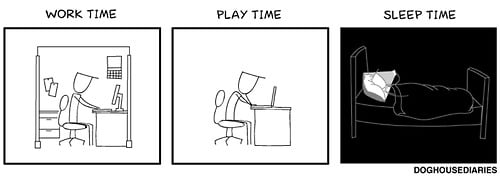
Work, play, sleep

Image source: DOGHOUSE

It’s also clear that many people’s identities are getting tied up in Facebook. And Facebook is really good at accelerating the pace at which that is happening. Much has been written about Edgerank — the algorithm Facebook uses to decide what stories to show in people’s News feeds — and how it ends up promoting confirmation bias by only showing users stories that they are likely to agree with. Facebook knows the truth behind Clay A. Johnson’s words in The Information Diet:

Just as food companies learned that if they want to sell a lot of cheap calories, they should pack them with salt, fat, and sugar — the stuff that people crave — media companies learned that affirmation sells a lot better than information. Who wants to hear the truth when they can hear that they’re right?

What’s even more interesting about this is that Facebook is in the process of reversing a media trend that started with telegraphy. Before the introduction of the telegraph all news was local, and had a high “information-action ratio” — meaning that you could do something about what you read or heard about. But as Neil Postman points out in Amusing Ourselves to Death:

The telegraph made a three-pronged attack on typography’s definition of discourse, introducing on a large scale irrelevance, impotence, and incoherence. These demons of discourse were aroused by the fact that telegraphy gave a form of legitimacy to the idea of context-free information; that is, to the idea that the value of information need not be tied to any function it might serve in social and political decision-making and action, but may attach merely to its novelty, interest, and curiosity. […] Most of our daily news is inert, consisting of information that gives us something to talk about but cannot lead to any meaningful action.

Television and the Internet kept this trend going. All I have to do is say the word “Kardashian” and you’ll know what I mean. But Facebook — and particularly Facebook Home — is a return to “news that’s relevant”. Because it’s news about the people you have let into your life, and therefore news you can do something with (even if it’s just liking a status). Whatever your thoughts are on the privacy and sociological implications of Facebook as a service, you have to admit that it increases “information-action ratio” by (1) giving you information that’s relevant and (2) reducing the effort required to take some kind of action on that information1. That’s pretty powerful stuff.

What Facebook Home is really about

So, let’s tie all of this together. What Home allows Facebook to do is put Edgerank and people’s “social graphs”2 on steroids by giving them easy access to their identities. A Facebook-centric phone that constantly tells you what you want to hear about yourself and your friends means that you’ll find less and less use for the rest of the Internet. And that’s very, very good for Facebook since engagement is everything for an ad-based business.

Where does this leave us? I’m trying to reserve judgment about where this road that Facebook is paving will lead us. All I know is that they are doing some very smart things from a strategic business perspective. They are making news relevant again. They are shaping people’s identities (with a lot of help from Edgerank). And now they have found a way to go beyond apps and do a complete takeover of the device that most people never leave out of their sight.

Tech journalists can write about privacy and the virtues of quitting Facebook all day long. The rest of the world won’t even hear about it, because they’ll be too busy getting immersed in the lives and identities of the friends they agree with.


  1. See Like, the Post-Literate Society 

  2. Just remember, The Social Graph is Neither 

What the demise of online services means for the web

Ryan Holiday’s Our Regressive Web is the best thing I’ve read so far about the importance of services like Google Reader and Delicious. He starts off with this statement:

The collapse of these services, to me, represents an alarming reduction of key services designed to improve online information from the user’s perspective.

Ryan explains how RSS helps to reduce noise and clutter, and he provides a theory for why it never really took off beyond geek circles:

In an ad-impression and pageview-driven business, a service that allows users to opt out of the noise and get content delivered directly to them is dangerous.

Maybe I’m just suffering from confirmation bias because I’m still pretty bitter about Google Reader’s shutdown, but this is a really good analysis. Well worth reading the whole thing.

Introducing two Flipboard magazines on UX and technology

Flipboard 2.0 was just released for iOS, and with it came a feature called Flipboard Magazines. From the blog post announcing the new version:

For the first time, you can collect and save articles, photos, audio and video by organizing them into beautiful magazines. These can be private, or if you want to connect with like-minded enthusiasts, you can make them public and share them on Flipboard and beyond. Now everyone can be a reader and an editor.

I’ve been playing around with this feature a bit, and I like it so far. It’s definitely an early release, so there are a few things missing. For example, you can’t edit the title of an article you’re adding to a Magazine, and you also can’t move articles around to be in a different order. But I’m sure those features will come. For now, it’s a great way to organize1 content — and the timing is particularly good with the impending demise of Google Reader.

I’ve created two magazines so far, which you’re welcome to follow on Flipboard. UX Design is all about design and related disciplines. Technology and us desperately needs a less cheesy name, but it’s a collection of articles about the various ways technology impacts our lives.

Flipboard magazine

Enjoy!


  1. We’re all so desperately trying to avoid using the word “curate” since Matt and Marco spoke out about it, but that’s really what this is. Anyway, I’ll stick with “organize” so as not to offend anyone’s Internet sensibilities. 

We're talking about hashtags again?

Hey, it’s time to argue about hashtags again! The Internet got all revved up about it this week when Daniel Victor published Hashtags considered #harmful:

In most searches, the quantity of tweets is overwhelming and the quality underwhelming. It’s worth questioning how many users find hashtag searches useful, but it’s hard to know, since Twitter doesn’t provide such data.

He goes on to make the argument that most blog posts and tweets about the article focused on:

I believe hashtags are aesthetically damaging. I believe a tweet free of hashtags is more pleasing to the eye, more easily consumed, and thus more likely to be retweeted (which is a proven way of growing your audience)

Sean Sperte followed up with On #hashtags1:

Hashtags actually do increase engagement. It may be tough to recognize through subjectivity, but the reality is, hashtags provide a mechanism for easier discovery, encourage brevity, promote a single key binding for disparate data, and even help inject tone/personality.

Whatever your personal thoughts on the use of hashtags2, it’s worth reminding ourselves that the American Dialect Society voted “hashtag” as the word of the year for 2012. So for a bit of history on our volatile relationship with the thing, have a look at these articles.


  1. Link via Kyle Baxter

  2. I agree with Daniel that they’re ugly, and I wonder if @beep is on to something

Binge-watching and the future of TV

Willa Paskin wrote a really interesting article for Wired about the future of television. The most interesting parts of Netflix Resurrected Arrested Development. Next Up: Television Itself are about the rise of “binge-watching” — the behavior of churning through multiple episodes at a time in one sitting. Netflix found that designing shows to allow for binge-watching is good business:

The more that ­people binge-watch, the more attached they become to the show. “Binge-watching is a behavior that really started for us back in the DVD days. The way ­people were returning the discs, they weren’t watching one a night or one a week,” Sarandos says. “As we got into the streaming business, it became more trackable. What we saw was that the ­people who did this were much more attached to the shows. And because they were more attached to the shows, they reported more value in watching them on Netflix.” In other words, the more you binge, the better for Netflix.

This is why Netflix released all 13 episodes of House of Cards at once, and why those who say it was a stupid decision will likely be proven wrong.

Twitter as river, RSS as filing cabinet

Cap Watkins is switching from RSS to Twitter, and so far he is very happy:

Now that I’ve started using Twitter for feeds, I’m unlikely to ever go back. The ease of sharing, Favoriting, Retweeting, sending to Instapaper, etc. not only match, but at times surpass even Reeder in terms of ease and simplicity. One less app to deal with is a win, not to mention that the links are ordered exactly as I like them (and holy crap, Tweetbot iCloud sync. So good).

Cap goes over the pros and cons of his decision, but I think there’s one major con that he left out: Twitter is a river, RSS is a filing cabinet. Ok, I apologize for the mixed metaphor, but hear me out.

Twitter updates flow by you in a never-ending stream of links. This means that if you choose to follow RSS feeds in this way, all the separate article feeds flow into that one river, and there’s no stopping it. If you happen to be offline for a day or two, it’s extremely likely that you’ll miss an update from an infrequently-updated website you love.

With RSS, that problem doesn’t exist. Since article feeds are separate, there isn’t one giant river (you can choose to view “All feeds” in most readers, but that’s optional). So, I just open the filing cabinet whenever I want, and I can immediately see how many updates my favourite sites have received. I can decide to nuke the unread counts on a site with 50 new items. I can seek out the content I really want. I don’t have to worry that the river will keep flowing and I’ll miss the boat completely (ok, now I’ve really killed this metaphor).

So, although I agree with the pros Cap highlights in his post, and I’m glad he found a reading flow that works for him, I’m not ready to give up RSS. It’s still my favorite way to discover good content.

Why the Google Reader shutdown matters

I was going to write about the Google Reader shutdown but Brent Simmons beat me to the argument I was going to make. In Why I love RSS and You Do Too he sums up why we should all care about Google Reader’s demise:

Even if you don’t use an RSS reader, you still use RSS. If you subscribe to any podcasts, you use RSS. Flipboard and Twitter are RSS readers, even if it’s not obvious and they do other things besides. Lots of apps on the various app stores use RSS in at least some way. […] And those people you follow on Twitter who post interesting links? They often get those links from their RSS reader. One way or another, directly or indirectly, you use RSS. Without RSS all we’d have is pictures of cats and breakfast.

Killing Google Reader doesn’t kill RSS, for sure, but it’s such a big part of the ecosystem that we should be concerned about the health of the platform. From the perspective of a guy with a blog this is pretty depressing news. RSS subscribers are extremely difficult to grow, but they are, by far, the best kind of readers. I’ve written about this before, but to reiterate: they’re loyal, they read almost everything, and they share your stuff. It’s the best way to build an audience. Hunter Walk makes this point succinctly:

Google Reader impact also undercounted if you strictly look at # users bec many power-curators/sharers use it as a discovery system

— Hunter Walk (@hunterwalk) March 14, 2013

But Scott Stein has perhaps the best TL;DR version of the whole debacle:

Google Reader is to Twitter as a well-labeled filing cabinet is to a bag of insane cats.

— Scott Stein (@jetscott) March 14, 2013

So, what now? For a bit of nostalgia, Buzzfeed has a great history of Google Reader. It’s a fascinating story, worth reading. And then, Om Malik has an interview with the original creator of Google Reader. Once you’re done grieving and ready to move on, Lifehacker has a very comprehensive post on the alternatives.

My phone isn't better than your phone

I really enjoyed Michele Catalano’s Grimes, Pop Music, and Cultural Elitism, which starts with this quote from Clare Boucher (better known as Grimes):

I don’t see why we have to hate something just because it’s successful, or assume that because it is successful it has no substance.

It’s an article about our tendency to look down on pop music (and the people who like pop music), but it points to a much broader cultural phenomenon:

The elitism one shows when they dismiss pop music as vapid and those who like it equally vapid is a detriment to any open conversation. The defenders of pop – myself included – are often put on the defensive, made to offer up excuses as to why we like what we do. No one should have to defend their musical choices. No artist who worked hard to get where they are should be roundly dismissed because their music doesn’t fit some elitist standard.

This kind of elitism is something we all have to watch out for. I will probably never switch away from my iPhone, but that doesn’t mean that Android users are undiscerning losers. The best phone is the phone you like the best. That’s all there is to it. As hard as it can be sometimes, we have to decouple the things people like and don’t like from their value as human beings.

The dirty world of Facebook EdgeRank Optimization

I’ve been seeing more and more scams like this one in my Facebook News Feed:

Dirty Facebook EdgeRank Optimization

You only have to think about it for 4 seconds to realize that making a comment on a photo on the web will result in you watching and seeing absolutely diddly-squat (“P.S.: This is not Insane after all!”). And yet, in this particular case, 259,304 people thought about it for 3 seconds or less, commented, waited and saw nothing, and then moved on to the next thing.

The question is, why do Page admins do this? What’s the use of tricking people into commenting on photos, especially when they’ll realize right away that they’ve been made to look like a fool? Well, because there’s money in it, of course.

This is a pretty transparent scam to beat Facebook’s EdgeRank system — the algorithm that Facebook uses to determine what articles should be displayed in a user’s News Feed. When someone comments on a picture it makes it more likely that the picture will show up in their friends’ News Feeds, so it’s an easy way for a Page to gain more exposure very quickly.

Once these Pages have built up hundreds of thousands of “Likes” using the scam, they usually do one of two things. They either start punting things they want to sell, or they sell the Page itself to a business that changes some of the details and uses it as their instantly enormously popular brand Page.

This is obviously pretty dirty, and also nothing new — we’ve had black hat SEO and dark patterns since the dawn of the web. But what I can never understand about the people who use these tactics is why they don’t long for the satisfaction and personal growth that comes from doing real work and reaping the rewards of that. Why create a community of people who couldn’t figure out that you’re scamming them, as opposed to a real community that values your company and what you do? I’ve written about this before in my defense of doing things the hard way:

When we do things the hard way, we invest in ourselves in the best possible way. We kick off an endless cycle of learning and mastery that helps us grow and lead fulfilling lives of purpose. When we take shortcuts, we become mere pretenders. We learn how to play the part, but there is no substance or continued growth. The instant gratification makes us build the house of cards ever higher, which brings anxiety about the whole thing coming tumbling down. Why would we shortchange ourselves like that?

So what can we do about these scams? Well, for one, obviously don’t comment on it. But I also recommend clicking on the little arrow on the right and hiding the post. That will tell EdgeRank that the person who commented on the photo is not worth paying attention to, so in time you’ll see less and less of those kinds of posts. Who says we can’t all be EdgeRank Optimization specialists?

Banner blindness and you

Joaquin (no last name?) talks about ad banner blindness in The non-click generation:

See, the point is, I know this ad is always in that space, I know what it does, I know its intentions, and I know the methods. It’s invisible to me because I know so much about it.

That’s nothing new, of course, but the article did remind me of Mike Lacher’s extremely funny I Am the One Who Clicks Banner Ads:

While you check the weather, I find out why California dermatologists hate the one weird skin care secret discovered by a stay-at-home mom. While you read the New York Times, I rollover for more information about how to get my diabetes under control. While you search IMDB, I click for showtimes, tickets, and behind-the-scenes videos for Think Like a Man. Page after page, banner after banner, I click and I click.

Oh, and while you’re on McSweeney’s, you might as well check out I’m a Social Media Community Manager!:

What is a Social Media Community Manager? Oh sorry, I didn’t hear you over the sound of how hip my job is.

The Internet would be so much less weird and fun without McSweeney’s.