Menu

Posts tagged “social media”

Twitter: better than flying cars

Bill Gates, pulling no punches in an interview with Wired:

Wired: Peter Thiel, expressing his dissatisfaction with technology’s progress, recently noted, “We wanted flying cars, instead we got 140 characters.” Do you agree with him?

Bill Gates: I feel sorry for Peter Thiel. Did he really want flying cars? Flying cars are not a very efficient way to move things from one point to another. On the other hand, 20 years ago we had the idea that information could become available at your fingertips. We got that done. Now everyone takes it for granted that you can look up movie reviews, track locations, and order stuff online. I wish there was a way we could take it away from people for a day so they could remember what it was like without it.

Gates’s point is well taken, but it’s also clear from his stance on the inefficiency of flying cars that he’s never been stuck in LA traffic.

(link via @ChrisFerdinandi)

What was shocking in 1995, we now call Facebook

I remember The Net as if it was yesterday. It’s a pretty laughable movie now, for sure, but back in 1995 it was an exciting and scary look at the future of the Internet. Chris Sims recently wrote a really funny and insightful retrospective of the movie, called What We Learned About Technology From 1995’s The Net. I especially like this part:

Really, though, the movie is more about how the rise of technology impacts our lives, and our changing ideas and concerns about privacy. Bennett was easily seduced by Devlin because he spied on her describing her ideal man in a chat room, and filled in the details by going through her records. As she says, our entire lives are recorded on computers, from our work to our taste in movies. In 1995, this was a shocking problem that people had to learn to deal with. In 2013, it’s basically how Facebook works.

Information that in 1995 required extensive sleuthing performed by clandestine government operations is now freely available to anyone who knows how to type a name into Google. It reminds me of this video (make sure you watch all the way to the end):

Community and kindness

Matt Alexander wrote a guest post on 512pixels while Stephen Hackett is away on vacation with his family. It’s called Community, and it really hit home for me:

Perhaps we’re brought together by a foundational love of design or genuinely good products — often embodied by Apple — but I believe we remain, regardless of evolving opinions, because of a visceral sense of community.

I encourage you to read the whole post, as well as Stephen’s letter to his son, which Matt links to at the beginning.

I’ve had a bit of a rough month that gave me a lot of doubts about remaining active in the design industry. But Matt’s post reminded me again that for every bad experience, there are ten examples of people in our community being generous and supporting each other. And maybe it’s time for us to talk about that a bit more, even on our tech-centric sites.

Cap Watkins did it recently, and so did Anil Dash. We need those constant reminders of what Frank Chimero sums up so well in Issue #1 of The Manual:

The web is a technology, but more importantly, it is people all the way down. People constitute and maintain the network. It is widespread and distributed, but it is very delicate. Like a real web, it needs constant maintenance to keep from tearing.

On CNN, the circus is the point

Elliot Hannon nails it in CNN Gets It Wrong — Why We Don’t Really Mind:

If we cared more about journalism than news theater we’d all be watching PBS. But no one’s talking about NewsHour. There are no meltdowns. The circus, itself, becomes the point — the reason to watch. Youtube videos go viral precisely because they are unexpected, unvarnished — embarrassing. This is CNN.

I know I talk about it a lot, but here’s another paragraph from Neil Postman’s 1985 book Amusing Ourselves to Death that could have been written about 24-hour news networks:

Thus, we have here a great loop of impotence: The news elicits from you a variety of opinions about which you can do nothing except to offer them as more news, about which you can do nothing. […]

And a few chapters later:

Our culture’s adjustment to the epistemology of television is by now all but complete; we have so thoroughly accepted its definitions of truth, knowledge, and reality that irrelevance seems to us to be filled with import, and incoherence seems eminently sane. And if some of our institutions seem not to fit the template of the times, why it is they, and not the template, that seem to us disordered and strange.

Why we should be wary of highly targeted information and ads

In his post Why we fear Facebook and why we shouldn’t Paul Jacobson makes an interesting counterpoint to the common refrain that it’s bad to share our personal data with companies:

Conventional wisdom is that if you are not paying for a product, you are the product. That may be true, as a generalisation. I prefer to think it isn’t so much we who are the products on Facebook but rather our preferences and attention. What does that buy us? For starters, it buys us Facebook, Twitter, Google services and more. It also buys us slightly less annoying ads that can be remarkably relevant. It buys advertisers a better chance that we may want to buy their products and services because those products and services may just be what we are looking for at that point in time.

It’s a good question. Is it really that bad to get highly targeted ads in our news feeds? The more targeted the ads are, the more useful they are to us, right? So why is there such pushback against this trend in companies like Google and Facebook to try to find out everything they can about us?

I think there are three main reasons why we need to be wary of letting ad-driven companies know too much about our preferences, even if they just use it to serve us more targeted information and ads.

1. It makes the web smaller

If we only see stuff we’re already interested in, we run the risk of becoming sucked into the Internet’s “filter bubble”, where it’s much harder to discover new information beyond our current knowledge. Maria Popova puts it like this in Are We Becoming Cyborgs?:

The Web by and large is really well designed to help people find more of what they already know they’re looking for, and really poorly designed to help us discover that which we don’t yet know will interest us and hopefully even change the way we understand the world.

When an algorithmic constraint is placed on the information we see, and that constraint is based solely on our current preferences, we will remain safely locked into the world we know. That means that we become less likely to broaden our horizons with new discoveries.

2. It results in heightened confirmation bias

When we’re steeped in information that confirms our existing beliefs (regardless of whether those beliefs are true or not) we not only seek out more of the same information everywhere we go, but we also become incapable of changing our minds even if we eventually are presented with the truth (the denial of Global Warming is a good example of this…). This is called confirmation bias, and Clay Johnson writes about it in the context of media and the Internet in his book The Information Diet:

It’s too high of a cognitive and ego burden to surround ourselves with people that we disagree with. If you’re a Facebook user, try counting up the number of friends you have who share your political beliefs. Unless you’re working hard to do otherwise, it’s likely that you’ve surrounded yourself with people who skew towards your beliefs. Now look beyond political beliefs—how many of your friends share the same economic class as you? […]

Those algorithms are everywhere: our web searches, our online purchases, our advertisements. This network of predictions is what Pariser calls the Filter Bubble in his book by the same name—the network of personalization technology that figures out what you want and keeps feeding you that at the expense of what you don’t want.

So, for example, through its EdgeRank algorithm Facebook figures out what we like and what we believe in, and then shows us stories and ads that confirm those beliefs. It doesn’t care about truth, it cares about engagement — even if that engagement comes at the expense of what is right.

3. It designs our lives for us

This is true for all advertising, but even more so for hyper-targeted advertising: it tries to sell us stuff we don’t necessarily need. Yes, I know we’re tired of hearing how we should all live with less stuff blah blah blah. That’s not necessarily what I’m saying. What I’m saying is that we need to be careful that we don’t become a society built around the needs of corporations. David Cain talks about this in his chilling essay called Your Lifestyle Has Already Been Designed:

We’ve been led into a culture that has been engineered to leave us tired, hungry for indulgence, willing to pay a lot for convenience and entertainment, and most importantly, vaguely dissatisfied with our lives so that we continue wanting things we don’t have. We buy so much because it always seems like something is still missing. […]

The perfect customer is dissatisfied but hopeful, uninterested in serious personal development, highly habituated to the television, working full-time, earning a fair amount, indulging during their free time, and somehow just getting by.

There’s nothing wrong with stuff, of course. But there is something scarily wrong about the way we let our desires be dictated by advertising — especially targeted advertising by companies that know us so well.

What it means…

I don’t think our biggest fears about the data that companies collect about us should revolve around identity theft or the government coming to get us (although, in some regions, that’s certainly legitimate concerns). Our biggest fear should be what Huxley points to in the future he paints in Brave New World: that we will be ruled by what he calls “man’s almost infinite appetite for distractions”. Huxley believed we should fear companies who aim to control us by inflicting pleasure on us, and I think he might have been on to something.

I know that sounds really alarmist. But still, I can’t look at my Facebook news feed and not think about this possible future. That’s why I think we should hold our personal data and preferences just a little bit closer to our hearts.

Foursquare: not lame any more

Back in 2009, whenever an overly enthusiastic Foursquare user managed to capture the attention of an unsuspecting potential victim long enough to try to convince them to download the app, the conversation went something like this:

“It’s really cool. See? You ‘check in’ to the cafés and restaurants you visit.”

“Why?”

“Because if you check in enough times, you become the mayor of that place.”

“Why?”

“Because being the mayor is cool!”

“You keep using that word. I don’t think it means what you think it means. I think the word you’re looking for is lame.”

The discussion would usually dampen the Foursquare user’s enthusiasm a little bit, but only for a day or two. Then they’d be at it again, continuing their quest to spread the word about a service they don’t quite understand, but can’t help but be excited about.

Yesterday, Foursquare 6.0 was released for iOS and Android. And it continues a slow, steady move away from a focus on the ‘check-in’ to a way to discover great places to explore. If you squint and look at Foursquare just right, you’ll realize that they are becoming what Path wants to be: a social network for close friends and family.

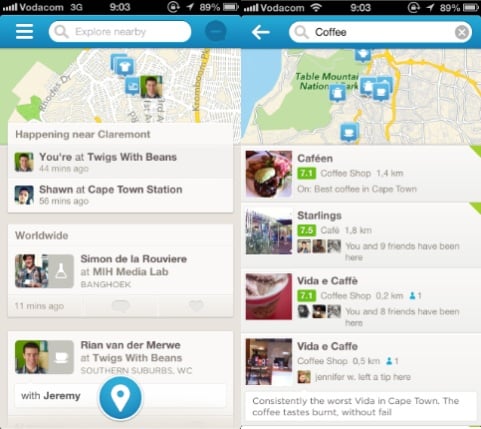
The new Foursquare home screen continues the trend to reduce the hierarchy of the check-in action in favor of telling you what’s happening in your network, and what places you might like to visit (see left side of the screen below). A tap inside the (much more prominent) search bar brings up the interface to show recommended places to visit within a specified category (see right side of screen below).

Foursquare 6.0

See, what Foursquare realized a while ago is that their real power is not in the mayorships and badges that defined them in 2009. The real power — as usual — is the data. It’s knowing what people like and don’t like. It’s knowing where to find good coffee, what restaurants to avoid, and where you should go when you’re in a new city. And they have been shifting towards that vision with steadfast tenacity. Dan Frommer discussed this when Foursquare 5.0 was launched in June 2012:

So: Foursquare has been evolving to a company that no longer simply answers “where are my friends?” but instead “where should I go right now?” This is smart: Everyone’s gotta eat. That’s why Explore is rapidly becoming Foursquare’s most important feature. This has always been part of the plan, I think. But it’s certainly carrying more emphasis in this new version of the app than ever before.

With Foursquare 6.0, the company’s move towards a discovery engine powered by people you like and trust appears to be almost complete. That said, it’s clear that they’re not done (watch out, Path). I’m sure they are thinking of more ways to make the experience better. So even though there are some design irregularities in version 6.0, those will be ironed out through constant iteration while they’re moving towards a clear vision for the future. Like Anil Dash said at the beginning of 2012 in Foursquare: Today’s best-executing startup:

Foursquare’s removed features from the core app a few times, constantly changes the design of its flagship iOS application, and in general asserts its authority over the experience that users have within the Foursquare application. Yet, unlike every single other major social application, they don’t inspire mass user revolts or negative press every time they iterate. […] Part of this is the small, well-paced timing of iteration on the application where there are always small things changing in ways that aren’t wildly disruptive, but do enough to set a tone that users know to expect the furniture might get rearranged once in a while.

So, with all of that said… If you’ve tried Foursquare before and found it lame, I think you should give it another go. It’s not lame any more. Any service that can help you avoid bad coffee makes the world a better place, right? Foursquare is such a service, and so much more.

Oh, one more thing. Posting your Foursquare check-ins to Facebook and Twitter? Still lame.

[Sponsor] Instatim — a social network for close friends and family

Thanks very much to Instatim for sponsoring Elezea’s RSS Feed this week.

Instatim is a more personal social network that helps you stay in touch with your closest friends, family and co-workers. Engineered for privacy, Instatim is unlike other social networks because we do not store information about our users’ past activities and locations. Your status is shared securely and only to people you have chosen.

Here’s what you can do with Instatim:

  • Status Updates: Keep in touch by posting status updates about what you’re doing (walking the dog, meeting a client, etc.) and reading your friends’ statuses.
  • Expiration Dates: Set an expiration for your status so your family knows how long you will be engaged in the activity.
  • Groups: Sort contacts into different groups. Share statuses with specific groups to keep the right people in the right loop.
  • Location: You can choose to include your location with your status so your friends and family know your whereabouts.

Download Instatim for free in the App Store.

Instatim

Sponsorship by The Syndicate.

Facebook is not a website, it's a data set

One of the most interesting analyses I’ve read about Facebook’s ad business and the future of the company is Kurt Eichenwald’s Facebook Leans In. This Marc Andreessen quote stood out immediately as core to a proper understanding of how Facebook works:

None of the people close to Mark and the company think of Facebook as a Web site. They think of it as a data set, a feedback loop.

Kurt does a stellar job of piecing together information from different sources to tell a compelling story:

The Facebook of old—well, of a year ago—is almost irrelevant to the company that exists today, which not only is set to change the world of social networking, but could herald the biggest transformation in American advertising since the advent of television.

That is my conclusion from months of interviews with Facebook ad clients, investors, the company’s senior management and other key executives, as well as reviews of reams of data, including confidential reports. What emerges is a portrait of a widely misunderstood company that has quietly been pioneering a marketing business model unlike any other in Silicon Valley—or, for that matter, Madison Avenue.

It’s a long article, but if you’re at all interested in how Facebook is redefining the ad business, it’s a must-read.

(link via @kbaxter)

The luminous squares of our digital lives

In Why You Won’t See My Child (Or Even His Name) On Facebook Caitlin Shetterly explains why she and her husband never post anything identifiable about their son online. My wife and I have some guidelines around the kind of stuff we post about our daughters too, albeit much less strict. This part got to me, though:

One of my favorite poems is called “Les Fenêtres” (“Windows”), by the French Symbolist poet Charles Baudelaire. In it, Baudelaire writes about looking out his own window and into those of his neighbors: “What one can see out in the sunlight is always less interesting than what goes on behind a window pane. In that black and luminous square life lives, life dreams, life suffers.” […]

In our lives today, once we put up our luminous squares on Facebook, we can’t really take them back. There is no curtain to close, no window to board up — they’re out there forever, no matter what you delete.

That’s something to keep in mind. Every photo is a window that can’t be boarded up.

How weather channels are turning no news into bad news

Gales Gone Wild, apart from being a great headline, is also a very interesting post by Timothy Egan on the changing role of weather sites and channels:

The scourge of 24-hour news, in which stuff that isn’t important gets its own countdown clock, is now doing to the weather what it did to public affairs and the stock market. It’s making us all a little jumpy and anxious, with a twisted view of the normal rhythms of the seasons.

Phrases like “meteorological thugs” and “cable television barker” makes this a delightful read, but Timothy also makes a scary observation:

The effect is to trivialize the real thing, to put breathless graphics and histrionics ahead of science and public safety.

Maybe it’s time for us to tone down our love affair with weather apps. Or, just switch to Merlin Mann’s new app:

Merlin Mann minimalist weather app