Menu

Posts tagged “social media”

How Facebook makes us feel inadequate

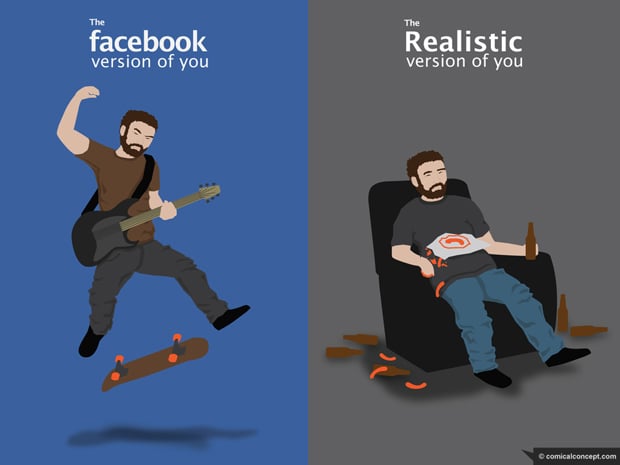
Why Generation Y Yuppies Are Unhappy is such a brilliant post. Funny, way too true, and great illustrations. It follows the story of Lucy, a fictional Gen Y yuppie who is not having such a good time right now. This part about social media sites (or what I guess is known as Facebook image crafting) really stuck with me:

Social media creates a world for Lucy where A) what everyone else is doing is very out in the open, B) most people present an inflated version of their own existence, and C) the people who chime in the most about their careers are usually those whose careers (or relationships) are going the best, while struggling people tend not to broadcast their situation.  This leaves Lucy feeling, incorrectly, like everyone else is doing really well, only adding to her misery

So that’s why Lucy is unhappy, or at the least, feeling a bit frustrated and inadequate. In fact, she’s probably started off her career perfectly well, but to her, it feels very disappointing.

I increasingly feel like Facebook has become a cacophony of ads and fake happiness, and I’m extremely turned off by it. I’m trying out Path again (I know, hypocrisy!), and I’m enjoying the quietness and sincerity there. It’s such a stark, appealing contrast to the endless shouting on Facebook.

The real Facebook

Where the hashtag really comes from

Keith Houston’s fascinating essay The Ancient Roots of Punctuation begins like this:

The story of the hashtag begins sometime around the fourteenth century, with the introduction of the Latin abbreviation “lb,” for the Roman term libra pondo, or “pound weight.” Like many standard abbreviations of that period, “lb” was written with the addition of a horizontal bar, known as a tittle, or tilde. And though printers commonly cast this barred abbreviation as a single character, it was the rushed pens of scribes that eventually produced the symbol’s modern form: hurriedly dashed off again and again, the barred “lb” mutated into the abstract #.

Which is why the hashtag is often referred to as the pound sign. Keith also explains the origins of the Pilcrow (¶), the Ampersand (&), the Manicule (☞), and the Diple (>). Great article.

The city as panopticon

I continue to be fascinated by the smart city movement. The multiplexed metropolis is a very interesting look by The Economist at the pros and cons of connecting cities through open access to all kinds of information:

But clever cities will not necessarily be better ones. Rather than becoming paragons of democracy, they could turn into electronic panopticons in which everybody is constantly watched. They could be paralysed by hackers, or by bugs in labyrinthine software. They could furnish new ways to exclude the poor. They might even put at risk the serendipity that makes cities such creative places, argues Richard Sennett, a sociologist at the LSE, making them “stupefying” instead.

I have to admit that I had to look up the word “panopticon” — and it’s such a great analogy. From Wikipedia:

The Panopticon is a type of institutional building designed by English philosopher and social theorist Jeremy Bentham in the late 18th century. The concept of the design is to allow a watchman to observe (-opticon) all (pan-) inmates of an institution without their being able to tell whether they are being watched or not.

Let’s hope we can avoid this…

What happens when we gut stuck doing something online

I love the phrase “getting caught in the melancholy of the infinite scroll.” That’s just one gem from Alexis Madrigal’s The Machine Zone: This Is Where You Go When You Just Can’t Stop Looking at Pictures on Facebook. He explores this strange dark side of “flow”, where we get stuck in an online activity and can’t stop doing it, even though there’s no tangible benefit:

What is the machine zone? It’s a rhythm. It’s a response to a fine-tuned feedback loop. It’s a powerful space-time distortion. You hit a button. Something happens. You hit it again. Something similar, but not exactly the same happens. Maybe you win, maybe you don’t. Repeat. Repeat. Repeat. Repeat. Repeat. It’s the pleasure of the repeat, the security of the loop.

We certainly do seem to treat “pull to refresh” like a slot machine in a casino. And the chances of winning something valuable are about the same, too.

Emoji and post-literacy

In The ‘Mood Graph’: How Our Emotions Are Taking Over the Web Evan Selinger writes about the rise if emoji and other emotional signals in social media:

But there are costs to a mood graph too. The more we rely on finishing ideas with the same limited words (feeling happy) and images (smiley face) available to everyone on a platform, the more those pre-fabricated symbols structure and limit the ideas we express. Such general symbols can also lead to even more confusion or misunderstanding due to cultural, generational, and other differences.

And finally, drop-down expression makes us one-dimensional, living caricatures of G-mail’s canned responses — a style of speech better suited to emotionless computers than flesh-and-blood humans.

It’s a great article well worth reading all the way through. This trend is a continuation of something I’ve discussed quite often here over the years: our move towards a post-literate society:

What is post-literacy? It is the condition of semi-literacy, where most people can read and write to some extent, but where the literate sensibility no longer occupies a central position in culture, society, and politics. Post-literacy occurs when the ability to comprehend the written word decays. If post-literacy is now the ground of society questions arise: what happens to the reader, the writer, and the book in post-literary environment? What happens to thinking, resistance, and dissent when the ground becomes wordless?

I find myself here in full agreement with Guy English from his post Learn to X:

But, let’s not kid ourselves, literacy is the new literacy. The ability to read, comprehend, digest and come to rational conclusions — that’s what we need more of.

Emoji are fine, and I’m as much a fan of the animated gif as anyone. But I do feel like we’re trying to create all these shortcuts to express our emotions because it’s hard to do it in words. The thing is, though, it should be hard to express our emotions. That’s how we understand them and work through them. So let’s go easy on the giphy.com searches every once in a while, and try to find the right words instead.

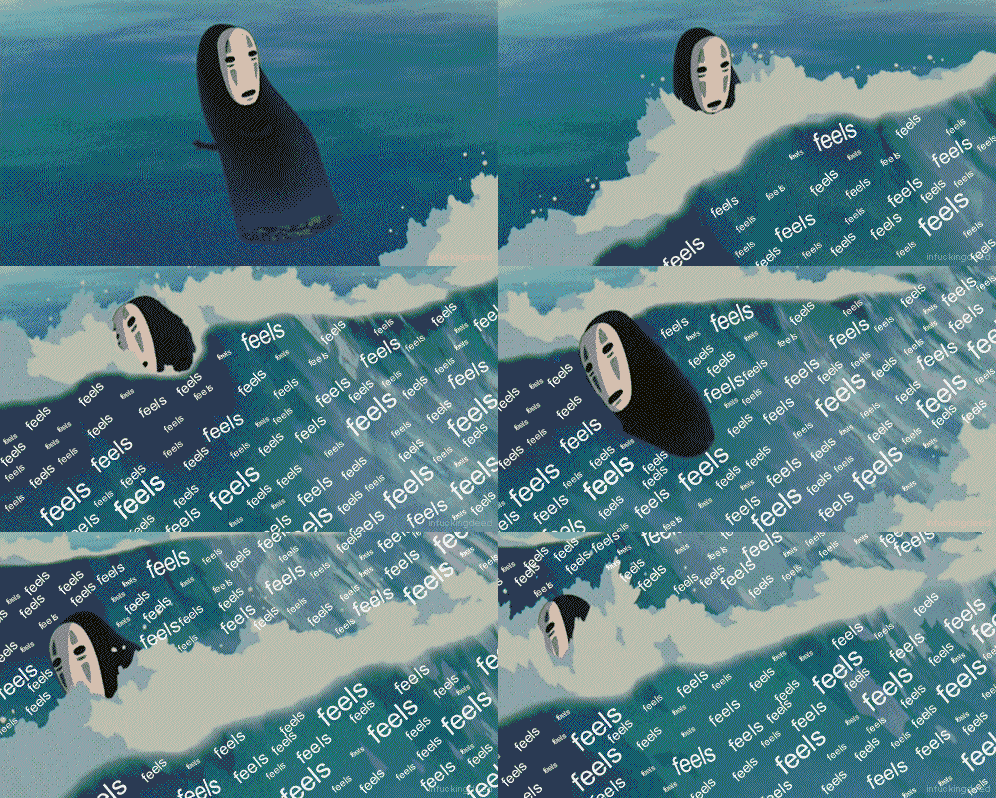
The Feels

Loneliness, social networks, and the power to get up

Geoff Livingston wrote a great essay called Is Existing Online a Quest of Loneliness or Giving? It’s worth reading the whole thing, but here’s an excerpt that stuck out for me:

We exist in a time where anyone can determine and create unique lives online, accountable to no one, yet visible to and dependent upon all. Digital existentialism extends the sense of modernistic distress. There are so many red herrings and lost pursuits that distract. You can drug yourself digitally with almost any pursuit, and at the end find yourself nano-famous and alone.

That last line is so spot on. I thought about it again when I saw Shimi Cohen’s excellent video The Innovation of Loneliness, which is making the rounds this week:

Later in his post Geoff says this:

We exist in the moment. Every effort spent, every tap on the keyboard provides a chance to impact an individual, contribute to the world, and add light to the picture.

Sure, efforts can lead towards darkness. Sometimes when we awaken to our outcomes, we realize the fruitlessness, or worse the destructiveness of our actions. What are you going to do, condemn yourself to the desert for a long march of hermitage? Or get up?

This is another good point. We’re all going to make mistakes. We might look at that video and feel like helpless victims. But that’s not true. We do have the power get up, to connect with people in a way that doesn’t just ignore the bad bits (I tried to do that here, and it worked out ok).

Related to this, I really enjoyed Chris Bowler’s Congestion, in which he discusses some ideas on how we might deal with this new reality of overload and over-connection:

To create is better than to consume.

But create for the few, not for the many.

Create for those you can see face to face.

Consume, but remember that the dose makes the poison.

When you consume something that is good, great, transcendent, consume it over and over … meditate on it, then act on it, be changed by it.

So much has been written about this topic, but I really like the common theme that runs through these posts and video: we are not victims of technology. We have a choice.

If software is eating the world, Medium is eating its content.

Medium

About two years ago Marc Andreessen proclaimed that software is eating the world (beware the WSJ paywall):

My own theory is that we are in the middle of a dramatic and broad technological and economic shift in which software companies are poised to take over large swathes of the economy.

We’ve seen this shift toward software in the content arena too, where it’s impossible to ignore the constant stream of stories about the struggles of print media. And lately, it seems that Medium is emerging as the first major successful content platform since the shift started. It feels like every second or third link on Twitter points to a Medium post, and somehow being on Medium gives content the perception of a certain level of prestige.

Why is that? Why is this platform so successful, and why does it have such a strong brand? I don’t agree with the direct comparison and the premise that Quora vs. Medium is an actual winner-takes-all situation, but AJ Juliani makes an interesting point about this in Why Medium May Succeed Where Quora Did Not:

Medium is about stories. Quora is about answers. And people love stories. Our favorite way to learn is through stories and narrative.

Medium is certainly a great platform for reading stories, and the tools available to writers make it a great creation experience as well. But there’s also been pushback recently on Medium’s apparent dominance in the individual writer domain. The biggest concern is that we don’t know what Medium’s plans are, and that authors are therefore giving up their words to an unknown entity. Here is Glenn Fleishman in Why You Should Be Your Own Platform:

I’ve written a few things on Medium (not paid) because I liked the experience of their writing tools, their statistics, and their reach. […] But it’s not mine. It’s theirs.

I can’t control the URL. I can’t embed. I have no idea about what their ultimate plans are. They could delete all non-owned/paid content in the future with no notice. They could rework the design and it would be ugly. My words’ persistence, both in appearance and permanent location, are dependent on factors beyond my control.

Marco Arment takes this argument further in Medium and Being Your Own Platform

Treat places like Medium the way you’d treat writing for someone else’s magazine, for free. It serves the same purpose: your writing gets to appear in a semi-upscale setting and you might temporarily get more readers than you would elsewhere, but you’re giving up ownership and a lot of control to get that.

As for me, I love the writing (and reading) experience on Medium. But I do have concerns that are big enough to make me take a step back:

  • Medium seems to be more about Medium than about authors. I don’t think we should move our personal blogs there — it’s already getting too crowded, and I still believe we should all own our own identities online.
  • Related to the last point: the idea of organizing content around topics (collections) is great, but there is no way to follow collections easily. RSS feeds are difficult to find, and it seems the only way to see what’s new in a collection is to go to its URL. This makes me worried about a walled garden approach to the content, similar to how Twitter and Google+ restrict how you can add and extract content.
  • There’s some great content being surfaced by the editorial team, but there are also a lot of duds when you dig a bit deeper into the collections. And by expanding the platform so quickly the noise is becoming louder. I’m worried Medium is quickly going to outgrow their initial focus on providing quality over quantity.

If we’ve learned anything over the past few years, it’s that we should be wary of platforms that offer large audiences at a price of admission that is not immediately apparent (See Facebook, Instagram, Twitter…).

The barrier to setting up your own site has never been lower (if you’re not into WordPress, try Scriptogr.am or Octopress). Yes, building an audience on your own platform is much harder than hoping to get picked by the Medium editorial team. But the longevity and the satisfaction you’ll get from maintaining your own voice is so much higher. Don’t give that away.

Facebook's brilliant mobile advertising strategy

Ben Thompson’s stratēchery has become one of my favorite sites. His insight into the tech world gives me a new perspective with every post. Recently he discussed what makes the Facebook app so compelling in Mobile Makes Facebook Just an App; That’s Great News:

Brand advertising on Facebook’s app shares the screen with no one. Thanks to the constraints of mobile, Facebook may be cracking the display and brand advertising nut that has frustrated online advertisers for years. […]

[Facebook] is the most indispensable tech product in most people’s lives, and every time one of those billion people use the mobile app, they see an advertisement that completely owns their device’s screen, if only for a moment.

“Ads in users’ faces” is certainly a great sell to advertisers, but I do wonder how far they can push it before people feel like their entire feed is taken over by advertising, and there’s just not enough content from their friends any more.

[Sponsor] Digg Reader: a Google Reader replacement

My thanks to Digg Reader for sponsoring Elezea’s RSS feed this week. If you haven’t settled on a Google Reader replacement (or even if you have), check it out!

Digg (yes, that Digg) has released a new RSS Reader for the web, iPhone, and iPad (Android coming soon). The design is sleek and clean, and the apps are speedy and efficient.

Whether you’re a hardcore RSS junky or simply want all your favorite online reading in one place, Digg Reader is for you. It’s free and available today!

Digg Reader

Sponsorship by The Syndicate.

The importance of Reddit

Ethan Zuckerman in Reddit: A Pre-Facebook Community in a Post-Facebook World:

Because Reddit connects strangers, it has certain advantages over Facebook, which connects friends. Ideas may spread more widely from Reddit than from Facebook despite a smaller pool of users. An idea shared between Facebook friends may peter out quickly as social networks reach saturation: an idea spread through friends who went to the same college may lose momentum when all alumni have heard about it.

Reddit users are connected to many different communities, and an idea spread on Reddit’s front page may go on to spread in thousands of different groups of friends on Facebook. This power to disseminate ideas to many different social subnets may explain why Reddit memes often go viral and why Reddit has emerged as a key node in online activism.

In social network theory terms, Reddit has figured out how to tap into “the strength of weak ties”1, whereas information on Facebook tends to keep getting recycled among people who already share strong ties offline.

Luke Kingma also touches on this strength in his interesting post The Next Great Social Network Will Not Put Relationships First:

The vast majority of us are not fortunate enough to have an incredibly diverse and interesting network of friends, family, and colleagues. Reddit works because the measure of a user is the content he shares, not the company he keeps. Moreover, visibility on Reddit is directly proportional to one’s utility in a given conversation. As a result, we are exposed to more interesting people, ideas, and perspectives.

This access to experts on any topic imaginable is what makes Reddit so powerful. The principle of content > relationships is probably also why Medium doesn’t have a follower model for its authors, but instead organizes content in topic collections. But Medium is a different topic altogether — I’ll post some thoughts on that platform soon.


  1. See my article How to increase the value you get out of social media for an extensive discussion of social network theory and weak ties.