Menu

Posts tagged “social media”

A product strategy approach to understanding Facebook, Instagram, and WhatsApp

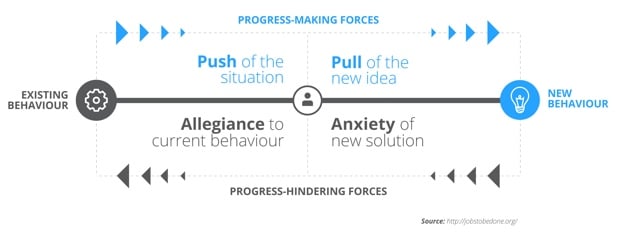
A few months ago I wrote about the forces at work when people choose a product. I discussed the Jobs-To-Be-Done concept of Progress-Making Forces, and shared this diagram to illustrate what happens when we try to get people to use our product instead of someone else’s:

Progress making forces

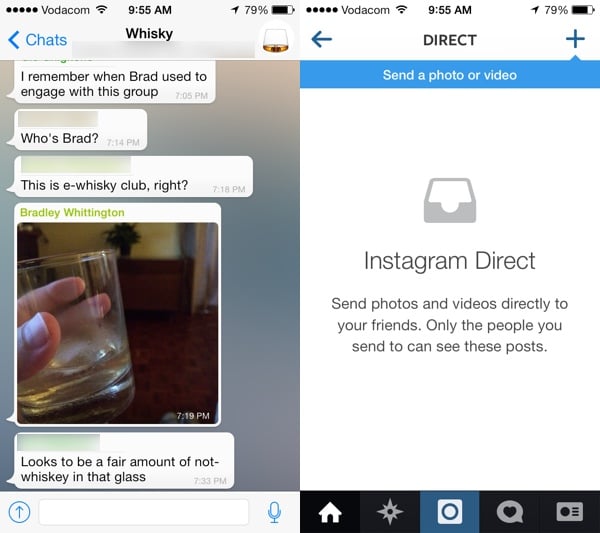
In this article I want to discuss this framework in the context of a practical example: WhatsApp vs. Instagram Direct (now both owned by Facebook). I started thinking about this recently after MG Siegler wrote his post Going Against The Grain:

We’re seeing over and over again now that the behemoths can’t simply add a startup’s functionality into their own app as a feature and kill said startup. But it’s equally important to note that if you are able to establish your startup, especially those in app form, it may be hard to get your users to do anything other than what they originally came to do. Especially if the new functionality is against the grain in any way.

So, let’s consider this statement in the context of the Progress-Making Forces, and apply it to Instagram’s decision to add private photo sharing with Instagram Direct. First, let’s talk about existing photo sharing behavior. How do people currently send photos to each other? Facebook used to be the king of photos, but people are increasingly using messaging apps for this instead:

WhatsApp is processing 500 million images per day, compared to 400 million Snapchat (“snaps”) per day, which could include photos or videos. For its part, Facebook processes a comparatively paltry 350 million photos a day.

Enter Instagram Direct, a way for Facebook to try to claim back some of the private photo sharing pie. That’s the new behavior in the context of the the forces diagram. So the big question for Facebook is this: How do you get people to move their private photo sharing from WhatsApp (existing behavior) to Instagram (new behavior)? According to our framework, the progress-making forces need to be stronger than the progress-hindering forces, so let’s look at each force in turn:

  • Push of the situation. Is there anything people are not able to do by sending photos through WhatsApp that they wish they could do? It doesn’t seem that way. Some of the biggest advantages of using WhatsApp for photos are that (1) it’s completely private, and (2) it ties into your phone’s camera roll, so you have access to any photo, not just the ones from a particular app.
  • Pull of the new idea. Is there anything in Instagram Direct that could entice people away from WhatsApp? Again, it doesn’t look like it. Using Instagram Direct is simply more work than using WhatsApp for photos. If the photo isn’t in Instagram yet you have to import it. You have to apply a filter because that’s what you do in Instagram. Only then can you send it. But then the entire conversation is centered around photos. You still have to use WhatsApp for text messaging. So now you’re communication is fragmented, while it’s all seamlessly integrated in WhatsApp. There’s no pull here.
  • Allegiance to current behavior. How strongly are people attached to their WhatsApp experience? Extremely. The benefits of having all conversations and photos centrally located in WhatsApp can’t be overstated. You’re not just sending photos, you’re talking about life. It becomes a timeline of your relationships, and everything is there.
  • Anxiety of new solution. How worried are people that the shift would ruin their experience? Well, it seems there would be quite a bit of anxiety involved in moving to a product that doesn’t support the functionality you’re used to, and sits within a walled garden.

This analysis clearly shows that while the progress-making forces for moving people to Instagram Direct are relatively weak, the progress-hindering forces are extremely strong. This keeps people glued to WhatsApp, and it explains Instagram Direct’s apparent failure.

So what happened here? I think Facebook realized that they won’t be able to change people’s existing photo-sharing behavior. And that’s why they bought WhatsApp.

Whatsapp Instagram Direct

How teens use Facebook and Twitter

Evie Nagy did a fascinating interview with danah boyd about her new book, It’s Complicated: The Social Lives of Networked Teens. On how teens use Facebook and Twitter:

They’re also more likely to have protected accounts, and use it to talk to a small group of their actual friends. To them Facebook is everyone they ever knew, and Twitter is something they’ve locked down to just a handful of people they care about — which is often the opposite of how adults use them.

A lot of the teens I talk to, they’ll have like 30 followers. It’s a small world for them, as opposed to trying to grow large followings. There are teens who are themselves microcelebrities, which is a different game. There are also a lot of teens who use Twitter around interests. An obsession with One Direction, and just talking to other One Direction people. That becomes Twitter, and then they’ll use Instagram with another group of friends. This one girl I talked to said, ‘Yeah, if you’re not into the things that I’m into, don’t follow me on Twitter.’

I’ve long been a fan of danah’s work, so I just bought the book and can’t wait to read it.

Related, Kayleigh Roberts wrote a very interesting article on how teens try to get celebrities to follow them on Twitter. From The Psychology of Begging to Be Followed on Twitter:

It’s not rare for a teen who is spamming to reach what is known as the tweet limit, something that the average user of the site might not even know exists. The tweet limit is 1,000 tweets per day, and many teens reach it regularly, especially when seeking the attention of a celebrity. It may seem excessive, but celebrities with millions of followers receive so many tweets, that it’s easy for even 1,000 to go unnoticed. Reaching the tweet limit can happen by accident, but it’s often a premeditated decision.

This is a world I didn’t even knew existed. I feel pretty old right now.

The strangeness of the Flappy Bird phenomenon

Flappy Bird gif

Flappy Bird — that insufferable iOS game — has been in the news quite a bit recently. One of the more incensed “reviews” comes from Paul Tassi’s Winged Fury:

Flappy Bird is not a game. It’s an addictive collection of pixels you don’t win, you simply play until you’re frustrated enough to delete it. And yet, it’s tapped into some primal sense of accomplishment for this, the attention-deficit world we live in. Have nothing to do for more than a few moments? Whip out your phone and flap your way through some pipes. You’ll be dead in seconds with each attempt, and therefore the game can kill any span of time from half a minute to hours. […]

The time spent there is lost forever. The skill required to achieve high scores is wasted potential with no benefit whatsoever to the player. To brag about a score here is to boast to a friend how many times you managed to punch a brick wall before stopping.

Ian Bogost’s The Squalid Grace of Flappy Bird starts like this:

Games are grotesque.

And it he only gets angrier from there:

Flappy Bird is a perversely, oppressively difficult game. […] Flappy Bird is not difficult to challenge you, nor even to teach the institution of videogames a thing or two. Rather, Flappy Bird is difficult because that’s how it is. It is a game that is indifferent, like an iron gate rusted shut, like the ice that shuts down a city. It’s not hard for the sake of your experience; it’s just hard because that’s the way it is. Where masocore games want nothing more than to please their players with pain and humiliation (thus their appropriation of the term “masochism”), Flappy Bird just exists. It wants nothing and expects even less.

Look, way too much time has been wasted discussing how much time people are wasting on Flappy Bird. Still, it’s just so exactly like the internet to latch onto a phenomenon like this and then blow it completely out of proportion — and in the case of Forbes and The Atlantic, turn it into some highbrow existential reflection. It’s why I hate the internet, and it’s why I love the internet, all wrapped up into one silly little game.

But perhaps the last word should go to Bogost:

For no matter how stupid it is to be a game, it is no less stupid to be a man who plays one.

The issue with @HistoryPics and lack of attribution

Internet

I rarely find myself in a position where I want to “engage” with the company who makes my toothpaste, so I generally don’t follow brands on Twitter (or any non-individual accounts, for that matter). But I recently indulged in a couple of guilty pleasure accounts. Faces in Things posts pictures of (wait for it) things that look like faces, and Behind the Scenes posts (wait for it) behind-the-scenes pictures from iconic movies.

I found the accounts interesting and funny for a while, but then I started noticing a few things that made me uncomfortable. Two things started bugging me:

  1. Photos are never attributed to their original sources, and
  2. These accounts (and several similar ones, most notably History In Pictures) seem to be run by the same people who just end up retweeting their own stuff to create some kind of snowball effect

I started suspecting that these accounts were created to amass hundreds of thousands of followers, only to then be sold to the highest bidder who wants to pimp their products to an unsuspecting audience. It’s a common practice on Facebook (I’ve written about that in The dirty world of Facebook EdgeRank Optimization), but I haven’t seen it on Twitter before.

Anyway, I unfollowed the accounts and didn’t think much more of it.

And then I read Wynken de Worde’s It’s history, not a viral feed1, in which he tears these Twitter accounts apart. He focuses quite a bit on the attribution issue, confirms that most of the accounts exist only for the bait-and-switch sale2, and then concludes:

Feeds like @HistoryinPics make it impossible for anyone interested in a picture to find out more about it, to better understand what it is showing, and to assess its accuracy. As a teacher and as someone who works in a cultural heritage institution, I am deeply invested in the value of studying the past and of recognizing that the past is never neutral or transparent. We see the past through our own perspective and often put it to use for our own purposes. We don’t always need to trace history’s contours in order to enjoy a letter or a photograph, but they are there to be traced. These accounts capitalize on a notion that history is nothing more than superficial glimpses of some vaguely defined time before ours, one that exists for us to look at and exclaim over and move on from without worrying about what it means and whether it happened. […]

And so @HistoryInPics makes me angry not for what it fails to do, but that it gets so many people to participate in it, including people who care about the same issues that I do. Attribution, citation, and accuracy are the basis of understanding history. @HistoryInPics might not care about those things, but I would like to think that you do. The next time you come across one of these pictures, ask yourself what it shows and what it doesn’t, and what message you’re conveying by spreading it.

The inaccuracy of these accounts (see, for example, 12 More Viral Photos That Are Totally Fake) is a huge deal, of course. But for some reason it’s still the lack of attribution that grates me the most. Back in 2009 I adopted Chris Messina’s use of slashtags on Twitter to attribute sources using the syntax “/via @name”. I’ve been using it ever since, and I saw many people who did the same. But it’s a practice that has slowly diminished over the past few years3.

Why is it a big deal to tell people where we found something? Isn’t the web free and open and we’re all one and blah blah blah? Sure, but the web is also fundamentally about hyperlinks. The ability to follow links back to their original sources — with plenty of pleasant detours along the way — is the core of what makes the internet such a wonderful place. Do you ever get happily lost on Wikipedia? Exactly. So if we stop caring about attribution, we rob others of the ability to find more people and topics that they might be interested in. I’ll say it again: It’s not about making the source feel important. It’s about helping others follow the breadcrumbs to places of interest.

So I guess the point of this post is to join in Wynken’s plea that we look at these new crop of Twitter accounts more critically, and call them what they are: get rich quick schemes. And to ask that we remember to take attribution seriously. It’s the right thing to do.


  1. Link via The Loop

  2. Also see Alexis Madrigal’s interesting reporting in The 2 Teenagers Who Run the Wildly Popular Twitter Feed @HistoryInPics

  3. There were other attempts at attribution syntax, of course — most notably the much-mocked curator’s ǝpoɔ

The awkwardness of IM chat indicators

I really enjoyed Ben Crair’s essay on those indicators that show you when someone else is typing during an IM chat — which he calls The Most Awkward Feature of Online Chat. I thought I was the only one who started getting anxious when I see that indicator sit there for more than a few seconds. A quote from Clive Thompson sums it up:

Hmmm, why did they start typing and then stop? Obviously, most of the time this isn’t an issue, but if you’re involved in a sensitive or emotionally charged conversation, these questions of pausing can become emotionally charged themselves!

And this:

But knowing when your partner is typing can also have the unsettling effect that Thompson described: It makes visible the care with which we pick our words. And the more visible this care becomes, the more the reader distrusts the message. Conversation is supposed to feel natural, after all. The quip is less funny if it’s not offhanded. Flirtation is not so flattering if it appears to require labor. And the apology can seem less heartfelt when you know it’s been self-lawyered.

The Internet is hard.

In real life

Justin Jackson’s This is real life is probably one of my favorite posts of the year so far. I don’t want to spoil it, so I’ll just quote this bit:

You see, I can pretend to be cool on the Internet, but in real life I’m just a dad in a bathrobe.

Justin, from a fellow dad in a bathrobe:

High five

If you don't like it, unfollow it

In The Joy of Unfollowing Maureen O’Connor takes on the idea that it’s possible to “do social networks wrong”. Here’s her take on whether it’s possible to “share too much” on Facebook or Twitter:

No. There is no such thing as TMI on the Internet. We are living in a post-TMI age, and everyone needs to deal with it. Preferably by using the “unfollow” button.

There is such a thing as too much information for you. There is such a thing as information the speaker will later regret. But if an audience is willingly and pleasurably consuming the information, then by definition, that is the right amount of information for them. Assuming the information in question is yours to share — your life, your ideas, your stories, your pictures, your theories about elf genealogy in Lord of the Rings — you cannot share too much of it. There are no captive audiences on the Internet. […]

If you follow someone on Twitter and you find that her tweets are too much for you, then you may unfollow her. If you continually recoil at TMI, it’s because you lack the willpower to stop consuming (or foresight to avoid) the information in question. That’s your fault.

We are responsible for the information we take in. We can’t blame other people for that. The hardest (and most important) thing to do, is to realise that it’s ok to let the vast majority of information pass us by.

(link via The Loop)

Technology invasion fear-mongering

Poorna Bell’s So Long, FOMO is making the rounds today:

At nearly every restaurant table I saw, there was at least one person (if not most) who spent most of their time taking photos or video to put on Facebook later, or searching for something on the internet, or playing games or just checking for texts. For more and more of us, technology is taking over, invading even our most personal and private of moments.

This idea that technology is turning us into antisocial monkeys is getting pretty old. Putting photos on Facebook helps you connect with others around the experience. Searching for something on the internet helps you move conversations forward (or change direction completely). All these activities are inherently social. Jason Feifer’s impassioned rejection of Sherry Turkle’s doom-and-gloom ideas provides a very good counterargument to all the fear-mongering:

Turkle imagines that any interaction with technology somehow negates all the time spent doing other things. She also imagines that we must devote ourselves in only one way to every task: At a dinner table, we are only serious and focused on conversation; at a memorial service, we are only mournful. That is not the way we live. It’s never been the way we live. And that’s the beauty of technology, which Turkle cannot see: We can use it for all purposes, to express joy and sadness, to have long conversations or send short texts. We made it. It is us.

It’s time for us to realise that we are evolving the way we communicate with each other, and that’s ok. I’m not saying we shouldn’t be mindful about how much time we spend staring at our phones, but we should recognize how much more social our devices are making us. Clive Thompson points this out in his book Smarter Than You Think:

What are the central biases of today’s digital tools? There are many, but I see three big ones that have a huge impact on our cognition. First, they allow for prodigious external memory: smartphones, hard drives, cameras, and sensors routinely record more information than any tool before them. We’re shifting from a stance of rarely recording our ideas and the events of our lives to doing it habitually. Second, today’s tools make it easier for us to find connections—between ideas, pictures, people, bits of news—that were previously invisible. Third, they encourage a superfluity of communication and publishing. This last feature has many surprising effects that are often ill understood.

And we should also remember that it’s not up to us to tell people how to experience the moments that are important to them. As usual, XKCD says it best:

Photos

The networked camera

Craig Mod’s Goodbye, Cameras kicked off an interesting discussion on the future of photography and connected devices:

As I’ve become a more network-focussed photographer, I’ve come to love using the smartphone as an editing surface; touch is perfect for photo manipulation. There’s a tactility that is lost when you edit with a mouse on a desktop computer. Perhaps touch feels natural because it’s a return to the chemical-filled days of manually poking and massaging liquid and paper to form an image I had seen in my head.

Yet if the advent of digital photography compressed the core processes of the medium, smartphones further squish the full spectrum of photographic storytelling: capture, edit, collate, share, and respond. I saw more and shot more, and returned from the forest with a record of both the small details — light and texture and snippets of life — and the conversations that floated around them on my social networks.

Also see Camera makers are desperately trying to stay a step ahead of smartphones—and failing and Connectedness for some interesting follow-up discussions.

Mixing public and private moments on social networks

Megan Garber takes on Instagram Direct1 in Behold, Facetwitterest: The Standardized Future of Social, and makes this observation:

So one of the biggest challenges facing the major (and the trying-to-be-major) social networks is a structural one: How do you build yourself up and out in ways that balance users’ desire for intimacy with their desire for publicity? How do you merge the web’s ability to create communities with its ability to create universalities? 

You could read Direct as Instagram’s (and Facebook’s) latest attempt to navigate that tension. The service is, basically, attempting to add a layer of privacy to its existing, public-leaning architecture. But Instagram isn’t just Snapchatting itself. It’s offering its users a Snapchat-like functionality within the context of its much more public social network. It’s trying to have it both ways — cynically, but perhaps ingeniously — by offering a refuge of privateness within a very public service.

It reminds me of something Luke Wroblewski said recently:

Every mobile app attempts to expand until it includes chat. Those applications which do not are replaced by ones which can.

Direct appears to be a necessary defensive move by Instagram — private messaging is now a basic expectation for social networks. But it also looks like people are getting more savvy about their privacy and what happens to their data (Thanks, NSA!), so it will be interesting to see how this mixing of public and private plays out in 2014.


  1. The ability to send photos privately to people in your network