Menu

Posts tagged “product strategy”

Airbnb's data-driven design success

Cliff Kuang wrote an interesting article about design at Airbnb called How Airbnb Evolved To Focus On Social Rather Than Searches:

For a couple years, registered Airbnb users have been able to star the properties they browse, and save them to a list. But Gebbia’s team wondered whether just a few tweaks here and there could change engagement, so they changed that star to a heart. To their surprise, engagement went up by a whopping 30%. The star, they realized, was a generic web shorthand and a utilitarian symbol that didn’t carry much weight. The heart, by contrast, was aspirational.

Cliff goes further to explain how Airbnb followed the data clues to understand exactly why the heart performed better, and then used those insights to make some very successful design changes. The data is there, we just have to measure, listen, and respond.

(link via @iamFinch)

Good design is good for business

Cliff Kuang has a great article in Fast Company called Why Good Design Is Finally A Bottom Line Investment. He tells a bunch of stories about companies who realized that good design is good for business, and he also covers some of the organizational challenges:

When designers lack influence, superb products become almost impossible. Good designs seldom stay good for very long if they must navigate a gauntlet of corporate approval. That’s because the design process is as much reductive as anything else — figuring out what can be simplified and taken out. Corporate approvals are usually about adding things on to appease internal overseers. When something has been approved by everyone, it may be loved by none.

That last sentence reminds me of the old Seth Godin quote: “Nothing is what happens when everyone has to agree.”

iPhone 5, the local maximum, and an important lesson for startups

Last week I used a product development theory called the Kano Model to explain why it’s wrong to be disappointed with the iPhone 5. I wrote the article just before the launch event, and lo and behold, it didn’t take long for the Internet to start yawning:

Um, it’s a little bit longer. Really Apple? You spent months in court fighting Samsung and portraying yourself as the world’s only truly innovative company and this is the best you can do? A phone that looks like what would happen if phones were capable of inbreeding?

Today I’d like to explore the fallacy of this kind of disappointment further using a mathematical theory I alluded to in my previous article, Maxima and Minima:

In mathematics, the maximum and minimum of a function are the largest and smallest value that the function takes at a point either within a given neighborhood (local or relative extremum) or on the function domain in its entirety (global or absolute extremum)

More specifically, I want to discuss the idea of the local maximum within the context of product development, and how that relates to innovation. For the purposes of product development, I liken the mathematical concept of neighborhood to product. For example, the iPhone (as a product) will hit a local maximum when the current design cannot be improved any more. This isn’t necessarily the best product you can make in the entire industry, but it is the best iteration of the current product1.
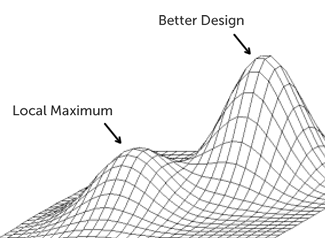
Local Maximum

(Image source: 52weeksofux)

To explore this further, we also have to differentiate between the concepts of iteration and variation. In product development, variation is a way to explore a bunch of alternative product solutions. In contrast, iteration solidifies the product idea that gets chosen. To quote Jon Kolko: “Where an iteration moves an idea forward (or backwards), a variation moves an idea left or right.” Or, to put it into the language of maxima and minima, variation surveys the landscape to help companies choose the right neighborhood (product) to move into. Iteration then helps them to find the local maximum in their chosen neighborhood.

Now, let’s look at the iPhone. Because of the Samsung trial we know that Apple did a great deal of variation work before they chose their neighborhood. See, for example, this sketch of different possible designs from a slide show on AllThingsD:

iPhone prototype

(Image source: AllThingsD)

If you dig deeper into the slide show you’ll see many variations they considered before settling on the basic design for the original iPhone.

It’s not just the hardware though, of course. There’s also iOS. As far as I’m aware there aren’t any early sketches for iOS publicly available, but I’m willing to bet a lot of money that they didn’t just sketch one thing and then designed it that way. It’s pretty safe to assume that the variation process on iOS was every bit as rigorous as for the iPhone hardware.

Once they’ve done a bunch of variation work on the hardware and software for the iPhone, Apple chose their neighborhood and started iterating. There were some major improvement jumps along the way (like iOS2, and iPhone 4), but it’s all still in the same neighborhood.

So let’s get to the crux of the matter. From an engineering perspective, variation is expensive, iteration is cheap. Especially if a product is already out there. Apple is able to give away the iPhone 4 for free because they have been iterating on the hardware for so long that they can manufacture the phones very cheaply. If the iPhone 5 was a drastically different phone (I’m talking about a completely different neighborhood), everything would have started from zero.

From a business perspective, why would Apple choose to make a very expensive move to a different neighborhood, when they know that they haven’t hit the local maximum on the current phone yet? Apple is iterating because they understand this concept, and because they know that the only thing that matters is if customers like it. As John Gruber said:

The collective yawn from the tech press was louder this year; the enthusiasm from consumers is stronger.

What does it mean for startups?

There are some important lessons for startups in the story of the iPhone evolution.

First, spend as much time and money as you can afford on variation upfront, because if you move into the wrong neighborhood, it’s really hard to change that later on. Some companies have done it successfully, like when Path completely redesigned their product from the ground up. Other companies are finding it really hard to move, as evidenced by the almost universal disdain for the new Twitter app for iPad2. And the jury is still out on whether Microsoft’s very expensive foray into the tablet OS world will be a success or not.

Second, don’t move to a new neighborhood until you’re absolutely sure that you’ve hit the local maximum right where you live. I’ll say it again - iteration is cheaper than variation. Instead of trying to rethink your product every few months/years, rather spend time to understand how you can make the current variation better. Apple is proof that this strategy pays off.

I have a feeling that Apple isn’t going to move out of their phone neighborhood any time soon. They might send some family members to buy a new house in the TV neighborhood. But when it comes to phones, they’re still on to a good thing, and they’re smart enough not to be tempted by the fake grass on the other side of the “change everything!” fence.


  1. In Is the iPhone good enough?, Horace Dediu speculates on whether the iPhone 5 has hit the local maximum yet. It’s a must-read piece. 

  2. I’m not as negative about the app as most people, because I understand where it’s coming from. The Twitter design team are most likely operating under some very specific business constraints, and they are doing everything they can to provide a good experience within those constraints. It’s a business, after all. 

Facebook’s activity problem

Kevin Kelleher in Facebook’s Growing Silent-Majority Problem:

This third group – the silent majority of Facebook users – hold the key to the company’s future. Facebook is never going to win over its harshest critics, and it’s unlikely to alienate the people who see it as part of the fabric of their everyday lives. If the company can persuade that silent majority to become more engaged in the site – interacting with bands, liking consumer brands, clicking on the ads targeted to their surfing habits – its future looks pretty bright.

I always find it useful to think about engagement metrics on the web in terms of the three A’s:

  • Acquisition. Getting new users to sign up for a site/service.
  • Activation. Getting those new users to make their first contribution/purchase.
  • Activity. Getting the first-time contributors/purchasers to repeat that activity over and over.

Facebook certainly doesn’t have an acquisition problem (yet), and their ramp-up process is very good, so I also don’t think they have an activation problem. But I can definitely see the argument that they might have a serious activity problem on their hands. Kevin shares some interesting engagement stats, as well as how he thinks Facebook can solve this problem.

(link via @mobivangelist)

Building slow companies

Jason Fried has a great interview on Fast Company:

Look at what the top stories are [on TechCrunch], and they’re all about raising money, how many employees they have, and these are metrics that don’t matter. What matters is: Are you profitable? Are you building something great? Are you taking care of your people? Are you treating your customers well? In the coverage of our industry as a whole, you’ll rarely see stories about treating customers well, about people building a sustainable business.

The story about his business icon is great as well.

Good riddance to the free web

Cap Watkins says goodbye to getting stuff for free — and celebrates a better way — in Death of the Free Web:

As a result, the web is becoming more localized, more niche. And what startups are beginning to realize is that they don’t need to be the next Facebook or Twitter or Google to achieve success and to grow a large, sustainable business. What they need to do is create products that connect with these small, but passionate groups of like-minded people. Instead of passionate users making up the minority of a product’s customers, the new goal is to make them the majority from the start. Because those passionate customers, it turns out, create even more passionate customers.

Cap gives some good examples as well. His post argues for a similar approach to what I discussed in Imagining a future without traditional marketing.

(link via @bokardo)

An argument against the innovation argument

I’m trying very hard to understand Samsung’s argument that losing the patent case with Apple is “a loss for the American consumer” and “will lead to fewer choices, less innovation, and potentially higher prices”. It just doesn’t make sense. Jim Dalrymple states the obvious fallacy of this line of thinking in The innovation argument:

If Samsung is forced to stop copying Apple, there is only one option left — innovate. Instead of sitting back and making their phones and tablets look exactly like the iPhone and iPad, Samsung will now have to do some work. The hardware and software will have to be different, unique and innovative.

Marco Arment phrased it slightly differently:

What’s really going to disrupt the iPhone is going to be something completely different, not something that tries so hard to clone the iPhone that it hits Apple’s patents.

Unoriginal manufacturers will need to pay for their unoriginality. The most reasonable course of action, therefore, is to truly innovate and design products that aren’t such close copies.

Apple’s patent victory is a good thing for consumers. We don’t need companies that try to be Apple. But we do need more companies that solve difficult problems in elegant ways.

The disciplined pursuit of fewer features

Greg McKeown’s The Disciplined Pursuit of Less is an article about careers, but his solid advice also applies to software product development:

If success is a catalyst for failure because it leads to the “undisciplined pursuit of more,” then one simple antidote is the disciplined pursuit of less. Not just haphazardly saying no, but purposefully, deliberately, and strategically eliminating the nonessentials. Not just once a year as part of a planning meeting, but constantly reducing, focusing and simplifying. Not just getting rid of the obvious time wasters, but being willing to cut out really terrific opportunities as well. Few appear to have the courage to live this principle, which may be why it differentiates successful people and organizations from the very successful ones.

Imagining a future without traditional marketing

I turned off satellite TV at our home about 5 months ago. This wasn’t some moral stand against the horrors of technology. It was simply a matter of return on investment. Satellite TV is ludicrously expensive in South Africa, and my wife and I are so happy with our Apple TV setup that I couldn’t justify the cost any more. I wondered if we would have some withdrawal symptoms, but I can honestly say I’ll never go back to satellite. I do miss the odd live sporting event, but that’s not compelling enough to fork out a gazillion dollars every month just to see some guy yelling about cake.

The side benefit of this decision is that we haven’t seen a TV commercial in 5 months. Combine that with my practice of doing most of my online reading in Instapaper, and things start to get interesting. The sheer volume of advertising I used to be bombarded with forced me to tune it all out. But now that it’s a bit scarcer I notice every ad I come across. And I don’t like what I see. It’s especially jarring on Facebook, where “Promoted pages” are starting to annoy the crap out of me. I used to scroll through them without a second thought, but now I grit my teeth as they fly by.

This got me thinking about the current state of traditional marketing, and what a future without it might look like.

RIP traditional marketing

I believe that marketing as we currently know and practice it is well on its way to extinction. That’s certainly not what ad agencies want you to believe, but the evidence is all around us. Marketing is losing its ability to convince people to buy things they don’t need. Jason Calacanis sums it up perfectly in The Age of Excellence: “If your product sucks, it’s over. Transparency is a bitch.”

We discuss products and services everywhere we go, and our friends and followers are listening. “Word of mouth” marketing isn’t new, but the tools to spread our views about a company or experience are now within everyone’s reach. And boy, are we reaching. Even a cursory look at Facebook’s usage metrics shows the staggering amount of time people spend there.

What frustrates companies, of course, is that they can’t control the conversation any more. They’re powerless against an angry mob of consumers who spew vitriol about their products all over the Internet. This is ultimately a good thing, because it will slowly scare companies into taking some of their marketing budgets and spending it on making better products instead. Because that’s where profit and sustainability will come from.

This doesn’t mean I don’t want to know about new things. I still want to find out about cool products or services that I might be interested in. But I don’t want to see it on TV or in a sponsored link on my Facebook page. I want to hear about it from people I trust. That can be through a tweet or blog post about a good experience, or even a paid ad related to a topic I care about (like the advertisements on the 5by5 network).

I’m not averse to marketing messages. I’m averse to being manipulated into buying something that won’t live up to its promises. When’s the last time you read the back of your shampoo bottle? Do you believe that the right shampoo will give you “gorgeous, luxuriously soft” hair, or maybe “the hair nature didn’t”? No? Then why are we ok with these ridiculous marketing messages? Why don’t we call companies on it when they do things like promise “everything you could ever want”?

The future of marketing is product

There is no traditional marketing in the future I’d like to see. There’s no professional advertising TV spots, no billboards, no videos created to be “viral content”. Instead, companies take the money they save from paying ad agencies, and spend it on building great products.

In this future, the people who work on products aren’t faceless entities. They are individuals who hang out online, who write on their blogs about their journeys, and who are active in the industries they operate in. Since they’re focused on providing value to others, they have a large enough following so that when their product launches, they can promote it to their networks without being overbearing. And if the product is good enough, that message gets amplified through the various networks to acquire customers. If it’s not good enough, they get the negative feedback and try again.

The outcome of this vision is that the products we use are made by people we know, and promoted by those who want to spread the word about something they like. I don’t think we’re even that far from being able to create this future. I’m happily unaware of TV advertising these days, and most of the things I buy are based on recommendations on Twitter or in offline conversations.

Granted, we need more success stories to convince companies to buy fewer ads and hire more product-focused people. And we need all those product people to start contributing to their communities and talk about what they’re working on. But the puzzle pieces are all there. We just haven’t finished putting them together.

Pinterest email notifications and ethical defaults

I just received an email from Pinterest to let me know that one of my Facebook friends has joined the service. I found the email odd, because I specifically remember turning off all email notifications (since I don’t use the site any more). I clicked through to “change notification preferences”, and saw this:

Pinterest default notifications

Ah, I see. This is a new “feature” Pinterest added, so they decided to turn the email notification on by default. I immediately thought of Vibhu Norby’s words:

Private is an ethical default. Public is not.

That principle should also go for email notifications from any service. “Off” is an ethical default. “On” is not. I’m picking on Pinterest because it’s the most recent example, but this has become common practice on the web. The irony is that sending me email I didn’t explicitly ask for makes me less likely to engage with a site, not more.