Menu

Posts tagged “product management”

Talk slides: User research challenges and solutions for the enterprise

Today I’m lucky enough to attend Industry Conf in Newcastle, and also do a talk on user research in large enterprises. Industry is a fantastic conference to speak at, and it’s run by one of the best and nicest people in our community—Gavin Elliot. I can’t say enough good things about the conference organization, the venue, and the quality & usefulness of the talks we’re exposed to here.

The slides for my talk, entitled User Research Challenges and Solutions for the Enterprise, are embedded below. For a more detailed write-up you can download a free e-book I made with the folks at UX Pin, called Practical User Research for Enterprise UX.

I want to thank Gavin for giving me the opportunity to speak at Industry this year. I had a blast!

Remote work, open offices, and focus

I recently started a new remote role as a Product Manager at Wildbit. And by “recently” I mean I’m on Day 4, so my experiences with full-time remote work is demonstrably limited. That said, there is one thing so far that I appreciate more than anything else about working in a dedicated office space in my basement: The Calm.

I say The Calm with due reverence because I don’t just mean quietness (I have music playing most of the time). I mean the relaxed ability to work focused and uninterrupted for long periods of time. The joy of this kind of work environment is hardly a new discovery, but since I’ve always worked in open offices this is a brand new and extremely joyful thing for me.

I suspect this is also the reason why everyone in our main office in Philly has their own office. It’s not that I (we) don’t like people. It’s that I get so much more done in a day while working in an environment where I’m able to shut everything else out and just work. The problems with open offices are well documented, of course. From The Economist’s Inside the box:

Open-plan offices are noisier and more interruption-prone. Too much noise causes high blood pressure, sleep problems and difficulty in concentrating. And cubicles’ flimsy walls do little to dampen sound. In studies where sound levels were raised from 39 to 51 decibels—roughly equivalent to moving from an average living room to a road with light traffic—participants were more tired and less motivated.

From Maria Konnikova’s The Open-Office Trap:

In 2011, the organizational psychologist Matthew Davis reviewed more than a hundred studies about office environments. He found that, though open offices often fostered a symbolic sense of organizational mission, making employees feel like part of a more laid-back, innovative enterprise, they were damaging to the workers’ attention spans, productivity, creative thinking, and satisfaction. Compared with standard offices, employees experienced more uncontrolled interactions, higher levels of stress, and lower levels of concentration and motivation. When David Craig surveyed some thirty-eight thousand workers, he found that interruptions by colleagues were detrimental to productivity, and that the more senior the employee, the worse she fared.

And yet, despite all the evidence against it, open office plans persist in most companies, and will for a long time to come.

But yeah, it’s Day 4. Let’s see if I go crazy after a couple of weeks…

Online experiences begin and end offline

A few years ago I almost went insane with commute-madness (which I’m reasonably sure is a thing). We lived in Bloubergstrand in South Africa, and I worked in the city of Cape Town. This meant that I had to be out of the house and on the road before 6am every morning (and leave work before 4pm), otherwise I would spend upwards of 90 minutes in traffic, as opposed to the more manageable (or so I thought…) 50-60 minutes.

It’s a little too soon for me to talk about the effect that commute had on my mental health, so I’ll just say this: I didn’t handle it well.

So I, along with thousands of my fellow commuters, rejoiced when the city of Cape Town extended the popular MyCiTi bus service out to where I lived. My joy was short-lived though. It turned out that even though they extended the bus line, the City decided not to provide parking nearby. So unless you lived within walking distance of the bus stop (which I didn’t) you were out of luck.

This seemed really silly to me, so I asked about it, and found out that the City didn’t want to provide parking until they could prove that the bus line was successful. It doesn’t take much to see the gigantic failure in logic here. The City didn’t want to provide parking until they could see that enough people used the buses, but not enough people can use the buses if there isn’t parking.

We ended up moving back to the city.

I tell this story because I recently got into a discussion with Vincent Hofmann, based on this tweet of his:

Cycle lanes in South Africa are a great idea but we’ll need orgs to get ready for healthier commuters with supporting infrastructure.

— Vincent Hofmann (@vincenthofmann) March 7, 2016

I brought up the MyCiTi thing, and then mentioned how different the experience is here in Portland, where I live now. I bike to work every day, and the only reason I can do that is that the end-to-end experience is designed well. It’s not just about the city installing bike lanes. Neighborhoods have to agree to stricter traffic rules. Companies need to provide facilities for safe bike parking and showers. It’s a collaboration between public and private sectors across the city. If anyone doesn’t pull their weight, the whole thing falls apart.

Luckily, in Portland, it all hangs together really well. Here are some photos of my end-to-end biking experience in Portland:
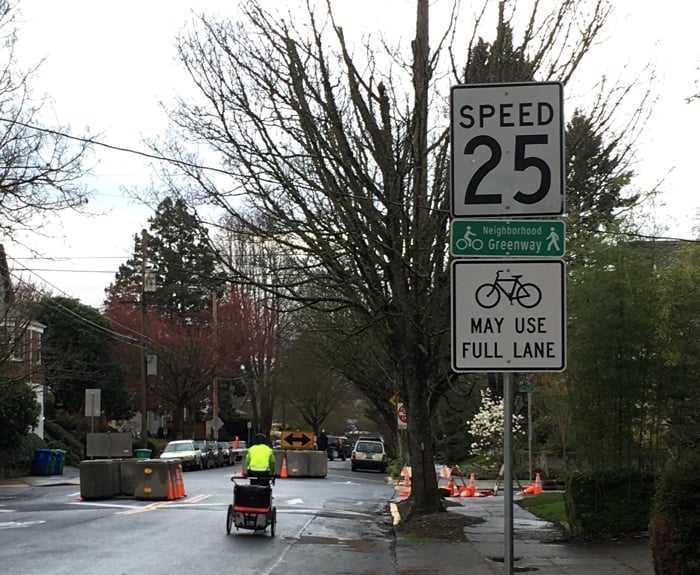

There is, of course, a big product management lesson here. We often spend so much time trying to perfect the experience people have with our products online, and we forget about what happens before and after they get there. And that’s often where the experience breaks down and we lose customers. As an example, I mentioned in my newsletter over the weekend how frustrating it can be if you can’t contact a company after making a purchase:

It sounds obvious, but it is still amazing to me how many companies see support as a liability. Any opportunity to interact with customers is a good thing. Yes, it’s expensive, and “case deflection” is a very effective way for companies to cut costs, but at what cost? A case deflected—either through finding the answer on a forum, or a customer simply giving up when they can’t figure out how to contact the company—is a missed opportunity to build loyalty and get input on your products.

And this, ultimately, is why customer journey mapping is such an essential activity for any product. It forces us to think about designing the end-to-end experience, from long before people get to our site, until long after.

Evidence of the danger of only focusing on the product experience itself is all around us—just look at the way our cities design public transport and bike commutes. Notice the differences between the two examples I shared above—one set up for failure, the other for success. And let that be a challenge to all of us to think about how people experience our products even when they’re not using our products.

The core elements of healthy, productive teams

Charles Duhigg has a long feature in the New York Times called What Google Learned From Its Quest to Build the Perfect Team. It includes a summary of really fascinating research on the core elements of a healthy, productive team:

As the researchers studied the groups, however, they noticed two behaviors that all the good teams generally shared. First, on the good teams, members spoke in roughly the same proportion, a phenomenon the researchers referred to as “equality in distribution of conversational turn-taking.” On some teams, everyone spoke during each task; on others, leadership shifted among teammates from assignment to assignment. But in each case, by the end of the day, everyone had spoken roughly the same amount. “As long as everyone got a chance to talk, the team did well,” Woolley said. “But if only one person or a small group spoke all the time, the collective intelligence declined.”

Second, the good teams all had high “average social sensitivity”—a fancy way of saying they were skilled at intuiting how others felt based on their tone of voice, their expressions and other nonverbal cues. One of the easiest ways to gauge social sensitivity is to show someone photos of people’s eyes and ask him or her to describe what the people are thinking or feeling—an exam known as the Reading the Mind in the Eyes test. People on the more successful teams in Woolley’s experiment scored above average on the Reading the Mind in the Eyes test. They seemed to know when someone was feeling upset or left out. People on the ineffective teams, in contrast, scored below average. They seemed, as a group, to have less sensitivity toward their colleagues.

So, effective teams are built on equality and empathy. Seems terribly obvious, of course, but I feel like very few teams actually live these values. We can do better.

Quote: Jon Kolko on product development that focuses on people first

The traditional way of building software focused on requirements, driven by a competitive view of the market, and responded to perceived needs with additional features and functions. Our new way of developing products focuses on people first: on spending lots of time with them in order to build an almost intuitive sense for their emotional journey. We design with that journey and those emotions in mind, and as a result, we can produce great products that people love.

—Jon Kolko, Understanding our product design strategy and ecosystem.

New e-book: Practical User Research for Enterprise UX

I worked with the wonderful folks at UXPin to write a short e-book on how to overcome some of the challenges of doing user research in large organizations. From the introduction:

Once a company grows over a certain size, the internal politics and number of people involved in every decision increase so much that it becomes virtually impossible to stay focused on fulfilling user needs and business goals. Instead, the focus turns inward to the opinions and whims of individuals inside the company. Add the complexity of designing B2B products to the mix and, well, things go bad very quickly.

When an abundance of stakeholders are involved in a product, user research is the only way to focus a whole team on the real needs and goals required for success. It’s also the only way to get people out of the habit of thinking “Well, I want this, so everyone else must want it too”—a view that I find much more common in enterprises than in smaller organizations.

If that sounds familiar to you, you’ll hopefully find the e-book useful. I discuss why it’s often so hard to get support for user research in enterprises. Then I provide some advice on how to sell the value of user research. Finally, I offer some practical tips for addressing the subtle differences of conducting research in larger organizations with users who aren’t buyers.

You can download the (free) e-book here: Practical User Research for Enterprise UX.

Why it's more difficult to prioritize features than problems

Daniel Zacarias’s Moving from Solutions to Problems is a must-read for all product managers, and anyone who’s involved in product prioritization. Daniel’s main thesis is that prioritizing problems results in much better products than prioritizing features—and I wholeheartedly agree with him. He addresses many issues with focusing on features, but the one that really resonated with me is that it’s much harder to prioritize features:

Products and features are versions of a solution to a problem. What this means is that by thinking in terms of the former, the problem they’re solving gets more difficult to grasp. Either because it’s a non obvious problem, or the product/feature are poor solutions for it.

In practical terms, this makes it much harder to prioritize a list of features than a list of problems. There are added layers of indirection that make us evaluate priorities in a different way. It gets difficult to determine the intent and expected impact from a feature. On the other hand, a problem (“low number of transactions”) can more easily lead to an objective (“increasing number of transactions per customer per month by 30%”).

The benefits of prioritizing customer retention over revenues

Horace Dediu has a characteristically astute analysis of Apple’s business model in Priorities in a time of plenty. The part I’m particularly interested in is where he discusses how Apple prioritizes their product roadmap:

Conventionally, product development is filtered through a sieve of metrics, market sizing and impact on top/bottom income lines. These “financial” measures of success are considered prudent and optimized for return on equity (also known as the maximization of shareholder returns).

But this can be a toxic formula. The financial optimization algorithm always prioritizes the known over the unknown since the known can be measured and is assigned a quantum of value while the unknown is “discounted” with a steep hurdle rate, and assigned a near zero net present value. Thus the financial algorithm leads to promoting efficiency at the expense of creation. Efficiency may be the right priority when times are difficult and resources are scarce but creativity is the right priority in a time of plenty. And abundance is what being big is all about.

The difficulty is that creativity is hard to quantify, and therefore hard to measure, and therefore hard to prioritize—particularly in large enterprises. Horace speculates that “the creation and preservation of customers” is Apple’s primary focus (above revenues), which changes the way they prioritize:

Seen this way each centralized resource allocation question can be assumed to be prefaced with “In order to create/preserve customers should we…?”

This leads to answers quite different from questions that start with “In order to sell/profit more should we…?”

Much to digest here, particularly around the role of managers to identify the right balance for prioritization, and the right metrics to measure if your primary goal is, in fact, “the creation and preservation of customers”.

Quote: Tomer Sharon on the importance of understanding a problem

The question “How do people currently solve a problem?” is critical, because deeply understanding a problem can go a long way toward solving it with a product, feature, or service. Falling in love with a problem happens through observing it happen in a relevant context, where the problem is occurring to people in your target audience.

—Tomer Sharon, Validating Product Ideas

Beyoncé, Coldplay, and the myth of the “average” user

I am not qualified to talk about politics so don’t worry, I won’t. That said, Spencer Kornhaber’s essay on Beyoncé’s Radical Halftime Statement is so incredibly good (and very applicable to product design) that it’s worth discussing here. The part that I found particularly interesting is how differently Beyoncé and Coldplay view their “target markets”. Beyoncé is very focused:

But in pop and in politics, “everyone” is a loaded term. Stars as ubiquitous as Beyoncé have haters, the “albino alligators” who “Formation” informs us she twirls upon. And in a more general historical sense, “everyone” can be a dangerous illusion that elevates one point of view as universal while minimizing others. Beyoncé gets all of this, it seems. As a pop star, she surely wants to have as broad a reach as possible. But as an artist, she has a specific message, born of a specific experience, meaningful to specific people. Rather than pretend otherwise, she’s going to make art about the tension implied by this dynamic. She’s going to show up to Super Bowl with a phalanx of women dressed as Black Panthers.

Whereas Beyoncé is very specific about who her music is for (and not for), Coldplay tries to please everyone:

The poor guys of Coldplay, meanwhile, actually think they can work solely at the level of the universal. “Wherever you are, we’re in this together,” Chris Martin cried out, early on, last night. I don’t want to diss that intention, nor the take-home message at the end: “Believe in Love.” But from their first hit, “Yellow,” to their recent Holi-appropriating music video with Beyoncé, to their pan-cultural rainbow rally at Levi’s Stadium last night, their theme has only been about love to the extent that it’s been about how everyone loves colors. It’s music about being awed by the blandest kind of harmony: ROYGBIV, yeah yeah yeah!

Coldplay’s approach reminds me of this classic Sharp Suits poster:

The problem with a target market of literally everyone is that you end up with a heavily compromised experience that appeals only to the very few people who identify with the “average” experience. Bringing this back to product design, this is why I’m still such a big fan of design personas. As opposed to a mythical “average” user, personas are solid people we can imagine using our product to achieve their goals. This is helpful because by focusing on a few different individuals that are closer to the edges of an experience, instead of the average, we end up catering for a larger portion of the user base:

Persona edges

This is what Beyoncé does so well. She makes music at the edges, so it’s exciting and anything but bland. It’s a lesson that Coldplay clearly hasn’t learned yet.