Menu

Posts tagged “prioritization”

Where are your "invisible asymptotes"?

Eugene Wei’s Invisible asymptotes is a long, excellent article about the importance of not just thinking about product-market fit, but also product-market unfit:

For so many startups and even larger tech incumbents, the point at which they hit the shoulder in the S-curve is a mystery, and I suspect the failure to see it occurs much earlier. The good thing is that identifying the enemy sooner allows you to address it. We focus so much on product-market fit, but once companies have achieved some semblance of it, most should spend much more time on the problem of product-market unfit.

For me, in strategic planning, the question in building my forecast was to flush out what I call the invisible asymptote: a ceiling that our growth curve would bump its head against if we continued down our current path. It’s an important concept to understand for many people in a company, whether a CEO, a product person, or, as I was back then, a planner in finance.

He goes on to discuss those asymptotes for different companies (for example, shipping fees for Amazon). Another interesting bit:

We speak often of the economics concept of the demand curve, but in product there is another form of demand curve, and that is the contour of the customers’ demands of your product or service. How comforting it would be if it were flat, but as Bezos noted in his annual letter to shareholders, the arc of customer demands is long, but it bends ever upwards. It’s the job of each company, especially its product team, to continue to be in tune with the topology of this “demand curve.”

I see many companies spend time analyzing funnels and seeing who emerges out the bottom. As a company grows, though, and from the start, it’s just as important to look at those who never make it through the funnel, or who jump out of it at the very top. The product market fit gradient likely differs for each of your current and potential customer segments, and understanding how and why is a never-ending job.

Figuring out what your product’s invisible asymptotes are sounds like a really good thought process to me. At the beginning of the article Eugene mentions one way Amazon tried (and succeeded) in answering this question:

For people who did shop with us, we had, for some time, a pop-up survey that would appear right after you’d placed your order, at the end of the shopping cart process. It was a single question, asking why you didn’t purchase more often from Amazon.

Another technique he mentions:

One approach I’ve taken when talking to companies who are trying to achieve initial or new product-market fit is to ask them why every person in the world doesn’t use their product or service. If you ask yourself that, you’ll come up with all sorts of clear answers, and if you keep walking that road you’ll find the borders of your TAM taking on greater and greater definition.

A good way to frame this could be to ask yourself something like this:

If we didn’t change anything about [product name], at what point would we hit a growth ceiling, and what are the factors that would cause that?

If you can have a reasonably confident answer to where the S-curve inflection point will be, you can start planning on avoiding it early. That’s a worthy effort, and definitely something I intend to think through for our products.

Tips for better estimates

Ah, estimates. That thing we all know we need to do (and get better at), but no one really wants to talk about. Well, Gina Trapani takes the topic head on in a great post called Estimation Is a Core Competency:

Estimates don’t need to be perfectly accurate as much as they need to be useful.

Good estimates create trust among your PMs and business leaders and collaborators. Being able to identify the risks and uncertainties in a project early gives your project team the information they need to plan around those risks and uncertainties.

Are you consistently getting waylaid by unforeseen work mid-flight, or just taking longer to execute on the work you did know about? That creates distrust between engineers and business leaders, and if it happens repeatedly, that distrust compounds and calcifies into resentment— that is, if you’re still in business.

Gina goes on to give some great tips for better (i.e. more useful) estimates.

Tracking development uncertainty with hill charts

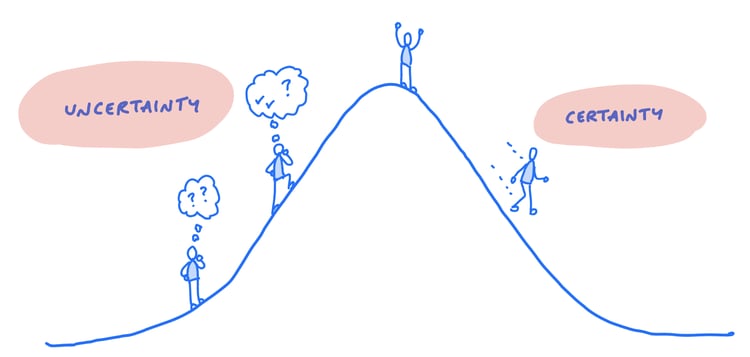
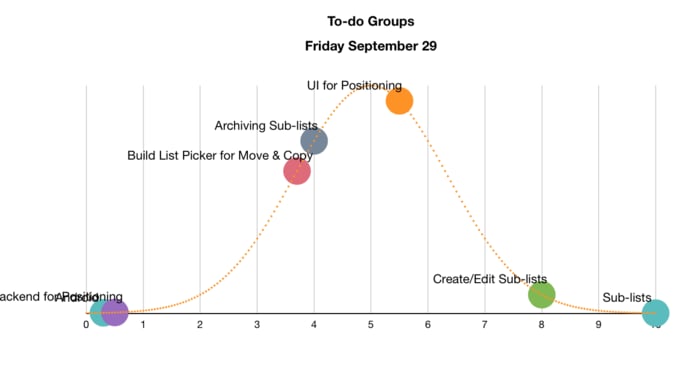
I read something recently that struck me as a really good idea for our team. Usually that feeling goes away after a couple of hours (“nah, it’s cool but not a good fit for us”) — but not this time. In Running in Circles, Ryan Singer talks about the knowns/unknowns in a project like a hill:

The most important question for a team isn’t “what is left?” but “what is unknown?” Can you see the edges? Have you gone in there and seen everything that needs to change? The only way to gain certainty is to roll up your sleeves and engage with the reality of problem.

At Basecamp our teams seek out the areas with the scariest unknowns and work on them first. This uphill work requires strategies. We wrote about these in Getting Real. Open the code, spike something that works, load it with real data and try it. When the whole feature is too big to prototype, factor out the most important pieces and spike them.

He has a a nice visualization of it:

He also uses an example from a recent project to show how they map this out:

As they “move over the hill”, different parts of the project become known, and they become more certain about what’s left to do. We’re working on some checklists to identify development risks before we start a project, and this looks like a great way to visualize those risks and track them as you go.

Product management for maturing products

Janna Bastow wrote a great post on product management for maturing products. From Growing up Lean: Lean Strategies for Maturing Products, here’s a recommendation for how to avoid becoming a “Feature Factory”:

Break the backlog up into two parts: The Product Backlog and the Development Backlog. […]

Product Backlog: A list of all of the things you could do. You’ll never complete everything on this list, and it’ll always be in a constant state of flux. It’ll include customer requests, suggestions from your team, through to insights from your experiments and prototypes. It should be accessible by your team, to both contribute and follow along on progress – your team should be helping to build and flesh out the ideas in your backlog. This is your space to prototype and spec out ideas, map them to your objectives, and track their progress until ready for production.

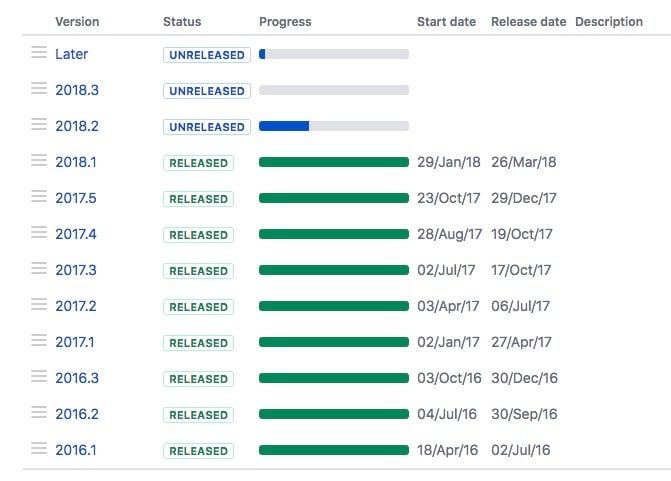
This is similar to how we do things at Postmark. Here is our Releases board in JIRA:

JIRA releases board

You’ll see that we have our short-term planning (the Development Backlog), that currently only covers 2018.2 and 2018.3 (roughly 6 weeks each). And then we have the mysterious Later release… that’s the Product Backlog. It’s that list of all the things we could do. When we do short-term planning we pull from that list, as well as other areas (most notably, our “Idea Zone” in Basecamp, which I should also write about at some point).


I’ve written about maturing products before as well. I’m happy to see that Jenna and I bring up similar points. Here’s a quote from my post Product Management for well-established products, which echoes some of her thoughts:

With an established product, it’s way too easy to get off track (Evernote, anyone…?). So what I argue for is a flexible quarterly roadmap of prioritized themes. You don’t write down dates next to a long list of features. You don’t make hard commitments for releases that might never happen.

Instead, you put together a list of themes you’d like to work on, in order of priority, based on how closely they align with your objectives and key results for the quarter.

The value of product specifications: a modest proposal

Questionable use of stock photography aside, Colin Lernell’s Is the Product Requirements Document Dead? A Debate. brings up some interesting points. I’ve long argued that if you do it right, a good “product spec” is essential to successful product management and development. We’ve come a long way since the original concept of a 45-page PRD that no one reads (not even the person who wrote it). The format has evolved as we’ve grown accustomed to leaner development processes.

One of Colin’s suggested alternatives to the dreaded PRD is what he calls an MVPRD. I don’t like the term (the overuse of the MVP concept makes it all but useless these days). But the approach is one I agree with:

Write your first MVPRD in a short, limited amount of time (just enough to communicate to your team and start work) to avoid bloat. As you move toward or through development, meet with your team frequently to assess and iterate on what should go into the document and what should be taken out. Remember to keep it lean and that your intent is to figure out what you need in the document and if you need it at all.

Our product specs at Postmark follow a similar journey. At the beginning of a project I start a new spec document from a template in our wiki. I fill out as much of the basics as possible, which in our case consists of the following:

  • Basic metadata like who the team is, links to technical specs, etc.
  • The job story.
  • A stripped down version of Marty Cagan’s Product Opportunity Assessment framework.
  • Known dependencies and risks (such as customer support and back-office systems).

We use that information for our team kick-off call, and then we start filling out the rest of the document as we go. We also go back and make changes as we get further down the road and make decisions. We have three main sections for this part of the document:

  • The solution overview provides a broad description of how we intend to solve the problem we identified in the Product Opportunity Assessment
  • Sketches, Wireframes, and Prototypes links to the the initial design assets we create, in whatever fidelity is right for the size and scope of the project
  • Final design has the final assets that are needed for implementation. In our case this is most often a completed front-end.

The important thing to remember about this fluid version of a product spec is that it is not a document you write from front to back at the beginning of a project and then never look at again. It’s also not something that’s every really done. It’s a document that starts small and that you keep working on as you go.

The benefits of doing it this way is that it not only helps you document all the little decisions you make along the way as you build a product, it also builds up organizational knowledge to remind you of why the team made the decisions they made. Because you will forget otherwise. So if you’re developing without a blueprint and feeling some pain and chaos, give this approach a shot. It might just provide the relief you need.

[Quote] Plan All of the Things!

I find teams generally do a good job of thinking of the features that make up the core customer-facing functionality of their project. It’s the non-customer-facing features that tend to be forgotten.

James Hood on why software project estimates are so often wrong, from Plan All of the Things!

The biggest mistakes product managers make (and how to avoid them)

There is essentially two ways to improve at your job. You either get better at the things you should be doing, or you learn to stop doing the things you shouldn’t be doing. We tend to spend a lot of time and effort on the first aspect—and for good reason. It’s absolutely essential to keep learning. But lately I’ve been consumed with that second part. Day in and day out, at the most inconvenient times, the same question jumped into my head:

What are the biggest mistakes I’ve been making as a product manager, and how do I stop doing those things?

I took some strange detours trying to answer that question. And in the end, the answer I came up with specifically for product management had its origin in an unlikely place: some graduate work I did almost two decades ago. So let’s take a quick detour into information science theory before we return to the matter at hand…


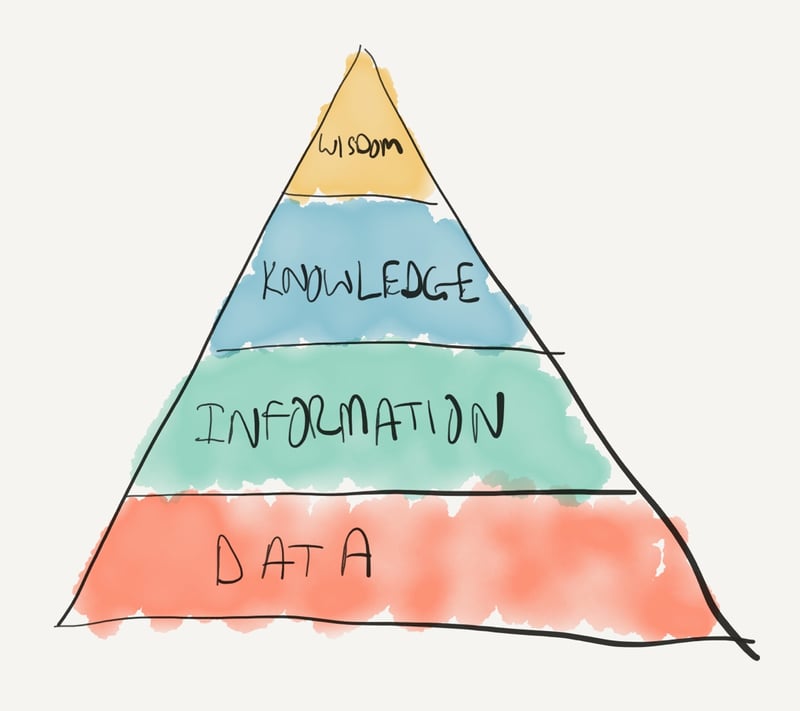
One of the first things you learn about knowledge management is what’s called the DIKW pyramid. It provides a model for thinking about the transformation of raw data into something more useful.

DIKW Pyramid

  • Data refers to facts and observations. They are the spreadsheets and SQL query outputs that come across our desks on an almost daily basis.
  • Information is inferred from data, and distinguishes itself from data in that it is actually useful for decisions or action. Company dashboards with business metrics like MAUs are information.
  • Knowledge refers to a framework for decision-making based on information, i.e. “we believe that when this happens, we should do something about it”.
  • Wisdom is illusive—both in definition and in… well, attaining it. I’ve always liked the definition that says wisdom is knowledge with judgment. Wisdom goes beyond having a framework for what to do, and describes having the judgment required to make the right decisions based on the information and knowledge available.

The model isn’t perfect, but it serves a valuable purpose. There are two aspects in particular that I’ve always found useful to remember.

First, to extract value from data it needs to be transformed into something more valuable, and you don’t get to skip phases. If, for example, you try to go straight from data to knowledge without first organizing the data as information, your knowledge isn’t going to be all that accurate.

Second, confusing one slice of the pyramid for another can be really dangerous. If, for example, you’ve been able to extract some knowledge from information, but you think you’re looking at wisdom, you’re going to make some bad decisions, because you haven’t taken the time to add the necessary judgment to the information in front of you.


With that as background, let’s get back to product management. If I think about the times when I’ve made my biggest mistakes as a product manager, it can all be traced back to one of two causes:

  • I misidentified data, information, knowledge, or wisdom. For example, if someone on the team who is steeped in our product and its users comes forward with a wise suggestion about where to take the product next, and I jump in with a process to take what I think is some information they provided and turn it into knowledge, I’m operating at the wrong level. Turning information into knowledge is essential, of course (remember, you can’t skip steps). But trying to pull wisdom back to an earlier phase in the transformation process is disruptive and demoralizing. We shouldn’t do that.
  • I communicated the wrong slice of the DIKW pyramid to the person or team I was speaking to. For example, let’s say a designer and I go through an extensive usability testing process on a prototype of a new feature. We collect data, we group that data into information, and then we discuss it to extract the knowledge and wisdom we need to make the appropriate changes to the product. The difficult part is knowing what to communicate to who. For some on the team, the end product (the “wisdom”) is good enough. Others, particularly those with good data transformation skills, might prefer to see all the information so that they can give feedback on the knowledge and wisdom we landed on. We need to know the difference of what’s needed by who, and share appropriately.

Knowing the mistakes you tend to make is only half the battle, though. So all of this led me to a statement I’m printing out and putting up above my desk, to help me avoid making those mistakes:

An effective product manager shepherds data from a variety of sources through the transformation of becoming information and knowledge and wisdom. They do so without getting bogged down in unnecessary process, and they only share the relevant parts that each person or team needs to make progress.

I’m sharing this here with the hope that it will resonate with some of you who may have been grappling with the same questions.

There’s one more important point I want to make. From my personal life I know the dangers of wallowing in introspection for too long, so I don’t intend to stay down here in mistakes-land. Wrestling with these questions was a helpful exercise, but it’s not a place I want to get stuck in. So I’m going to head out to that other place for now. You know, the one where we get to learn new things and improve our skills. Maybe we’ll see each other on the road.

Using mind mapping to clarify your job and bring order to task-switching chaos

In a recent blog post about our 4-day work week experiment at Wildbit, Natalie (our CEO) wrote about some things we’re doing to focus our jobs a bit better. The example she used in that post is the exercise I went through to clarify my role as product manager, so I thought it would be interesting to talk about that process a little bit more.

If you’re in a position where you’re a little unsure about the focus of your role, or what exactly you should be working on day-to-day, you might find the process I describe here useful to help you figure it all out.

What exactly would you say you do here?

Even though no one can quite agree on how to define the role of the product manager (but you should totally read my book about that), I think we’re all in agreement that it requires lots of different kinds of tasks—which results in lots of context switching. This means that focus is a constant struggle for PMs. Yes, this is true for many roles, but it is especially true for PMs since the ability to switch between different tasks is so central to what we do to help keep things moving.

The issue is not just that switching contexts all the time is hard, it’s also that knowing what to switch to next can be such a challenge. PM minds are in a constant state of prioritization and reprioritization.

It’s with this as background that Natalie and I had a very long 1:1 a few months ago as we realized I’d drifted away slightly from what my core focus at Postmark needs to be. As we got our development process nailed down, that part of the business needed less involvement from me so I started to spend more time on things like metrics frameworks and improving our prioritization methods. Because that’s just what PMs do—we look for things to fix, and then we jump in.

I had a huge realization that I was starting to spend time on the wrong things when Natalie said to me,

Rian, stop trying to turn us into a big company.

That is arguably the most important thing she has ever told me. Because that is exactly the path I was inadvertently going down. Process improvements aren’t bad, but at that time it was not what the team needed. So we got to work to find out what our team needs in our context and our culture.

Mapping a chaotic role into submission

Natalie encouraged me to go through an exercise she has gone through before. It involves creating a detailed mind map of all the things you do during a particular week, and then using that to identify and prioritize your focus areas. I jumped into MindNode, and after a couple of weeks of working on it with Natalie, we came up with the following map of what my focus areas should be:

Mind mapping your focus areas

It looks all neat and sensible now, but it’s worth mentioning that the process was messy for a quite a while. My natural propensity for order made me want to start at the left with the big buckets of my role, and then expand to the right into more and more detail. In practice it didn’t work like that at all. I ended up starting with cataloging some of the mid-level tasks I spend my time on (such as Regular customer calls and Prioritization). With those things as a starting point I then branched out—sometimes to the right (Customer calls leads to defining that we should talk about Pain points), and sometimes to the left (Prioritization leads back to a larger Planning bucket).

I also ended up deleting a bunch of stuff on the far right during my discussions with Natalie. Specifically, we started to see where I was doing too much of the things that the marketing team was doing already. Once we had a visual picture it was easy to see where I need to scale back, and which areas need more definition.

Bringing order to day-to-day tasks

Once this was done, as I stared at the map for a while, I wondered if I could somehow use it to make my days a feel a little less arbitrary. So I took it one step further and simplified my role as a progression from Listen to Think to Act:

Mind mapping your focus areas

This model now helps me prioritize my days when it comes down to deciding what to work on. If I’m in Listen mode I’m more likely to spend most of the day on calls and discussions with the team and customers. Other days are primarily focused on Act so I tend to spend a bunch of time in JIRA or Basecamp creating the content we need on projects.

This has helped a lot with the scattered feeling I often got when switching contexts too much. I still switch between tasks, but keeping it in the same “family” helps so much with focus and productivity.

In summary—I think you should do this

Creating this mind map has been an eye-opening experience for me. It not only helped me to clarify what I should work on (and when), it also constantly ensures that Natalie and I are on the same page about what I should be spending my time on. This is especially important as a remote employee where we don’t catch up all the time about what I spend my time on.

Natalie and I look at my focus areas together and discuss any changes we might need to make. But other than that, I feel confident that I’m doing the stuff that’s most important for our team, our customers, and the business. I like that feeling a lot.

Product Management for well-established products

There’s a lot you need to get right when launching a new product. There’s figuring out the user needs and the business goals; there’s testing hypothesis and finding product/market fit; there’s prioritizing the roadmap (or more likely these days, deciding not to use a roadmap at all)… the list goes on and on. So naturally there’s quite a bit of writing on this topic. Most product management advice (including, ahem, a certain book) covers this area of fresh or updated products very well. What we see less of is articles and books about how to manage a well-established product.

What do I define as a well-established product? It’s fuzzy, but I see it roughly as a product that has been in the market for more than a couple of years, has a steady and growing revenue stream, as well as a few healthy competitors. The reason I’m interested in well-established products is because, well, Postmark (where I work) is one. We have a product that most of our customers love, and it’s growing in both users and revenue. Of course we have ideas on how to make it better, but we’re in a different stage of our journey. We’re not frantically playing catchup with competitors or trying to complete a bunch of features that aren’t adding value to any customers yet.

This is, I’ll admit, a wonderful position to be in as a product manager. But it doesn’t mean there’s no work to do. I’ll stop short of pulling out the “software is never done” trope (in fact, I’d argue that software can be done). I will say that we’re definitely not done with ours yet. So as a product manager, I learned this year that well-established products face a different set of challenges than newer products. Here’s an incomplete list of my hypotheses about managing such products:

  • Prioritization becomes a much finer art (with a little less science).
  • Roadmaps become more important.
  • Process becomes more necessary.

I’d like to spend a little time discussing each of these issues separately.

Weekend work

Prioritization

When I started at Postmark we went through a full product discovery and prioritization exercise. I wrote a long post about it on our blog: How we built a product vision and roadmap. I also followed that up a few months later with From roadmap to shipping: effective product management for remote teams — a post on how we moved from strategy to execution. Something I didn’t get into in those posts is how my understanding of prioritization evolved as we moved further into the details.

Postmark is a tool for developers. That means that feedback from customers comes in often, and it comes in detailed. Feature requests are usually incredibly specific (and useful), ranging from a field that’s needed in an API, to missing functionality and how that affects their business. Due to the sheer volume of high-quality feedback we get, I learned quickly that I needed an efficient way to categorize and prioritize things as they come in, otherwise everything would just go die on a backlog somewhere.

The biggest shift here was to move to a system where we prioritize themes, not individual problems or features. A theme is loosely defined as a particular customer problem or opportunity we need to solve — similar to the “hypothesis” nomenclature in lean development. Now, when new ideas come in to JIRA (Yes, yes, I know; more on JIRA later) — either internally or from customers — I follow a set of steps to (1) process and (2) prioritize them:

  1. First I do a gut check: is this something we’d ever do? Does it point to a customer problem or business opportunity that would be beneficial for all of us to solve? If so, great. If not, the request gets rejected with a note so we can get back to the customer or internal stakeholder.
  2. If a theme already exists for a particular idea (e.g., Improvements to the Bounce webhook, or Improvements to the Statistics page), I add it there, and considered it processed. It would be too overwhelming to think through the details of every single idea, but I know that when the time comes to work on a particular theme, it’ll be there, and we’ll go through it then.
  3. If a theme doesn’t already exist for that idea, it gets a little trickier. Is this important enough to group together with other things to create a new theme? Do we expand a theme to “make room” for the idea? This is where things get decidedly less certain, and I have to be comfortable with a certain amount of fluidity. I might create a new theme, only to merge it into something else later. That’s ok. As long as it’s somewhere manageable where we won’t forget about it, I’m happy.

During our quarterly planning I don’t make the team go through every single JIRA ticket (to their enormous relief). Instead, we discuss our OKRs (Objectives and Key Results) for the quarter, and then decide which themes to work on that line up with those OKRs. Once our themes are prioritized, I work with the teams to figure out how best to address it — it’s usually a combination of some of the ideas already inside that theme, and a few new ones we come up with.

And this leads me to my next point…

Roadmaps

I’m still quite amazed at how out-of-fashion roadmaps have become. It seems to me that a lot of people got burnt by 2-year corporate plans that weren’t allowed to change, and then decided that the only way to deal with that (admittedly atrocious) situation was to get rid of roadmaps altogether.

I respectfully disagree.

I’ve written about this before, so I’ll just reiterate one bit here:

The purpose of a product roadmap is to set forth a long-term vision for the business, and break that up into smaller, meaningful pieces of work, based on what you know now. It’s fallacy to believe that this is an unchangeable list of dates about where the business is headed. A product roadmap that doesn’t react to day-to-day changes in the market and within the company is a pretty dumb document.

This is, in my experience, especially true for a well-established product. There is a lot more leeway to mess around and see where things go on a new product. With an established product, it’s way too easy to get off track (Evernote, anyone…?). So what I argue for is a flexible quarterly roadmap of prioritized themes. You don’t write down dates next to a long list of features. You don’t make hard commitments for releases that might never happen.

Instead, you put together a list of themes you’d like to work on, in order of priority, based on how closely they align with your objectives and key results for the quarter. And then you meet every week as a core team to discuss a couple of things:

  • Did any new theme arise over the week that is important for us to discuss?
  • If so, and if we should work on it soon, what does it replace?
  • If not, then let’s get back to work.

This keeps the roadmap flexible, and it keeps the team aligned on what the most important themes are for the product and our customers.

Process

Which brings me to my last point… process. I’ll quote Michael Lopp on this until the day I die:

Engineers don’t hate process. They hate process that can’t defend itself.

Considering the sheer number of detailed input we get on the product as well as the amazing ideas coming from inside the team, there’s no way I could just wing it. Maybe there are some PMs who can hold everything together in some kind of virtual kanban board in their heads, but I just can’t do that.

So yes, we use JIRA, and you know what? It works for us. The Customer Success and Marketing teams submit ideas and hypotheses with links to the customers who request it. If and when those ideas make it into a theme, they continue to add more customers to it as we go. They can always see where something is in the development process, and when it gets released they get to go tell a bunch of customers that the thing they asked for is now live. And that is really cool.

I understand why people hate JIRA, I really do. But I think I’m such a big proponent of it because we were able to come up with a way for it to benefit the whole team, and actually make their lives easier, not harder. We have a process that can defend itself. And I don’t think you can work on a well-established product without something like that.


This year has been an enormous learning experience for me. I’ve never worked on a product like Postmark before. It’s a product that is basically universally loved, where feedback comes in from people who are passionate about it and can’t imagine their development lives with out it.

As much as it is a dream to work on a product like this, I feel like I had to learn a whole new set of skills to be effective as a product manager in such an environment. I know I still have a long way to go, but I can tell you one thing — I’m excited to learn more in 2017.
Easy features can be very expensive

James Gill has a good overview of How bad features are born:

Most importantly, does this feature deserve to exist? Why are you working on it?

If you’re embarking on a new feature primarily because you’ve seen a competitor release something similar, then you probably haven’t thoroughly considered or even identified the problem you’re trying to solve. If you’re jumping into a new feature because it seems like “it wouldn’t be too hard to do” that’s great, but does it actually deserve to be built right now?

The biggest danger I see is this “it’s easy to implement” argument. A feature might be easy to implement, but that doesn’t make it “cheap”. The problem with implementing even easy features is that they’ll most likely remain in the product forever. That creates the potential for lots of (expensive) maintenance and support.

Also see How Much Does A New Feature Cost?