Menu

Posts tagged “prioritization”

What I look for in product management software

I’ve had this vague sense for a while that I need to dig into the product management software space a lot more. So on Friday I just did it — I signed up for a bunch of accounts and started playing around. As I went through each product I realized two things:

  1. I didn’t know what I was looking for.
  2. Most of the products I was looking at didn’t know why they wanted me to use it either. The landing pages are all great, but once I was in the product, it was like a different (and very confusing) world. Which is kind of ironic for a product that’s aimed at product managers.

So I took a step back and asked myself why I’m actually doing this. What are the issues I’m hoping to address with software? What am I looking for?

In short, I am looking for a better way to plan. JIRA is a great execution tool — I don’t want to change that part. But JIRA is a terrible planning tool. And our current process of using Basecamp and Dropbox Paper for planning works just ok for me. The combination lacks a bunch of things to make it as effective as it can be.

I then identified what I would need to feel like our planning and scheduling process is effective and efficient:

  • A visual, lightweight, flexible representation of our product ideas and overall strategy, to help us with prioritization.
  • Prioritization scoring (customer / business impact, effort, etc.). I’d like to try a version of RICE at some point, but it should be flexible enough to use whatever system we want.
  • Incorporating, summarizing, and linking customer feedback from a variety of sources. We currently do this in JIRA, and it’s not a great workflow.
  • A way to go from general idea to product specifics in an orderly and predictable fashion. Right now we use JIRA, Confluence, Dropbox Paper, and Basecamp, and that can get a little confusing.

This gave me the framework I needed to evaluate the different products I was looking at. I’m not done evaluating, but right now productboard is the one that seems to fit our particular culture and goals the best.
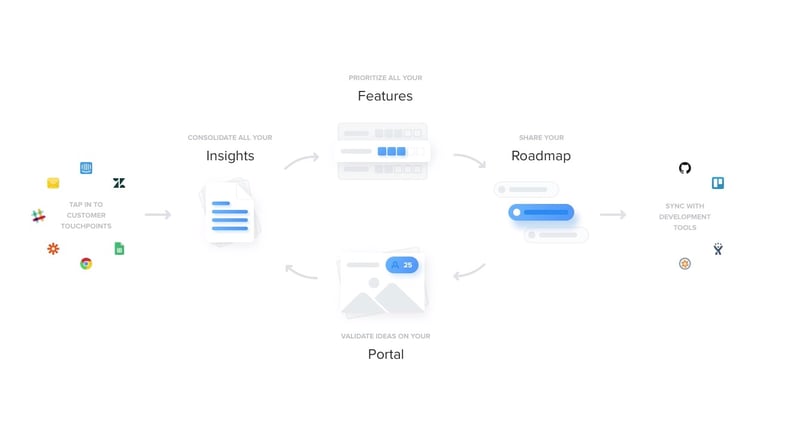
productboard overview

Here are the list of things productboard has going for it:

  • The one thing that makes it stand out from all the others is that it’s a flexible system rather than a process (see the overview diagram above). Instead of forcing a particular software development process, it has no opinion on the specific methodology you use to prioritize and get work done. It’s focused on letting you use your own way to gather customer insights, define business goals, and prioritize work.
  • It will let us gather all user insights together, and prioritize features based on our goals and objectives (or “drivers” in the productboard language).
  • It will let us easily share, communicate, and change the plan without getting too formal about it.
  • If we wanted to, we could have a public-facing portal to get feedback on ideas, like this.

Oh, and their Why productboard? page is pretty solid, especially this phrase:

a way that provides transparency, fosters collaboration, and encourages alignment with the broader product team.

I’m not done evaluating yet, and who knows where we’ll end up. But I thought I’d share my initial thoughts and explorations of this interesting meta-industry.

Using Opportunity Solution Trees to focus on the product priorities that matter

Prioritize Opportunities, Not Solutions is a really good post by Teresa Torres about using the Opportunity Solution Tree methodology to make sure we place lots of product bets early on in a lifecycle, and only implement the ideas that matter. I also like her distinction between one-way door decisions (“once you’ve walked through the door, you can’t turn around and come back through”) and two-way door decisions:

Your opportunity assessment and prioritization decisions are two-way door decisions. Once you choose a target opportunity, you’ll test whether or not you made the right decisions by prototyping and experimenting with solutions that address those opportunities. If you learn through experimentation that you didn’t choose the best opportunity, you can always walk back up the tree and choose another opportunity.

The problem with Impact/Effort prioritization

Itamar Gilad shares a healthy critique of the Impact/Effort prioritization matrix that is so ingrained in every product manager’s brain:

As straightforward as this all seems, there are major problems with Impact/Effort prioritization that cause us to pick the wrong winners. Most importantly Impact/Effort analysis requires us to make somewhat reliable predictions on future events — the effort we will require to complete a task and the value that will be delivered to users and/or to the company once completed. As it turns out both are jobs we’re exceptionally bad at.

He doesn’t say we need to stop using it though, just that we need to move the borders of the matrix around a little bit. It’s also worth noting that there is no “one size fits all” prioritization method. I’ve written about different prioritization techniques, and am a proponent of choosing and adapting the ones that work best within the culture of an organization.

From output-based to outcome-based product planning

Cause & Effect and Product Risk” is a good good post by Scott Sehlhorst on the importance of moving to an outcome-based approach when evaluating and planning product features. He also discussed how to use Impact Mapping to do it:

When we collaborate to develop a shared understanding that explicitly connects “building X” with “realizing benefit Y” we address the first problem. Impact maps are great for this, because in the process of creating the connections, we intentionally challenge those connections and explore others; creating a better plan, shifting to a bigger goal. All while providing deep context throughout the teams, increasing likelihood of successful delivery and effective stakeholder management.

The power of “why now?” as a prioritization technique

I imagine that if you made one of those pull-string dolls of a Product Manager, it would just say “Why?” over and over1. We love figuring out the real reason behind an idea or a customer problem — as we should. But I think we often miss an important follow-up question: “Why now?”

We have so many methodologies for prioritizing problems and features, but I’ve found that this one question is able to cut through all the complex reasoning and (rightfully) stop unneeded projects in their tracks. Most things we could work on in a product are important. But going through the thought process of why it’s important to work on something right away is really helpful to separate the truly worthy projects from the ones that can wait.

The problem is that “Why now?” is not always an easy question to answer. It’s too vague, too broad. But if you flip it around and ask it a different way, things start to become clear very quickly. So here’s a question I recommend you ask yourself and the team the next time you debate a project:

What is the danger of not doing this project right now?

If we don’t solve this problem or add this feature right now, what do we lose? Are sign-ups going to drop? Are we going to lose customers? Are we going to miss a major shift in the market? If so, then, yes, now is a good time to work on it. But if the room suddenly falls silent and everyone comes up short on the downside of skipping over the idea — or if the downside is something like “this one customer will stop sending us angry emails” — that’s a pretty good indication that this thing can wait for later.

I say “wait for later”, and not “forget about for forever and ever”, because it’s quite possible that a few months from now you’ll answer that question differently, and suddenly now becomes the perfect time to work on it. The point is that we should never do something now if later is a better option.


  1. Like Woody but for Product Managers? I want one! 

Data-driven vs. data-informed decision-making

The Netflix Data War is a very interesting post about the internal discussions that happen between Netflix’s content team and their data team. In short, data isn’t everything:

[…] in almost any decision-making situation involving data, there is some non-zero percentage of the process that involves “gut”. The reason is because not all information about a process can be incorporated into a data analysis, and it’s important for data analysts to realize that.

That’s an important point to reflect on. It doesn’t matter how complete a data model is. There are some variables that simply cannot be included, because it’s impossible to know what should be included in any particular model.

Apart from that, it’s also just a fascinating look at the internal workings of Netflix.

When it comes to roadmaps, focus on outcomes, not features

Here’s a pragmatic approach to roadmaps that I can get behind. Escape From the Feature Roadmap to Outcome-driven Development:

You’re exploring new lands. You know where you want to get to — that’s your outcome — but there’s no established route to get there. So you’ll probably set out, and if you’re measuring yourself correctly and you’ve got good feedback loops in place, you’ll be able to course correct and quickly iterate towards your outcome. But you could only draw the complete roadmap with hindsight.

So it’s time to take a new approach: forget the features and focus on the outcomes.

Roadmaps that include a bunch of features are doomed to fail. Instead, say “here’s the problem we want to solve in this iteration.” That allows you to be flexible on scope, and ship solutions to customers quickly.

Product managers and the prioritization of problems vs. solutions

Scott Colfer writes about product roadmaps in this article, but it includes what I think is a pretty valuable overview of the core role of a product manager:

Product management makes promises to solve problems over commitments to specific solutions. We take the human tendency to specify the means of doing something, rather than the result that is wanted, and redirect it by specifying what is to be achieved, rather than how to achieve it. Product managers are usefully agnostic about solutions — we help teams to prioritize the most valuable problems to solve and then help them to prioritize the solution that requires the least work for the most value — and we’re happy when we learn something that helps us to refine and simplify our solution.

Prioritize themes, not features

Mind the Product has a good write-up of C. Todd Lombardo’s talk called Roadmaps are Dead! Long Live Roadmaps! I’m also in the “prioritize themes, not features” camp:

Every theme on your roadmap should have a problem, an objective, and even some potential ideas you have to solve those problems. In practice, this changes how your roadmap looks. Rather than being a list of features, it might start from an objective of reducing support costs, and then show themes that might help reach that objective such as improving invoicing options or expanding payment types. By removing the details of what features will be built to fulfill these themes, it gives the team the freedom to figure out how best to solve the problems presented.

This is similar to some thoughts I had in a 2011 post called Product roadmaps are safe.

Real Work vs. Imaginary Work

The key point here is: imaginary work doesn’t count. Get to running code early. Or a rough interface. Or an outline of the copy. Whatever it is, the way to get uphill is to roll up your sleeves. Show evidence that the approach works and seek out the things that might go wrong. Then when you get over the hill, your team can trust that the work is really going to ship as planned.

— Ryan Singer, Real Work vs. Imaginary Work